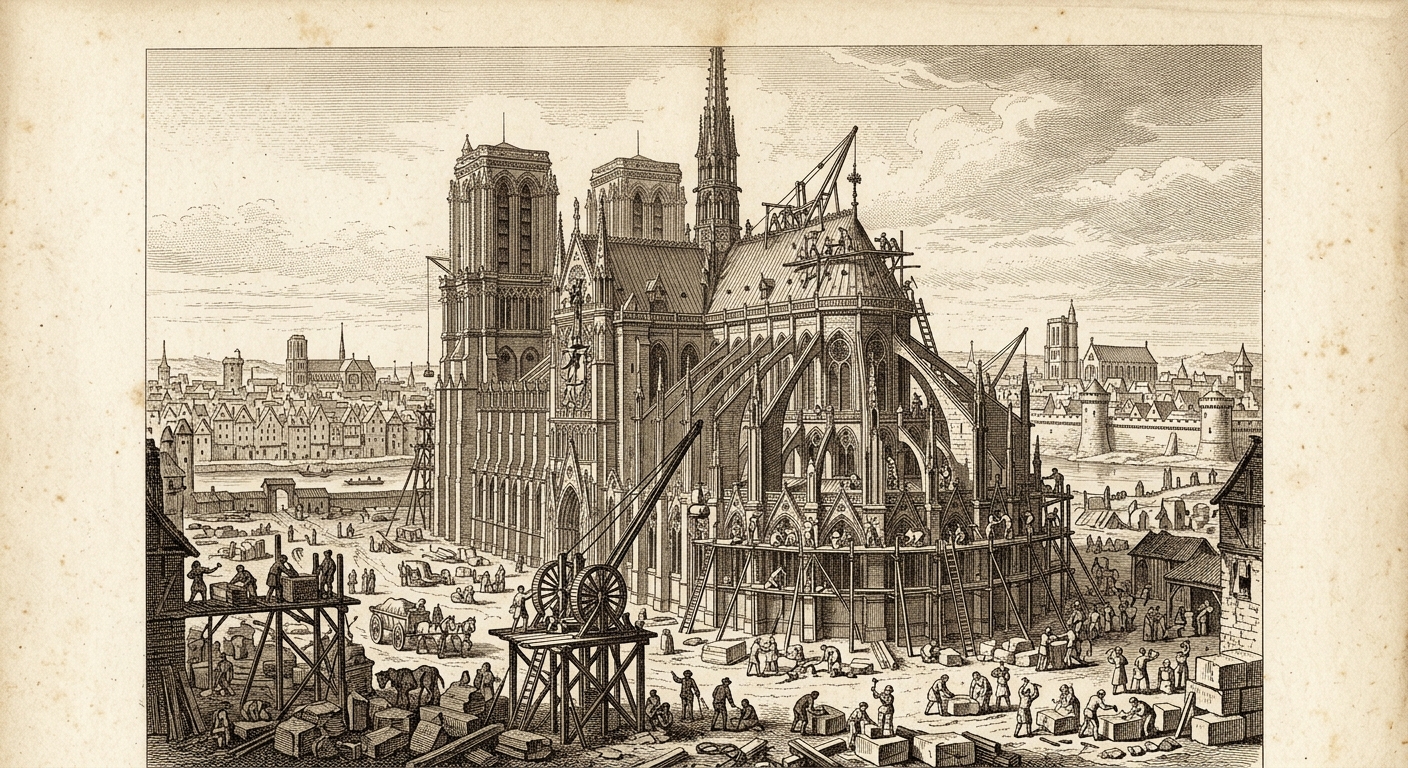
Middle Ages Timeline
The Middle Ages lasted roughly a thousand years after the fall of Rome, shaped by feudalism, the Catholic Church, crusades, and plagues — ending on the eve of the Renaissance.
When the Western Roman Empire collapsed in AD 476, it left behind a fragmented Europe of small kingdoms, ruined roads, and fading cities. For the next thousand years, life in Western Europe was shaped by three great forces: the Catholic Church (the main source of education, law, and community), feudalism (a system of land and loyalty that tied lords and peasants together), and a series of dramatic events — Viking raids, Crusades, plagues, and wars — that transformed the continent. The Middle Ages are often misunderstood as simply dark and backward, but they were also a time of great cathedrals, brilliant philosophy, and the slow rebuilding of European civilization.
- ~500
The Early Middle Ages Begin
After the fall of the Western Roman Empire, Europe fragments into small Germanic kingdoms and the Catholic Church becomes the main unifying force.
Why it mattered: The Church preserved learning, administered justice, and gave people a shared identity — without it, the chaos after Rome might have lasted far longer.
- 800
Charlemagne Crowned Emperor
Pope Leo III crowns the Frankish king Charlemagne as Holy Roman Emperor on Christmas Day.
Why it mattered: Charlemagne briefly reunited much of Western Europe, promoted education and Christianity, and created a model of Christian kingship that influenced rulers for centuries.
- 1066
Norman Conquest of England
William the Conqueror defeats King Harold at the Battle of Hastings and takes the English throne.
Why it mattered: The Norman Conquest transformed England — bringing French language, feudal institutions, and a new ruling class that permanently reshaped English culture, government, and law.
- 1095
The First Crusade
Pope Urban II calls on Christian knights to take back Jerusalem from Muslim rulers; thousands respond and capture the city in 1099.
Why it mattered: The Crusades opened Europe to trade and new ideas from the Islamic world, but also triggered centuries of religious conflict and left deep wounds that lasted far beyond the Middle Ages.
- 1215
Magna Carta
English barons force King John to sign the Magna Carta, limiting royal power and guaranteeing certain legal rights.
Why it mattered: The Magna Carta was a landmark step toward the rule of law — the idea that even a king must obey the law — and directly influenced the US Constitution and Bill of Rights.
- 1347–51
The Black Death
A devastating plague sweeps across Europe, killing an estimated one-third to one-half of the entire population.
Why it mattered: The Black Death was one of history's greatest catastrophes — it killed tens of millions, shattered the social order, weakened the Church's authority, and accelerated the end of the feudal system.
- 1337–1453
Hundred Years' War
England and France fight a series of wars over the French throne; French heroine Joan of Arc plays a decisive role before being burned at the stake.
Why it mattered: The war forged a sense of national identity in both England and France, and the use of longbows and early cannons began to transform medieval warfare.
- ~1450s
Gutenberg's Printing Press
Johannes Gutenberg develops movable-type printing in Germany; his Gutenberg Bible, printed around 1455, is the first major book produced with the new press.
Why it mattered: The printing press was one of the most transformative inventions in history — it spread ideas, enabled the Reformation, and eventually helped launch the Scientific Revolution.
- 1453
Fall of Constantinople
Ottoman Turks capture Constantinople, ending the thousand-year Eastern Roman Empire.
Why it mattered: The fall drove many Greek scholars and their manuscripts west to Italy — helping trigger the Renaissance — and established the Ottoman Empire as the dominant power in the eastern Mediterranean.
- 1492
End of the Middle Ages
Columbus reaches the Americas and Spain completes the Reconquista, expelling the last Muslim rulers from the Iberian Peninsula.
Why it mattered: These events mark the conventional end of the Middle Ages and the dawn of a new era — European exploration, the Renaissance, and the modern world.
Middle Ages Quiz
Check what you learned — read on screen, or use the Printable quiz button above for a worksheet version with an answer key.
What held Western Europe together after the fall of Rome?
- A) A new Roman empire based in Gaul
- B) The feudal kingdoms of Germany and France
- C) The Catholic Church, which became the main unifying institution
- D) The Byzantine Empire in the West
What was the significance of the Magna Carta in 1215?
- A) It ended the Crusades
- B) It limited royal power and established the principle that even kings must obey the law
- C) It united England and France under one king
- D) It created the first European parliament
What did the Norman Conquest of 1066 do to England?
- A) It brought England under direct Church control
- B) It connected England to the Islamic world through trade
- C) It transformed England's language, culture, and government through Norman French rulers
- D) It ended feudalism in England
What were the Crusades?
- A) Wars between England and France for control of the English Channel
- B) Campaigns by Christian knights to take back Jerusalem and the Holy Land from Muslim rulers
- C) Invasions of Western Europe by Ottoman Turks
- D) Wars to spread the printing press across the Islamic world
What was the Black Death?
- A) A series of wars caused by the collapse of the feudal system
- B) A devastating plague that killed one-third to one-half of Europe's population
- C) The dark period after the fall of Rome before Charlemagne
- D) The name for the Viking raids that terrorized Europe
What did Gutenberg's printing press do?
- A) It spread Christianity to the Americas
- B) It ended the Hundred Years' War
- C) It made books cheap and fast to produce, allowing ideas to spread rapidly across Europe
- D) It helped defeat the Ottoman Turks at Constantinople
Why was the fall of Constantinople in 1453 historically important?
- A) It ended the Crusades permanently
- B) It ended the Byzantine Empire and drove Greek scholars west, helping spark the Renaissance
- C) It gave the Ottoman Empire control of all of Western Europe
- D) It started the Hundred Years' War
Joan of Arc is associated with which conflict?
- A) The Crusades
- B) The Norman Conquest
- C) The Hundred Years' War between England and France
- D) The defense of Constantinople against the Ottomans
Show answer key
1. C · 2. B · 3. C · 4. B · 5. B · 6. C · 7. B · 8. C
Related timelines
 Renaissance Timeline — The Renaissance was a rebirth of art, learning, and science in Europe, beginning in Italy and spreading across the continent — bridging the Middle Ages and the modern world. Open →
 Age of Exploration Timeline — The Age of Exploration was the period when European sailors mapped the world, opening sea routes to Asia, reaching the Americas, and beginning a new era of global trade — and colonization. Open →
How to print
Choose Download PDF for a ready-to-print timeline that fits US Letter paper (8.5 × 11"). The blank fill-in version keeps the dates and gives students empty lines to write each event — great for review and quizzes.
Frequently asked questions
What were the Middle Ages?
The Middle Ages (roughly 500 to 1500 AD) is the period between the fall of the Western Roman Empire and the beginning of the Renaissance. It is sometimes divided into the Early Middle Ages (500-1000), the High Middle Ages (1000-1300), and the Late Middle Ages (1300-1500). Life was shaped by feudalism, the Catholic Church, and an agricultural economy — but the period also produced great universities, cathedrals, and philosophy.
What was feudalism?
Feudalism was the social and political system of medieval Europe. Kings gave land to nobles in exchange for military service; nobles gave land to knights; and peasants (serfs) worked the land in exchange for protection. The system created a strict hierarchy that defined most people's lives from birth to death, and it began to break down after the Black Death killed so many laborers that the survivors could demand better conditions.
What paper size should I print this on?
The timeline is sized for standard US Letter paper (8.5 × 11 in.). The Download PDF button gives you a print-ready file that fits the page automatically.