 Printable Scholar
Physical and Chemical Changes
Free printable physical and chemical changes diagram and worksheet for grades 5-8: melting, cutting, dissolving and boiling next to burning, rusting, cooking and fizzing, with the signs of a chemical change and a blank diagram to label. PDF for Letter paper.
Part of the Physical and Chemical Changes teaching pack for grades 5 to 8 (introductory level): 29 lesson slides and 9 printables with answer keys. The diagram and the blank one to label are free.
Teaching ideas for Physical and Chemical Changes
Pick the ideas that suit your class, then follow the plan or use the sheets in any order.
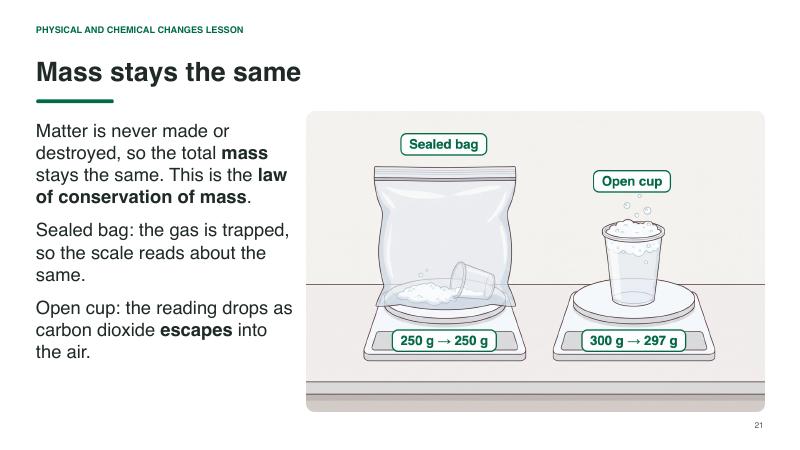
- Fizz in a bag. Put baking soda in a zip bag with a small cup of vinegar standing inside. Seal it, weigh it, then tip the cup. The bag puffs up, but the reading stays about the same.
- Rust in a dish. Leave a damp piece of plain steel wool in a dish and a dry piece beside it. Over a few days the damp one turns orange-brown; the dry one stays gray.
- Sort real changes. Show a melting ice cube, a torn sheet of paper, a slice of toast and an apple slice gone brown. Students decide which are new substances and name the clue.
- Find the sugar. Stir sugar into a little water in a shallow dish and leave it on a sunny windowsill. When the water has evaporated, the sugar is left behind.
A plan for the week
| Day 1 | Open with one of the ideas above. Teach the lesson with the slides while students fill in the guided notes. Then students label the blank diagram. | Lesson slides (PowerPoint) (in the pack) Physical and Chemical Changes Guided Notes (in the pack) Physical and Chemical Changes Diagram Blank Physical and Chemical Changes |
| Day 2 | On “Read the Diagram,” students use the pictures to tell a new gas from water vapor, show that dissolved sugar is still there and explain why cutting and burning differ though neither can be undone. | Read the Diagram (in the pack) |
| Day 3 | Read “Same Stuff or New Stuff?” and answer the questions. Then students sort fourteen everyday changes on “Physical or Chemical?” | Same Stuff or New Stuff? (in the pack) Physical or Chemical? (in the pack) |
| Day 4 | Weigh a sealed bag of baking soda and vinegar before and after it fizzes. Then students work out the masses on “Conservation of Mass.” | Conservation of Mass (in the pack) |
| Day 5 | Review with the crossword, then give the quiz. | Physical and Chemical Changes Crossword (in the pack) Physical and Chemical Changes Quiz (in the pack) |
The sheets marked “in the pack” are in the Physical and Chemical Changes teaching pack below.
NGSS standards
- Supports 5-PS1-4: Conduct an investigation to determine whether the mixing of two or more substances results in new substances.
- Supports 5-PS1-2: Measure and graph quantities to provide evidence that regardless of the type of change that occurs when heating, cooling, or mixing substances, the total weight of matter is conserved.
- Supports MS-PS1-2: Analyze and interpret data on the properties of substances before and after the substances interact to determine if a chemical reaction has occurred.
- Supports MS-PS1-5: Develop and use a model to describe how the total number of atoms does not change in a chemical reaction and thus mass is conserved.
Physical and Chemical Changes teaching pack
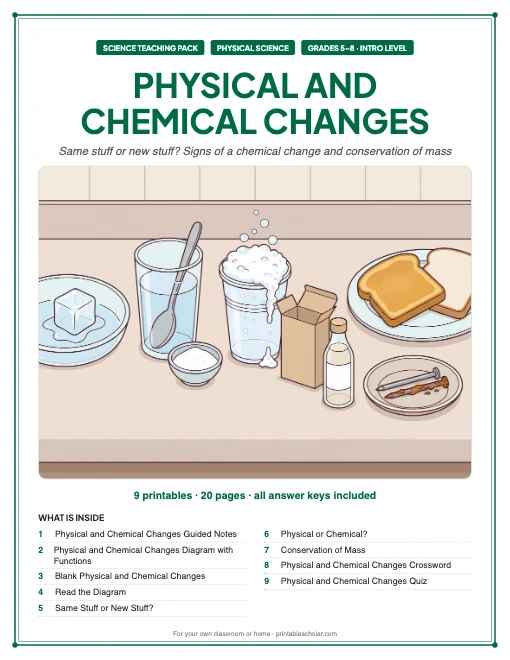
A ready-to-teach lesson: 29 slides and 9 printables. Present the slides while students fill in the guided notes, then use the worksheets, crossword and quiz, with every answer key.
Teaching physical and chemical changes? This pack has ready-made lesson slides and 9 printables that take students from “same stuff or new stuff?” to the signs of a chemical change and conservation of mass, in teaching order, with every answer key.
Free on this page: the diagram and the blank one to label, marked Download below. The whole pack is $7: 20 pages in one print-ready file, the 29 lesson slides, the practice sheets, the crossword, the quiz and every answer key.
OnlineThe pack also comes as an online lesson for Google Classroom: every part on screen for students, plus a self-grading Google Forms quiz.
One-time purchase. Instant download. Secure checkout by Stripe. Want to see a whole pack first? The Parts of an Atom pack is free.See all 17 packs in the bundle
- Cells
- Mitosis
- DNA
- Heredity and Punnett Squares
- Carbon Cycle and Greenhouse Effect
- The Nitrogen Cycle
- Excretory System
- Endocrine System
- Immune System
- Layers of the Skin
- Plate Tectonics and Earthquakes
- Life Cycle of a Star
- Parts of an Atom
- The Periodic Table
- Physical and Chemical Changes (this pack)
- Waves and the Electromagnetic Spectrum
- Acids, Bases and the pH Scale
Teach Physical and Chemical Changes with 29 ready-made slides
Open the PowerPoint and teach: an opening question, the parts one at a time on the diagram, quick checks and an exit question. Students fill in the guided notes sheet as you go.
Every slide comes with teacher notes: what to say, what to ask, and sample answers.
The slides (PowerPoint and a PDF copy) and the guided notes sheet come with the pack.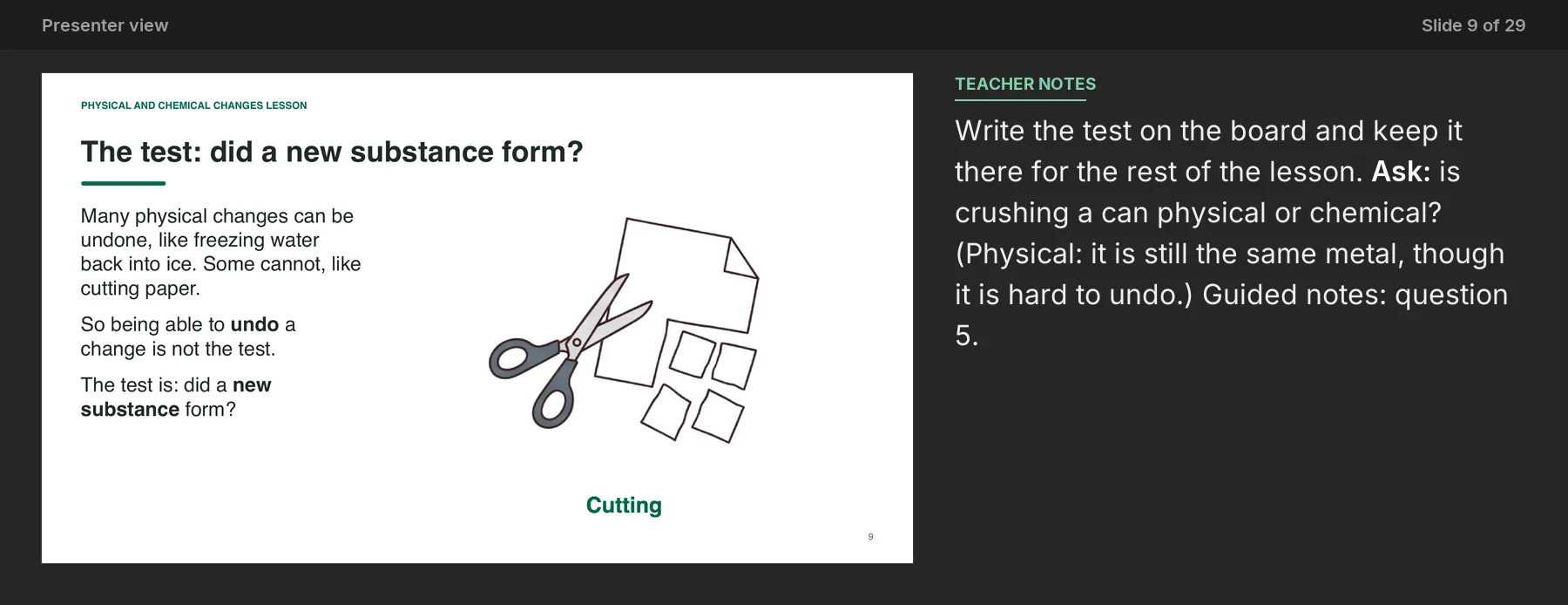
What is in the pack, in teaching order
 In the pack
1. TeachLesson Slides29 slides to present, with your notes for each one.In the $7 pack
 In the pack
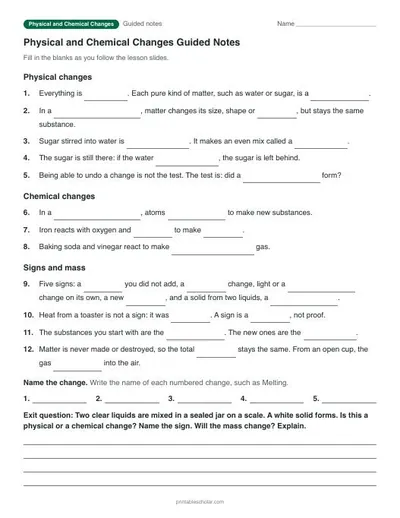
1. TeachPhysical and Chemical Changes Guided NotesStudents fill in the blanks as you present. With answer key.In the $7 pack
 Free
 Free
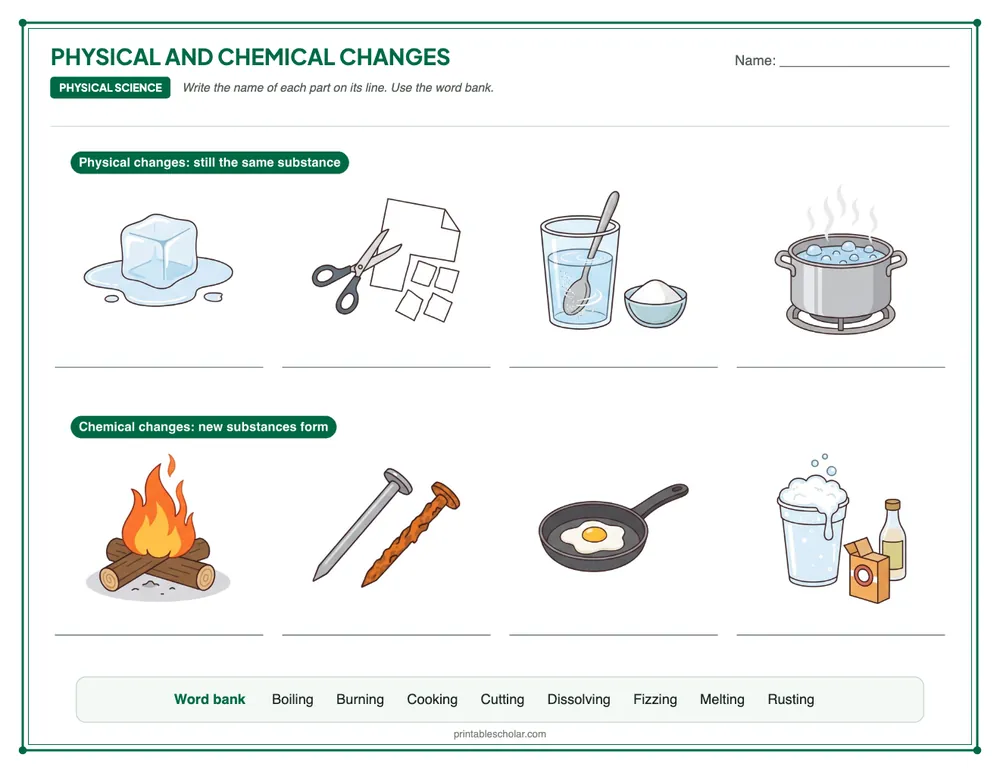
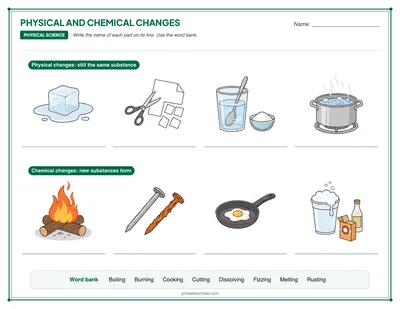
2. LabelBlank Physical and Chemical ChangesStudents label 8 changes from a word bank.Download free PDF
 In the pack
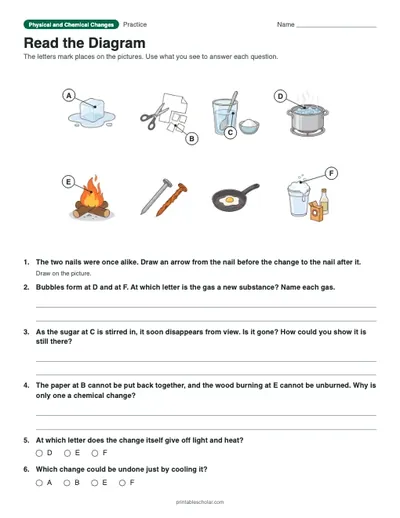
3. ReasonRead the DiagramRead the eight pictures: show which way rusting goes, tell a new gas from water vapor, prove dissolved sugar is still there and decide which changes can be undone.In the $7 pack
 In the pack
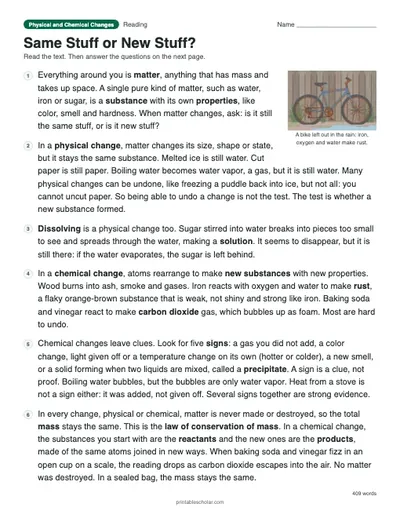
4. ReadSame Stuff or New Stuff?A one-page text on physical and chemical changes, dissolving, the five signs of a chemical change and conservation of mass, with eight questions.In the $7 pack
 In the pack
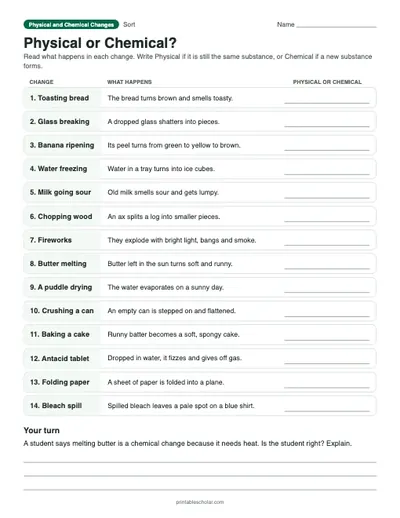
5. SortPhysical or Chemical?Sort fourteen everyday changes as physical or chemical, then explain why melting butter is not a chemical change.In the $7 pack
 In the pack
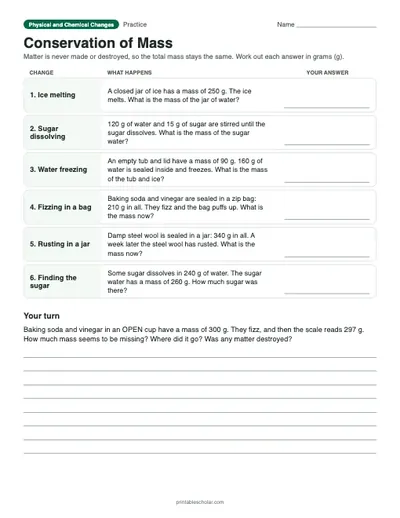
6. ApplyConservation of MassWork out the mass after five physical and chemical changes, find a missing mass, and explain where the “lost” mass from an open cup went.In the $7 pack
 In the pack
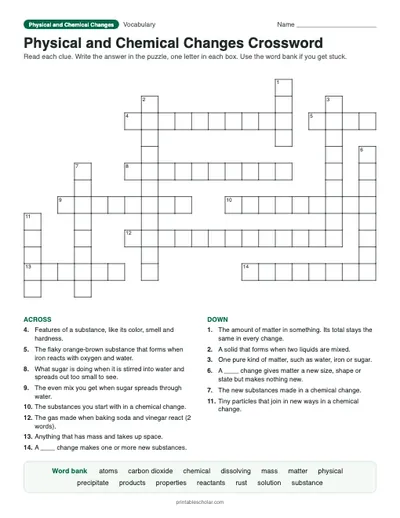
7. ReviewPhysical and Chemical Changes CrosswordFourteen physical and chemical change words with clues and a word bank.In the $7 pack
 In the pack
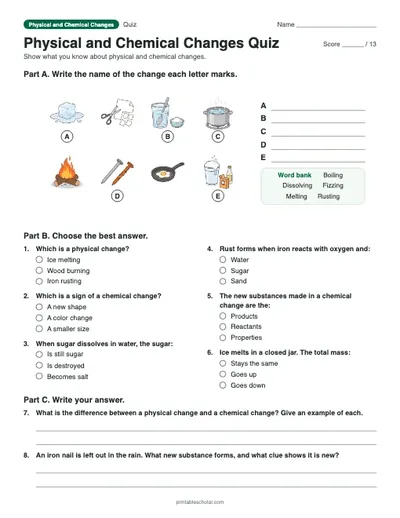
8. CheckPhysical and Chemical Changes QuizName five changes on the diagram, six multiple choice and two written answers. Scored out of 13.In the $7 pack
Physical and Chemical Changes worksheets, crossword and quiz
The Physical and Chemical Changes teaching pack is 29 lesson slides (PowerPoint and PDF) and 9 printables with answer keys for grades 5 to 8 (introductory level), in the order you would teach them: the guided notes for the lesson slides, the labeled diagram and the blank one to label, then “Read the Diagram” (a worksheet), “Same Stuff or New Stuff?” (a reading passage), “Physical or Chemical?” (a sorting table), “Conservation of Mass” (a worksheet), a vocabulary crossword and a quiz.
The sheets are in a suggested teaching order: teach the lesson, have students label the blank diagram, then work through the practice sheets and finish with the quiz. Use them all over a week or pick the ones you need. The answer keys are together at the back.
The diagram and the blank one to label are free to download on this page. The other sheets come with the pack ($7), which is also in the Middle School Science bundle (grades 5 to 8).
The question to ask about any change is: is it still the same stuff, or is it new stuff? When ice melts, it is still water. When paper is cut, the pieces are still paper. These are physical changes: the size, shape or state changes, but the substance does not. Many physical changes can be undone, like freezing the water back into ice, but not all of them (you cannot uncut paper), so being able to undo a change is not the test. In a chemical change, the atoms rearrange into new substances with new properties. Wood burns into ash, smoke and gases; iron rusts into flaky orange-brown rust. Chemical changes leave clues: a gas you did not add, a color change, light given off or a temperature change on its own, a new smell, or a solid forming when two liquids are mixed. A clue is not proof, because boiling water bubbles too, but several clues together are strong evidence. In both kinds of change, matter is never created or destroyed: the total mass stays the same. This is called the law of conservation of mass.
Eight everyday changes
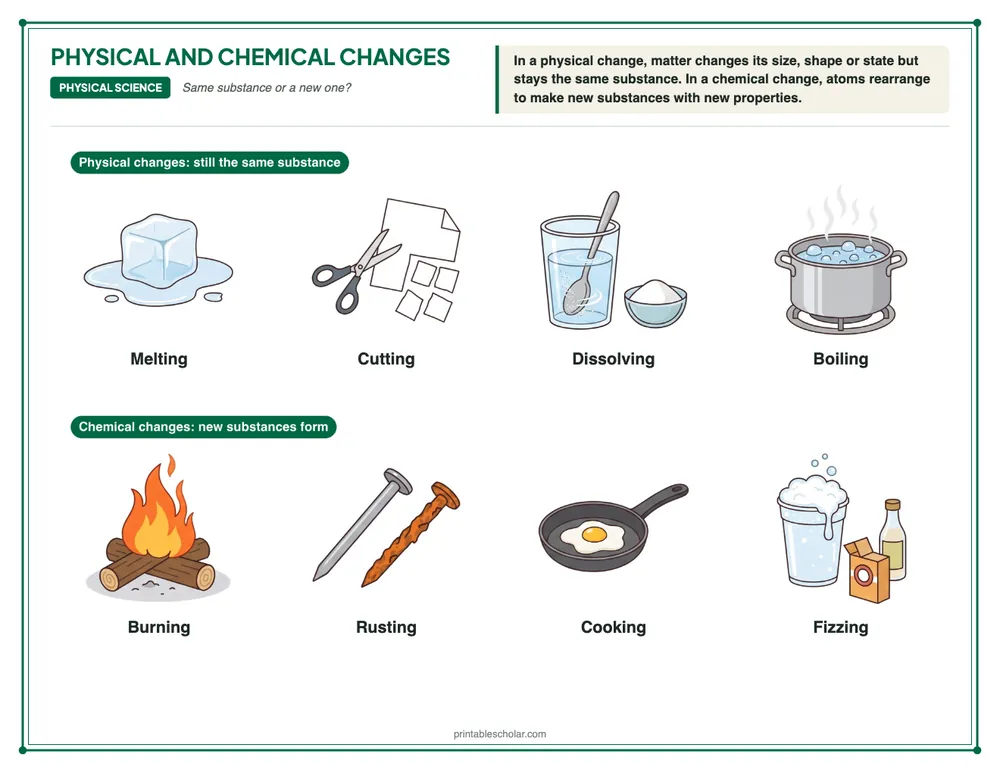
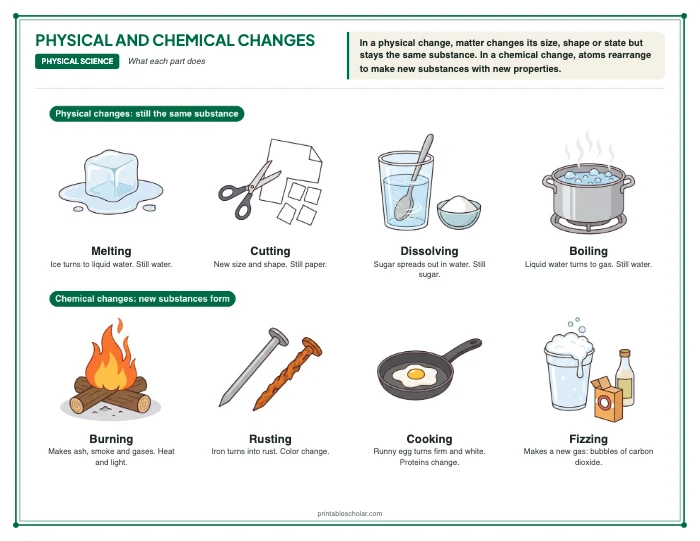
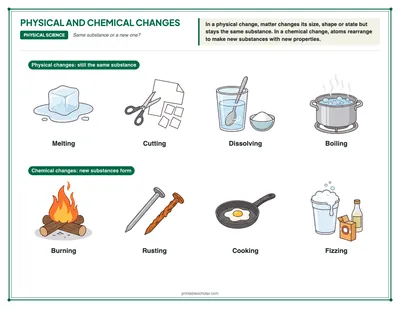
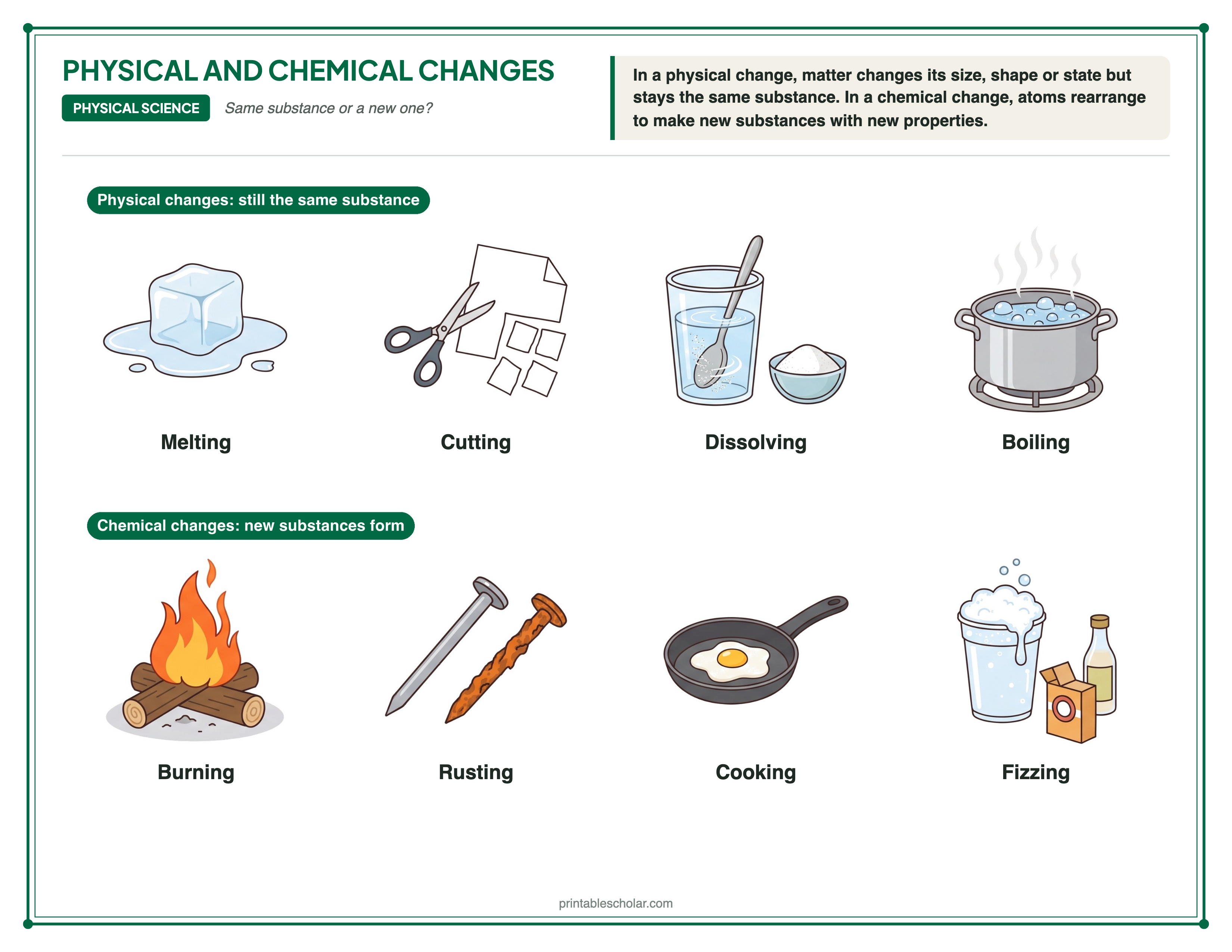
Matter changes all the time. In a physical change it gets a new size, shape or state but stays the same substance. In a chemical change its atoms rearrange to make new substances with new properties. This diagram shows four of each from everyday life. Here is what happens at each labeled part of the diagram:
| Change | What it does | Why it matters |
|---|---|---|
| Melting | A solid turns into a liquid when it warms up. Ice melting is still water: a physical change. | Melting changes the state of a substance, not the substance itself. Put the puddle back in the freezer and it turns into ice again. The water particles are the same; they only move more freely. |
| Cutting | Cutting changes the size and shape of the paper, but every piece is still paper: a physical change. | Cutting, tearing, crushing and bending are all physical changes. You cannot put the paper back together, which shows that not every physical change can be undone. The test is whether a new substance formed, and here none did. |
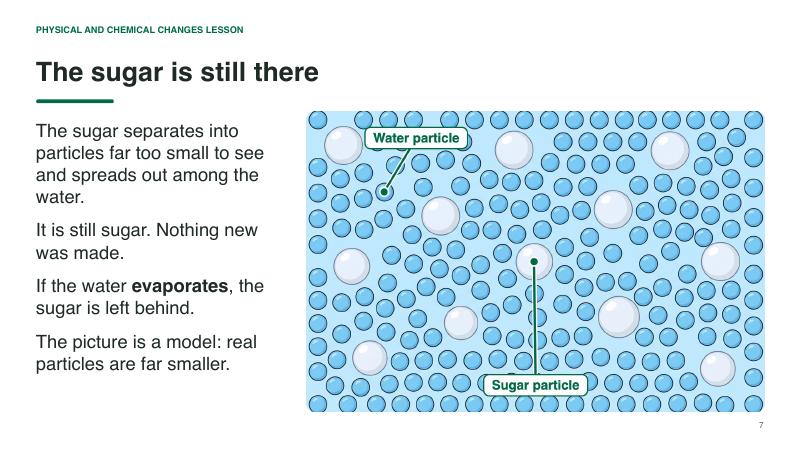
| Dissolving | Sugar spreads out through water and seems to disappear, but it is still sugar: a physical change. | The sugar breaks into particles too small to see and mixes evenly with the water, making a solution. The water still tastes sweet, and if the water evaporates the sugar is left behind. Nothing new was made. |
| Boiling | Liquid water turns into water vapor, a gas. It is still water: a physical change. | The bubbles in boiling water are water vapor, not a new gas, so bubbles alone do not prove a chemical change. Water vapor itself is invisible: the white cloud above the pot is tiny drops of water that have cooled back into liquid. |
| Burning | Wood reacts with oxygen in the air and gives off heat and light. Ash, smoke and gases are new substances: a chemical change. | Burning (combustion) gives off heat and light on its own once it has started, and it leaves ash that cannot be turned back into wood. The wood’s atoms join with oxygen to make carbon dioxide and water vapor, which go into the air. |
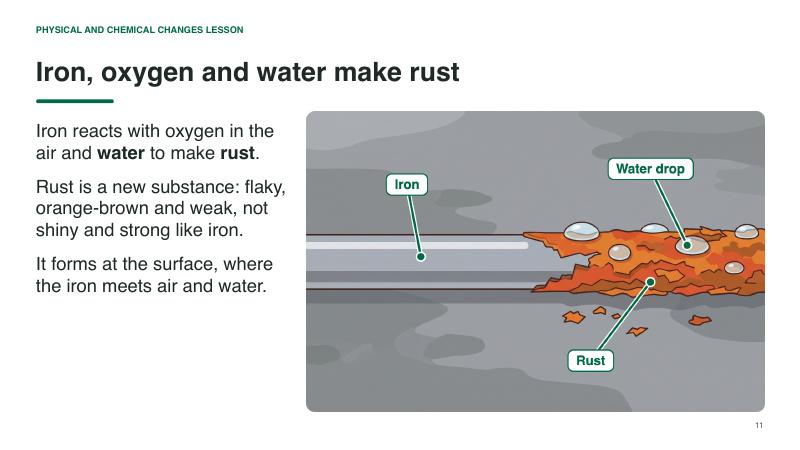
| Rusting | Iron reacts slowly with oxygen and water to make rust, a new orange-brown substance: a chemical change. | Rust is iron oxide. It is flaky and weak, not shiny and strong like iron, so it has new properties. The color change is the clue. Rusting needs both oxygen and water, which is why a nail left out in the rain rusts and a dry one indoors stays shiny. |
| Cooking | Heat changes the egg white from clear and runny to white and firm, with new properties: a chemical change. | Heat changes the proteins in the egg so they unfold and link together into a new solid. The egg has new properties: new color, new texture and a new smell. Cooling it down does not turn it back into a raw egg. |
| Fizzing | Baking soda and vinegar react to make carbon dioxide gas, which bubbles up as foam: a chemical change. | The gas was not in the cup before: the reaction made it. A gas you did not add is one of the clues of a chemical change. If the cup is weighed before and after, it seems to lose mass, because the gas escapes into the air. In a closed container the mass stays the same. |
How to print
Choose Download PDF for a ready-to-print file that fits US Letter paper (8.5 × 11") in landscape, or Download PNG for the high-resolution image.
Frequently asked questions
What is the difference between a physical change and a chemical change?
In a physical change, matter changes its size, shape or state but stays the same substance, like ice melting or paper being cut. In a chemical change, atoms rearrange to make one or more new substances with new properties, like wood burning or iron rusting.
What are the signs of a chemical change?
Five clues: a gas forms that you did not add (bubbles), the color changes, light is given off or the temperature changes on its own (hotter or colder), a new smell appears, or a solid forms when two liquids are mixed (a precipitate). A clue is not proof, because physical changes can bubble or need heat too, so look for several clues and ask whether a new substance was made.
Is melting a physical or chemical change?
Melting is a physical change. Melted ice is still water, and it can freeze back into ice. All changes of state, such as melting, freezing, boiling, evaporating and condensing, are physical changes.
Is burning a physical or chemical change?
Burning is a chemical change. The fuel reacts with oxygen and makes new substances, such as carbon dioxide, water vapor and ash, while giving off heat and light. A burning candle shows both kinds: the wax melting is physical, the wax burning at the wick is chemical.
Is rusting a chemical change?
Yes. Iron reacts with oxygen and water to form rust (iron oxide), a new substance that is orange-brown, flaky and weaker than iron.
Is dissolving sugar in water a physical change?
Yes. The sugar spreads out into particles too small to see, but it is still sugar: the water tastes sweet, and when the water evaporates the sugar is left behind.
What is the law of conservation of mass?
Matter is not created or destroyed in a physical or chemical change, so the total mass stays the same. If a gas escapes from an open container, the scale shows less mass, but the gas still exists in the air. In a closed container the mass before and after is the same.
What paper size should I print this on?
The diagram is sized for standard US Letter paper (8.5 × 11") in landscape orientation. Use "Download PDF" for a print-ready file that fits the page automatically.
Are there Physical and Chemical Changes worksheets to go with the diagram?
Yes. The Physical and Chemical Changes teaching pack, for grades 5 to 8 (introductory level), has 29 lesson slides and 9 printables with answer keys: the guided notes for the lesson slides, the labeled diagram and the blank one to label, then “Read the Diagram” (a worksheet), “Same Stuff or New Stuff?” (a reading passage), “Physical or Chemical?” (a sorting table), “Conservation of Mass” (a worksheet), a vocabulary crossword and a quiz. The diagram and the blank one to label are free to download on this page. The other sheets come with the pack ($7), which is also in the Middle School Science bundle (grades 5 to 8).
Related: Changes of state are explained in the states of matter diagram, and the atoms that rearrange in a chemical change in the atomic structure diagram.