Computing & Internet History Timeline
The history of computing is the story of how humans went from filling entire rooms with calculating machines to putting a more powerful computer in every pocket — transforming every aspect of work, communication, science, and daily life in under a century.
The computer was invented twice — once on paper, and once in metal and wire. In 1936, British mathematician Alan Turing described a purely theoretical 'universal computing machine' that could simulate any calculation imaginable. He never built it. Nine years later, engineers at the University of Pennsylvania built ENIAC — a room-filling monster of 18,000 vacuum tubes that could do in seconds what took humans hours. The problem was that ENIAC weighed 30 tons and broke constantly. Then the transistor — the tiny electronic switch — changed everything. Computers shrank from rooms to desks to laps to pockets. The ARPANET connected a few university computers across a phone line in 1969; by 1991, Tim Berners-Lee's World Wide Web had turned that connection into a global library. Google organized it. The iPhone put it in your hand. In less than a human lifetime, computing went from a theoretical concept to the invisible infrastructure underlying almost everything we do.
- 1936
Turing Describes the Universal Computer
British mathematician Alan Turing publishes 'On Computable Numbers,' describing a theoretical 'universal computing machine' that can simulate any calculation by reading and writing symbols on a tape — laying the mathematical foundation for all modern computers.
Why it mattered: Turing's paper proved what computers could and couldn't do before a single electronic computer existed — his theoretical framework defined the limits and capabilities of computing and influenced every computer design that followed; Turing is considered the father of computer science.
- 1945
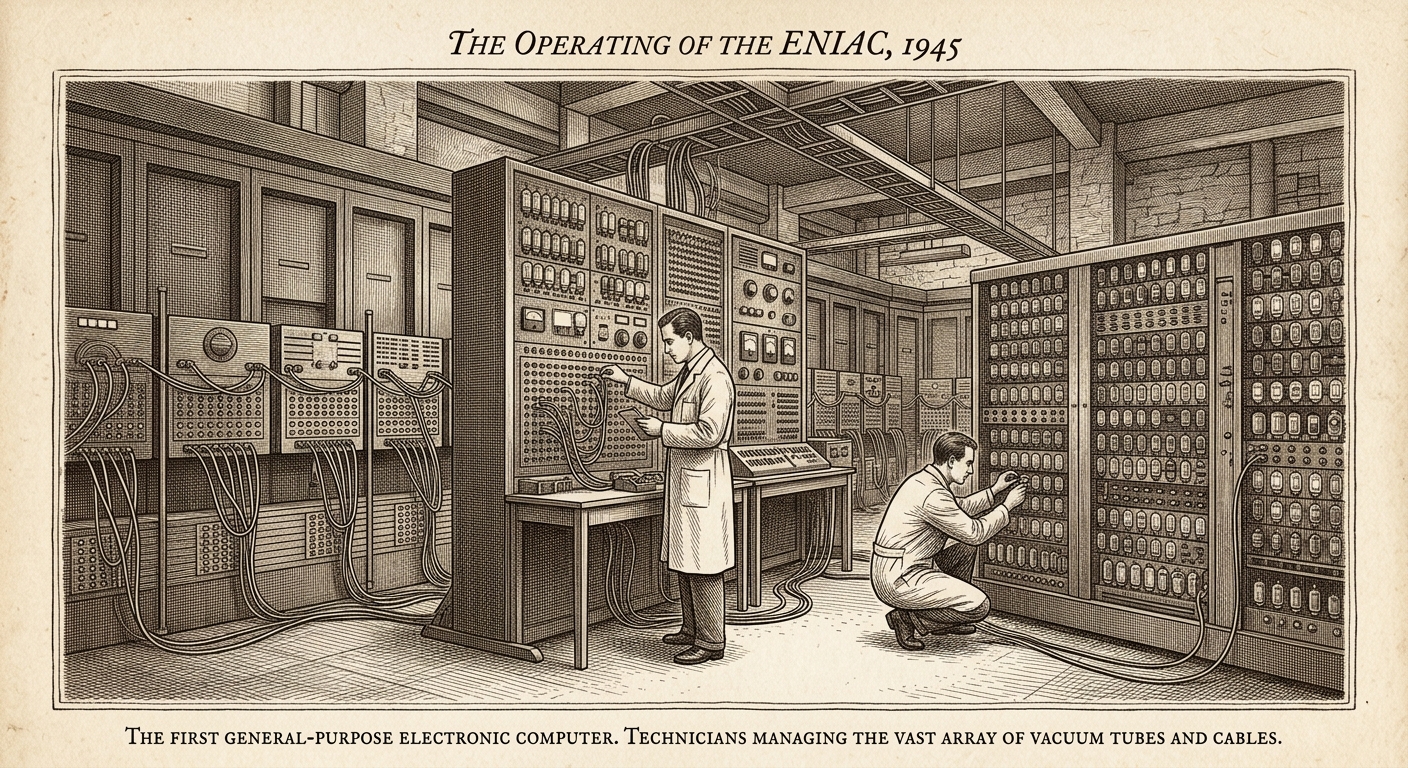
ENIAC — First General-Purpose Electronic Computer
Engineers at the University of Pennsylvania complete ENIAC — the Electronic Numerical Integrator and Computer — filling an entire room with 18,000 vacuum tubes, weighing 30 tons, and performing thousands of calculations per second, far faster than any human.
Why it mattered: ENIAC proved that an electronic computer could solve real problems at useful speeds — it was used to calculate artillery firing tables and later hydrogen bomb calculations; its existence launched the race to build smaller, faster, more reliable computers.
- 1969
ARPANET — First Internet Message
The US Defense Department's ARPANET sends its first message between computers at UCLA and Stanford on October 29, 1969 — the network crashes after just two letters ('LO' of 'LOGIN'), but the age of networked computing has begun.
Why it mattered: ARPANET was the seed of the modern internet — a network designed to survive a nuclear attack by routing information around damaged sections; within years it connected universities and research labs across the US, creating the communication infrastructure the internet would eventually inherit.
- 1971
First Microprocessor
Intel engineers Ted Hoff, Federico Faggin, and Stanley Mazor design the Intel 4004 — the first commercially available microprocessor, placing the equivalent of an entire computer's processing power onto a single chip smaller than a fingernail.
Why it mattered: The microprocessor was the invention that made personal computers possible — instead of a roomful of circuits, a computer's brain could fit on a chip costing a few dollars; every computer, smartphone, and electronic device built since runs on a descendant of this idea.
- 1975–76
Personal Computer Revolution Begins
The Altair 8800 kit computer ignites a hobbyist movement (1975); Bill Gates and Paul Allen found Microsoft to write software for it; Steve Jobs and Steve Wozniak found Apple (1976) and release the Apple I — the first wave of computers designed for individual people, not institutions.
Why it mattered: The personal computer shifted computing from a tool of governments and corporations to something an individual could own — the garage-startup culture of Gates, Allen, Jobs, and Wozniak redefined who could shape the future of technology and launched the modern tech industry.
- 1981–84
IBM PC and the Macintosh
IBM releases the IBM PC (1981), instantly legitimizing personal computers for business and establishing the architecture that most PCs still follow; Apple's Macintosh (1984) introduces a graphical user interface — windows, icons, and a mouse — to a mass consumer audience.
Why it mattered: The IBM PC set the hardware standard that created a mass market for personal computers; the Macintosh showed that computers didn't have to be command-line tools for experts — a visual interface made computing accessible to anyone, not just programmers.
- 1991
World Wide Web Goes Public
British computer scientist Tim Berners-Lee publishes the code for the World Wide Web — a system of interlinked documents accessible via the internet — making it freely available to anyone, and transforming the internet from a scientists' network into a global public resource.
Why it mattered: The Web turned the internet from a network for sending files and email into a universal library and communication platform — Berners-Lee's decision to give it away free, rather than patent it, allowed it to grow from a single website in 1991 to billions of pages within a decade.
- 1998
Google Founded
Stanford PhD students Larry Page and Sergey Brin found Google, launching a search engine that ranks pages by how many other pages link to them — producing dramatically more useful results than existing search engines and quickly becoming the primary gateway to the web.
Why it mattered: Google solved the problem that was threatening to make the web useless — as pages multiplied into the billions, finding anything relevant became nearly impossible; Google's search algorithm organized the web and made it navigable, becoming the most used tool on the internet.
- 2007
iPhone Launches the Smartphone Era
Steve Jobs introduces the iPhone on January 9, 2007 — a device combining a phone, internet browser, camera, and music player in a touchscreen with no physical keyboard — launching the smartphone era and beginning the shift to mobile computing.
Why it mattered: The iPhone put a full-powered internet-connected computer in billions of pockets — within a decade, more people accessed the internet through smartphones than through computers; it also created a new economy of apps, reshaped social media, and changed how humans communicate, navigate, shop, and consume information.
Computing & Internet History Quiz
Check what you learned — read on screen, or use the Printable quiz button above for a worksheet version with an answer key.
What did Alan Turing describe in his 1936 paper, and why does it matter?
- A) The first practical design for an electronic computer using vacuum tubes instead of mechanical relays
- B) A theoretical 'universal computing machine' that could perform any calculation — the mathematical foundation for all modern computers
- C) The concept of connecting multiple computers through a network so they could share information
- D) A programming language that computers could use to perform calculations without human input for each step
What was ENIAC, built in 1945?
- A) The first theoretical model of a computer, published by Alan Turing at the University of Cambridge
- B) The first commercially available microprocessor, placing computing power onto a single small chip
- C) The first general-purpose electronic computer — a room-sized machine using 18,000 vacuum tubes to perform calculations at high speed
- D) The first personal computer designed for individual home use rather than military or scientific institutions
What did the ARPANET's first message in 1969 demonstrate?
- A) That computers could perform calculations faster than any human mathematician
- B) That a network connecting computers at different locations was possible — even though the first message crashed after two letters
- C) That the internet could survive a nuclear attack by automatically rerouting messages around damaged nodes
- D) That personal computers were now powerful enough to communicate directly with each other without a mainframe
Why was the microprocessor such a significant invention?
- A) It made ARPANET possible by providing the processing power needed to route messages between computers
- B) It was the first device that could perform the logical operations Turing had described in his 1936 theoretical paper
- C) By placing an entire computer's processing power on a single small chip, it made personal computers and eventually smartphones possible
- D) It replaced vacuum tubes in mainframe computers, making them faster but not significantly smaller
What did Apple's Macintosh introduce in 1984 that changed how people use computers?
- A) The first microprocessor powerful enough to run word processing and spreadsheet software simultaneously
- B) A graphical user interface with windows, icons, and a mouse — making computers accessible to people who couldn't program
- C) The first personal computer cheap enough for ordinary families to purchase for home use
- D) The concept of an 'app store' where users could download software created by independent developers
What did Tim Berners-Lee create in 1991, and what made his approach historically significant?
- A) The first internet search engine, which he licensed to companies to fund further development of internet infrastructure
- B) The World Wide Web — a system of interlinked documents accessible via the internet — which he gave away free, allowing it to grow without restriction
- C) The TCP/IP protocols that allowed different computer networks to communicate with each other across the internet
- D) The first graphical web browser, which he sold to Netscape and which became the dominant way people accessed the internet
How did Google solve a problem that was threatening to make the internet less useful?
- A) Google created a system for verifying that websites contained accurate information before displaying them in results
- B) Google built faster servers that could load web pages more quickly than any previous search engine
- C) Google's algorithm ranked pages by how many other pages linked to them, producing far more relevant search results as the web grew to billions of pages
- D) Google compressed web pages so they could be accessed more quickly over the slow internet connections of the late 1990s
Why was the iPhone's launch in 2007 a turning point in computing history?
- A) The iPhone was the first smartphone — no mobile phone before it could access the internet or send email
- B) The iPhone put a full internet-connected computer in people's pockets, launching the smartphone era and shifting most internet use to mobile devices within a decade
- C) The iPhone introduced the App Store concept, making it the first device where users could purchase and download software directly
- D) The iPhone proved that a computer company could successfully enter the phone market, leading to the collapse of Nokia and BlackBerry
Show answer key
1. B · 2. C · 3. B · 4. C · 5. B · 6. B · 7. C · 8. B
Related timelines
 History of Electricity Timeline — The history of electricity is the story of how humans went from kite-flying in thunderstorms to lighting cities, building power grids, and inventing the transistor — the tiny device that makes every computer and smartphone possible. Open →
 Space Race Timeline — The Space Race was a Cold War competition between the United States and the Soviet Union to achieve milestones in space exploration, culminating in the Apollo 11 moon landing. Open →
How to print
Choose Download PDF for a ready-to-print timeline that fits US Letter paper (8.5 × 11"). The blank fill-in version keeps the dates and gives students empty lines to write each event — great for review and quizzes.
Frequently asked questions
What is the difference between the internet and the World Wide Web?
The internet is the global network of interconnected computers — the physical and software infrastructure of cables, routers, and protocols that allow computers to communicate. It has existed since ARPANET in 1969. The World Wide Web is one application that runs on top of the internet — Tim Berners-Lee's system of interlinked web pages, accessible through a browser. The web (http://) is the most visible part of the internet for most users, but the internet also carries email, streaming video, online gaming, and many other services that are not part of the web. Think of the internet as the road system and the web as one type of vehicle that uses it.
How did computing change so quickly in such a short time?
Computing improved so fast because of a pattern called Moore's Law — observed by Intel co-founder Gordon Moore in 1965 — that the number of transistors on a chip roughly doubles every two years while the cost stays the same. This exponential growth meant that computers that filled rooms in 1945 could fit on a desk by 1981, in a pocket by 2007, and in a watch by 2015. Exponential improvement is counterintuitive — small consistent doublings produce enormous gains over decades. The same pattern drove improvements in memory, storage, and internet bandwidth, making each generation of computing dramatically more powerful than the last.
What paper size should I print this on?
The timeline is sized for standard US Letter paper (8.5 × 11 in.). The Download PDF button gives you a print-ready file that fits the page automatically.