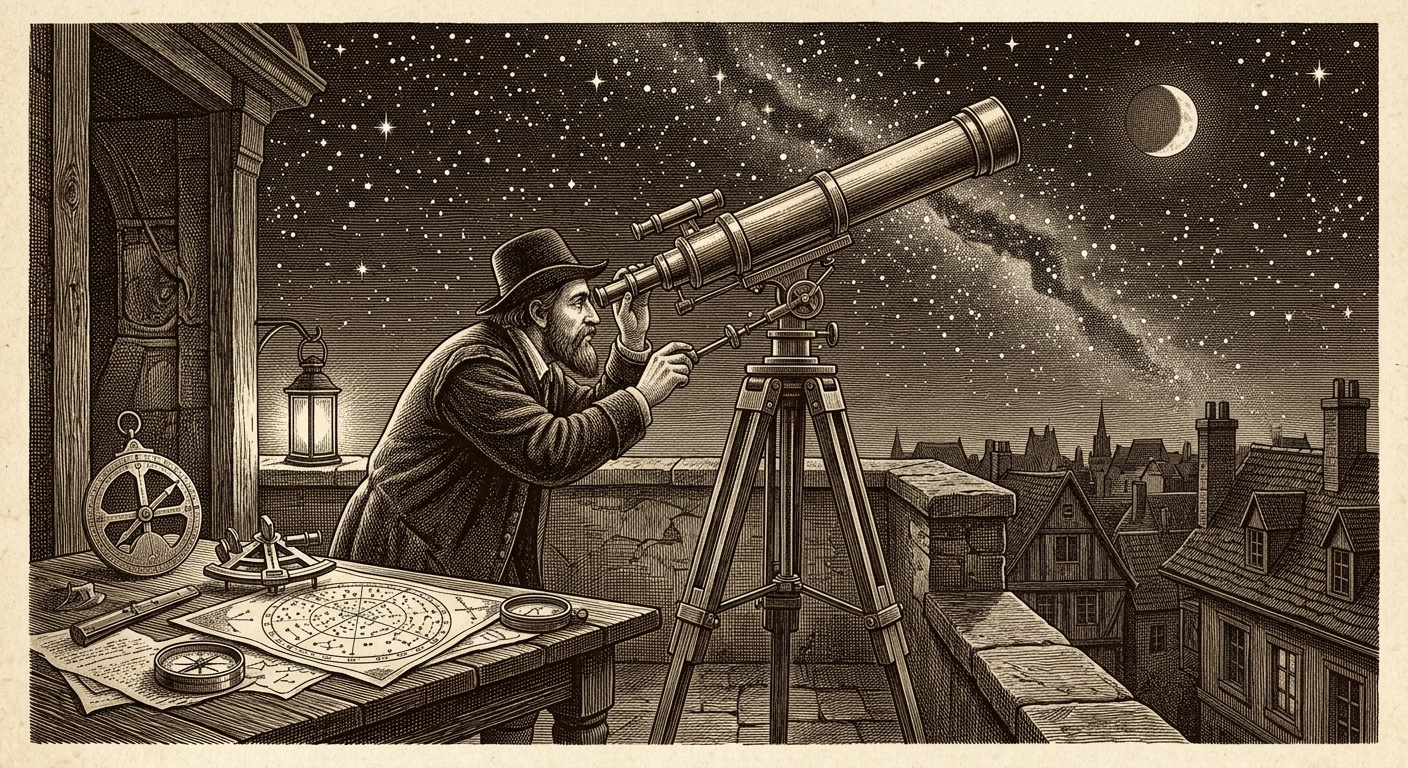
History of Astronomy Timeline
The history of astronomy is the story of how humans figured out what the universe actually is — from ancient Greeks who proposed the Earth moves around the Sun, to telescopes that see to the edge of time itself.
For most of human history, the universe was a mystery wrapped in a night sky. Ancient Greeks argued about whether the Earth or the Sun was at the center. Copernicus proved the Earth moves. Galileo saw Jupiter's moons with a primitive telescope and knew the Church-approved model was wrong. Newton figured out that the same force pulling an apple to the ground also holds the Moon in orbit. Then, century by century, the universe kept getting bigger: first one galaxy, then billions of galaxies, then a cosmos so vast the Hubble Space Telescope could point at an empty-looking patch of sky and find three thousand galaxies in a single photograph. Every generation of astronomers has looked up and discovered that the universe is stranger, larger, and more extraordinary than the generation before them imagined.
- c. 270 BCE
Aristarchus Proposes Heliocentrism
The Greek astronomer Aristarchus of Samos proposes that the Earth orbits the Sun — not the other way around — nearly 1,800 years before the idea would be widely accepted.
Why it mattered: Aristarchus was right, but most ancient thinkers rejected his model in favor of an Earth-centered universe; his idea had to wait nearly two millennia to be vindicated, showing how long it can take for a correct scientific idea to overcome accepted belief.
- 1543
Copernicus Publishes His Heliocentric Model
Nicolaus Copernicus publishes De Revolutionibus, his mathematical proof that the Earth and planets orbit the Sun — reviving and refining Aristarchus's ancient idea with detailed calculations.
Why it mattered: Copernicus's publication launched the Scientific Revolution — it directly inspired Galileo, Kepler, and Newton, and fundamentally changed how humans understood their place in the universe.
- 1609–10
Galileo Turns the Telescope on the Sky
Galileo Galilei improves the newly invented telescope and turns it skyward — discovering that Jupiter has four moons, that Venus has phases like the Moon, and that the Milky Way is made of countless individual stars.
Why it mattered: Galileo's observations provided the first direct evidence that not everything orbits the Earth — moons orbit Jupiter, just as Copernicus said the planets orbit the Sun. His conflict with the Catholic Church over these findings became history's defining story of science versus authority.
- 1687
Newton's Law of Universal Gravitation
Isaac Newton publishes Principia Mathematica, showing that the same force — gravity — that makes an apple fall also governs the orbits of planets and moons, following a precise mathematical law.
Why it mattered: Newton's law unified earthly and celestial mechanics for the first time, giving scientists a mathematical tool to predict planetary motion precisely and showing that the universe operates by knowable, universal laws.
- 1781
Uranus Discovered
William Herschel discovers Uranus — the first planet found with a telescope, and the first planet unknown to the ancient world — instantly doubling the known size of the solar system.
Why it mattered: Uranus's discovery proved that the solar system was larger than anyone had thought, and demonstrated that the telescope could reveal objects invisible to the naked eye; it triggered a search for even more distant planets.
- 1915–16
Einstein's General Relativity
Albert Einstein publishes his theory of general relativity, describing gravity not as a force but as the curvature of space-time — predicting phenomena like black holes, gravitational waves, and the bending of light around massive objects.
Why it mattered: General relativity replaced Newton's model for extreme conditions and predicted phenomena — black holes, gravitational waves, the expanding universe — that astronomers are still confirming more than a century later.
- 1924–29
Hubble Discovers Galaxies and the Expanding Universe
Edwin Hubble proves that the Andromeda 'nebula' is actually a separate galaxy far beyond the Milky Way; by 1929 he shows that the universe is expanding in all directions.
Why it mattered: Hubble's discoveries instantly expanded the known universe from a single galaxy to something almost incomprehensibly vast — and the expanding universe implied it had a beginning, leading directly to the Big Bang theory.
- 1977
Voyager Launches
NASA launches Voyager 1 and 2; over the following decade they fly past Jupiter, Saturn, Uranus, and Neptune, returning the first detailed close-up images of the outer planets and their moons.
Why it mattered: The Voyager missions gave humanity its first detailed look at the outer solar system — revealing volcanic moons, complex ring systems, and dozens of new moons — and Voyager 1 eventually became the first human-made object to leave the solar system.
- 1990–95
Hubble Space Telescope and the Deep Field
The Hubble Space Telescope is launched in 1990; in 1995 it photographs the Hubble Deep Field — pointing at an apparently empty patch of sky and revealing over 3,000 galaxies in a single image.
Why it mattered: The Hubble Deep Field changed how humans see the universe — a patch of sky that seemed empty contained thousands of galaxies, implying the observable universe holds an estimated two trillion galaxies. Hubble also helped confirm that the expansion of the universe is accelerating.
- 2019–22
First Black Hole Image and James Webb Space Telescope
In 2019 the Event Horizon Telescope produces the first image of a black hole; in 2022 the James Webb Space Telescope returns images of galaxies from less than 500 million years after the Big Bang.
Why it mattered: These breakthroughs confirmed what had seemed almost philosophical — that black holes truly exist as Einstein described, and that we can now see nearly to the beginning of the universe, observing galaxies that formed when the cosmos was less than 4% of its current age.
History of Astronomy Quiz
Check what you learned — read on screen, or use the Printable quiz button above for a worksheet version with an answer key.
Who first proposed that the Earth orbits the Sun, about 1,800 years before the idea was widely accepted?
- A) Nicolaus Copernicus, in the 16th century
- B) Galileo Galilei, after building his telescope
- C) Aristarchus of Samos, a Greek astronomer around 270 BCE
- D) Isaac Newton, in his Principia Mathematica
What did Galileo observe with his telescope that helped prove the heliocentric model?
- A) He saw the rings of Saturn and realized they were made of ice
- B) He discovered that Jupiter has moons orbiting it — proving that not everything in the universe orbits the Earth
- C) He measured the distance from the Earth to the Sun for the first time
- D) He discovered the planet Uranus orbiting far beyond Saturn
What did Newton's law of universal gravitation explain?
- A) Why the stars appear to move across the sky each night
- B) That the universe is expanding in all directions away from us
- C) That the same force — gravity — governs both falling objects on Earth and the orbits of planets and moons
- D) That light bends when it passes near a massive object like the Sun
What made the discovery of Uranus in 1781 significant?
- A) It was the first planet found to have a moon
- B) It was the first planet discovered using a telescope, doubling the known size of the solar system
- C) It was the first evidence that planets orbit the Sun rather than the Earth
- D) It was the first planet found to have a ring system
What did Einstein's theory of general relativity predict?
- A) That the solar system contains exactly eight planets
- B) That light travels at a constant speed regardless of the observer's motion
- C) Phenomena like black holes, gravitational waves, and the bending of light around massive objects
- D) That the universe has always existed and has no beginning
What did Edwin Hubble discover in the 1920s?
- A) The planet Pluto, located beyond Neptune in the outer solar system
- B) That the Andromeda 'nebula' is actually a separate galaxy, and that the universe is expanding
- C) That the Milky Way is the only galaxy in the observable universe
- D) That the Moon was formed when a large object collided with the early Earth
What did the Hubble Deep Field photograph reveal in 1995?
- A) The surface of Mars in greater detail than ever before seen from Earth
- B) A patch of sky that appeared empty but contained over 3,000 galaxies
- C) The moment of the Big Bang, captured by pointing the telescope at the edge of the universe
- D) The first clear image of a planet orbiting another star
What did the Event Horizon Telescope capture for the first time in 2019?
- A) The surface of Pluto, revealing mountains and plains of nitrogen ice
- B) A comet striking the surface of Jupiter
- C) The first image of a black hole, confirming predictions Einstein had made over 100 years earlier
- D) The James Webb Space Telescope launching from Earth
Show answer key
1. C · 2. B · 3. C · 4. B · 5. C · 6. B · 7. B · 8. C
Related timelines
 Space Race Timeline — The Space Race was a Cold War competition between the United States and the Soviet Union to achieve milestones in space exploration, culminating in the Apollo 11 moon landing. Open →
 History of Electricity Timeline — The history of electricity is the story of how humans went from kite-flying in thunderstorms to lighting cities, building power grids, and inventing the transistor — the tiny device that makes every computer and smartphone possible. Open →
How to print
Choose Download PDF for a ready-to-print timeline that fits US Letter paper (8.5 × 11"). The blank fill-in version keeps the dates and gives students empty lines to write each event — great for review and quizzes.
Frequently asked questions
How did ancient people study astronomy without telescopes?
Ancient astronomers were remarkably sophisticated even without optical instruments. They tracked the positions of stars and planets with the naked eye, built structures aligned to astronomical events (like Stonehenge, aligned to the summer solstice), and developed mathematics to predict eclipses and planetary motion. The ancient Greeks catalogued stars, measured the Earth's circumference, and estimated the distance to the Moon with surprising accuracy. The Babylonians had records of astronomical observations going back thousands of years and could predict eclipses reliably. The telescope, invented in 1608, revolutionized the field — but it built on millennia of careful naked-eye observation and mathematical astronomy.
What is the Big Bang theory?
The Big Bang theory is the scientific explanation for the origin of the universe. It holds that about 13.8 billion years ago, all matter and energy in the universe was compressed into an extraordinarily hot, dense point that rapidly expanded — not into space, but as space itself. Edwin Hubble's 1929 discovery that the universe is expanding in all directions was the key evidence: if everything is moving apart now, then everything must have been together in the past. The cosmic microwave background radiation — a faint glow of heat left over from the Big Bang — was detected in 1965 and is now our most detailed map of the early universe.
What paper size should I print this on?
The timeline is sized for standard US Letter paper (8.5 × 11 in.). The Download PDF button gives you a print-ready file that fits the page automatically.