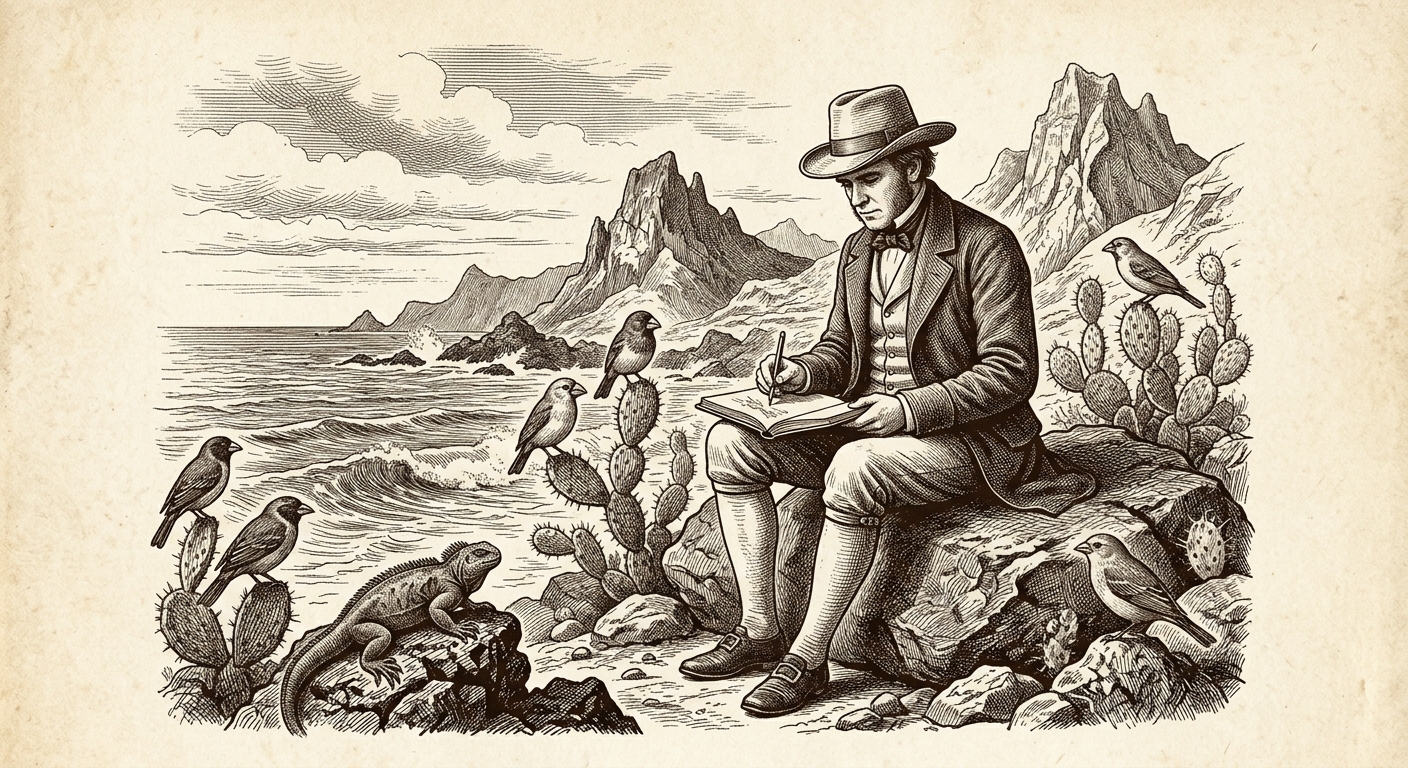
Evolution & Natural Selection Timeline
The theory of evolution by natural selection — developed by Charles Darwin in the 19th century and confirmed at the molecular level in the 20th — is the central organizing theory of all biology, explaining how all living things are related and how species change over time.
The idea that species change over time seems obvious now — fossils show creatures that no longer exist, and anyone who has bred dogs knows traits can be selected. But for most of human history, most people believed every species had been created exactly as it exists today and never changed. Charles Darwin changed all of that. After five years sailing around the world on HMS Beagle, observing finches in the Galápagos whose beaks varied island-to-island, Darwin returned home with a revolutionary idea: all living things are related, and species change over generations through natural selection — individuals better suited to their environment survive and reproduce more. His 1859 book On the Origin of Species convinced most scientists within a decade. Gregor Mendel's genetics explained the mechanism. The discovery of DNA's double helix showed it at the molecular level. By the time the Human Genome Project sequenced the human genome in 2003 — confirming that humans share 98-99% of their DNA with chimpanzees — evolution had become one of the most thoroughly confirmed theories in science.
- 1831–36
Darwin's Voyage on the Beagle
Charles Darwin, aged 22, joins the HMS Beagle as a naturalist on a five-year voyage around the world — collecting thousands of specimens and observing subtle variations in animals across different locations, including the famous finches of the Galápagos Islands.
Why it mattered: The Beagle voyage gave Darwin the raw evidence for evolution — diverse organisms on isolated islands, fossil mammals resembling living species, and small variations between populations across short distances — all pointing toward species changing over time in response to local conditions.
- 1844–58
Darwin Develops His Theory
Darwin writes out his theory of natural selection fully in 1844 but holds back from publishing for fifteen more years — aware of the controversy it will cause — while quietly gathering more evidence and corresponding with scientists around the world.
Why it mattered: Darwin's 15-year delay shows how carefully he built his case; it also led to one of science's great near-misses — when Alfred Russel Wallace independently arrived at the same theory in 1858 and wrote to Darwin, Darwin was finally pushed to publish.
- 1858
Wallace and Darwin Present Natural Selection
Alfred Russel Wallace, working in the Malay Archipelago, independently develops the same theory as Darwin; their ideas are jointly presented to the Linnean Society in London on July 1, 1858 — the formal birth of the theory of evolution by natural selection.
Why it mattered: The joint presentation is one of science's great moments of coincidence — two scientists on opposite sides of the world arriving at the same revolutionary idea independently — and ensured that both men received historical credit for the discovery.
- 1859
On the Origin of Species Published
Darwin publishes On the Origin of Species, laying out the evidence for evolution by natural selection in exhaustive detail — the first edition of 1,250 copies sells out on the day of publication, November 24, 1859.
Why it mattered: Origin of Species is one of the most important books ever written — within a decade, most scientists accepted the fact of evolution; it gave biology a single unifying principle that explains the diversity of all life on Earth and remains the foundation of modern biology.
- 1865–66
Mendel Discovers the Rules of Inheritance
Gregor Mendel, an Augustinian friar in what is now the Czech Republic, presents and publishes the results of his experiments breeding pea plants — discovering that traits are passed down in predictable ratios through discrete units (what we now call genes).
Why it mattered: Mendel discovered what Darwin lacked: a mechanism for inheritance. Darwin knew natural selection worked but couldn't explain exactly how traits were passed from parents to offspring; Mendel's genetics provided the missing answer — though his work went unnoticed for 35 years.
- 1900
Mendel's Work Rediscovered
Three European scientists independently rediscover Mendel's forgotten 1865 papers; his laws of genetics are quickly recognized as the explanation for how inherited variation — the raw material of natural selection — is transmitted between generations.
Why it mattered: The rediscovery of Mendel was the moment evolution and genetics merged — it launched the Modern Synthesis of the 20th century, which unified Darwin's natural selection with Mendelian genetics into the robust framework that underpins all modern biology.
- 1925
The Scopes Trial
Tennessee teacher John Scopes is tried for teaching evolution in violation of a state law banning it; the 'Scopes Monkey Trial' becomes a national sensation, pitting attorney Clarence Darrow against former presidential candidate William Jennings Bryan in a debate followed across the country.
Why it mattered: The Scopes Trial showed that evolution was not just a scientific question but a cultural flashpoint — it put the teaching of evolution at the center of the American debate about science, religion, and public education, a debate that continues in school boards and courts today.
- 1953
Watson, Crick, and Franklin Discover DNA's Structure
James Watson and Francis Crick, building critically on X-ray crystallography data produced by Rosalind Franklin, discover that DNA is a double helix — two strands wound around each other, explaining exactly how genetic information is stored and copied during cell division.
Why it mattered: The double helix explained evolution at the molecular level — the heritable information that Mendel studied as abstract units was now a physical molecule that could be read, copied, mutated, and compared across species; it launched molecular biology and the era of genetic medicine.
- 1972
Punctuated Equilibrium Proposed
Stephen Jay Gould and Niles Eldredge propose punctuated equilibrium — the idea that evolution happens in bursts of relatively rapid change separated by long periods of stability — based on patterns they observe in the fossil record.
Why it mattered: Punctuated equilibrium was a productive refinement of Darwin's original model, sparking debate about the pace of evolution and showing that the theory of evolution continues to grow and improve — scientists debate HOW evolution works even as the fact that it occurs is entirely settled.
- 2003
Human Genome Project Completed
The Human Genome Project completes the first full sequence of human DNA — three billion base pairs — providing the reference genome that allowed scientists to later confirm humans share roughly 98-99% of their DNA with chimpanzees, and revealing the molecular blueprint shared by all human beings.
Why it mattered: The Human Genome Project gave evolution its fullest molecular confirmation — the patterns of similarity and difference in DNA across species match exactly what evolution predicts, provided tools for personalized medicine and disease research, and connected every living human being through a shared genetic heritage.
Evolution & Natural Selection Quiz
Check what you learned — read on screen, or use the Printable quiz button above for a worksheet version with an answer key.
What did Darwin observe on the Galápagos Islands that helped inspire his theory?
- A) Dinosaur fossils that proved prehistoric creatures had once walked the islands
- B) Finches whose beak shapes varied between islands in ways that seemed matched to local food sources
- C) A species of giant tortoise that appeared to change its shell color based on the environment
- D) Coral reefs that showed how living organisms could build structures over millions of years
What is natural selection?
- A) The process by which scientists selectively breed animals to produce desirable traits
- B) The idea that all species were created separately and have never changed over time
- C) The process by which individuals better suited to their environment survive and reproduce more, gradually changing the character of a species over generations
- D) The discovery that DNA mutations always produce improvements in an organism's ability to survive
Why did Darwin wait 15 years to publish his theory after developing it?
- A) He needed to complete additional voyages to the Galápagos to gather more finch specimens
- B) He was carefully building more evidence and was aware of the controversy the theory would cause — he was finally pushed to publish when Wallace independently developed the same idea
- C) He was waiting for Gregor Mendel to publish his genetics research so he could include it in his book
- D) His publisher refused to print the book until Darwin could prove evolution had occurred in a laboratory
What did Gregor Mendel discover about inheritance?
- A) That traits are inherited randomly, with no predictable pattern between parents and offspring
- B) That only the father's traits are passed on to offspring, while the mother's traits disappear
- C) That traits are passed down in predictable ratios through discrete inherited units — what we now call genes
- D) That acquired traits — skills learned during a lifetime — are passed directly to offspring
What was the Scopes Trial?
- A) The trial of a scientist who claimed fossils proved the Earth was billions of years old
- B) The trial of a Tennessee teacher for teaching evolution, which became a national debate about science and education
- C) A court case that banned the teaching of genetics in American public schools
- D) A legal battle between Darwin's supporters and religious leaders over publication of On the Origin of Species
What did Watson and Crick discover in 1953?
- A) The first genetic mutation that causes cancer, leading to new cancer treatments
- B) That genes are made of proteins rather than DNA, overturning a previous mistaken theory
- C) The double helix structure of DNA — explaining how genetic information is stored and copied
- D) The process of natural selection at the molecular level, confirming Darwin's theory using chemistry
Why was Rosalind Franklin important to the discovery of DNA's structure?
- A) She independently discovered the double helix structure before Watson and Crick
- B) Her X-ray crystallography images of DNA were critical evidence that Watson and Crick used to work out the double helix structure
- C) She proved that DNA, not protein, is the molecule that carries genetic information
- D) She developed the mathematics that Watson and Crick used to model the double helix
What did sequencing the human genome help scientists confirm about evolution?
- A) That humans evolved independently of all other primates, with no common ancestor
- B) That DNA evidence does not support the theory of evolution by natural selection
- C) By providing a human reference genome, it allowed scientists to later confirm that humans share roughly 98-99% of their DNA with chimpanzees — exactly what evolution predicts about common ancestry
- D) That each human population evolved in complete isolation, developing entirely different genetic codes
Show answer key
1. B · 2. C · 3. B · 4. C · 5. B · 6. C · 7. B · 8. C
Related timelines
 Dinosaurs Timeline — Dinosaurs ruled the Earth for over 165 million years — rising after a mass extinction, dominating every ecosystem on every continent, and disappearing in a sudden catastrophe that gave rise to the mammals, and eventually, to us. Open →
 History of Astronomy Timeline — The history of astronomy is the story of how humans figured out what the universe actually is — from ancient Greeks who proposed the Earth moves around the Sun, to telescopes that see to the edge of time itself. Open →
How to print
Choose Download PDF for a ready-to-print timeline that fits US Letter paper (8.5 × 11"). The blank fill-in version keeps the dates and gives students empty lines to write each event — great for review and quizzes.
Frequently asked questions
What is the difference between evolution as a fact and natural selection as a theory?
In everyday speech, 'theory' often means a guess or hunch. In science, a theory is a well-tested explanation supported by extensive evidence. Evolution — the fact that species change over time and share common ancestors — is supported by evidence from the fossil record, genetics, comparative anatomy, and direct observation. Natural selection is the primary mechanism that explains HOW evolution happens: individuals with traits better suited to their environment survive and reproduce more, passing those traits to offspring. Natural selection is supported by overwhelming evidence, including direct observation in bacteria, insects, and other fast-reproducing organisms.
Does evolution apply to humans?
Yes. Humans are subject to the same evolutionary processes as all other living things. The fossil record documents the evolution of the human lineage over millions of years, from early primates through Australopithecus and Homo habilis to Homo sapiens. Genetic evidence shows that humans share common ancestry with all other primates — and, going further back, with all life on Earth. Modern medicine also relies on understanding human evolution: the study of how diseases have evolved alongside human immune systems is central to developing vaccines and fighting antibiotic resistance.
What paper size should I print this on?
The timeline is sized for standard US Letter paper (8.5 × 11 in.). The Download PDF button gives you a print-ready file that fits the page automatically.