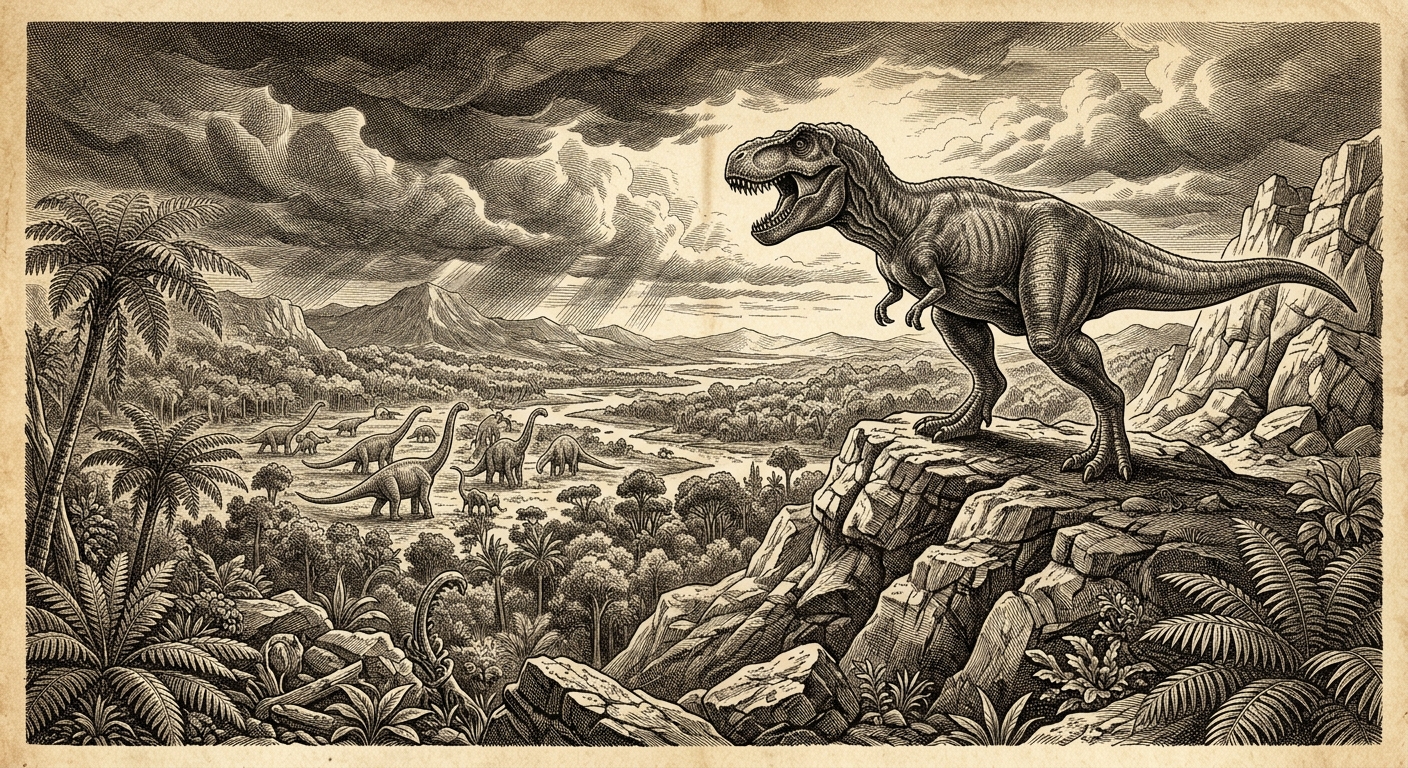
Dinosaurs & Prehistoric Life Timeline
Dinosaurs ruled the Earth for over 165 million years — rising after a mass extinction, dominating every ecosystem on every continent, and disappearing in a sudden catastrophe that gave rise to the mammals, and eventually, to us.
Dinosaurs didn't come first. Before them, the Earth was ruled by other reptiles — until a catastrophic mass extinction wiped out nearly all life on Earth about 252 million years ago. In the wreckage, a new group of animals appeared: the first dinosaurs. They were small, fast, and bipedal — nothing like the giants we imagine. But they had a key advantage: an upright stance that made them more efficient movers than their competitors. Over tens of millions of years, they diversified into every shape and size, from the plate-backed Stegosaurus to the long-necked Brachiosaurus to the fearsome Tyrannosaurus rex. They also gave rise to birds — which are, scientifically speaking, living dinosaurs. Then, 66 million years ago, an asteroid the size of a city struck the Yucatán Peninsula and ended the Age of Dinosaurs. The world that emerged from that catastrophe would eventually produce human beings — curious enough to dig up the bones and piece together the story.
- 252 million years ago
The Great Dying — Permian Mass Extinction
The largest mass extinction in Earth's history kills an estimated 90–96% of all species on Earth — most marine life, most plants, and most land animals — in what scientists call the Great Dying.
Why it mattered: The Permian extinction cleared the ecological slate — without it, the dominant reptiles of the Permian would likely have continued to rule and dinosaurs might never have evolved; mass extinction, as catastrophic as it is, is also one of evolution's great reshuffling forces.
- 245–230 million years ago
First Dinosaurs Appear
The first true dinosaurs appear in the Triassic period — small, upright-walking reptiles with a posture more like a bird or mammal than a sprawling lizard, giving them a significant advantage in speed and endurance.
Why it mattered: The upright stance of the earliest dinosaurs — combined with more efficient breathing — gave them an edge over the other reptiles they competed with; these advantages would eventually allow their descendants to grow into the largest land animals Earth has ever seen.
- 200 million years ago
End-Triassic Extinction Opens the Door
A mass extinction at the end of the Triassic period kills most large land reptiles and many marine animals — leaving dinosaurs as the dominant large land vertebrates on Earth.
Why it mattered: The End-Triassic extinction was the dinosaurs' great opportunity: most of their competitors were eliminated, leaving a world that dinosaurs would rule for the next 135 million years.
- 201–145 million years ago
Jurassic Period — Age of Giants
The Jurassic period produces the largest animals ever to walk the Earth — sauropods like Brachiosaurus and Diplodocus stretch over 80 feet and weigh more than 50 tons; Allosaurus is the dominant apex predator.
Why it mattered: Dense Jurassic forests provided enough vegetation to sustain enormous plant-eaters, which in turn supported massive predators; the Jurassic was the golden age of giant dinosaurs, when these animals reached sizes never seen before or since on land.
- c. 150 million years ago
First Birds Evolve
Archaeopteryx — a creature with both dinosaur features (teeth, clawed wings, long bony tail) and bird features (feathers, wishbone) — appears in the fossil record, marking the origin of birds from small feathered theropod dinosaurs.
Why it mattered: Archaeopteryx is one of the most important fossils ever found — it proved that birds are living dinosaurs, that feathers evolved before flight (likely for insulation or display), and that the line between 'dinosaur' and 'bird' is blurry by design.
- 68–66 million years ago
Cretaceous Peak — T. rex and Triceratops
The late Cretaceous produces the most famous dinosaurs — Tyrannosaurus rex (the most powerful land predator ever), Triceratops, Ankylosaurus, and the long-necked titanosaurs; flowering plants spread across the world alongside new species of insects and mammals.
Why it mattered: The late Cretaceous was dinosaurs at their most diverse and extreme — T. rex had the most powerful bite force of any land animal in history, and the variety of species (horned, armored, duck-billed, crested) was greater than at any earlier time.
- 66 million years ago
Chicxulub Asteroid Impact — Mass Extinction
An asteroid roughly 6 miles (10 km) wide strikes what is now the Yucatán Peninsula in Mexico at 40,000 mph, triggering planet-wide wildfires, a 'nuclear winter' that blocks the Sun for years, and the collapse of food chains — killing all non-avian dinosaurs and 75% of all species.
Why it mattered: The Chicxulub impact ended the Age of Dinosaurs in geological terms instantly — but it also cleared the way for mammals to diversify from small nocturnal creatures into the dominant large animals on Earth, eventually including primates, and human beings.
- 1842
Richard Owen Names the Dinosaurs
British scientist Richard Owen studies fossil bones and recognizes that some ancient reptiles were fundamentally different from anything alive today — he coins the term 'Dinosauria' (from the Greek for 'terrible lizard') to describe them.
Why it mattered: Owen's naming of the dinosaurs was the founding moment of vertebrate paleontology — it established that an entirely different world of giant reptiles had once existed and gave scientists a framework for identifying and classifying fossil finds.
- 1877–1892
The Bone Wars
American paleontologists Othniel Charles Marsh and Edward Drinker Cope wage a bitter rival fossil-hunting competition across the American West, discovering over 100 new dinosaur species between them — including Stegosaurus, Allosaurus, Diplodocus, and Triceratops.
Why it mattered: The Bone Wars were science through intense competition — the rivalry produced extraordinary discoveries but also sabotage, bribery, and the deliberate destruction of fossil sites; despite the chaos, Marsh and Cope assembled the foundation of what we know about North American dinosaurs.
- 1980–91
Asteroid Impact Theory Proposed and Confirmed
Luis and Walter Alvarez publish evidence that the non-avian dinosaur extinction was caused by an asteroid impact — identifying a worldwide layer of iridium (rare on Earth but common in asteroids) at the exact geological boundary where dinosaurs disappear from the fossil record.
Why it mattered: The Alvarez hypothesis transformed how we understand mass extinctions — before 1980 the dinosaur extinction seemed mysterious and gradual; after, we understood that a single catastrophic event could abruptly end the dominant life forms on Earth, with the Chicxulub crater confirmed in 1991.
Dinosaurs Quiz
Check what you learned — read on screen, or use the Printable quiz button above for a worksheet version with an answer key.
What event made it possible for dinosaurs to become the dominant land animals on Earth?
- A) A sudden warm climate change that killed off the mammals that competed with dinosaurs
- B) The Permian mass extinction, which wiped out most competing reptiles and cleared ecological niches for dinosaurs to fill
- C) The invention of warm-bloodedness, which gave dinosaurs an advantage over cold-blooded competitors
- D) A volcanic eruption that killed the giant insects that had ruled the Jurassic period
What physical advantage did the earliest dinosaurs have over other reptiles?
- A) They were larger and heavier than any other land animals of the time
- B) They could breathe underwater, allowing them to survive floods
- C) An upright stance that made them faster and more energy-efficient than sprawling competitors
- D) They were cold-blooded, requiring less food than the warm-blooded animals they competed with
How large did the biggest Jurassic sauropod dinosaurs grow?
- A) About the size of a modern elephant, roughly 15 feet long and 10 tons
- B) Up to about 80 feet long and over 50 tons — the largest land animals in Earth's history
- C) About 40 feet long, similar in size to a modern humpback whale
- D) Up to 200 feet long — so large they had to live partially in water to support their weight
What does Archaeopteryx prove about the relationship between birds and dinosaurs?
- A) That birds evolved from pterodactyls, the flying reptiles of the Jurassic period
- B) That birds and dinosaurs shared a common ancestor in fish but then evolved separately
- C) That birds are living dinosaurs, having evolved from small feathered theropod dinosaurs
- D) That all dinosaurs had feathers, including Tyrannosaurus rex and Triceratops
What caused the mass extinction 66 million years ago that killed the non-avian dinosaurs?
- A) A gradual ice age that slowly made the Earth too cold for large reptiles
- B) A series of volcanic eruptions over millions of years that changed the climate
- C) An asteroid roughly 6 miles wide struck the Yucatán Peninsula, triggering wildfires and blocking the Sun
- D) A worldwide pandemic disease that spread among dinosaur populations
Who coined the term 'Dinosauria' in 1842?
- A) Charles Darwin, while studying fossils during his voyage on the Beagle
- B) Othniel Charles Marsh, during the Bone Wars fossil competition in the American West
- C) British scientist Richard Owen, who recognized that certain fossils represented a distinct group of ancient reptiles
- D) Mary Anning, the fossil hunter who discovered the first complete dinosaur skeletons in England
What were the 'Bone Wars'?
- A) The name given to the mass extinction at the end of the Cretaceous period
- B) A bitter rival fossil-hunting competition between American paleontologists Marsh and Cope that discovered over 100 new dinosaur species
- C) The scientific debate in the 1980s over whether an asteroid or volcanic eruptions killed the dinosaurs
- D) The series of legal battles over who owned the fossil rights to public land in the American West
What evidence did the Alvarez team find in 1980 that proved an asteroid caused the dinosaur extinction?
- A) A worldwide layer of iridium — rare on Earth but common in asteroids — at the exact geological boundary where dinosaurs disappear from the fossil record
- B) The first complete Tyrannosaurus rex skeleton, buried under a layer of impact debris
- C) Microscopic burn marks on dinosaur bones proving that wildfires swept across the planet 66 million years ago
- D) Computer models showing that an asteroid of sufficient size could produce a nuclear winter lasting long enough to kill all large animals
Show answer key
1. B · 2. C · 3. B · 4. C · 5. C · 6. C · 7. B · 8. A
Related timelines
 History of Astronomy Timeline — The history of astronomy is the story of how humans figured out what the universe actually is — from ancient Greeks who proposed the Earth moves around the Sun, to telescopes that see to the edge of time itself. Open →
 Ancient Egypt Timeline — Ancient Egypt was one of the world's first great civilizations, ruled by pharaohs along the Nile River for more than 3,000 years. Open →
How to print
Choose Download PDF for a ready-to-print timeline that fits US Letter paper (8.5 × 11"). The blank fill-in version keeps the dates and gives students empty lines to write each event — great for review and quizzes.
Frequently asked questions
How long did dinosaurs exist?
Non-avian dinosaurs existed for about 165–170 million years, from roughly 230 million years ago (Late Triassic) until the mass extinction 66 million years ago. To put that in perspective, the time between the extinction of T. rex and today (66 million years) is less than half the time T. rex's early ancestors had already been around. If you include birds, which are avian dinosaurs, then dinosaurs have existed for about 230 million years and are still very much alive today — there are roughly 10,000 living bird species.
Were dinosaurs warm-blooded or cold-blooded?
This was debated for a long time, but the scientific consensus is now that most dinosaurs were warm-blooded (endothermic) — more like birds and mammals than like modern reptiles. Evidence includes fast growth rates seen in bone cross-sections, the presence of feathers (which insulate, suggesting the animal needed to retain heat), and the finding that birds (which are dinosaurs) are warm-blooded. Some very large sauropods may have used 'bulk homeothermy' — maintaining stable body temperature through sheer body size rather than metabolic heat — but the sharp distinction between 'warm-blooded dinosaurs' and 'cold-blooded reptiles' has largely collapsed.
What paper size should I print this on?
The timeline is sized for standard US Letter paper (8.5 × 11 in.). The Download PDF button gives you a print-ready file that fits the page automatically.