History of Electricity Timeline
The history of electricity is the story of how humans went from kite-flying in thunderstorms to lighting cities, building power grids, and inventing the transistor — the tiny device that makes every computer and smartphone possible.
For most of human history, electricity was a mystery — lightning from the sky, static shocks from a wool rug, the strange jolt from a torpedo fish. Then Benjamin Franklin flew a kite in a thunderstorm and changed everything. He showed that lightning was electricity, and that electricity was a natural force that could be studied and put to work. What followed was one of the most consequential chains of discovery in human history. Volta built the first battery. Faraday found that a moving magnet could generate electric current — the principle behind every generator ever built. Edison lit up New York City. Tesla and Westinghouse fought the famous War of Currents to determine whether AC or DC would power the world — and AC won, because it could travel hundreds of miles. By 1947, when Bell Labs invented the transistor, electricity had already transformed every aspect of human life. And the transistor was about to do it all over again.
- 1752
Franklin's Lightning Experiment
Benjamin Franklin flies a kite with a metal key attached during a thunderstorm, drawing an electric spark from the sky and proving that lightning is electricity — a natural phenomenon, not a supernatural one.
Why it mattered: Franklin's experiment demolished the idea that lightning was divine punishment and showed it was electricity — enabling the invention of the lightning rod and proving that electricity was a fundamental natural force that could be studied and harnessed.
- 1800
Volta Invents the Battery
Italian physicist Alessandro Volta invents the first battery — the 'voltaic pile,' a stack of zinc and copper discs separated by brine-soaked cloth — creating the first sustained, reliable source of electric current.
Why it mattered: Before Volta's battery, scientists could only study electricity in brief static sparks; the battery made continuous current possible for the first time, giving researchers a practical tool and enabling all the discoveries that followed.
- 1820
Electromagnetism Discovered
Danish physicist Hans Christian Ørsted notices that an electric current deflects a nearby compass needle — proving that electricity and magnetism are not separate phenomena but two faces of the same force.
Why it mattered: Ørsted's discovery launched the field of electromagnetism and directly inspired Faraday, Maxwell, and others; it eventually led to the understanding that light itself is an electromagnetic wave — unifying optics, electricity, and magnetism into a single framework.
- 1831
Faraday Invents the Electric Generator
Michael Faraday demonstrates electromagnetic induction — showing that a moving magnet generates an electric current in a nearby wire — and builds the world's first simple electric generator and motor.
Why it mattered: Faraday's discovery is arguably the most important in the history of electricity: the ability to generate current by moving a magnet (turning a turbine) is how almost all the world's electricity is produced today, from coal plants to hydroelectric dams to wind turbines.
- 1879
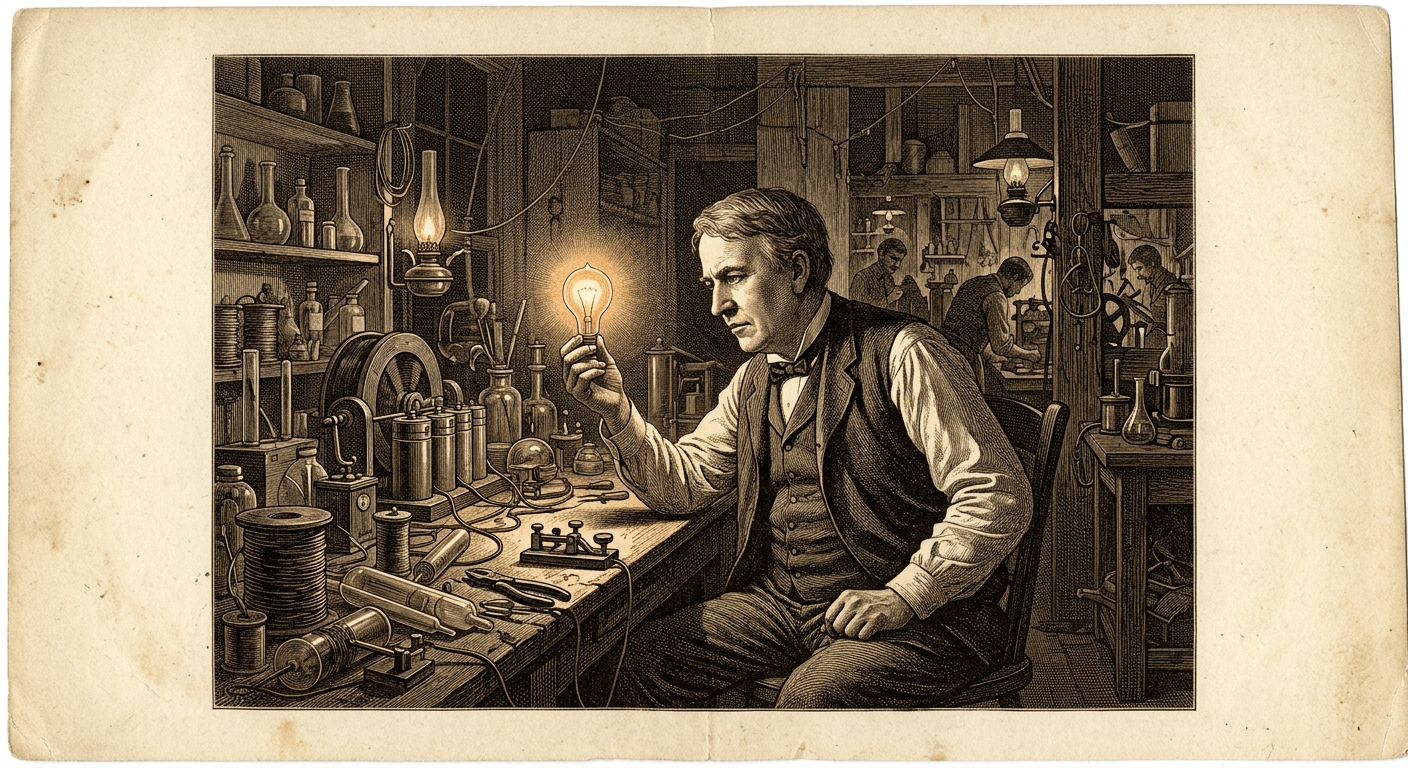
Edison's Practical Light Bulb
Thomas Edison, after testing thousands of materials, develops a practical incandescent light bulb using a carbonized cotton thread that burns for about 40 hours — demonstrating it publicly on New Year's Eve 1879; he later improved it with a bamboo filament lasting over 1,200 hours.
Why it mattered: Edison's light bulb transformed human life by extending the productive day beyond sunset — but its deeper significance was that it created massive demand for a reliable electrical supply, which Edison then set out to build.
- 1882
First Commercial Power Grid
Edison opens the Pearl Street Station in New York City — the world's first commercial electrical power station — supplying electricity to 85 customers and 400 lamps in a square-mile area of lower Manhattan.
Why it mattered: Pearl Street proved that electricity could be generated centrally and distributed to homes and businesses at scale — the model that powers every city in the world today; within two years Edison's system served over 500 customers.
- 1888–95
The War of Currents: AC Defeats DC
Nikola Tesla develops practical alternating current (AC) motors and generators; George Westinghouse champions AC against Thomas Edison's direct current (DC) in a fierce public battle; AC wins decisively when the Niagara Falls power plant opens in 1895.
Why it mattered: AC won because it could be transmitted hundreds of miles at high voltage and stepped down cheaply with transformers — DC could only travel about a mile from a generator; the AC victory set the design of the entire world's electrical infrastructure.
- 1897
Discovery of the Electron
British physicist J.J. Thomson discovers the electron — the first subatomic particle ever identified — proving that atoms have internal structure and that electricity is a flow of these tiny charged particles.
Why it mattered: The electron explained what electricity actually IS — a flow of electrons through a conductor — and opened the door to electronics, vacuum tubes, radio, and eventually the transistors and computer chips that define the modern world.
- 1947
Transistor Invented
Bell Labs scientists John Bardeen, Walter Brattain, and William Shockley invent the transistor — a tiny solid-state switch that amplifies or controls electric current without the heat, bulk, and fragility of vacuum tubes.
Why it mattered: The transistor is arguably the most consequential invention of the 20th century: replacing vacuum tubes with something tiny, cool, and reliable made possible the integrated circuit, the microprocessor, and every computer, smartphone, and electronic device — each containing billions of transistors.
History of Electricity Quiz
Check what you learned — read on screen, or use the Printable quiz button above for a worksheet version with an answer key.
What did Franklin's kite experiment prove?
- A) That lightning rods were ineffective at protecting buildings from electrical storms
- B) That electricity could only be produced by batteries and generators, not found in nature
- C) That lightning is electricity — a natural force that could be studied and controlled
- D) That static electricity and lightning were completely different phenomena
Why was Volta's battery such an important invention?
- A) It was the first device that could generate electricity from sunlight
- B) It created the first sustained, reliable source of electric current — replacing the brief sparks of static electricity with continuous current that could be studied and used
- C) It proved that electricity and magnetism were the same force
- D) It made it possible to store electricity generated by generators for use later
What did Ørsted discover in 1820?
- A) That an electric current deflects a compass needle — proving electricity and magnetism are connected
- B) That a moving magnet generates electric current in a wire — the principle behind all generators
- C) That lightning rods could safely redirect electrical strikes to the ground
- D) That copper and zinc, when placed in acid, produce a steady electric current
What is the principle behind all electrical generators, discovered by Faraday?
- A) A chemical reaction between two different metals in an acid solution generates a current
- B) A moving magnet near a wire generates an electric current — called electromagnetic induction
- C) An electrical current, when passed through a wire, creates heat that can do work
- D) Two electrical currents flowing in opposite directions create a magnetic field between them
Why was Edison's Pearl Street Station historically important?
- A) It was the first place where a practical light bulb was successfully demonstrated
- B) It was the first power station to use alternating current to serve customers
- C) It was the world's first commercial power station, proving electricity could be generated and distributed to homes at scale
- D) It was where Edison and Tesla worked together to develop the modern electrical grid
What was the War of Currents, and why did AC electricity win?
- A) A debate between scientists about whether electricity was a fluid or a flow of particles — resolved when Thomson discovered the electron
- B) A competition between Edison (DC) and Tesla/Westinghouse (AC) — AC won because it could travel hundreds of miles at high voltage, while DC could only go about a mile
- C) A political battle over who would control the patents for the light bulb — resolved when Edison and Tesla merged their companies
- D) A series of experiments to determine whether electricity or steam would power 20th-century industry — electricity won decisively
What did J.J. Thomson's discovery of the electron explain?
- A) Why alternating current could travel farther than direct current
- B) How Faraday's generator converted mechanical motion into electrical energy
- C) What electricity actually is — a flow of electrons — and opened the door to electronics and modern technology
- D) Why copper and other metals conduct electricity while rubber and glass do not
Why is the transistor considered one of the most important inventions of the 20th century?
- A) It made long-distance radio transmission possible for the first time
- B) It replaced unreliable vacuum tubes with a tiny, reliable switch — making possible the integrated circuit, microprocessor, and every modern electronic device
- C) It proved that electricity could be converted into light efficiently, enabling LED lighting
- D) It allowed AC and DC electricity to be freely converted between each other without energy loss
Show answer key
1. C · 2. B · 3. A · 4. B · 5. C · 6. B · 7. C · 8. B
Related timelines
 Industrial Revolution Timeline — The Industrial Revolution transformed the world from a farming society to a factory society, beginning in Britain and spreading across Europe and America. Open →
 History of Astronomy Timeline — The history of astronomy is the story of how humans figured out what the universe actually is — from ancient Greeks who proposed the Earth moves around the Sun, to telescopes that see to the edge of time itself. Open →
How to print
Choose Download PDF for a ready-to-print timeline that fits US Letter paper (8.5 × 11"). The blank fill-in version keeps the dates and gives students empty lines to write each event — great for review and quizzes.
Frequently asked questions
What is the difference between AC and DC electricity?
Direct current (DC) flows in one direction — like the current from a battery. Alternating current (AC) reverses direction many times per second (60 times per second in the US). Edison championed DC for his early power grid; Tesla and Westinghouse championed AC. AC won the War of Currents in the 1890s because it can be transmitted at very high voltage over long distances and then stepped down to safe household voltage using transformers — DC cannot do this economically. Today, the power in your home's outlets is AC, but most electronics (phones, computers, LED lights) convert it to DC internally.
How does a generator produce electricity?
A generator works by electromagnetic induction — the principle Faraday discovered in 1831. When a coil of wire is rotated inside a magnetic field (or a magnet is rotated inside a coil of wire), the changing magnetic field induces an electric current in the wire. Almost every power plant in the world — whether burning coal, natural gas, or nuclear fuel, or using falling water or wind — uses this same basic principle. The fuel or natural force turns a turbine, which spins a coil of wire in a magnetic field, generating electricity. Solar panels are the main exception: they convert light directly into electricity using the photovoltaic effect.
What paper size should I print this on?
The timeline is sized for standard US Letter paper (8.5 × 11 in.). The Download PDF button gives you a print-ready file that fits the page automatically.