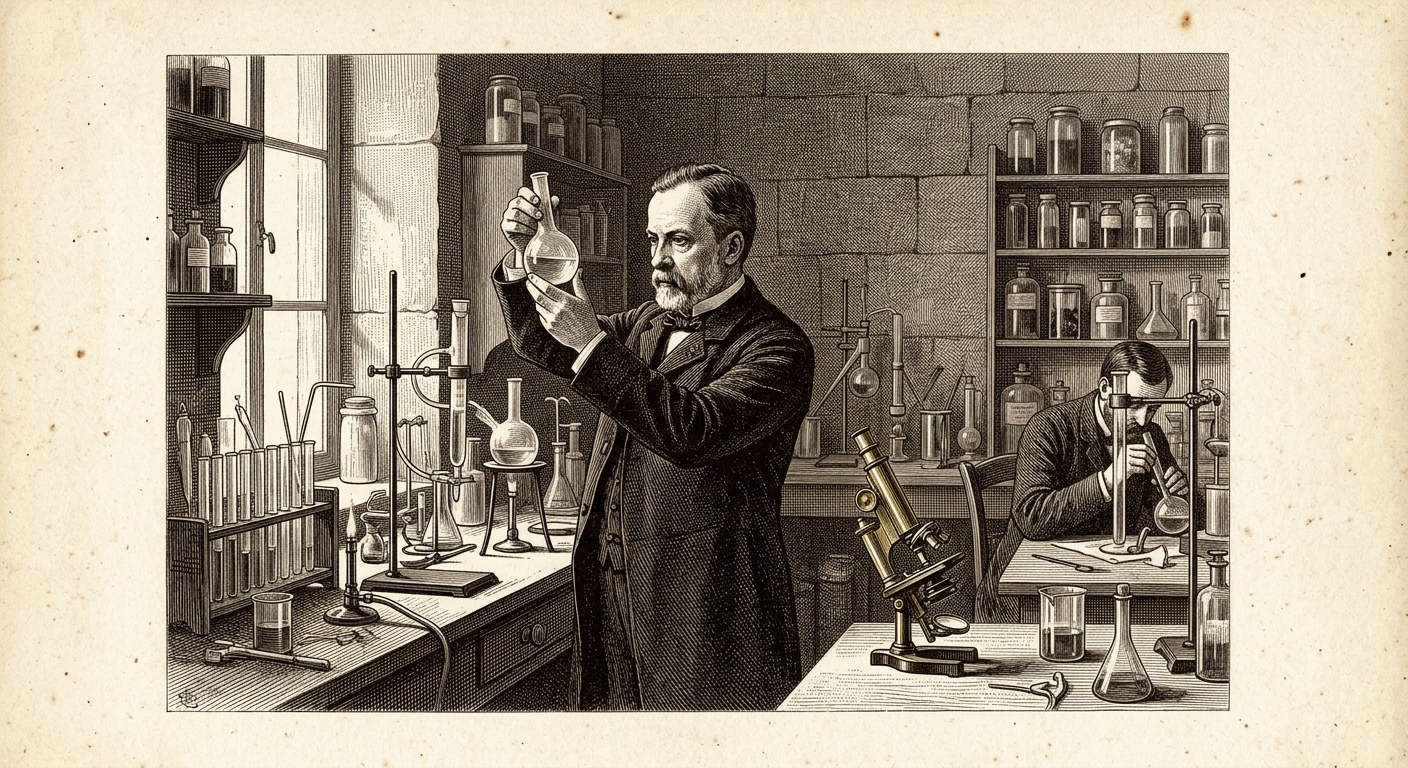
Germ Theory & Vaccines Timeline
Germ theory — the discovery that invisible microorganisms cause infectious disease — is one of medicine's most life-saving ideas, transforming surgery, public health, and disease prevention in less than a century.
Before germ theory, doctors had no idea why people got sick. The leading explanation was 'miasma' — bad air from rotting matter. Surgeons operated in street clothes without washing their hands, killing as many patients with infection as they saved with the knife. Cholera outbreaks swept through cities and no one knew why — or how to stop them. Then, in the 19th century, a series of brilliant and stubborn scientists changed everything. Edward Jenner noticed that milkmaids who caught cowpox seemed immune to smallpox — and figured out how to protect people before they ever got sick. John Snow traced a cholera epidemic to a single contaminated water pump. Louis Pasteur proved that invisible microorganisms cause disease. Joseph Lister used that knowledge to transform surgery. Robert Koch showed that specific bacteria cause specific diseases. Alexander Fleming stumbled upon a mold that killed bacteria — penicillin. And Jonas Salk produced a vaccine that ended the terror of polio. Each discovery built on the last, turning medicine from guesswork into science.
- 1796
Jenner Invents Vaccination
English physician Edward Jenner discovers that people inoculated with cowpox — a mild cattle disease — become immune to smallpox, one of history's most lethal killers; he calls the procedure vaccination (from vacca, Latin for cow).
Why it mattered: Jenner's vaccine was the first proof that a disease could be prevented before it struck — the founding concept of immunology; smallpox vaccination eventually eradicated the disease entirely in 1980, making it one of the greatest medical achievements in history.
- 1847
Semmelweis and Hand-Washing
Hungarian doctor Ignaz Semmelweis discovers that doctors who wash their hands with a chlorinated solution before delivering babies cut maternal death rates from childbed fever by more than 90% — but is ridiculed and ignored by the medical establishment.
Why it mattered: Semmelweis's discovery was tragically ahead of its time — without germ theory to explain WHY hand-washing worked, most doctors refused to believe invisible particles on their hands could kill patients; he died in an asylum before his ideas were vindicated by Pasteur and Lister.
- 1854
Snow Maps the Cholera Outbreak
London physician John Snow traces a cholera epidemic in Soho to a single contaminated water pump on Broad Street — by mapping where victims lived, he proves cholera spreads through contaminated water, not bad air, and convinces authorities to disable the pump.
Why it mattered: Snow's cholera map is the founding document of epidemiology — the science of tracking and controlling disease outbreaks; his method of tracing disease to its source is still how public health officials investigate outbreaks today.
- 1859–61
Pasteur Proves Germ Theory
French chemist Louis Pasteur publishes a series of experiments proving that microorganisms — not spontaneous generation or bad air — cause fermentation and disease; his 'swan-neck flask' experiment demonstrates that sterilized broth stays sterile unless exposed to airborne microbes.
Why it mattered: Germ theory was the single most important idea in the history of medicine — once doctors understood that invisible living organisms caused disease, every aspect of medicine could be rebuilt on that foundation: surgery, food safety, water treatment, and vaccine development.
- 1867
Lister Introduces Antiseptic Surgery
Scottish surgeon Joseph Lister, inspired by Pasteur's germ theory, begins using carbolic acid to sterilize surgical instruments, clean wounds, and spray the operating room — cutting post-surgical infection deaths from roughly 50% to under 15%.
Why it mattered: Lister's antiseptic surgery transformed an operation from a likely death sentence into a survivable procedure — before Lister, most patients who survived the knife died of infection afterward; his methods (later refined into sterile technique) are used in every operating room today.
- 1876–84
Koch Identifies Disease-Causing Bacteria
German physician Robert Koch proves that a specific bacterium (Bacillus anthracis) causes anthrax (1876); he later identifies the bacteria causing tuberculosis (1882) and cholera (1883), establishing 'Koch's postulates' — the rules for proving a microbe causes a disease.
Why it mattered: Koch's work transformed medicine from theory to precision — by proving that each infectious disease has a specific microbial cause, he made it possible to develop targeted treatments and vaccines; his postulates are still the standard framework for proving what causes an infectious disease.
- 1892–98
Discovery of Viruses
Russian biologist Dmitri Ivanovsky (1892) and Dutch scientist Martinus Beijerinck (1898) discover that tobacco mosaic disease is caused by something smaller than any known bacterium — too small to be filtered out — establishing the existence of a new category of infectious agent: viruses.
Why it mattered: The discovery of viruses explained diseases — including smallpox, influenza, and polio — that no known bacterium could account for; it opened a new branch of medicine and, eventually, led to antiviral drugs and vaccines against diseases previously beyond medicine's reach.
- 1928
Fleming Discovers Penicillin
Scottish bacteriologist Alexander Fleming notices that a mold (Penicillium notatum) contaminating a petri dish has killed the surrounding bacteria; he identifies the mold's antibacterial substance as penicillin — though it takes over a decade for others to turn it into a usable drug.
Why it mattered: Penicillin was the first antibiotic — a drug that kills bacteria inside the body — and it transformed medicine overnight; diseases that had killed millions (pneumonia, sepsis, syphilis, wound infections) became treatable; penicillin saved an estimated 200 million lives in the 20th century.
- 1955
Salk Polio Vaccine
American physician Jonas Salk announces a successful vaccine against polio — a disease that paralyzed tens of thousands of children every year, including Franklin D. Roosevelt; mass vaccination campaigns eliminate polio from the United States within a decade.
Why it mattered: The Salk vaccine ended one of the 20th century's most feared diseases — parents had kept children home from swimming pools and movie theaters every summer in terror of polio; within years of the vaccine's introduction, polio was gone from the developed world, a direct vindication of Jenner's original insight 160 years earlier.
Germ Theory & Vaccines Quiz
Check what you learned — read on screen, or use the Printable quiz button above for a worksheet version with an answer key.
What did Edward Jenner discover in 1796?
- A) That cholera was spread by contaminated water rather than bad air
- B) That inoculating people with cowpox protected them from smallpox — the first vaccine
- C) That microorganisms, not spontaneous generation, cause disease and infection
- D) That washing hands before surgery dramatically reduced patient deaths from infection
Why was Ignaz Semmelweis's hand-washing discovery ignored by most doctors in 1847?
- A) Doctors already washed their hands and disagreed with Semmelweis's statistics
- B) Hand-washing was too expensive and time-consuming to adopt in hospital settings
- C) Without germ theory to explain why it worked, doctors couldn't believe that invisible particles on their hands were killing patients
- D) Semmelweis published his findings in Hungarian and most European doctors never read them
What did John Snow's cholera map prove in 1854?
- A) That cholera was caused by a specific bacterium identified for the first time during the Soho outbreak
- B) That cholera spread through contaminated water rather than bad air — by tracing victims' locations to a single pump on Broad Street
- C) That cholera could be treated by boiling water and isolating infected patients for 14 days
- D) That cholera spread through person-to-person contact rather than through the environment
Why is Louis Pasteur's germ theory considered the most important idea in the history of medicine?
- A) It proved that diseases were caused by chemical imbalances that could be corrected with medication
- B) It explained why surgery was dangerous and led directly to Lister's antiseptic techniques
- C) It showed that invisible microorganisms cause disease — a foundation that transformed surgery, public health, food safety, and vaccine development
- D) It identified the specific bacteria responsible for tuberculosis, cholera, and anthrax for the first time
What did Robert Koch's work establish beyond identifying specific bacteria?
- A) Koch's postulates — the rules for proving that a specific microbe causes a specific disease, still used in medicine today
- B) The first effective antibiotic treatment, derived from a mold found growing on one of his laboratory cultures
- C) The germ theory of disease, overturning the previous belief that illness was caused by bad air or miasma
- D) The discovery of viruses as a category of infectious agent smaller and different from bacteria
What is penicillin, and how was it discovered?
- A) A chemical vaccine against bacterial infections, developed intentionally by Pasteur after his germ theory work
- B) The first antiviral drug, discovered when Fleming noticed a mold killing viruses in a petri dish
- C) The first antibiotic — discovered accidentally when Fleming noticed a mold had killed bacteria in a contaminated petri dish
- D) A sterilizing agent derived from carbolic acid, developed by Lister to prevent post-surgical infections
What disease did the Salk vaccine target, and why was it so feared?
- A) Tuberculosis, which infected millions of people in crowded urban environments every decade
- B) Smallpox, which had killed hundreds of millions of people over thousands of years of human history
- C) Polio, which paralyzed tens of thousands of children every year and had no treatment before the vaccine
- D) Cholera, which caused massive urban outbreaks that could kill a city's population within weeks
What is the connection between Jenner's 1796 vaccine and the Salk polio vaccine of 1955?
- A) Both vaccines used the same cowpox virus to stimulate immunity against a different, more dangerous disease
- B) Both vaccines were discovered accidentally — Jenner noticed immune milkmaids; Salk noticed a mold killing bacteria
- C) Both vaccines work on the same principle Jenner discovered: expose the immune system to a harmless form of a pathogen to build protection before the real disease strikes
- D) Both vaccines were initially rejected by the medical establishment before being proven effective in large clinical trials
Show answer key
1. B · 2. C · 3. B · 4. C · 5. A · 6. C · 7. C · 8. C
Related timelines
 Evolution & Natural Selection Timeline — The theory of evolution by natural selection — developed by Charles Darwin in the 19th century and confirmed at the molecular level in the 20th — is the central organizing theory of all biology, explaining how all living things are related and how species change over time. Open →
 History of Electricity Timeline — The history of electricity is the story of how humans went from kite-flying in thunderstorms to lighting cities, building power grids, and inventing the transistor — the tiny device that makes every computer and smartphone possible. Open →
How to print
Choose Download PDF for a ready-to-print timeline that fits US Letter paper (8.5 × 11"). The blank fill-in version keeps the dates and gives students empty lines to write each event — great for review and quizzes.
Frequently asked questions
What is the difference between a vaccine and an antibiotic?
A vaccine prevents infection by training your immune system to recognize and fight a specific pathogen before you encounter it. It works by exposing your immune system to a harmless version of the pathogen (weakened, killed, or just a piece of it) so your body builds defenses in advance. An antibiotic, by contrast, kills bacteria that have already infected your body. Antibiotics (like penicillin) only work against bacteria — not viruses. Vaccines exist for both bacterial and viral diseases, but antibiotics are useless against viruses. This is why there are no antibiotics for colds or flu (viral), but vaccines for both measles (viral) and tetanus (bacterial).
What happened to the diseases discussed in this timeline?
The results are extraordinary. Smallpox — the disease Jenner targeted — was completely eradicated in 1980, the only human infectious disease ever wiped out entirely. Polio has been eliminated from most of the world and may soon follow. Tuberculosis, cholera, and anthrax are still present but controllable with antibiotics and vaccines. Penicillin and subsequent antibiotics transformed formerly deadly infections (pneumonia, wound infections, syphilis) into treatable conditions. The life expectancy in wealthy countries roughly doubled between 1900 and 2000, and vaccines and antibiotics are among the main reasons why.
What paper size should I print this on?
The timeline is sized for standard US Letter paper (8.5 × 11 in.). The Download PDF button gives you a print-ready file that fits the page automatically.