 Printable Scholar
Layers of the Skin
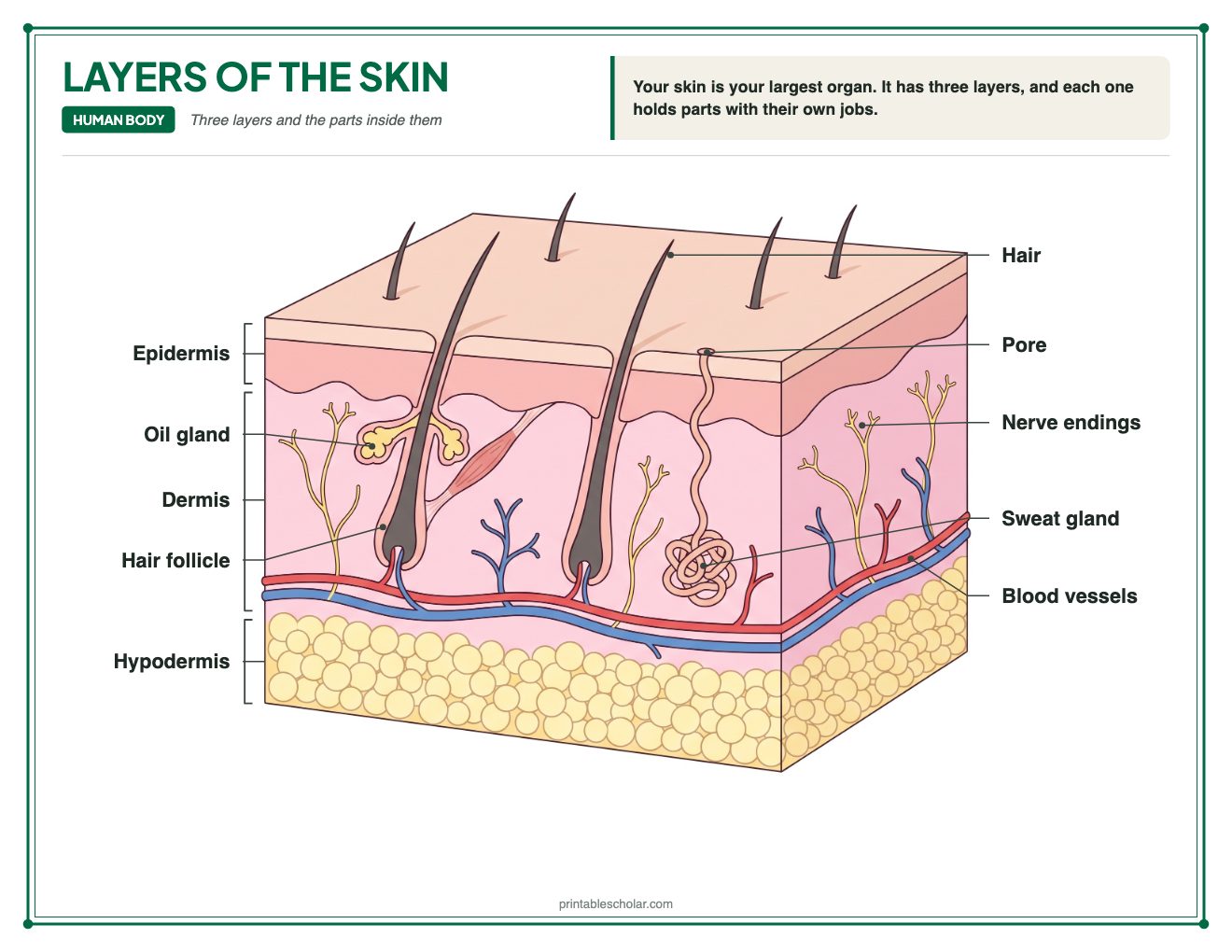
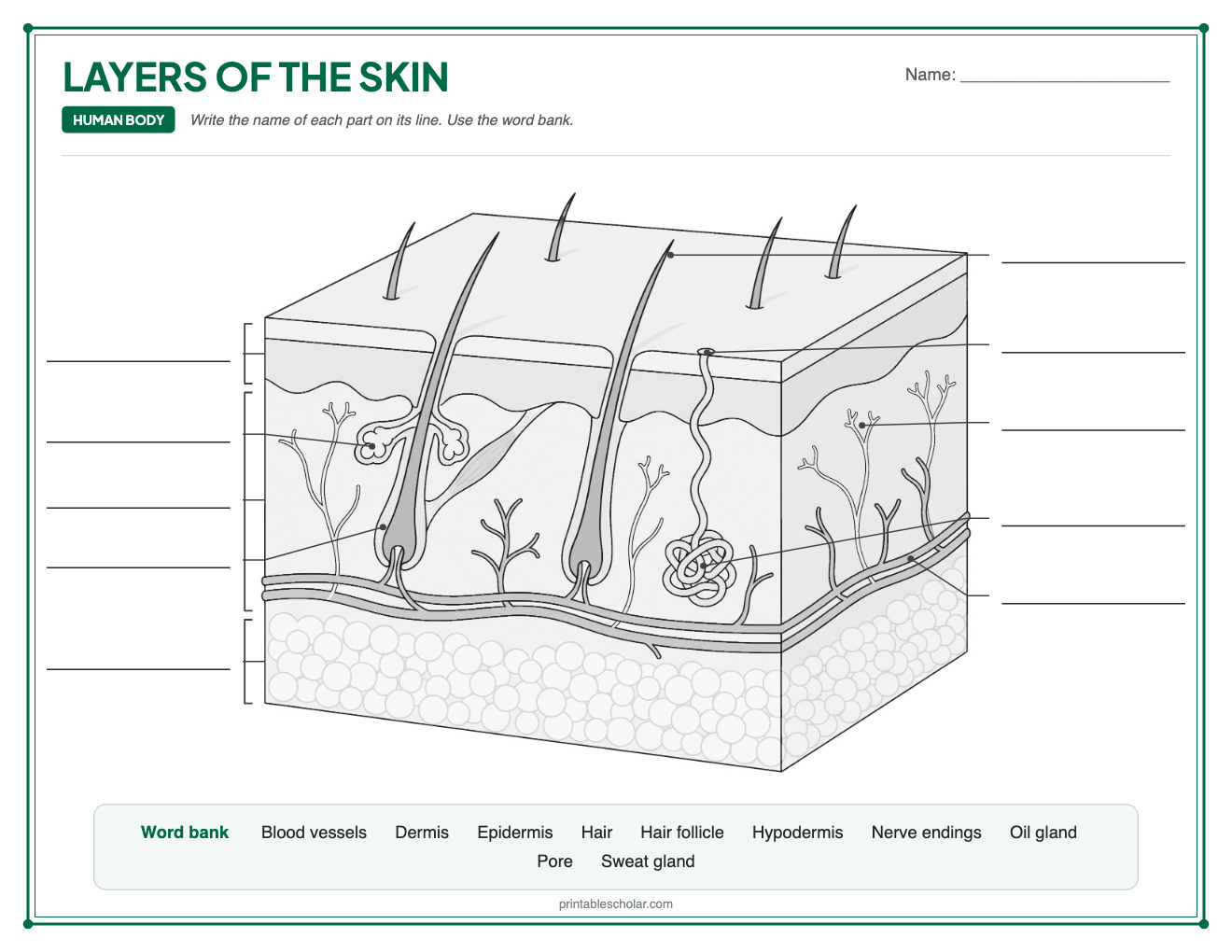
Free printable skin diagram: the three layers of the skin (epidermis, dermis and hypodermis) and the parts inside them, labeled, plus a blank diagram to label. Download a high-resolution PDF or PNG for Letter paper.
Part of the Layers of the Skin teaching pack for grades 6 to 8 (introductory level): 22 lesson slides and 8 printables with answer keys. The diagram and the blank one to label are free.
Blank diagram to label
Download blank version + answer key 10 blanks, a word bank, and the answer key on page 2Teaching ideas for Layers of the Skin
Pick the ideas that suit your class, then follow the plan or use the sheets in any order.
- Look closer. Students look at the back of their own hand with a hand lens. They find the tiny hairs and the fine lines in the skin, then point to the hair on the diagram.
- Fingerprints. Students rub a pencil on paper, press a fingertip on the dark patch, then onto clear tape. They stick the print on a card and compare patterns with a hand lens.
- Touch test. With eyes closed, a student is touched by a partner on the back of the hand, then on a fingertip, with one pencil eraser or two held side by side. Which spot can tell two from one?
- Cool down. Students wipe a damp cloth over one forearm and leave the other dry, then wave both arms gently. The damp arm feels cooler as it dries, just as sweat cools skin.
A plan for the week
| Day 1 | Open with one of the ideas above. Teach the lesson with the slides while students fill in the guided notes. Then students label the blank diagram. | Lesson slides (PowerPoint) (in the pack) Layers of the Skin Guided Notes (in the pack) Layers of the Skin Diagram Blank Layers of the Skin |
| Day 2 | Students match each part to its job on “Skin Parts and Their Jobs” and answer the questions. | Skin Parts and Their Jobs (in the pack) |
| Day 3 | Read “Your Skin at Work” and answer the questions. | Your Skin at Work (in the pack) |
| Day 4 | Put the steps of “How Sweat Cools You” in order and answer the questions. | How Sweat Cools You (in the pack) |
| Day 5 | Review with the crossword, then give the quiz. | Layers of the Skin Crossword (in the pack) Layers of the Skin Quiz (in the pack) |
The sheets marked “in the pack” are in the Layers of the Skin teaching pack below.
NGSS standards
- Supports MS-LS1-3: Use argument supported by evidence for how the body is a system of interacting subsystems composed of groups of cells.
- Supports MS-LS1-8: Gather and synthesize information that sensory receptors respond to stimuli by sending messages to the brain for immediate behavior or storage as memories.
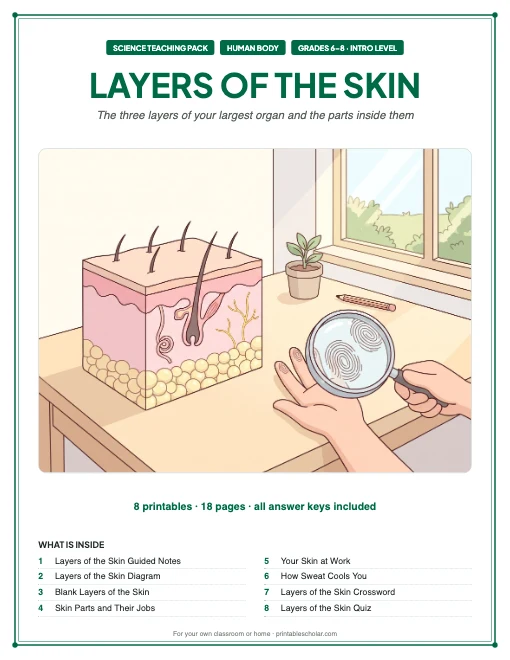
Layers of the Skin teaching pack
Teaching the layers of the skin? This pack has ready-made lesson slides and 8 printables that cover the three layers and the parts inside them, in teaching order, with every answer key.
Free on this page: 2 of the 9 printables, marked Download below. The whole pack is $7: 18 pages in one print-ready file, the 22 lesson slides, the practice sheets, the crossword, the quiz and every answer key.
One-time purchase. Instant download. Secure checkout by Stripe. Want to see a whole pack first? The Cells pack is free.See all 13 packs in the bundle
Teach Layers of the Skin with 22 ready-made slides
Open the PowerPoint and teach: an opening question, the parts one at a time on the diagram, quick checks and an exit question. Your notes for each slide are in the speaker notes. Students fill in the guided notes sheet as you go.
The slides (PowerPoint and a PDF copy) and the guided notes sheet come with the pack.What is in the pack, in teaching order
In the pack
1. TeachLesson Slides22 slides to present, with your notes for each one.In the $7 pack
 In the pack
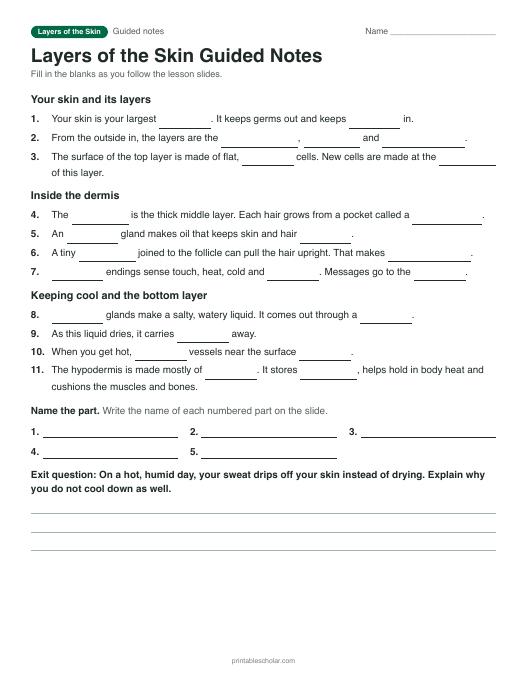
1. TeachLayers of the Skin Guided NotesStudents fill in the blanks as you present. With answer key.In the $7 pack
Free
2. LabelBlank Layers of the SkinStudents label 3 layers and 7 parts from a word bank.Download free PDF
 In the pack
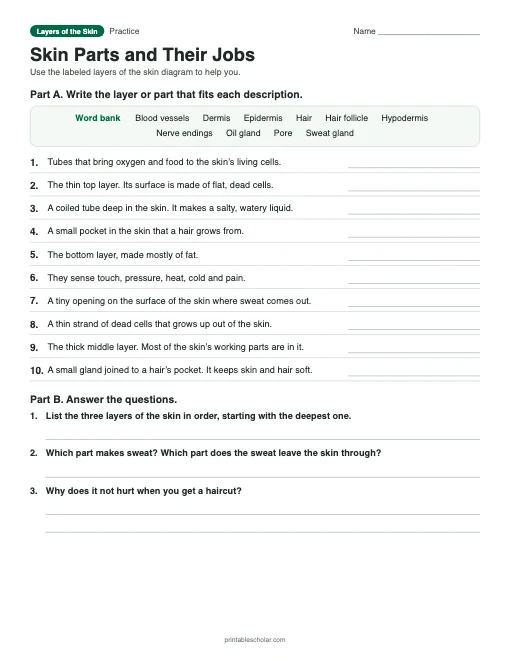
3. MatchSkin Parts and Their JobsMatch the 3 layers and 7 parts of the skin to their jobs, then answer three questions.In the $7 pack
 In the pack
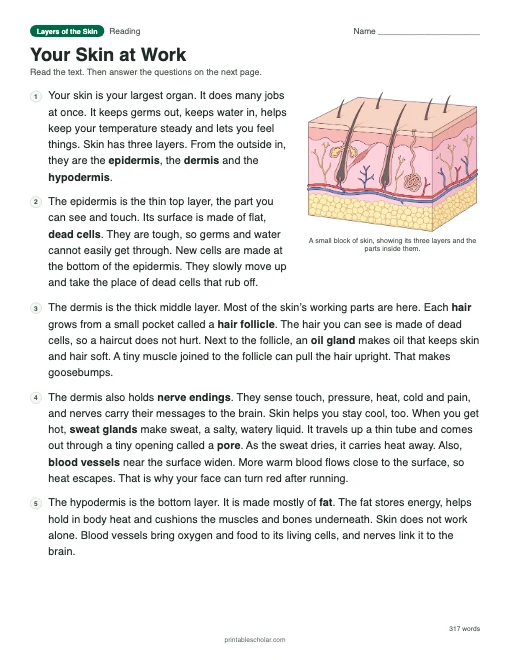
4. ReadYour Skin at WorkA one-page text on the three layers of the skin and how they protect, cool and sense, with eight questions.In the $7 pack
 In the pack
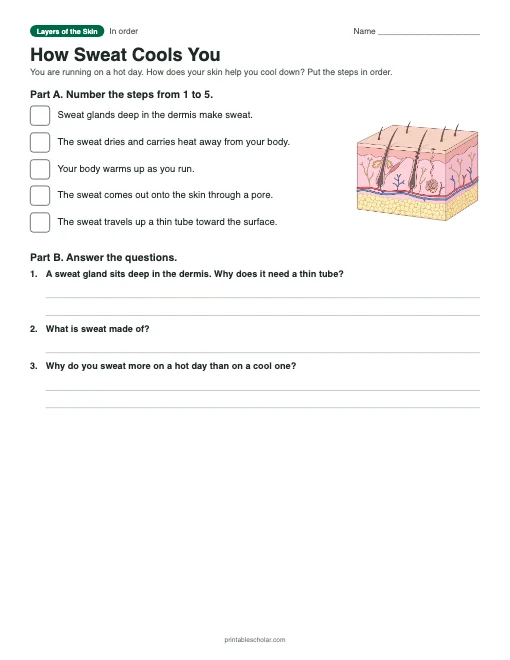
5. OrderHow Sweat Cools YouPut five steps in order to show how sweat cools the body, then answer three questions.In the $7 pack
 In the pack
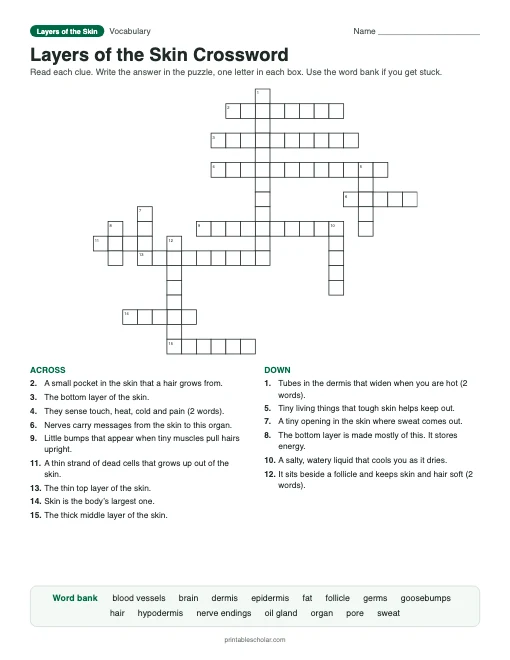
6. ReviewLayers of the Skin CrosswordFifteen skin words with clues and a word bank.In the $7 pack
 In the pack
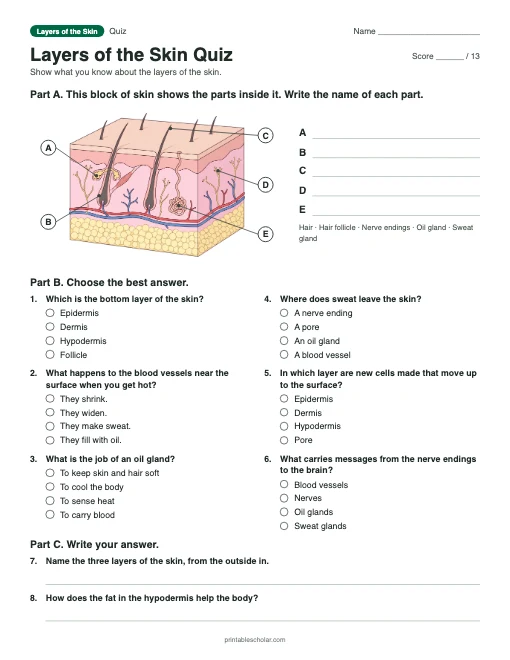
7. CheckLayers of the Skin QuizLabel five parts, six multiple choice and two written answers. Scored out of 13.In the $7 pack
Layers of the Skin worksheets, crossword and quiz
The Layers of the Skin teaching pack is 22 lesson slides (PowerPoint and PDF) and 8 printables with answer keys for grades 6 to 8 (introductory level), in the order you would teach them: the guided notes for the lesson slides, the labeled diagram and the blank one to label, then “Skin Parts and Their Jobs” (a worksheet), “Your Skin at Work” (a reading passage), “How Sweat Cools You” (an ordering worksheet), a vocabulary crossword and a quiz.
The sheets are in a suggested teaching order: teach the lesson, have students label the blank diagram, then work through the practice sheets and finish with the quiz. Use them all over a week or pick the ones you need. The answer keys are together at the back.
The diagram and the blank one to label are free to download on this page. The other sheets come with the pack ($7), which is also in the Middle School Science bundle (grades 5 to 8).
Skin covers your whole body. It keeps germs out, keeps your body from drying out, helps keep your temperature steady, and lets you feel touch, heat, cold and pain. The top layer, the epidermis, is a tough outer covering that is always replacing itself. Under it, the thicker dermis holds most of the working parts: hair follicles, oil and sweat glands, blood vessels and nerve endings. The bottom layer, the hypodermis, is mostly fat, which stores energy, keeps you warm and cushions your body. An adult has about 20 square feet (about 2 square meters) of skin.
The layers and parts of the skin
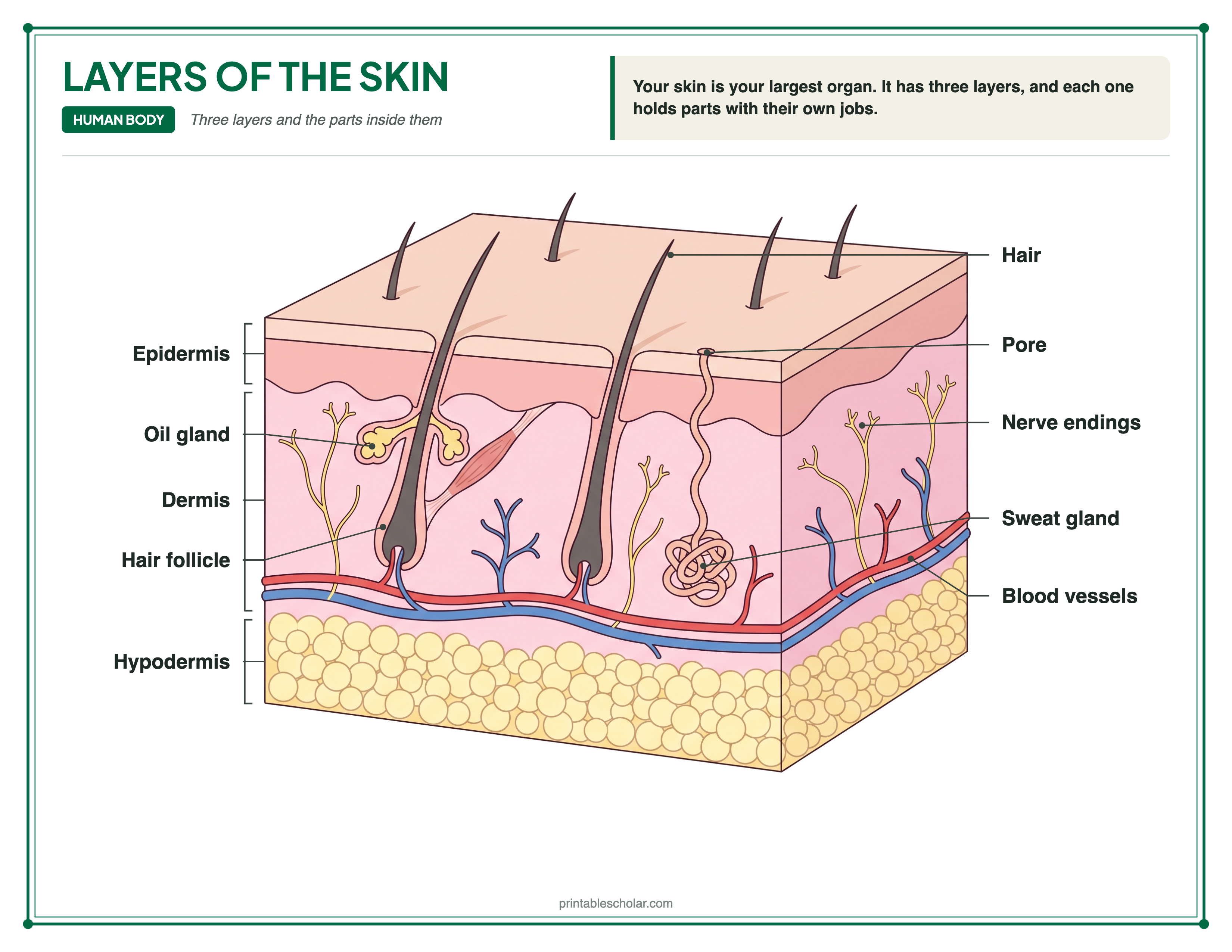
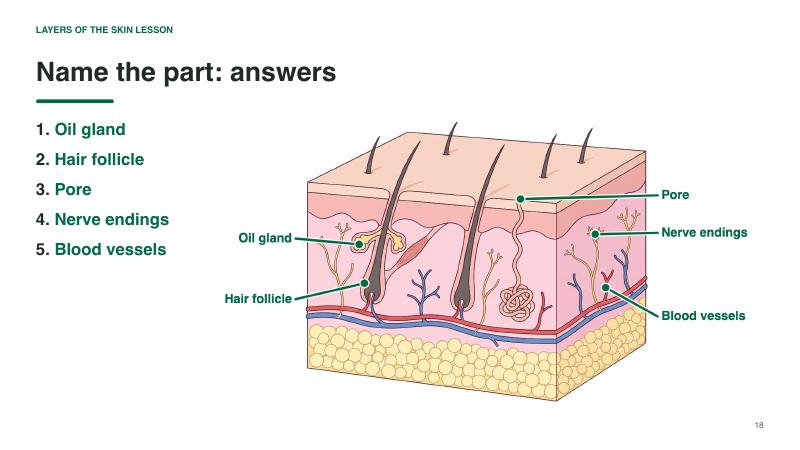
Your skin is your largest organ. It has three layers, and each layer holds parts with their own jobs: hairs, glands, blood vessels and nerves. Here is what happens at each labeled part of the diagram:
| Part | What it does | Why it matters |
|---|---|---|
| Epidermis | The thin top layer of the skin, the part you can see and touch. | The surface of the epidermis is made of flat, dead cells packed with a tough protein that keeps water and germs out. New cells are made at the bottom of the epidermis and slowly move up to replace the ones that wear away, so your outer skin renews itself about every month. |
| Dermis | The thick middle layer, under the epidermis. It holds hair follicles, glands, blood vessels and nerves. | The dermis is full of tough, stretchy fibers that make skin strong and let it spring back when you pinch it. Most of the skin’s working parts sit in this layer. The epidermis has no blood vessels, so a scrape of the epidermis alone does not bleed, but a cut that reaches the dermis does. |
| Hypodermis | The bottom layer, made mostly of fat. It is also called the subcutaneous layer. | The fat in the hypodermis stores energy, helps hold in body heat and cushions the muscles and bones underneath. It also joins the skin to the body below it. |
| Hair | A thin strand that grows up out of the skin. | The part of a hair you can see is made of dead cells, which is why a haircut does not hurt. Hair helps keep the body warm and protects places like the eyes and nose from dust. |
| Hair follicle | A small pocket in the skin that a hair grows from. | Living cells at the bottom of the follicle divide to make the hair grow longer. A tiny muscle joined to the follicle can pull the hair upright, which makes goosebumps. |
| Oil gland | A small gland next to a hair follicle that makes an oil called sebum. | The oil flows out along the hair to the surface. It keeps skin and hair soft and helps keep them from drying out and cracking. |
| Sweat gland | A coiled tube deep in the dermis that makes sweat. | When you get hot, sweat glands pour sweat onto the skin. As the sweat dries, it carries heat away and cools you down. You have millions of them. |
| Pore | A tiny opening on the surface of the skin where sweat comes out. | Each sweat gland has a thin tube, called a duct, that runs up through the epidermis to a pore. The pores are too small to see without a magnifier. |
| Blood vessels | Tubes that carry blood through the dermis and hypodermis. | Blood brings oxygen and food to the skin’s living cells. When you are hot, the vessels near the surface widen and let heat escape, which is why your face can turn red after running. |
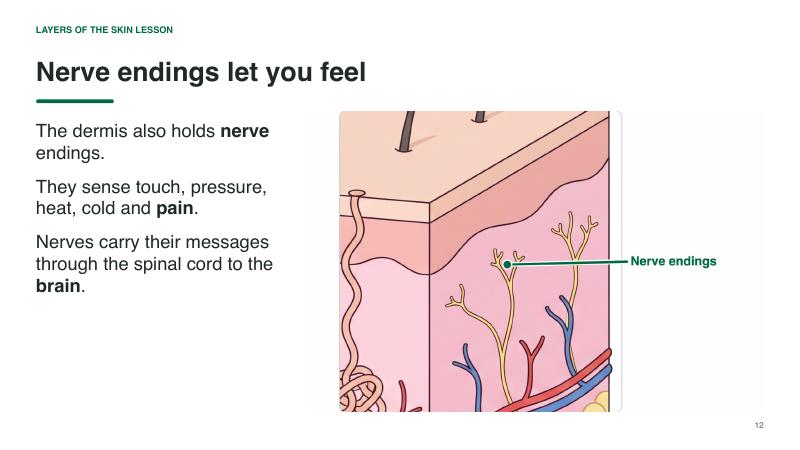
| Nerve endings | The ends of nerves in the skin that sense touch, pressure, heat, cold and pain. | Most nerve endings are in the dermis, and some reach up into the epidermis. They send messages to your brain, so you can feel a soft blanket, a hot stove or a sharp pin. Fingertips and lips have more of them than your back does. |
How to print
Choose Download PDF for a ready-to-print file that fits US Letter paper (8.5 × 11") in landscape, or Download PNG for the high-resolution image.
Frequently asked questions
What are the three layers of the skin?
From the outside in: the epidermis, the dermis and the hypodermis (also called the subcutaneous layer).
What is the largest organ of the body?
The skin. In an adult it covers about 20 square feet (about 2 square meters).
What does the skin do?
It protects the body from germs and injury, keeps water in, helps control body temperature with sweat and blood flow, and lets you sense touch, heat, cold and pain.
What paper size should I print this on?
The diagram is sized for standard US Letter paper (8.5 × 11") in landscape orientation. Use "Download PDF" for a print-ready file that fits the page automatically.
Are there Layers of the Skin worksheets to go with the diagram?
Yes. The Layers of the Skin teaching pack, for grades 6 to 8 (introductory level), has 22 lesson slides and 8 printables with answer keys: the guided notes for the lesson slides, the labeled diagram and the blank one to label, then “Skin Parts and Their Jobs” (a worksheet), “Your Skin at Work” (a reading passage), “How Sweat Cools You” (an ordering worksheet), a vocabulary crossword and a quiz. The diagram and the blank one to label are free to download on this page. The other sheets come with the pack ($7), which is also in the Middle School Science bundle (grades 5 to 8).