Muscular System Diagram
Free printable muscular system diagram — a labeled illustration of the major muscles: deltoid, pectorals, biceps, triceps, abdominals, quadriceps and more. Download PDF or PNG for Letter paper.
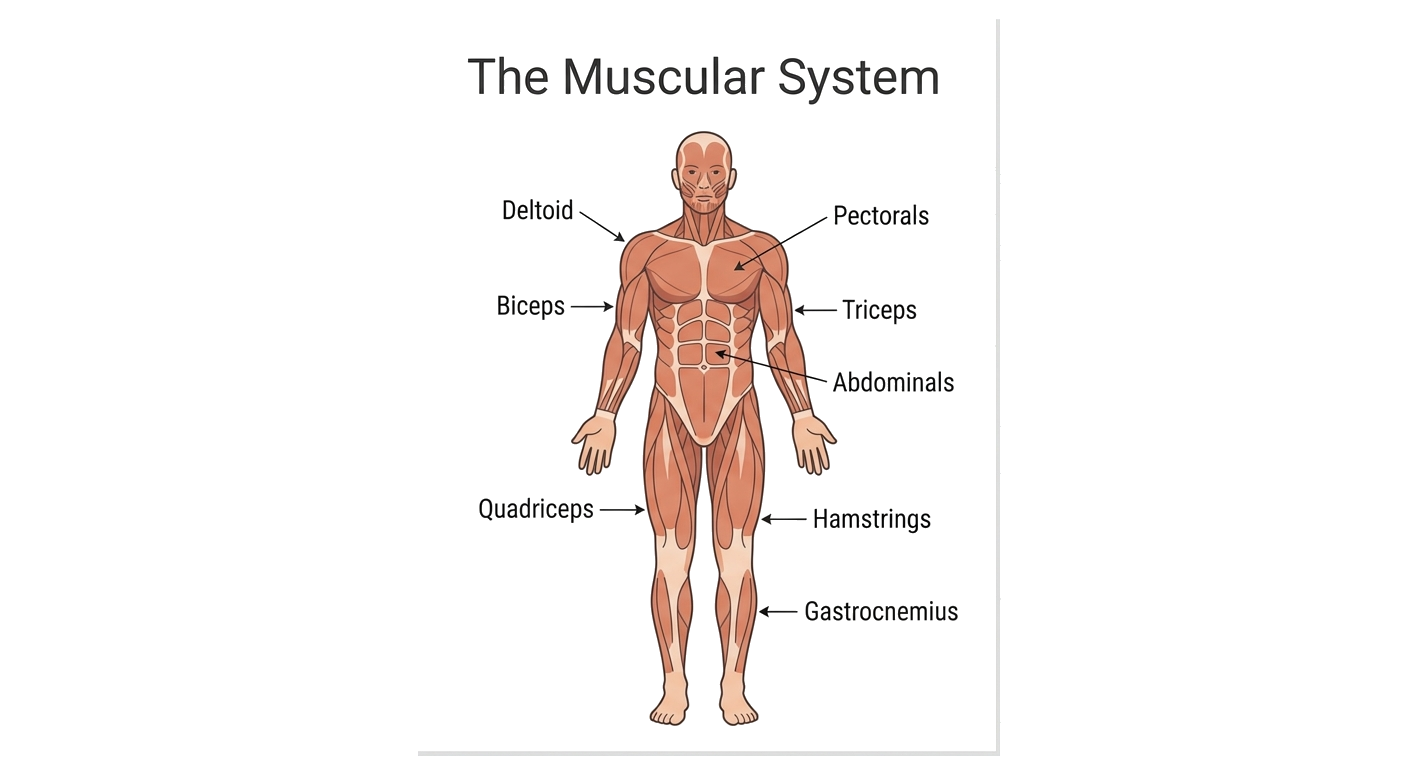
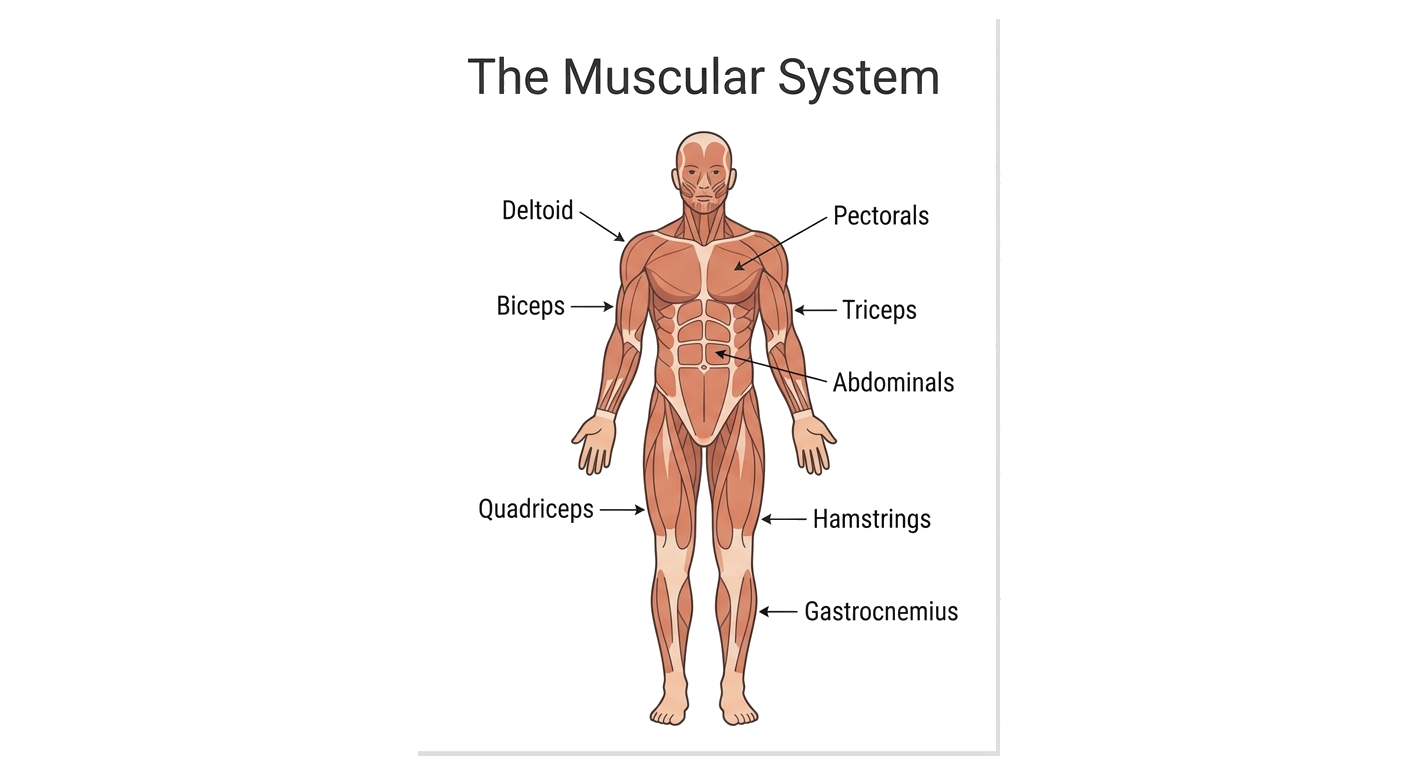
The major muscles of the body
The muscular system is made of muscles that move the body and hold it upright. Here is what happens at each labeled part of the diagram:
| Muscle | What it does | Why it matters |
|---|---|---|
| Deltoid | The shoulder muscle that lifts the arm. | Without the deltoid, you couldn't lift your arm away from your side — reaching for a shelf, throwing a ball, or even waving would be impossible. It wraps around the shoulder like a thick cap, giving the joint both its rounded shape and its wide range of motion. |
| Pectorals | The chest muscles used to push and move the arms. | Every time you push a door open or do a push-up, the pectorals are doing the heavy work of driving your arms forward and across your body. They also stabilize the shoulder joint, which would otherwise be surprisingly easy to dislocate. |
| Biceps | The front upper-arm muscle that bends the elbow. | Curling your arm to carry a backpack or bring food to your mouth depends entirely on the biceps contracting and shortening. It is one of the most famous muscles in the body precisely because it bulges visibly when it contracts — a rare case where you can watch a muscle working in real time. |
| Triceps | The back upper-arm muscle that straightens the elbow. | Because the biceps can only bend the elbow, the triceps is the essential partner that straightens it back out — without it, your arm would stay permanently curled. Pushing movements like shooting a basketball or pressing overhead rely almost entirely on the triceps. |
| Abdominals | The stomach muscles that support the body and help it bend. | A weak core means the spine has no muscular support, which is why lower back pain is one of the most common injuries in people who sit for long periods. Beyond posture, the abdominals generate the force needed to cough, sneeze, and even breathe deeply. |
| Quadriceps | The front thigh muscles that straighten the knee. | Standing up from a chair, climbing stairs, or kicking a soccer ball all depend on the quadriceps snapping the knee straight with explosive force. They are the largest and most powerful muscle group in the body — which makes sense, since they carry your entire weight every time you take a step. |
| Hamstrings | The back thigh muscles that bend the knee. | As the opposing partner to the quadriceps, the hamstrings bend the knee and drive the leg backward during running — they are what gives a sprint its power. Hamstring tears are among the most common sports injuries because the muscle has to decelerate the leg at high speed, which puts enormous strain on the fibers. |
| Gastrocnemius | The calf muscle used to point the foot and walk. | Every time your heel leaves the ground — whether walking, running, or jumping — the gastrocnemius is contracting to push off the floor. It is also the muscle responsible for the burning sensation in your calves when you climb a long flight of stairs, because it is working nearly non-stop to lift your body weight with each step. |
Companion worksheet
A free fill-in worksheet with an answer key, built from the labels above — students match each muscle to its description, then answer a couple of short questions. Great for a quick check after using the diagram.
How to print
Choose Download PDF for a ready-to-print file that fits US Letter paper (8.5 × 11") in portrait, or Download PNG for the high-resolution image.
Frequently asked questions
How many muscles are in the human body?
The human body has more than 600 muscles.
What do muscles do?
Muscles pull on bones to move the body, hold you upright, and power automatic jobs like your heartbeat.
What paper size should I print this on?
The diagram is sized for standard US Letter paper (8.5 × 11") in portrait orientation. Use "Download PDF" for a print-ready file that fits the page automatically.