Seasons Diagram
Free printable seasons diagram — a labeled illustration showing Earth at the summer solstice, autumnal equinox, winter solstice, and vernal equinox, with the 23.5° axial tilt explained. Download a high-resolution PDF or PNG for Letter paper.
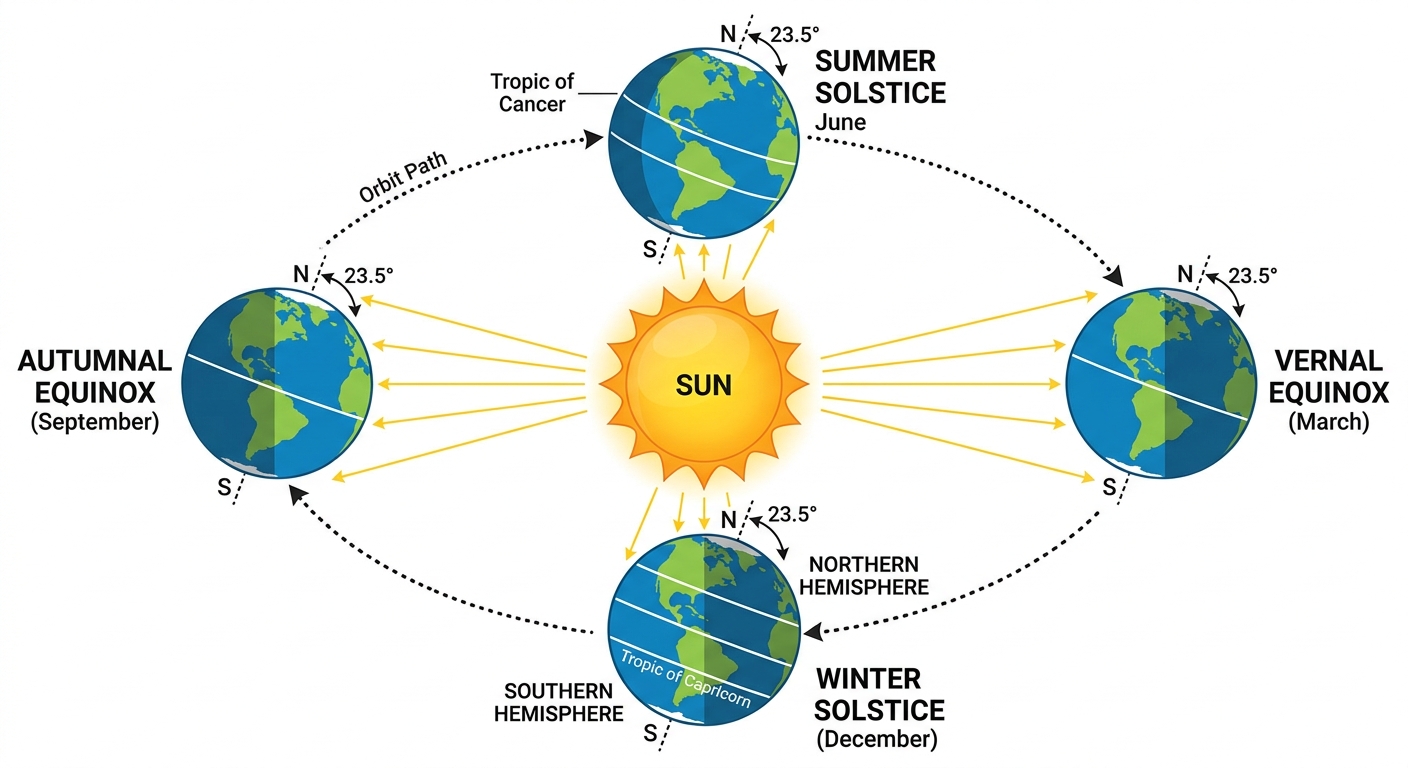

Earth's four seasonal positions
Earth's seasons are caused by the tilt of its axis — not its distance from the Sun. As Earth orbits the Sun, the tilt causes each hemisphere to receive more or less direct sunlight at different times of year. Here is what happens at each labeled part of the diagram:
| Position | What it does | Why it matters |
|---|---|---|
| Summer Solstice | Around June 21 — the Northern Hemisphere is tilted toward the Sun, giving it the longest day of the year. | At the summer solstice the Northern Hemisphere is tilted as directly toward the Sun as it ever gets (23.5°), so the Sun rises highest in the sky, traces its longest daily arc, and shines most directly on the surface. The result is the most hours of daylight and the strongest heating. At the same time, the Southern Hemisphere is tilted away and experiencing its winter solstice — its shortest day. At the Arctic Circle the Sun does not set at all (the "midnight sun"), while Antarctica is in continuous polar night. |
| Autumnal Equinox | Around September 22 — the Sun is directly above the equator and day and night are equal everywhere. | At the equinoxes Earth's axial tilt is neither toward nor away from the Sun — both hemispheres receive equal amounts of sunlight. "Equinox" comes from the Latin for "equal night," and on these two days the length of day and night is approximately 12 hours almost everywhere on Earth. The autumnal equinox marks the official start of autumn in the Northern Hemisphere and spring in the Southern Hemisphere — a perfectly symmetrical transition between the extremes. |
| Winter Solstice | Around December 21 — the Northern Hemisphere is tilted away from the Sun, giving it the shortest day of the year. | The winter solstice is the mirror image of the summer solstice: the Northern Hemisphere is now tilted as far from the Sun as it gets. The Sun rises low in the sky, traces a short arc, and sets early, producing the fewest hours of daylight of the year. The sunlight that does reach the surface arrives at a steep angle and is spread over a larger area, delivering less energy per square metre — which is why winter days feel so much colder than summer ones, not because Earth is further from the Sun (it is actually slightly closer in January). |
| Vernal Equinox | Around March 20 — the second equinox, marking the start of spring in the Northern Hemisphere. | The vernal (spring) equinox repeats the equal day-and-night balance of the autumnal equinox, but this time the Northern Hemisphere is moving toward summer. Day lengths are increasing, the Sun is climbing higher each day, and temperatures are beginning to rise. Many cultural and religious celebrations — Easter, Nowruz, Holi — are timed to the vernal equinox, as it has marked the symbolic renewal of spring for thousands of years across many cultures. |
| Earth's Axial Tilt | Earth's axis is tilted at 23.5° relative to its orbit — this tilt is the entire cause of the seasons. | If Earth's axis were perfectly upright (0° tilt) every part of the planet would receive the same amount of sunlight year-round and there would be no seasons at all. It is the 23.5° tilt that creates the cycle — as Earth orbits the Sun over the course of a year, first one hemisphere and then the other is tilted toward the Sun. This tilt is also responsible for the midnight sun at the poles in summer and the polar night in winter. The tilt itself barely changes over human timescales, though it does wobble very slightly over thousands of years. |
| Sun | The Sun sits at the centre of Earth's orbit — its position does not change as Earth orbits around it. | The Sun does not move toward or away from Earth enough to cause the seasons — Earth's orbit is nearly circular, with a variation of only about 3 percent in distance between closest approach (perihelion, early January) and furthest point (aphelion, early July). Remarkably, Earth is actually closest to the Sun in January, the heart of Northern Hemisphere winter. This proves conclusively that distance from the Sun is not the cause of the seasons — axial tilt is. |
Companion worksheet
A free fill-in worksheet with an answer key, built from the labels above — students match each position to its description, then answer a couple of short questions. Great for a quick check after using the diagram.
How to print
Choose Download PDF for a ready-to-print file that fits US Letter paper (8.5 × 11") in landscape, or Download PNG for the high-resolution image.
Frequently asked questions
What causes the seasons?
Earth's axial tilt (23.5°) — not its distance from the Sun. As Earth orbits, the tilt causes each hemisphere to receive more or less direct sunlight at different times of year.
Why is it summer in the Northern Hemisphere when it is winter in the Southern Hemisphere?
When the Northern Hemisphere is tilted toward the Sun it receives more direct sunlight (summer); at the same time the Southern Hemisphere is tilted away and receives less direct sunlight (winter).
What paper size should I print this on?
The diagram is sized for standard US Letter paper (8.5 × 11") in landscape orientation. Use "Download PDF" for a print-ready file that fits the page automatically.