Space Size Comparison Book
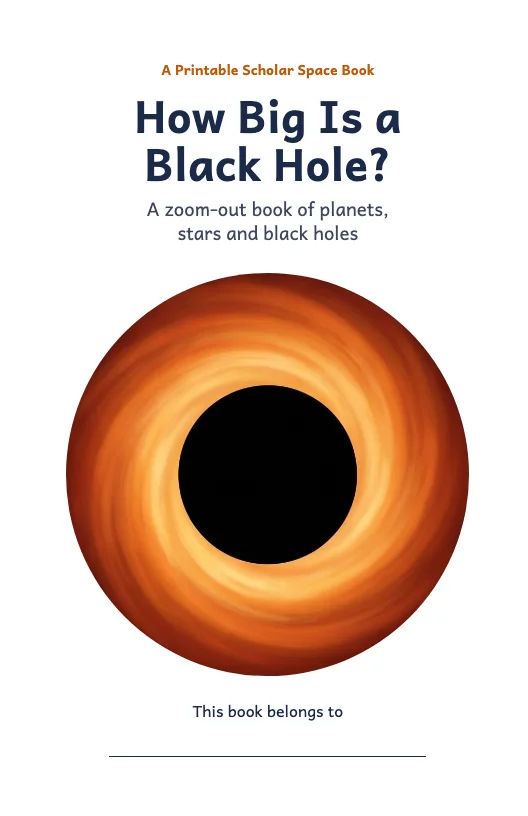
How big is a black hole next to the Sun? This free printable book zooms out one step at a time, from the Moon to the giant black hole TON 618. Every page shows two things drawn to the same scale, so kids can see the difference with their own eyes.
Download the book (PDF)What is in the book
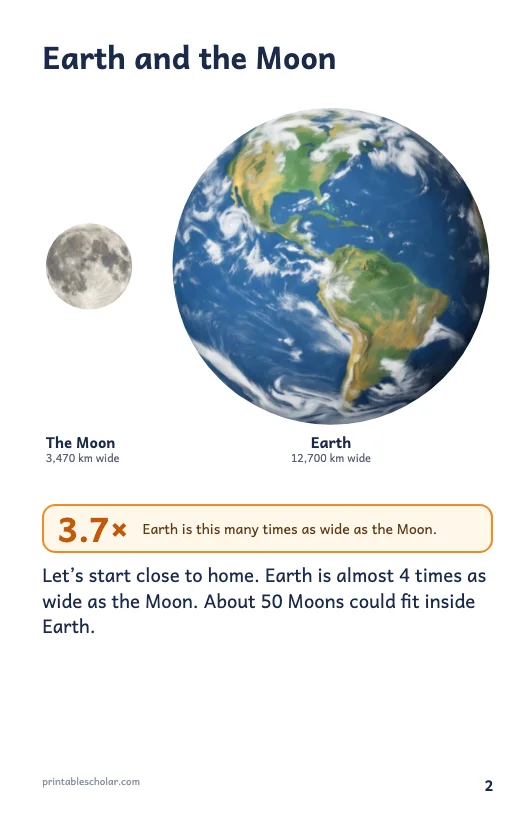
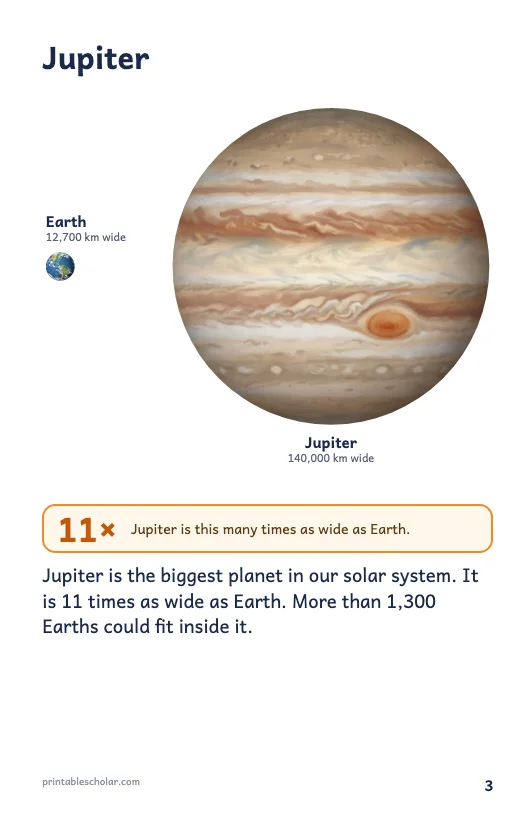
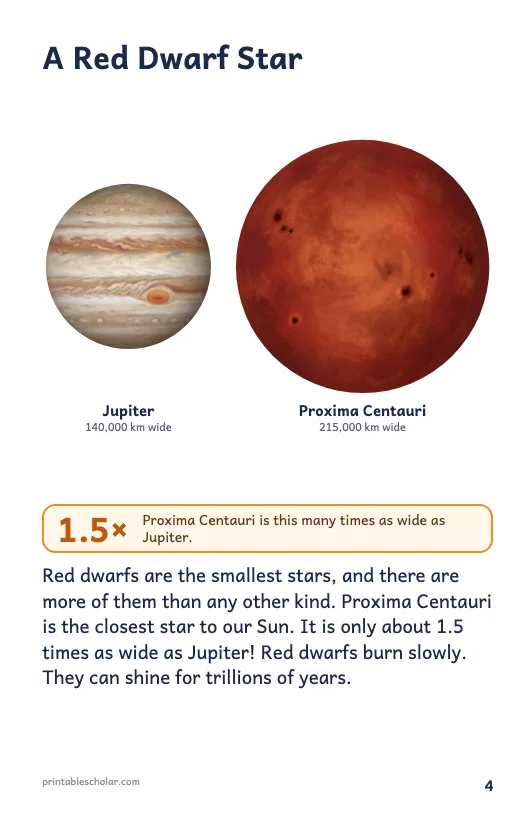
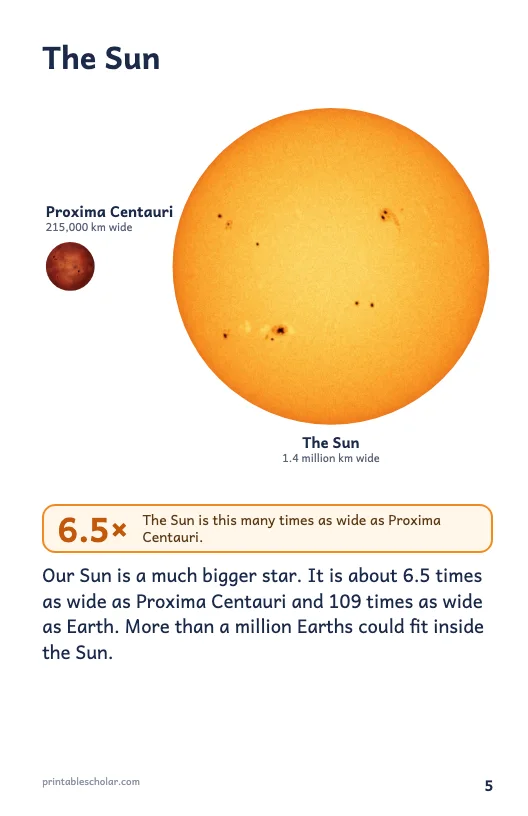
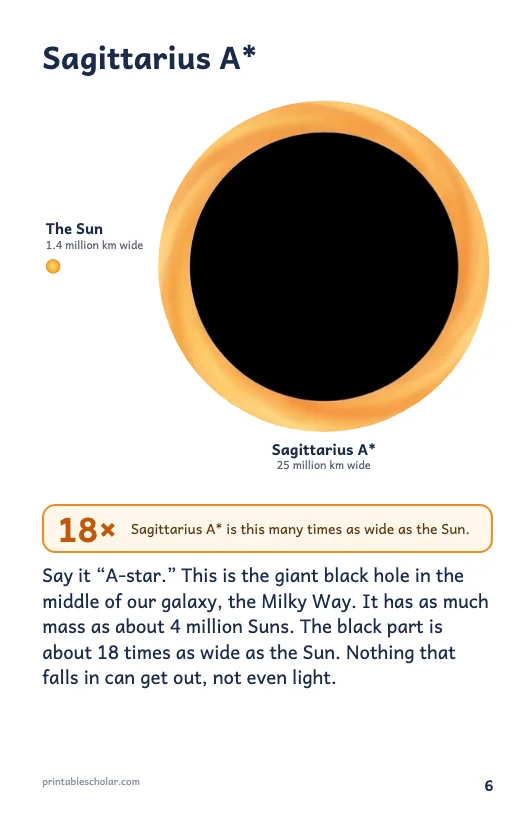
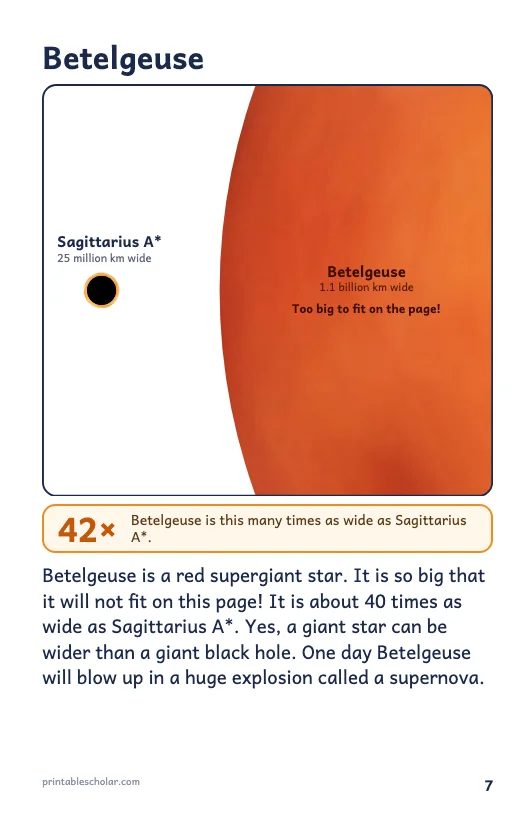
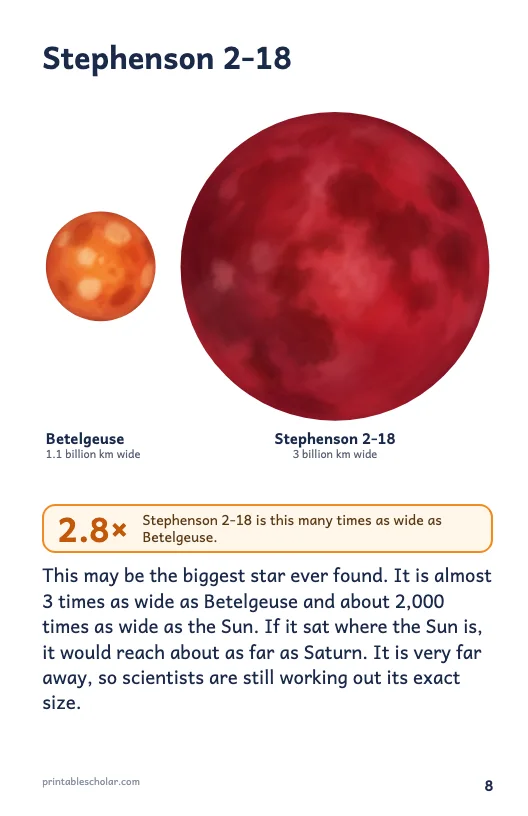
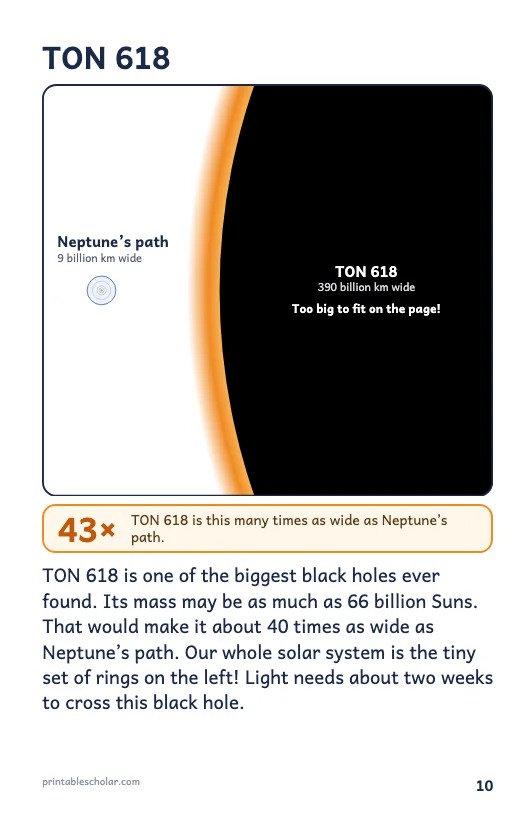
Each page takes the biggest thing from the page before and puts it next to something bigger. The orange box tells how many times as wide the new one is. Two of them, Betelgeuse and TON 618, are so much bigger that they run off the page.
How to make the book
- Print the 6 sheets on one side, in color. Black and white works too.
- Cut each sheet in half on the dashed line.
- Stack the pages in order, with the cover on top.
- Staple down the left side.
Space size comparison chart
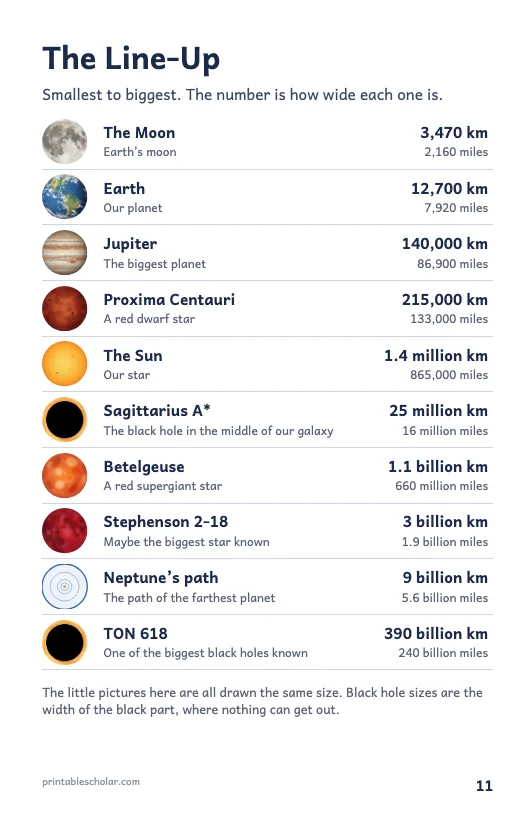
These are the sizes used in the book, from smallest to biggest. The last column compares each one with the one before it.
| Name | Width | Compared with the one before |
|---|---|---|
| The MoonEarth’s moon | 3,470 km2,160 miles | |
| EarthOur planet | 12,700 km7,920 miles | 3.7× the Moon |
| JupiterThe biggest planet | 140,000 km86,900 miles | 11× Earth |
| Proxima CentauriA red dwarf star | 215,000 km133,000 miles | 1.5× Jupiter |
| The SunOur star | 1.4 million km865,000 miles | 6.5× Proxima Centauri |
| Sagittarius A*The black hole in the middle of our galaxy | 25 million km16 million miles | 18× the Sun |
| BetelgeuseA red supergiant star | 1.1 billion km660 million miles | 42× Sagittarius A* |
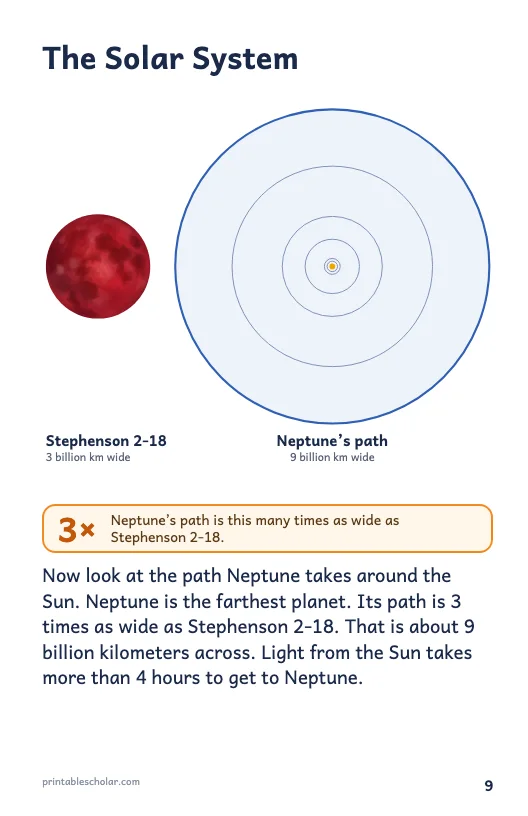
| Stephenson 2-18Maybe the biggest star known | 3 billion km1.9 billion miles | 2.8× Betelgeuse |
| Neptune’s pathThe path of the farthest planet | 9 billion km5.6 billion miles | 3× Stephenson 2-18 |
| TON 618One of the biggest black holes known | 390 billion km240 billion miles | 43× Neptune’s path |
Where the numbers come from
The sizes of the Moon, Earth, Jupiter, the Sun and Neptune’s path are well measured. Star sizes are harder. Betelgeuse is drawn at about 764 times the width of the Sun, and Stephenson 2-18 at about 2,150 times, which are current estimates that could change.
A black hole’s size here means the width of its event horizon, the black part that light cannot leave. That width comes straight from the black hole’s mass. Sagittarius A* is about 4.3 million times the mass of the Sun. TON 618 is drawn at 66 billion times the mass of the Sun, the largest common estimate. Some studies put it closer to 40 billion, which would make it about 60% as wide.
Teaching a space unit? The life cycle of a star diagram shows how a star like Betelgeuse ends as a supernova, and the solar system diagram shows the planets in order.