Phases of the Moon
Free printable phases of the Moon diagram — all eight phases in order, from new moon to waning crescent, each labeled with the correct lit side. Download a high-resolution PDF or PNG for Letter paper.
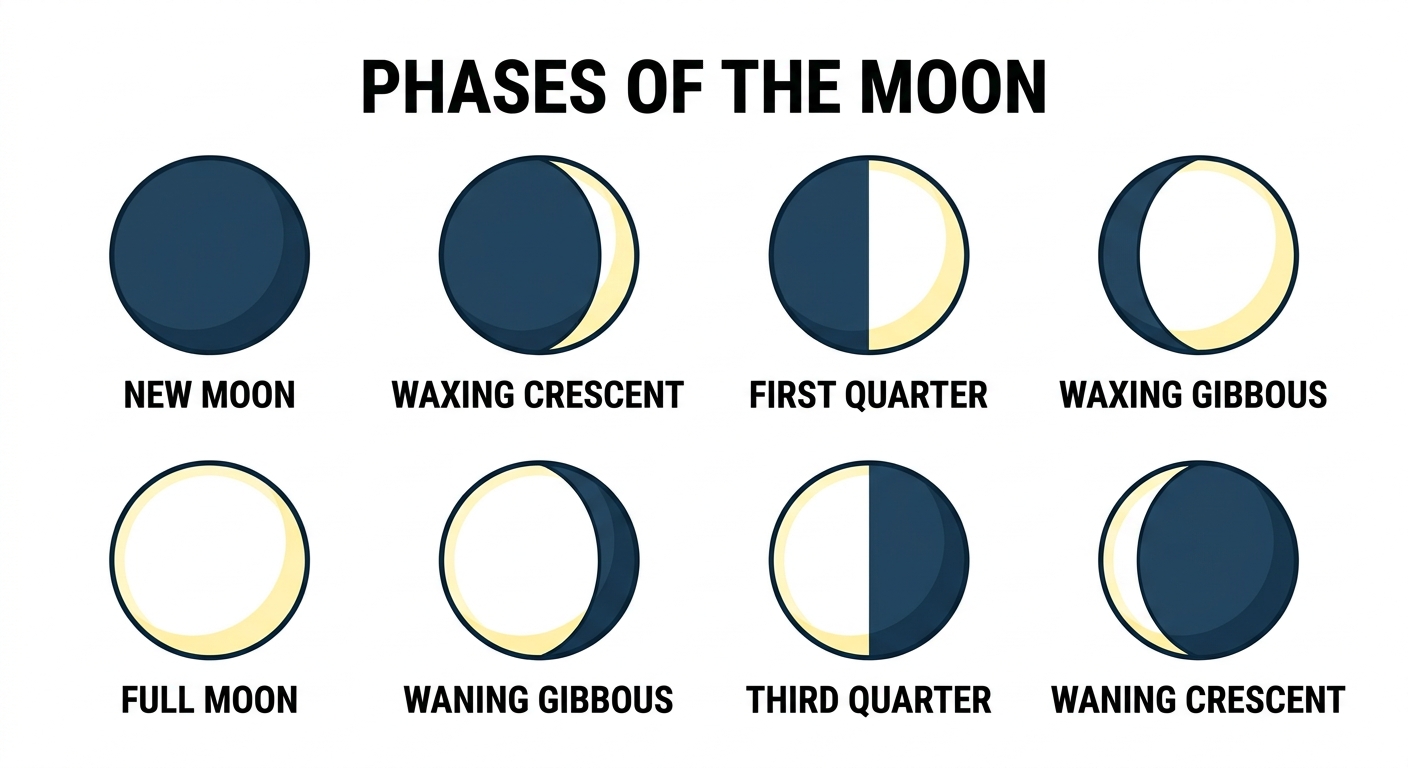
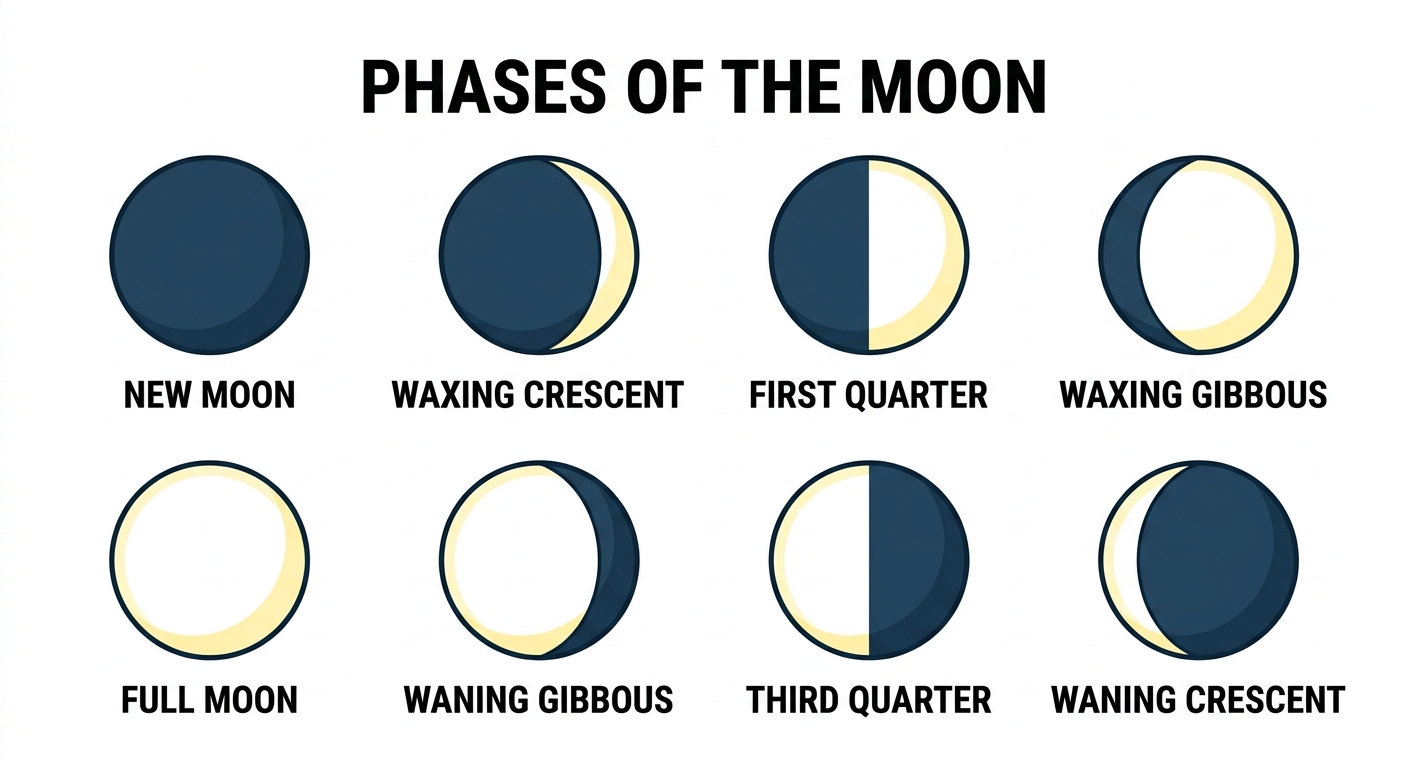
The eight phases of the Moon
As the Moon orbits the Earth, the amount of its sunlit side that we can see changes in a repeating cycle of eight phases, about once a month. Here is what happens at each labeled part of the diagram:
| Phase | What it does | Why it matters |
|---|---|---|
| New Moon | The Moon is between the Earth and the Sun, so the side facing us is dark and the Moon is almost invisible. | Because the Moon's dark side faces us, the night sky is at its blackest — and that darkness is a gift to astronomers, who schedule their deepest telescope observations during new moon nights when starlight isn't washed out. |
| Waxing Crescent | A thin sliver of light appears on the right side and grows each night. "Waxing" means growing. | That first thin sliver rising after sunset is how ancient cultures marked the start of a new month — the word "Monday" literally traces back to the Moon, and the crescent was the signal to flip the calendar. |
| First Quarter | The right half of the Moon is lit, so it looks like a half-circle. | Halfway to full, this phase rises around noon and sets around midnight, making it one of the easiest Moon phases to spot in a bright daytime sky — proof that the Moon is often visible in daylight even when most people assume it only comes out at night. |
| Waxing Gibbous | More than half is lit and still growing, with only a small dark sliver left. | This overlooked phase actually gives more illuminated surface area than a first-quarter moon, producing enough natural light on a clear night to cast faint shadows on the ground — handy long before electric streetlights existed. |
| Full Moon | The whole face of the Moon is lit. The Earth is now between the Sun and the Moon. | With the Moon on the opposite side of Earth from the Sun, its gravity pulls on our oceans in line with the Sun's pull, creating the month's highest high tides and lowest low tides — a pattern that coastal ecosystems and harbor pilots still plan around today. |
| Waning Gibbous | The lit part begins to shrink from the right. "Waning" means shrinking. | Rising after sunset and staying up past midnight, this phase was historically the "harvest moon" light that let farmers keep working in the fields after dark when autumn days were too short to bring in all the crops. |
| Third Quarter | The left half of the Moon is lit — the opposite of the first quarter. | A mirror image of the first quarter, this half-lit Moon rises around midnight and is often the one insomniacs or early-morning runners spot hanging in a pale dawn sky — the same shape, but now on the Moon's left side instead of its right. |
| Waning Crescent | Only a thin sliver of light is left on the left side before the cycle begins again. | Just before disappearing entirely, this sliver rises in the east shortly before sunrise — if you've ever wondered why some mornings show a faint curved sliver low on the horizon as the sky brightens, this is that phase completing its journey back to new. |
Companion worksheet
A free fill-in worksheet with an answer key, built from the labels above — students match each phase to its description, then answer a couple of short questions. Great for a quick check after using the diagram.
How to print
Choose Download PDF for a ready-to-print file that fits US Letter paper (8.5 × 11") in landscape, or Download PNG for the high-resolution image.
Frequently asked questions
What are the 8 phases of the Moon in order?
New moon, waxing crescent, first quarter, waxing gibbous, full moon, waning gibbous, third quarter, and waning crescent.
What do waxing and waning mean?
Waxing means the lit part is growing (before the full moon); waning means it is shrinking (after the full moon).
What paper size should I print this on?
The diagram is sized for standard US Letter paper (8.5 × 11") in landscape orientation. Use "Download PDF" for a print-ready file that fits the page automatically.