 Printable Scholar
Moon Phases
Move the Moon around Earth and watch it change shape in the sky.
How to play
Drag the Moon around Earth, or tap a phase in the row under the picture. The big picture looks down on Earth from above the North Pole, with sunlight coming from the left. The box on the right shows the Moon as you would see it from Earth at that moment, with its phase, how much of it is lit and the date. Time runs on its own and stops while you move the Moon. Press 📅 to jump to any date from 1901 to 2100, and ⟲ to come back to tonight.
Things to try
- Drag the Moon to the far side of Earth from the Sun. What phase is it, and how much of the lit half can the person on Earth see?
- Find the phase when the Moon is between Earth and the Sun. Why can’t we see it?
- Look at the Moon in space at every phase. Is it ever less than half lit? So what is the dark part we see from Earth?
- Drag the Moon slowly all the way round and name each phase as it goes.
- Press “Show me” to watch the next lunar eclipse. What colour does the Moon turn?
- Stop at a full moon with no eclipse and look at the side view. Where is the Moon compared with Earth’s shadow?
- Press “Line them up” and make a solar eclipse and a lunar eclipse.
- Pick your birthday. What did the Moon look like the day you were born?
- Tap “Real distance”. How many Earths would fit between Earth and the Moon?
Teaching the phases of the Moon?
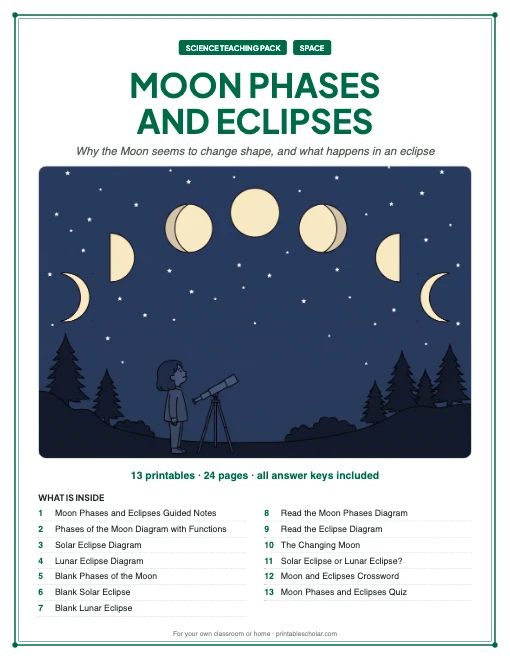
The Moon Phases and Eclipses teaching pack has lesson slides, labeled diagrams, practice sheets and every answer key for grades 4 to 6. Use this game as the warm-up or the hands-on part. The phases of the Moon diagram, the solar eclipse diagram and the lunar eclipse diagram are free.
Questions
What causes the phases of the Moon?
The Sun always lights half of the Moon, the half facing it. As the Moon travels around Earth once a month, we see different amounts of that lit half. When the Moon is between Earth and the Sun we see none of it (new moon). When it is on the far side of Earth we see all of it (full moon). In between we see part of it: a crescent, a half (quarter moon) or a gibbous moon.
Are the phases caused by Earth’s shadow?
No. That is the most common mix-up. Earth’s shadow points away from the Sun, and the Moon is almost never in it. The dark part of a crescent moon is just the Moon’s own night side, facing us. The only time Earth’s shadow falls on the Moon is a lunar eclipse, and that can only happen at a full moon.
How long does it take to go through all the phases?
About 29.5 days, from one new moon to the next. That is where the word “month” comes from. The game shows which day of the cycle the Moon is on.
What do waxing and waning mean?
Waxing means the lit part we see is growing (from new moon to full moon). Waning means it is shrinking (from full moon back to new moon). In the Northern Hemisphere a waxing moon is lit on the right and a waning moon is lit on the left.
Why isn’t there an eclipse every month?
The Moon’s path around Earth is tilted about 5 degrees compared with Earth’s path around the Sun. So at most full moons the Moon passes just above or below Earth’s shadow, and at most new moons its shadow misses Earth. Eclipses happen only when a full or new moon falls near the two places where the paths cross, which happens in two “eclipse seasons” a year. The side view in the game shows this.
Why do we always see the same side of the Moon?
The Moon turns once on its axis in exactly the time it takes to go around Earth once, so the same side always faces us. In the game the small orange dot marks that side. This is called tidal locking.
Does the Moon look different in the Southern Hemisphere?
Yes. From Australia, South Africa or Argentina the Moon looks upside down compared with how it looks from North America or Europe, so a waxing moon is lit on the left. Tick “Southern Hemisphere” under the sky view to see it.
Are the dates real?
Yes. The phase for any date from 1901 to 2100 is worked out from the Moon’s and Sun’s real positions (Jean Meeus, Astronomical Algorithms), and it matches the U.S. Naval Observatory’s published phase times to within a few minutes. Every eclipse comes from NASA’s eclipse catalog.
What is a Blue Moon?
A Blue Moon is usually the second full moon in one calendar month. It happens about every two and a half years. The Moon doesn’t actually look blue.
Is it really free?
Yes. No sign-up, no ads. The Moon picture is NASA’s Lunar Reconnaissance Orbiter map and the Earth is NASA’s Blue Marble.