Solar Eclipse Diagram
Free printable solar eclipse diagram — a labeled illustration showing the Sun-Moon-Earth alignment, the Moon's umbra and penumbra shadow cones, total and partial eclipse zones on Earth, and a view from Earth during totality. Download a high-resolution PDF or PNG for Letter paper.
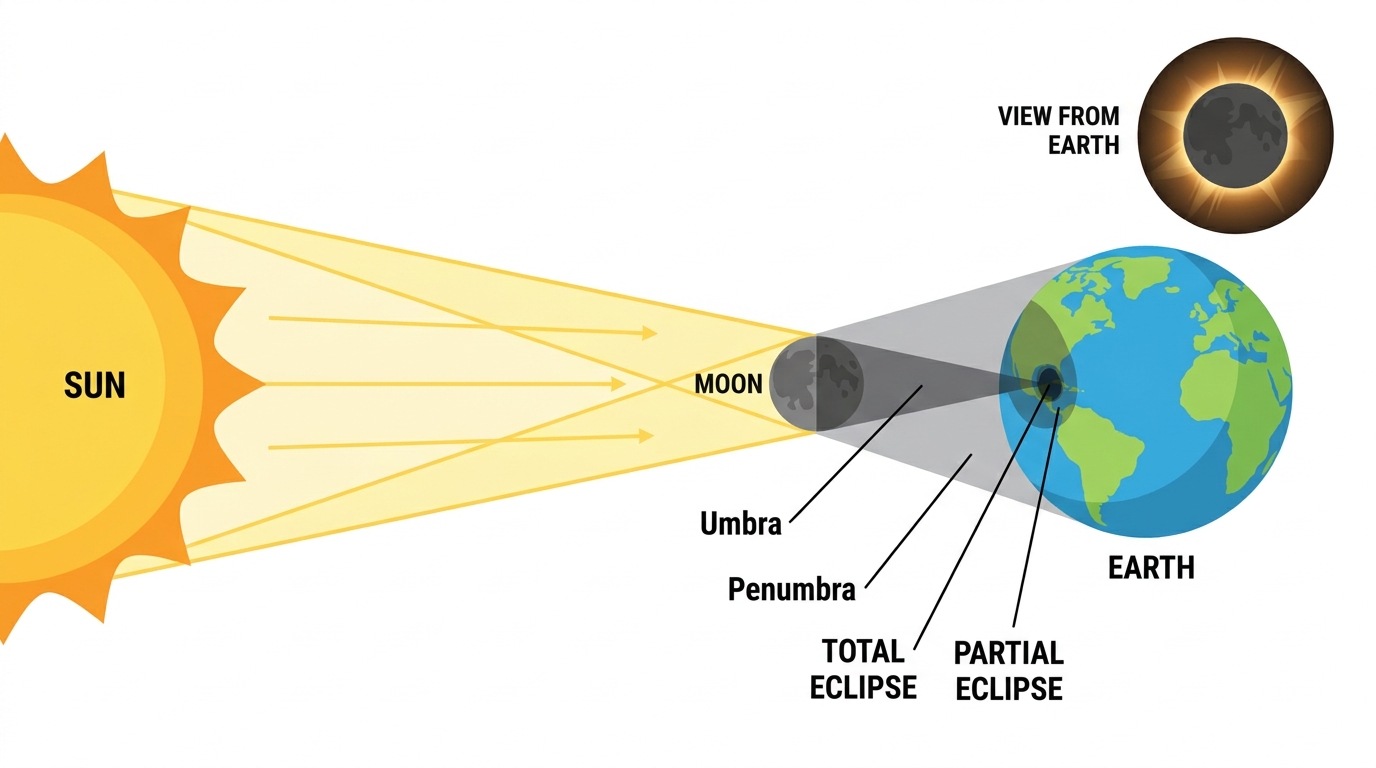

The parts of a solar eclipse
A solar eclipse happens when the Moon moves directly between the Earth and the Sun, casting a shadow on Earth's surface and briefly blocking sunlight. Here is what happens at each labeled part of the diagram:
| Part | What it does | Why it matters |
|---|---|---|
| Sun | The star at the centre of our solar system, the source of the light that the Moon blocks during a solar eclipse. | The Sun is about 400 times wider than the Moon, but it is also about 400 times further away — a remarkable coincidence that makes the Sun and Moon appear almost exactly the same size in Earth's sky. This near-perfect size match is the only reason total solar eclipses are possible: the Moon is just large enough to cover the Sun's disc completely, revealing the faint corona around the edges. |
| Moon | Earth's natural satellite, whose shadow falls on Earth during a solar eclipse. | The Moon's shadow has two parts: the umbra (the darkest, central cone where the Sun is completely blocked) and the penumbra (the larger, lighter outer cone where the Sun is only partially blocked). Because the Moon's orbit is slightly elliptical, its distance from Earth varies — when it is closer it appears larger and produces a total eclipse; when further away its disc is too small to cover the Sun entirely and it produces an annular ("ring of fire") eclipse instead. |
| Earth | The planet on which observers stand — the part of Earth under the umbra experiences a total eclipse. | During a total solar eclipse the Moon's umbra traces a narrow path across Earth's surface called the path of totality, typically only 100-160 km wide. Observers within this strip see the sky go dark in the middle of the day, stars appear, and the temperature drops noticeably. The entire path moves at supersonic speed as the Moon's shadow races across Earth, meaning totality at any single location lasts only a few minutes at most. |
| Umbra | The Moon's darkest shadow — people in the umbra see a total solar eclipse. | The umbra is a cone-shaped region where the Moon completely blocks the Sun. Its tip only just reaches Earth's surface because the Moon is close enough to block the full disc — if the Moon were slightly further away, the umbra would not reach Earth at all. Standing in the umbra during a total eclipse is the only safe time to look directly at the Sun, because the disc is completely covered and only the corona is visible. |
| Penumbra | The Moon's partial shadow — people in the penumbra see a partial solar eclipse. | The penumbra is the much larger outer shadow surrounding the umbra, where the Moon covers only part of the Sun. Observers in the penumbra see a partial solar eclipse — the Sun appears as a crescent as the Moon slides across it. Unlike total eclipses, partial eclipses are not safe to view with the naked eye: even a thin sliver of the Sun's disc is enough to cause permanent eye damage without proper solar filters. |
| Total Eclipse | The zone on Earth's surface where the umbra falls — the Sun is completely blocked. | Within the path of totality the sky darkens to a twilight-like dimness, the horizon glows orange in all directions, nocturnal animals sometimes begin their evening routines, and the Sun's outer atmosphere — the corona — blazes in a white halo that is normally invisible. Totality is the most dramatic natural spectacle visible from Earth's surface, which is why eclipse chasers travel thousands of miles to stand in the narrow path. |
| Partial Eclipse | The zone where the penumbra falls — the Sun is only partly covered. | A much larger area of Earth's surface experiences the partial eclipse than the total eclipse — the penumbra can be thousands of kilometres wide. Observers see the Moon progressively cover and then uncover the Sun over a period of roughly an hour on either side of totality (or maximum coverage for those outside the path). Pinhole projectors and certified eclipse glasses are the safe ways to watch a partial eclipse without risking eye damage. |
Companion worksheet
A free fill-in worksheet with an answer key, built from the labels above — students match each part to its description, then answer a couple of short questions. Great for a quick check after using the diagram.
How to print
Choose Download PDF for a ready-to-print file that fits US Letter paper (8.5 × 11") in landscape, or Download PNG for the high-resolution image.
Frequently asked questions
What causes a solar eclipse?
A solar eclipse occurs when the Moon passes directly between the Earth and the Sun, casting its shadow on part of Earth's surface.
What is the difference between a total and a partial solar eclipse?
In a total eclipse the Moon completely covers the Sun (seen from within the narrow umbra path). In a partial eclipse the Moon only covers part of the Sun (seen from the wider penumbra region).
What paper size should I print this on?
The diagram is sized for standard US Letter paper (8.5 × 11") in landscape orientation. Use "Download PDF" for a print-ready file that fits the page automatically.