Food Chain Diagram
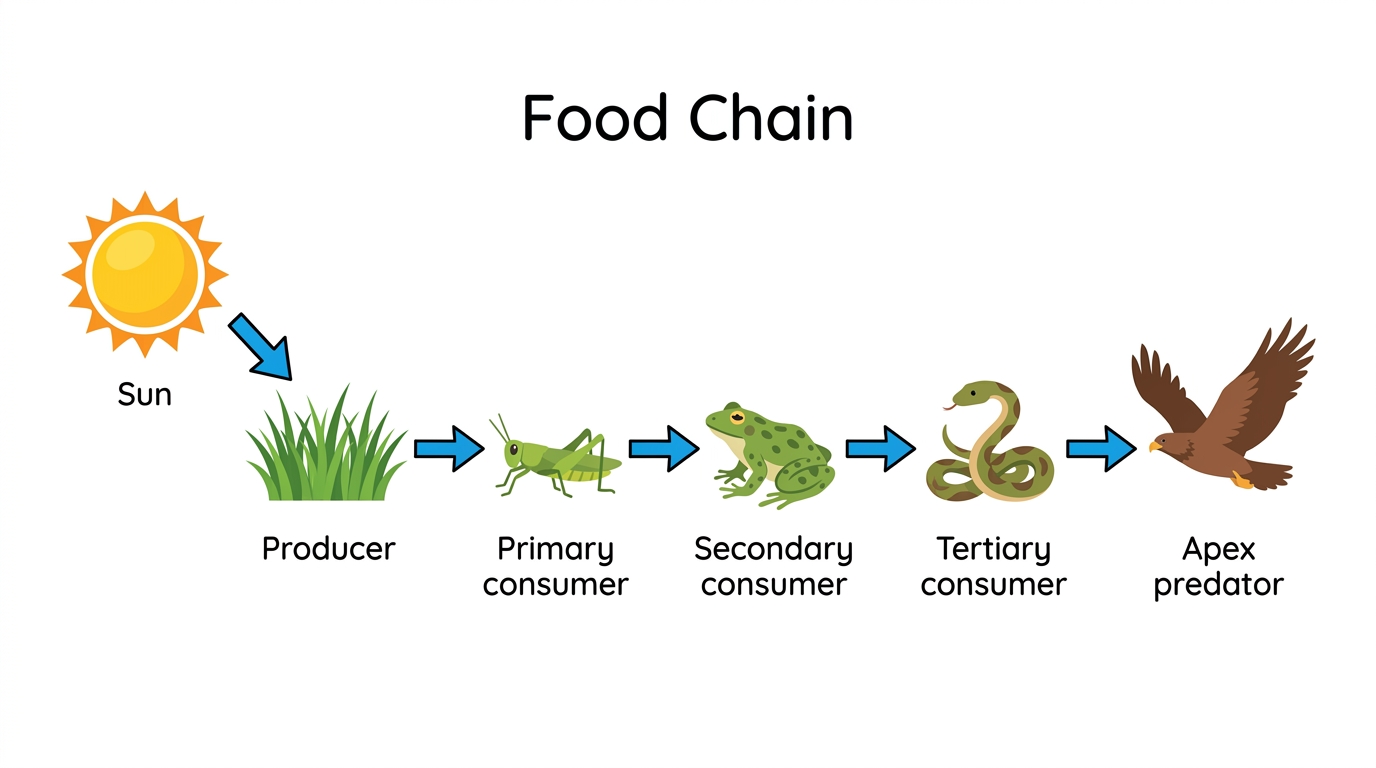
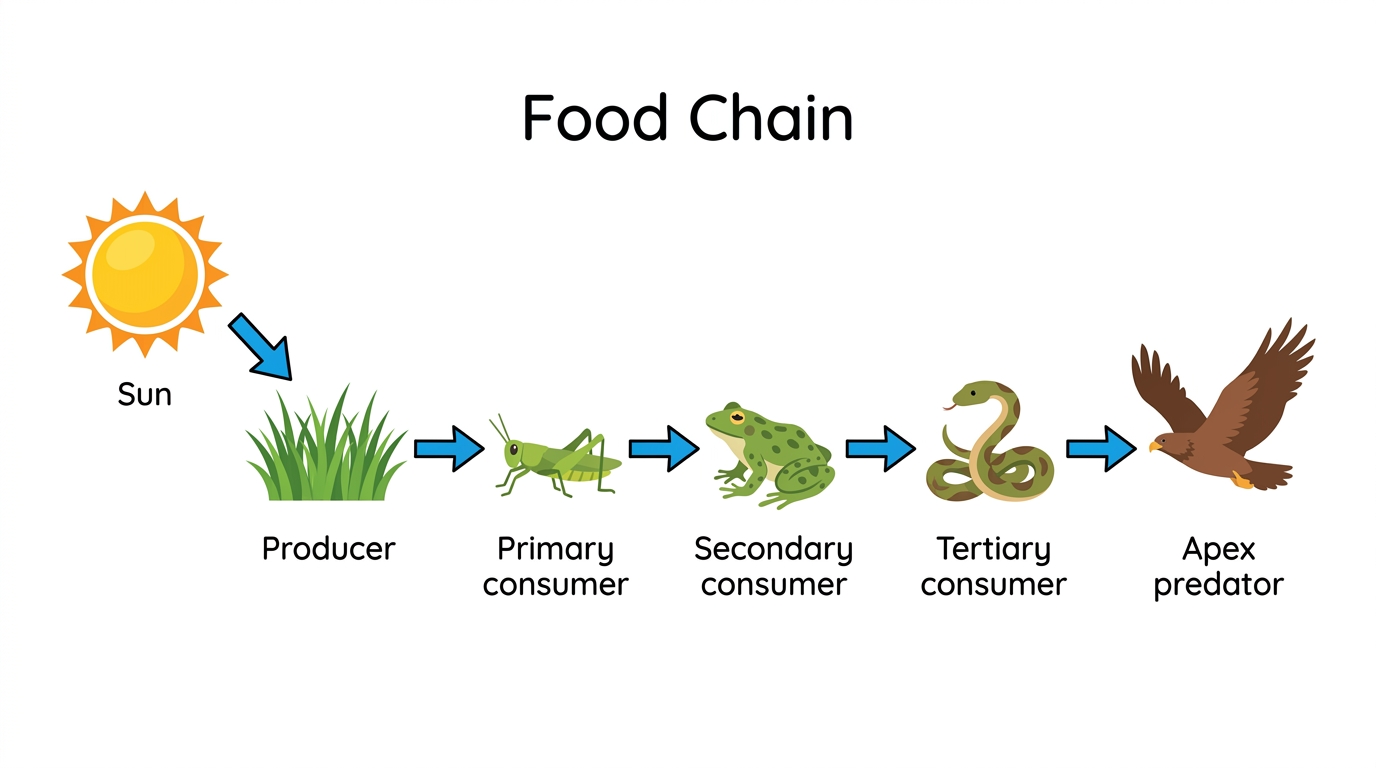
Free printable food chain diagram — a labeled illustration showing how energy flows from the sun to producers and consumers. Download a high-resolution PDF or PNG for Letter paper.
The links in a food chain
A food chain shows how energy passes from one living thing to the next, starting with the sun. Here is what happens at each labeled part of the diagram:
| Link | What it does | Why it matters |
|---|---|---|
| Sun | The original source of energy for almost every food chain. | Remove the sun and nearly every food chain on Earth collapses within days, because there would be no new energy entering the living world at all. A few rare ecosystems near deep-sea vents run on chemical energy instead, but for the vast majority of life — including every plant, animal, and person you've ever seen — it all starts here. |
| Producer | A plant, such as grass, that makes its own food from sunlight. | Producers do something no animal can: they convert raw sunlight into stored chemical energy that the rest of the food chain can actually eat. A single acre of grassland captures enough solar energy to feed herds of animals — without producers in the chain, every animal on the planet would starve. |
| Primary consumer | An animal that eats producers — usually a plant-eater (herbivore). | By eating producers, primary consumers transfer the sun's stored energy into a form that meat-eaters can reach. They also act as population control for plants — without herbivores grazing, some plant species would crowd out others and reduce the variety of life in an ecosystem. |
| Secondary consumer | An animal that eats the primary consumer. | Secondary consumers keep herbivore populations in check; without them, plant-eaters could multiply until they stripped an area bare of vegetation. A classic example is wolves in Yellowstone — when they were removed, elk overgrazed riverbanks so heavily that it changed the course of rivers. |
| Tertiary consumer | An animal that eats the secondary consumer. | Each step up the chain concentrates energy into fewer, often larger animals — a tertiary consumer like a hawk or a large fish represents energy that has passed through three other organisms to reach it. These animals are usually rare precisely because so much energy is lost at each transfer; only about 10% passes from one level to the next. |
| Apex predator | A top predator at the end of the chain that nothing else hunts. | Apex predators regulate every level below them, keeping the whole chain in balance through what ecologists call a trophic cascade — one top predator can indirectly protect plants it never even touches. When apex predators disappear from an ecosystem, the effects ripple all the way down to the producers, often with dramatic and unexpected consequences. |
Companion worksheet
A free fill-in worksheet with an answer key, built from the labels above — students match each link to its description, then answer a couple of short questions. Great for a quick check after using the diagram.
How to print
Choose Download PDF for a ready-to-print file that fits US Letter paper (8.5 × 11") in landscape, or Download PNG for the high-resolution image.
Frequently asked questions
What is a food chain?
A food chain is a diagram that shows the order in which living things depend on each other for food, tracing how energy flows from the sun to plants and then through a series of animals.
What is the difference between a producer and a consumer?
A producer (a plant) makes its own food from sunlight. A consumer is an animal that gets its energy by eating producers or other consumers.
What paper size should I print this on?
The diagram is sized for standard US Letter paper (8.5 × 11") in landscape orientation. Use "Download PDF" for a print-ready file that fits the page automatically.