Lunar Eclipse Diagram
Free printable lunar eclipse diagram — a labeled illustration showing Earth's shadow falling on the Moon, with umbra and penumbra cones, full moon, partial eclipse, and total lunar eclipse (blood moon). Download a high-resolution PDF or PNG for Letter paper.
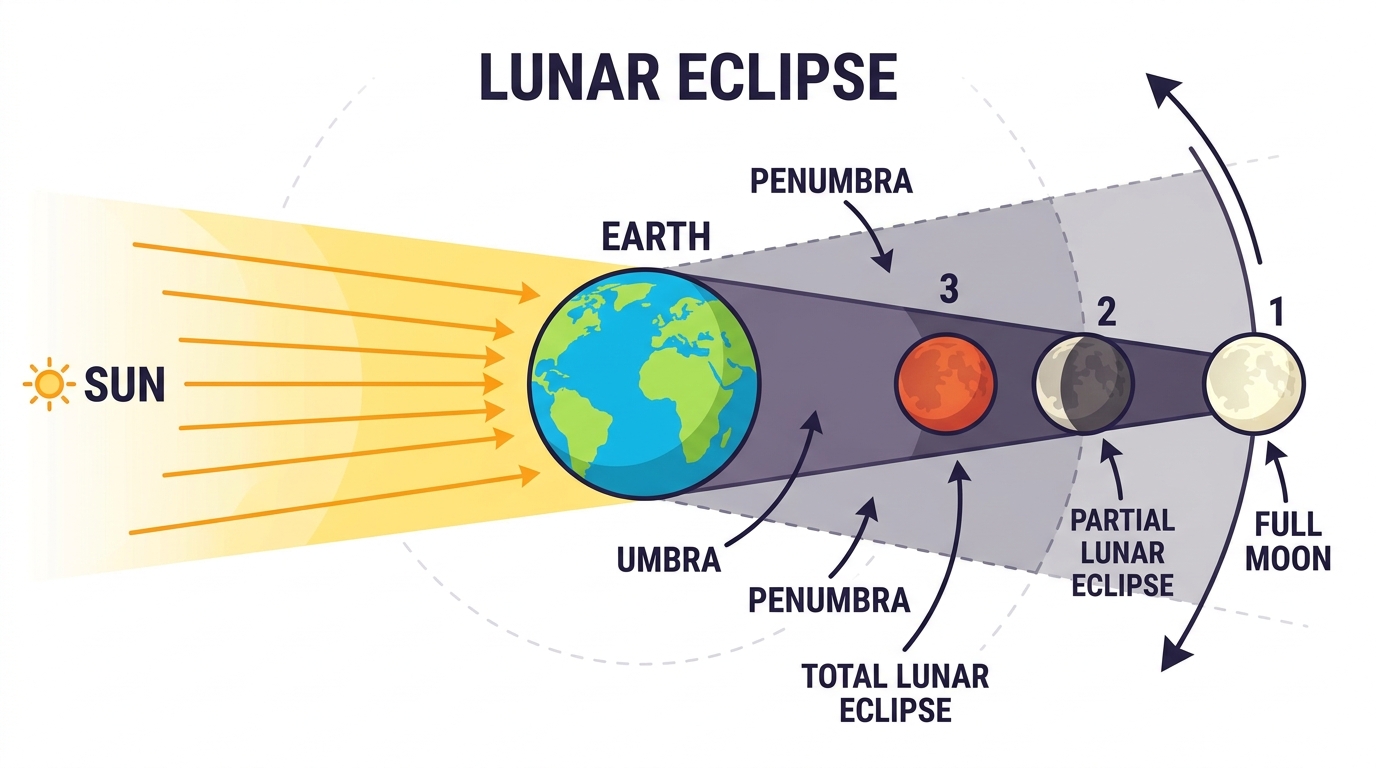

The parts of a lunar eclipse
A lunar eclipse happens when the Earth moves between the Sun and the Moon, casting Earth's shadow onto the Moon's surface and turning it a deep red-orange colour. Here is what happens at each labeled part of the diagram:
| Part | What it does | Why it matters |
|---|---|---|
| Sun | The source of sunlight whose rays Earth blocks during a lunar eclipse. | During a lunar eclipse the Sun, Earth, and Moon must be precisely aligned — a configuration called syzygy. Because the Moon's orbit is tilted about 5 degrees relative to Earth's orbit around the Sun, this perfect alignment does not happen every month: the Moon usually passes slightly above or below Earth's shadow at full moon. When the alignment is precise enough, Earth's shadow falls across the Moon and a lunar eclipse occurs. |
| Earth | Earth's shadow falls on the Moon — its umbra causes totality, its penumbra causes partial dimming. | Earth casts a shadow with two zones, just like the Moon does during a solar eclipse. The umbra is the dark, cone-shaped central shadow where no direct sunlight reaches. The penumbra is the larger outer zone where some sunlight still gets through. Whether the Moon passes through the penumbra only, clips the edge of the umbra, or passes fully through the umbra determines whether observers see a penumbral, partial, or total lunar eclipse. |
| Moon | The Moon passes through Earth's shadow — its appearance changes as it moves from full moon to blood moon and back. | Unlike a solar eclipse, a lunar eclipse is visible simultaneously from everywhere on Earth where the Moon is above the horizon — no narrow path of totality is required. The Moon can take several hours to move fully through Earth's shadow, making it a leisurely spectacle compared to the few minutes of a total solar eclipse. During totality the Moon does not disappear entirely; it turns red because Earth's atmosphere bends some sunlight around the edges of the planet onto the Moon. |
| Umbra | The darkest part of Earth's shadow — the Moon in the umbra turns deep red or orange. | When the Moon enters Earth's umbra, direct sunlight is completely blocked — but the Moon does not go dark. Instead, Earth's atmosphere acts like a lens, bending some sunlight around the edge of the planet and filtering out the blue wavelengths. Only the longer red and orange wavelengths make it through, casting a dim red glow on the Moon. The exact colour depends on how much dust and cloud is in Earth's atmosphere at the time: after major volcanic eruptions, the blood moon can be a deep brick red. |
| Penumbra | The lighter outer shadow — the Moon in the penumbra appears slightly dimmed. | The penumbra is the outer portion of Earth's shadow where some direct sunlight still reaches the Moon. When the Moon is only in the penumbra, the dimming is subtle — often too slight to notice without careful observation. Penumbral eclipses are the most common type but the least dramatic. The penumbra becomes noticeable only when the Moon is near the edge of the umbra, where the boundary between the two shadow zones creates a visible dark curve across the lunar surface. |
| Full Moon | The Moon's phase required for a lunar eclipse — it must be directly opposite the Sun. | A lunar eclipse can only happen during a full moon, because only then is the Moon on the opposite side of Earth from the Sun and in a position to enter Earth's shadow. However, not every full moon produces an eclipse — the Moon's orbit must also be nearly in the same plane as Earth's orbit around the Sun. There are typically two to four lunar eclipses per year (counting penumbral ones), with total lunar eclipses occurring roughly once every year or two. |
| Total Lunar Eclipse | The Moon is fully inside Earth's umbra and appears blood red. | A total lunar eclipse, also called a blood moon, occurs when the Moon passes completely into the darkest part of Earth's shadow. Totality can last up to about 100 minutes — far longer than a total solar eclipse — giving observers plenty of time to appreciate the eerie red Moon. Unlike a solar eclipse, a total lunar eclipse is entirely safe to view with the naked eye: the Moon at totality is simply reflecting the light of all the sunrises and sunsets happening simultaneously on Earth's rim. |
Companion worksheet
A free fill-in worksheet with an answer key, built from the labels above — students match each part to its description, then answer a couple of short questions. Great for a quick check after using the diagram.
How to print
Choose Download PDF for a ready-to-print file that fits US Letter paper (8.5 × 11") in landscape, or Download PNG for the high-resolution image.
Frequently asked questions
What causes a lunar eclipse?
A lunar eclipse occurs when Earth passes directly between the Sun and the Moon, casting Earth's shadow onto the Moon's surface.
Why does the Moon turn red during a total lunar eclipse?
Earth's atmosphere bends some sunlight around the planet and filters out blue light, so only red and orange wavelengths reach the Moon — the same effect that makes sunsets red on Earth.
What paper size should I print this on?
The diagram is sized for standard US Letter paper (8.5 × 11") in landscape orientation. Use "Download PDF" for a print-ready file that fits the page automatically.