 Printable Scholar
Balancing Equations
Change the big numbers until every atom on the left is on the right.
Reactants
Products
Atom count
| Atom | Left | Right |
|---|
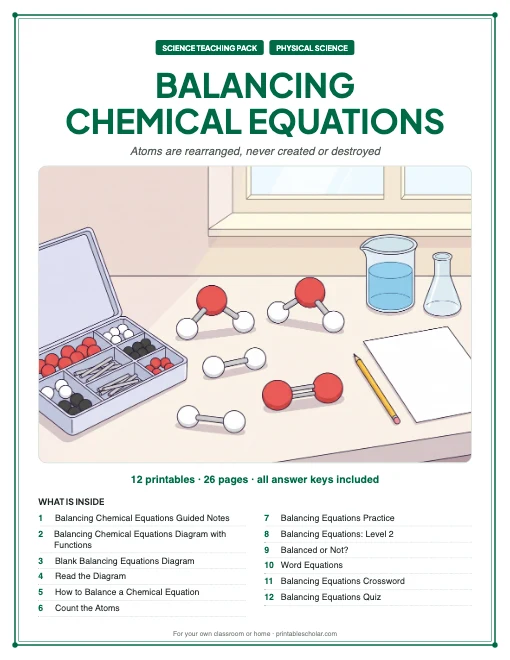 Teaching pack · Grades 8–10 · $7Teaching this? Get the Balancing Chemical Equations pack →31 lesson slides and 12 printables with answer keys, from counting atoms to combustion and word equations.
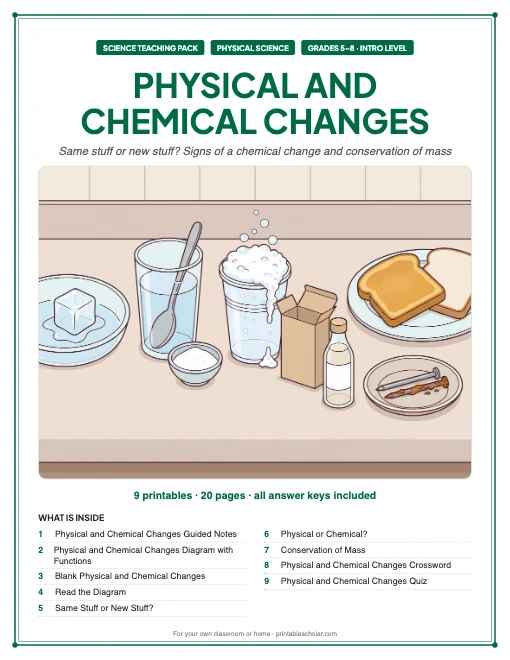 Teaching pack · Grades 5–8 · $7Teaching chemical changes? Get the Physical and Chemical Changes pack →Lesson slides and 9 printables with answer keys: in a chemical change, atoms regroup into new substances.
How to play
Tap ▲ or ▼ under any substance in the equation to change its coefficient, the big number in front. Each time, a copy of that substance pops into the box below (or one fades out), drawn as its atoms. The scales under the boxes count every element on the left and the right. A scale tips toward the side with more and turns green and level when the two sides match. When every scale is level the equation is balanced. If all your numbers can still be divided by the same number, the game asks for smaller ones. Pick any of the 24 reactions from the list, from easy to hard; nothing is locked. Reset puts the reaction back to all 1s.
Things to try
- Balance rust (Fe + O₂ → Fe₂O₃). Why does the iron end up needing a 4 in front?
- Try to fix water by tapping a subscript, and see why you can't: H₂O₂ isn't water any more.
- Balance propane burning: do carbon first, then hydrogen, and oxygen last.
- Balance water with 4, 2, 4. It balances, but can you use smaller numbers?
- In barium chloride + sodium sulfate, count the sulfate (SO₄) as one unit. It never splits up.
- Balance respiration, the biggest one: 36 atoms on each side.
Teaching balancing equations?
The Balancing Chemical Equations teaching pack has lesson slides with guided notes, two levels of balancing practice, word equations, a quiz and every answer key for grades 8 to 10. For younger students, the Physical and Chemical Changes teaching pack covers grades 5 to 8. Build the molecules themselves in the Molecule Builder.
Questions
What is a coefficient?
A coefficient is the big number in front of a formula. It says how many of that substance take part. In 2H₂O the coefficient 2 means two water molecules, so four hydrogen atoms and two oxygen atoms. A coefficient of 1 is not written.
What is the difference between a coefficient and a subscript?
A subscript is the small number inside a formula, and it is part of what the substance is: H₂O is water, but H₂O₂ is hydrogen peroxide, a different chemical. A coefficient only changes how many of the substance there are. So you balance an equation by changing coefficients, never subscripts.
Why do chemical equations have to balance?
Atoms are not made or destroyed in a chemical reaction. They only come apart and join up in new ways. This is the law of conservation of mass: every atom on the left (the reactants) must still be there on the right (the products), so the count of each element has to match.
Why use the smallest whole numbers?
4H₂ + 2O₂ → 4H₂O is balanced, but every number can be divided by 2, so it says the same thing as 2H₂ + O₂ → 2H₂O. By agreement an equation is written with the smallest whole numbers that balance it, and that is what a teacher marks right. The game tells you when you are balanced but not yet at the smallest numbers.
How do you balance a chemical equation step by step?
Count the atoms of each element on both sides. Start with an element that is in only one substance on each side, often a metal or carbon, and change a coefficient to match it. Leave hydrogen and oxygen for last, and do oxygen very last if it is on its own as O₂. Recount everything after each change. If an ion like sulfate (SO₄) stays whole on both sides, count it as one unit. When every count matches, check that the numbers can't all be divided by the same number.
Why does the game not call salt a molecule?
Salts like sodium chloride (NaCl) and metal oxides like iron oxide (Fe₂O₃) are not separate molecules. They are huge grids of ions packed together. NaCl only tells you the ratio, one sodium for every chlorine, and one NaCl is called a formula unit. The game draws one formula unit as a small packed cluster.
Is it really free?
Yes. No sign-up, no ads. The reactions you have balanced are saved on this device.