 Printable Scholar
Periodic Table with Valence Electrons
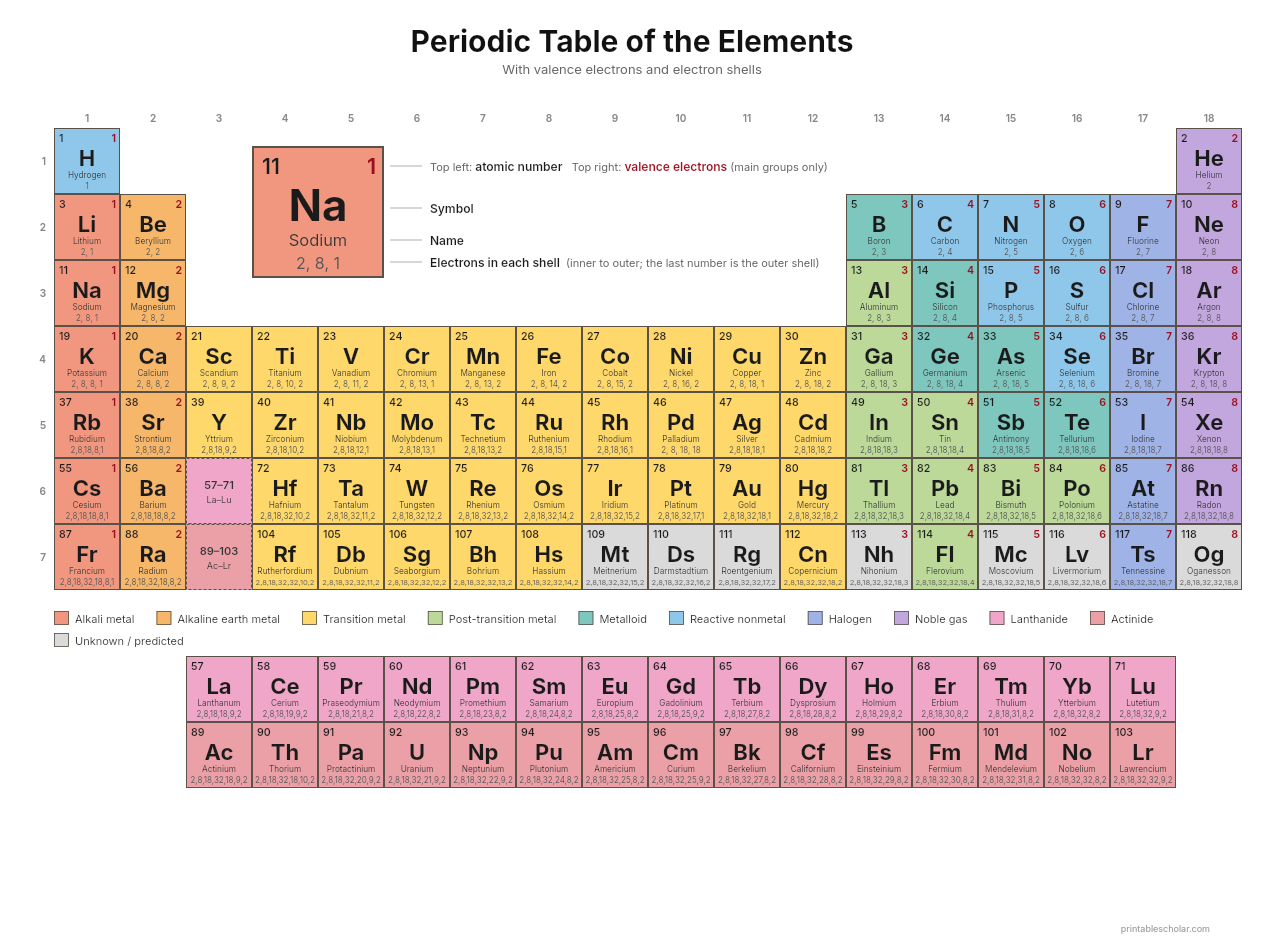
Free printable periodic table with valence electrons — the valence electron count for every main-group element and the electrons in each shell for all 118. Color-coded PDF + PNG, Letter size.
About this periodic table with valence electrons
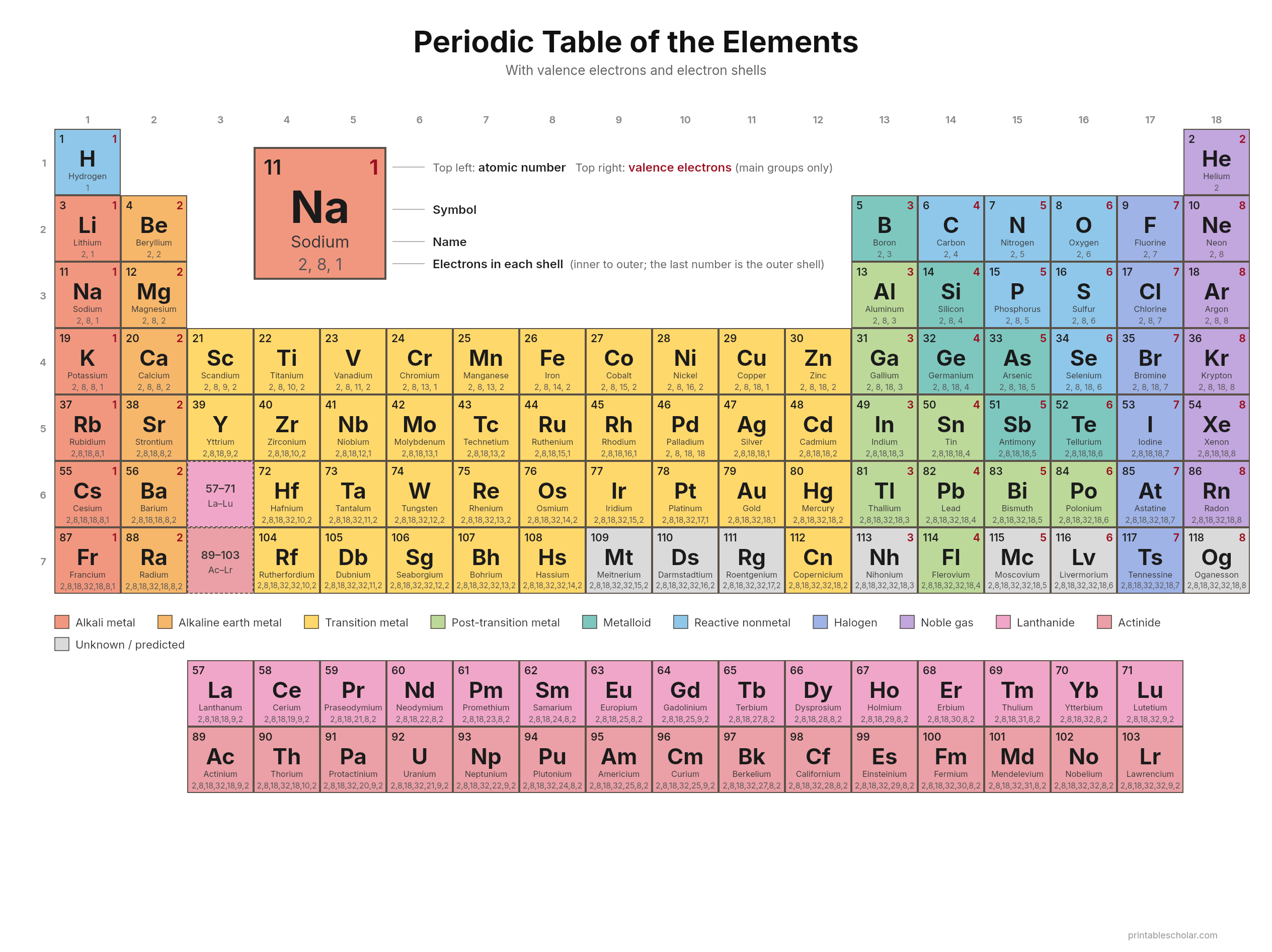
Free printable periodic table with valence electrons — the valence electron count for every main-group element and the electrons in each shell for all 118. Color-coded PDF + PNG, Letter size. Every square is drawn from real element data — atomic number, symbol, name and electron shells — rendered at high resolution so it stays crisp when you print it. There are 118 elements, laid out in the standard 18-column form with the lanthanide and actinide series shown below.
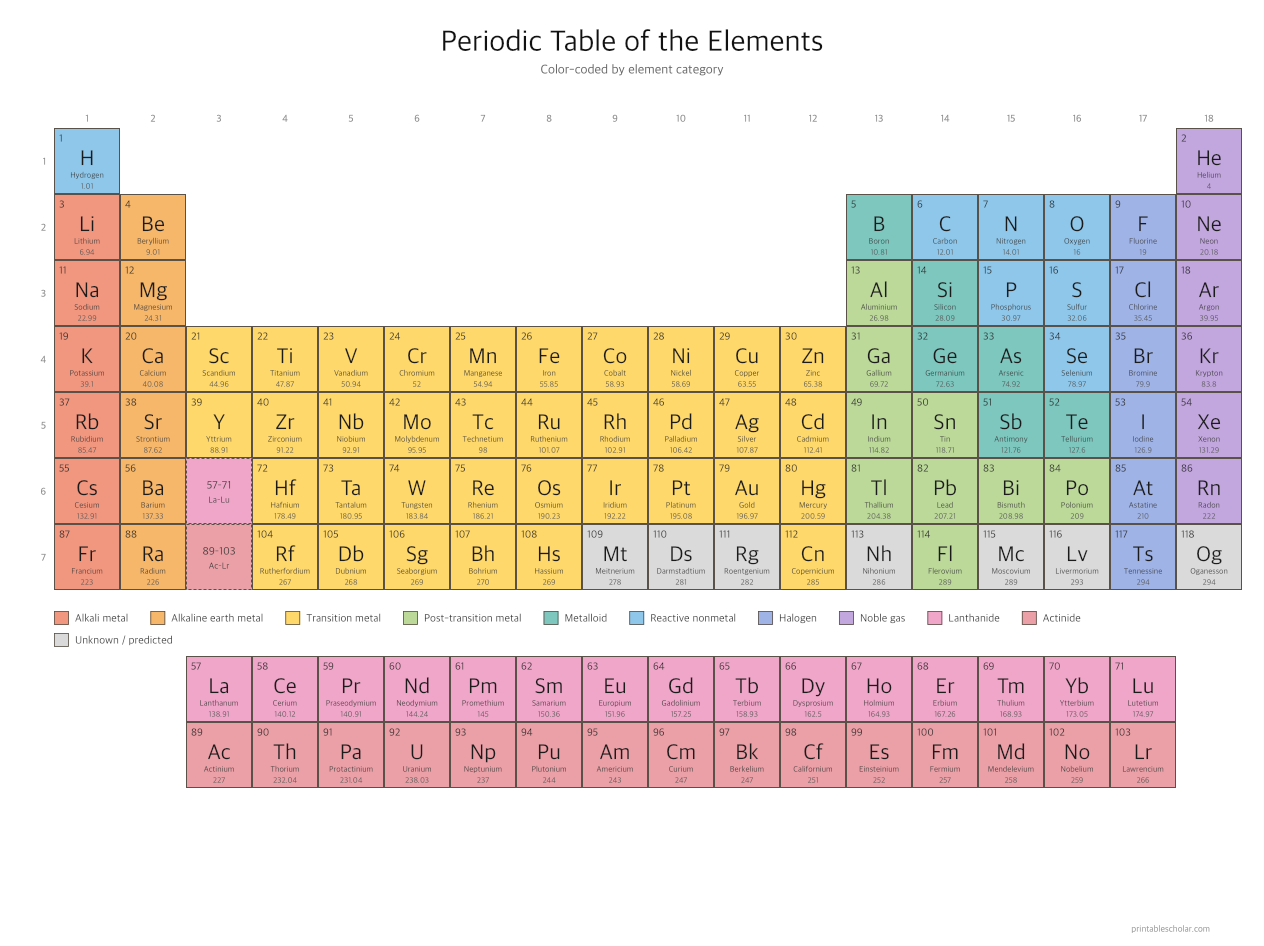
Elements are color-coded by category, and a legend printed on the table names every color so you can quickly tell metals, metalloids, nonmetals and noble gases apart.
Reading the valence electrons
The red number in the top-right corner is the number of valence electrons: the electrons in the outer shell, the ones an atom uses to bond. The line along the bottom of each square lists the electrons in each shell, from the inner shell out, so sodium's 2, 8, 1 means two electrons in the first shell, eight in the second and one in the third. That is the information you need to draw a Bohr model.
For the main groups the count follows the column: group 1 has 1, group 2 has 2, and groups 13 to 18 have 3 to 8. Helium has 2, a full first shell. Atoms gain, lose or share electrons to reach a full outer shell of 8, which is why sodium (1) gives one away and chlorine (7) takes one.
Transition metals, lanthanides and actinides have no valence count shown: they can use electrons from more than one shell, so the number depends on the reaction. Their shell lists are still given.
How to read the periodic table
Each element occupies one square showing four things: the atomic number (how many protons the atom has), the element's symbol (one or two letters), its name, and its atomic mass (the average mass of one atom). The columns are called groups — elements in the same group share similar chemical behavior — and the rows are called periods. Reading left to right, top to bottom, follows increasing atomic number.
Element categories
Elements fall into families with shared properties. From the reactive metals on the left to the stable gases on the right, here is what each color group means:
- Alkali metals. Group 1 (except hydrogen) — soft, silvery, highly reactive metals such as lithium and sodium.
- Alkaline earth metals. Group 2 — reactive metals such as magnesium and calcium.
- Transition metals. Groups 3–12 — the large central block, including iron, copper, silver and gold.
- Post-transition metals. Softer metals to the right of the transition block, such as aluminum, tin and lead.
- Metalloids. Elements with properties between metals and nonmetals, such as boron and silicon.
- Reactive nonmetals. Elements essential to life, including carbon, nitrogen, oxygen and sulfur.
- Halogens. Group 17 — very reactive nonmetals such as fluorine, chlorine and iodine.
- Noble gases. Group 18 — stable, largely unreactive gases such as helium, neon and argon.
- Lanthanides. The upper series (57–71), the rare-earth elements.
- Actinides. The lower series (89–103), including uranium and plutonium.
How to print
Choose Download PDF for a ready-to-print file that automatically fits US Letter paper (8.5 × 11") in landscape orientation, or Download PNG for the high-resolution image. For the sharpest wall poster, print the PDF at 100% scale (not "fit to page shrink") on the largest paper your printer supports.
Other versions
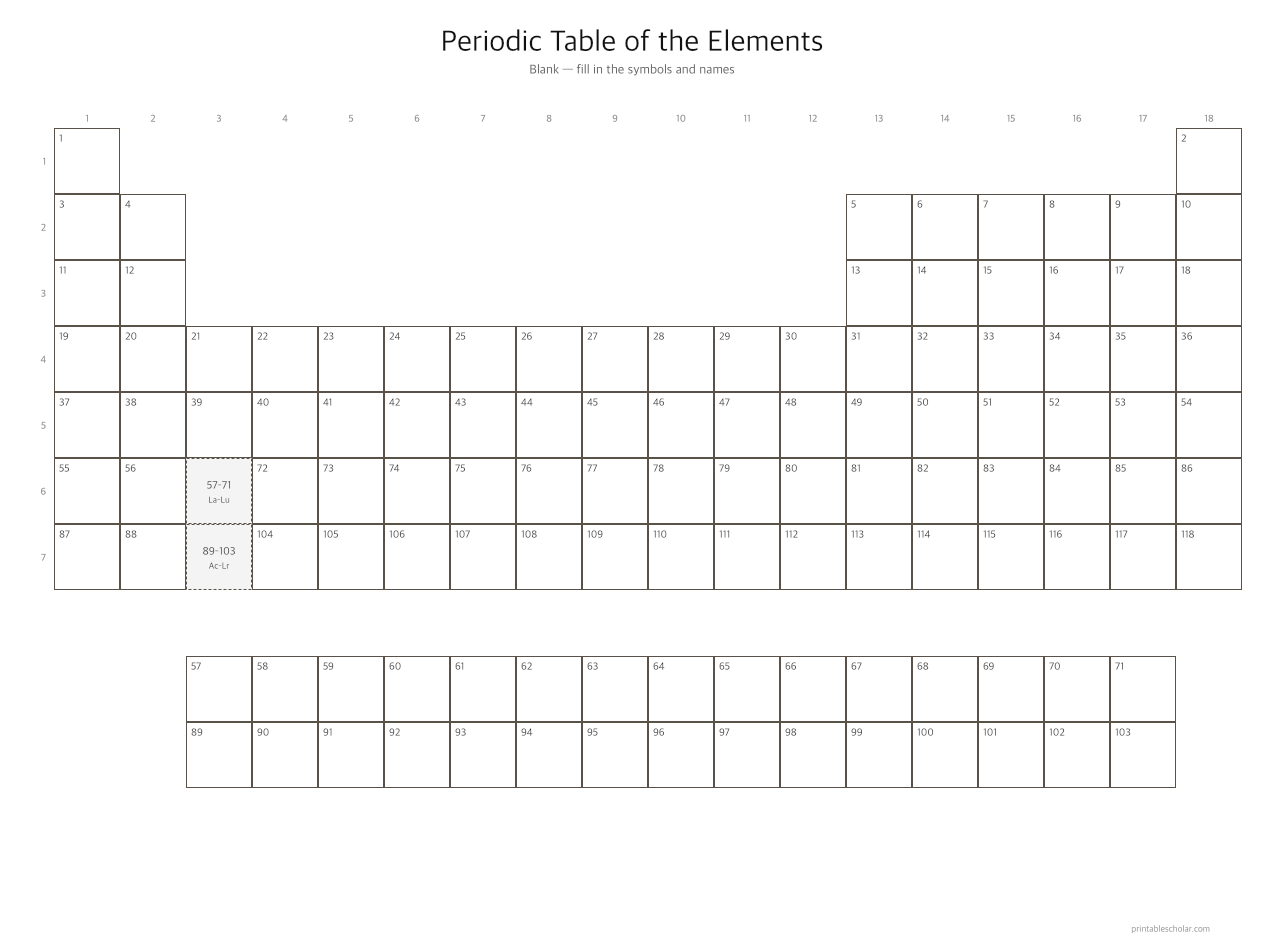
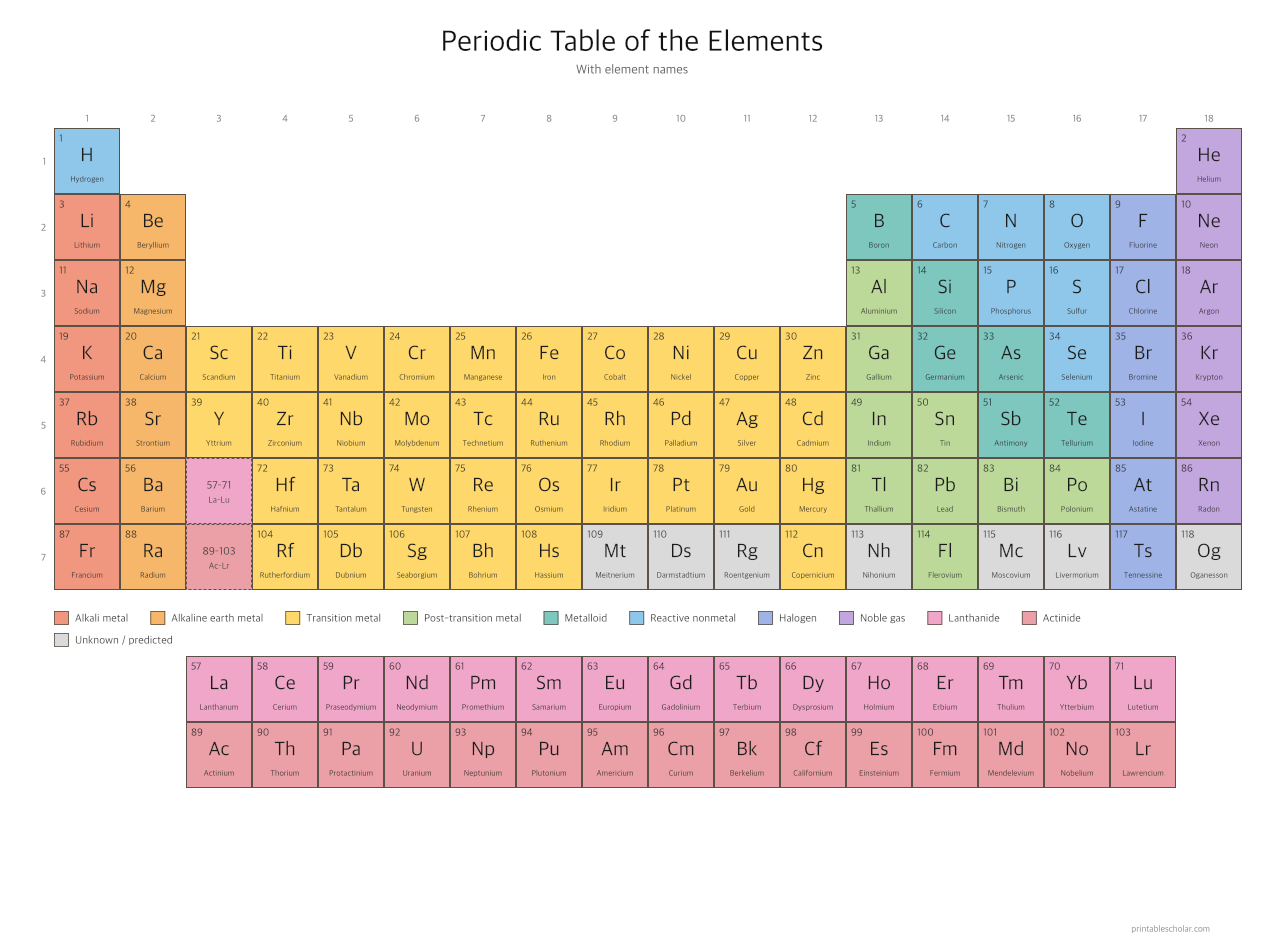
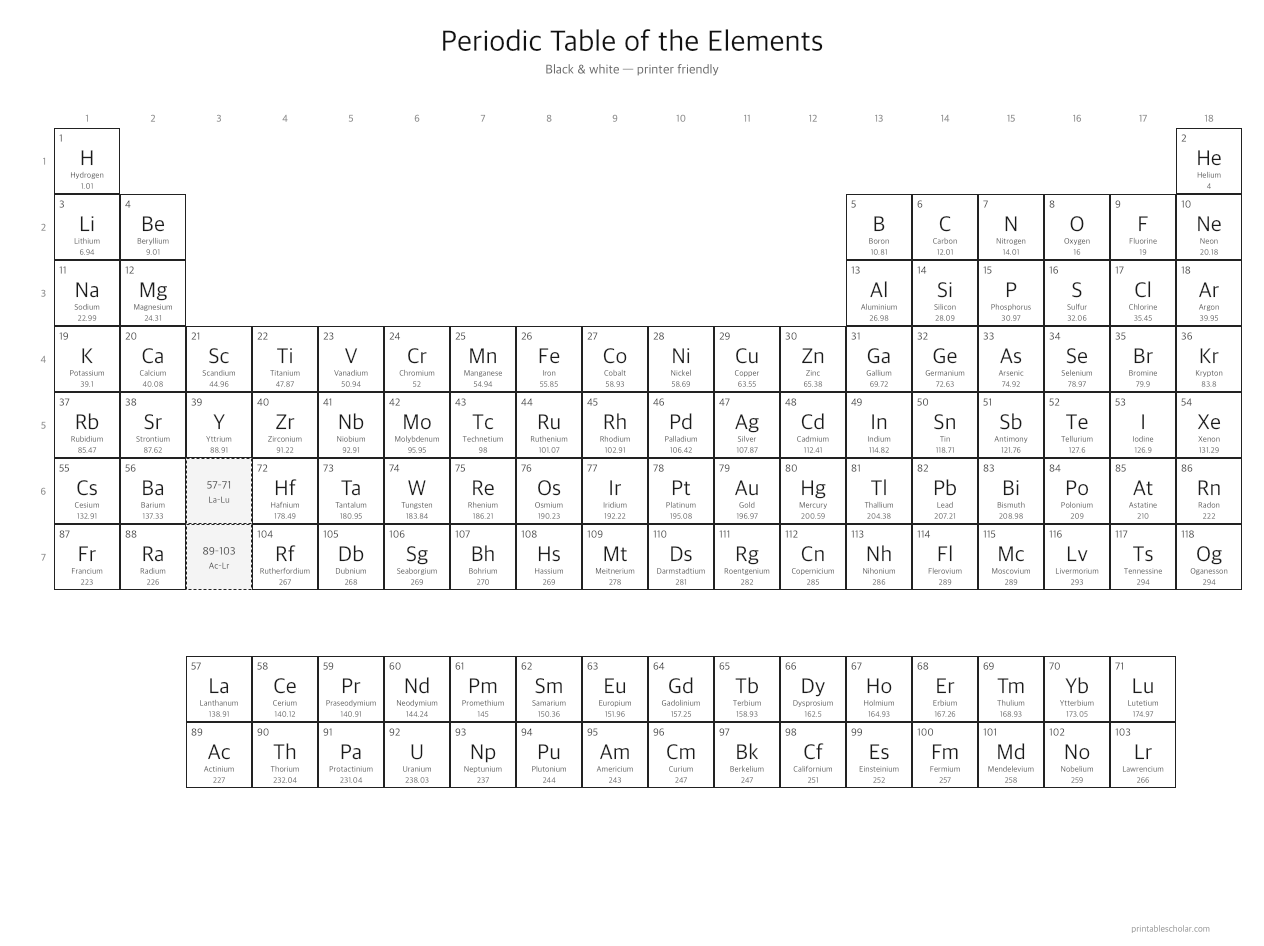
More chemistry printables
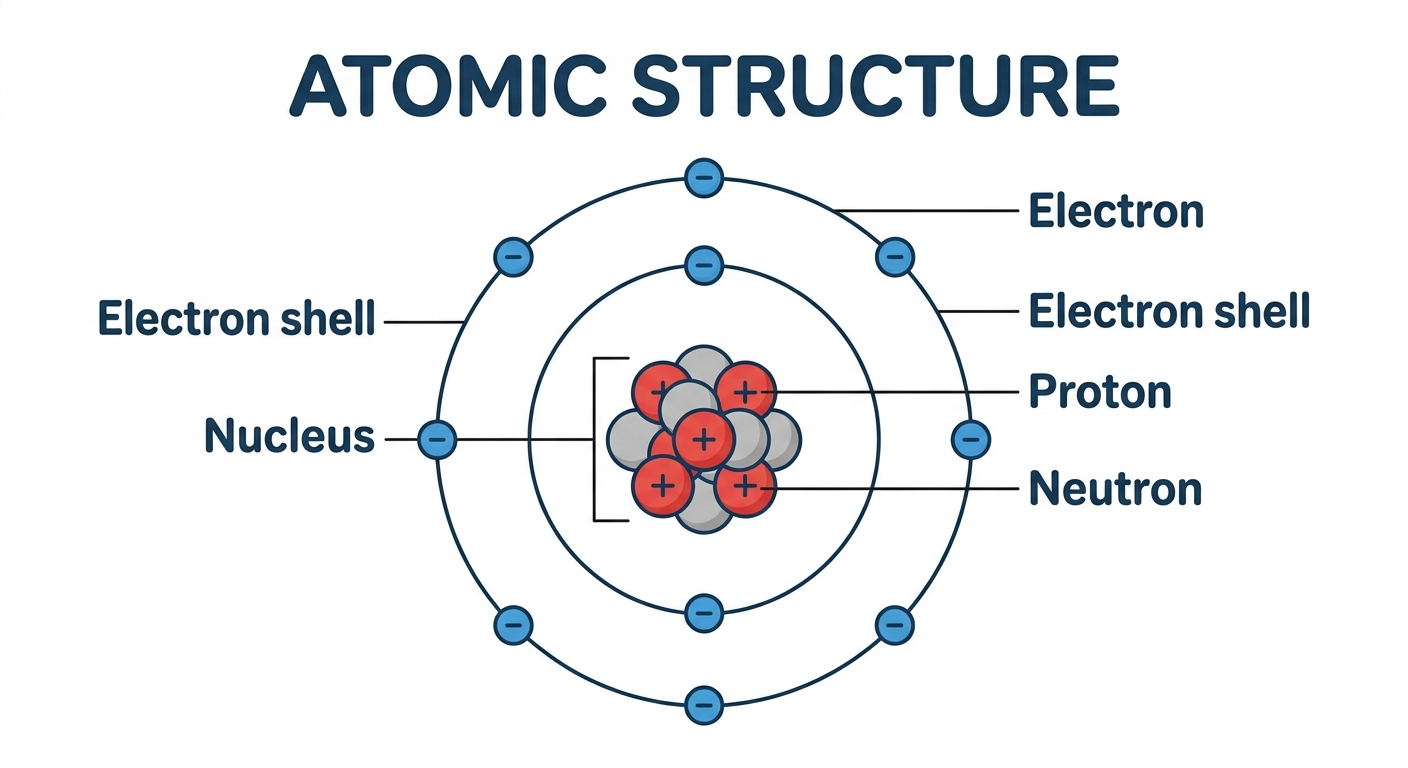
Teaching atoms? The free Parts of an Atom teaching pack has lesson slides and 8 printables with answer keys. See all science printables
Frequently asked questions
What is the periodic table?
The periodic table organizes all 118 known chemical elements by their atomic number and chemical properties. The rows are called periods and the columns are called groups; elements in the same group behave in similar ways.
How do I read the periodic table?
Each square shows the element's atomic number (the number of protons in its nucleus), its one- or two-letter symbol, its name, and its atomic mass (the average mass of one atom). Reading left to right and top to bottom follows increasing atomic number.
How do you find valence electrons on the periodic table?
For the main groups, read it from the group number: groups 1 and 2 have 1 and 2 valence electrons, and groups 13 to 18 have 3 to 8 (take away 10). Helium is the exception with 2. Valence electrons are the electrons in the outer shell, so they are also the last number in the shell list on each square.
What paper size should I print this on?
This table is sized for standard US Letter paper (8.5 × 11 inches) in landscape orientation. Click "Download PDF" for a print-ready file that fits the page automatically, or "Download PNG" for the high-resolution image.
How many elements are on the periodic table?
There are 118 confirmed elements, from hydrogen (atomic number 1) to oganesson (atomic number 118).