 Printable Scholar
Periodic Table with Electronegativity
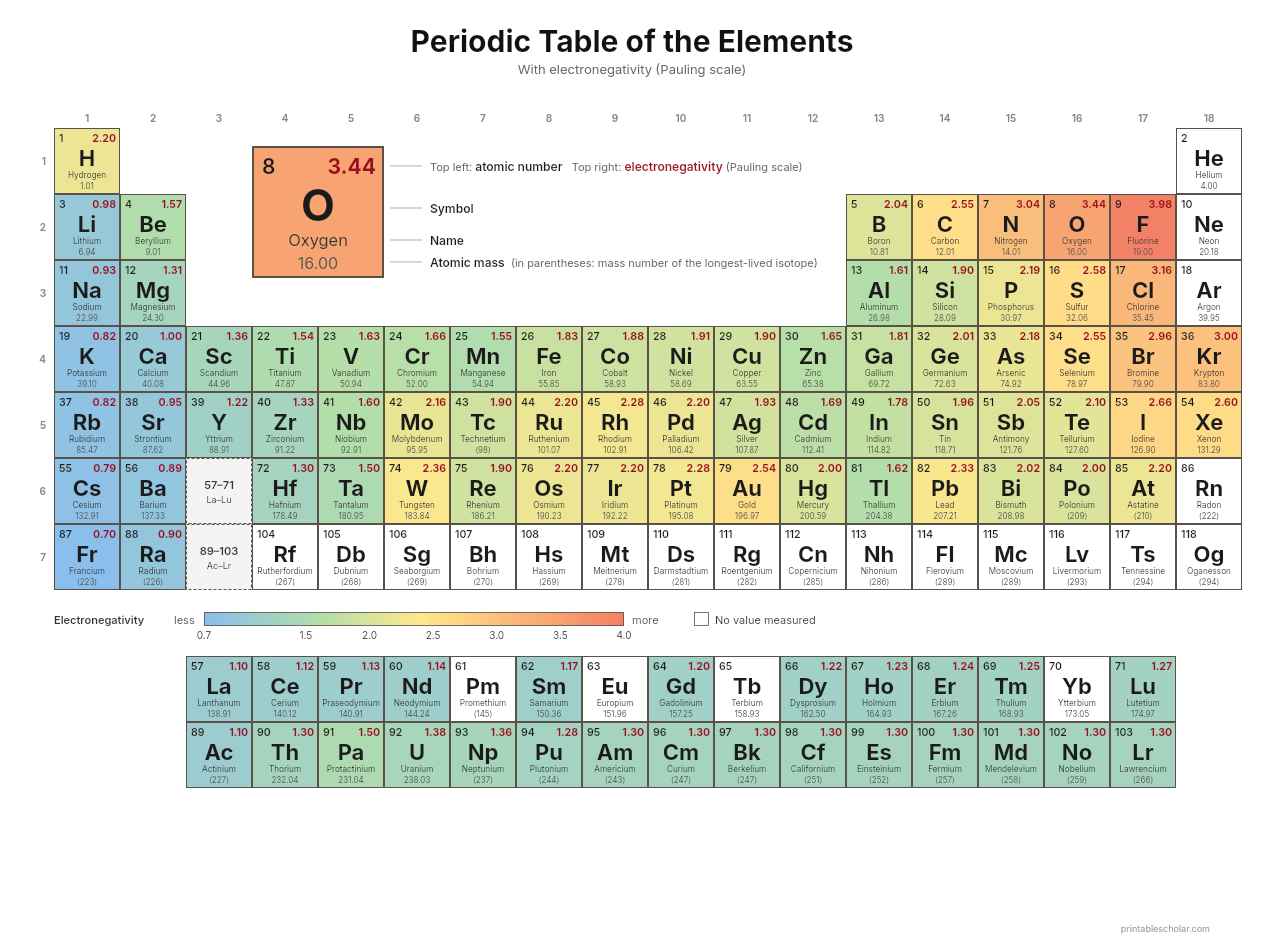
Free printable periodic table with electronegativity values — the Pauling electronegativity of every element, shaded from least to most electronegative. PDF + PNG, Letter size.
About this periodic table with electronegativity
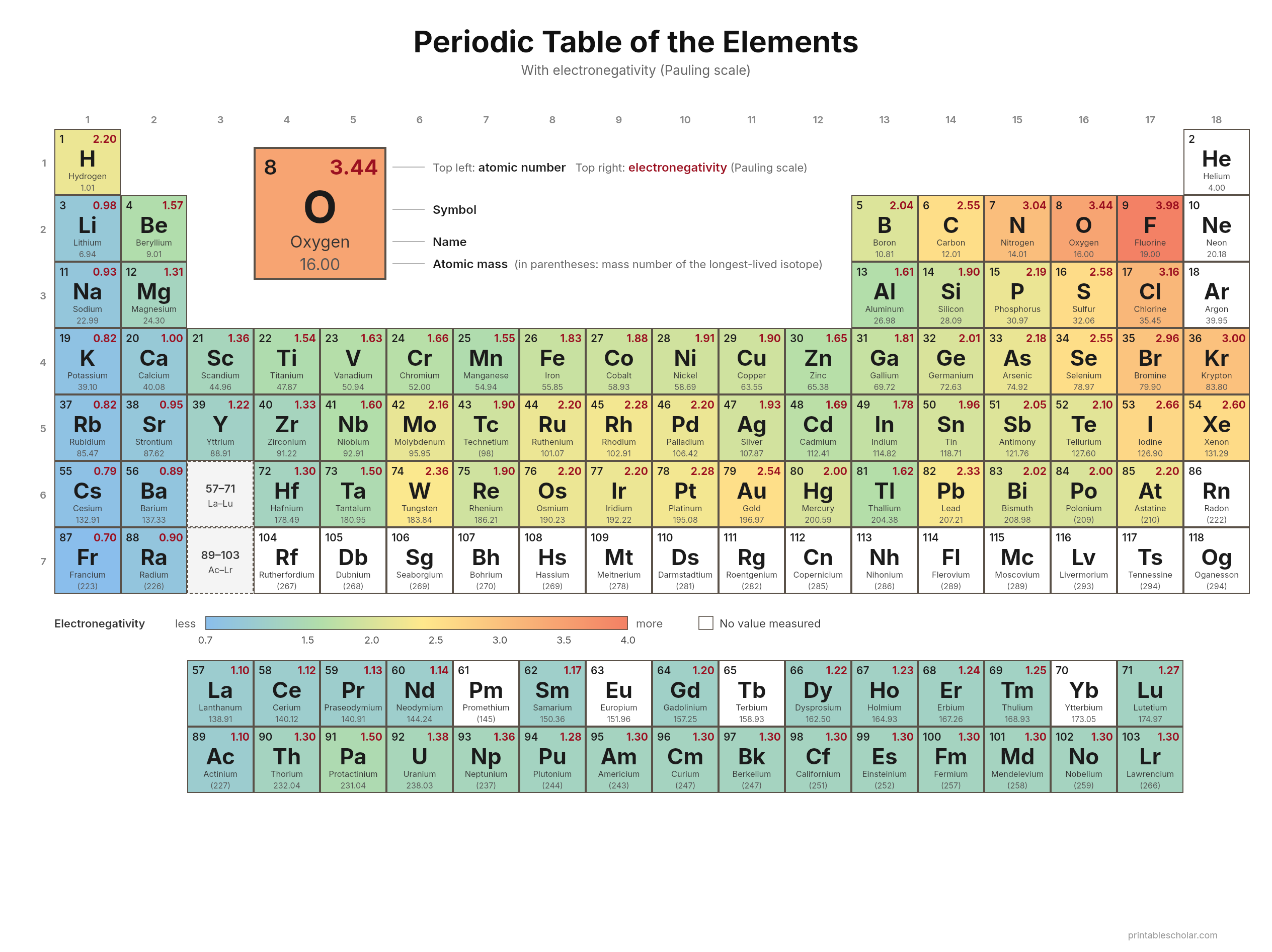
Free printable periodic table with electronegativity values — the Pauling electronegativity of every element, shaded from least to most electronegative. PDF + PNG, Letter size. Every square is drawn from real element data — atomic number, symbol, name and atomic mass — rendered at high resolution so it stays crisp when you print it. There are 118 elements, laid out in the standard 18-column form with the lanthanide and actinide series shown below.
Each square is shaded by its electronegativity, from blue (least) through green and yellow to red (most), with the value printed in the top-right corner. Squares left white have no measured value. Values are from PubChem (U.S. National Library of Medicine).
Reading the electronegativity values
Electronegativity measures how strongly an atom attracts the electrons it shares in a bond. The values here are on the Pauling scale, which runs from about 0.7 for francium to 3.98 for fluorine, the most electronegative element.
The trend runs across the table: electronegativity rises from left to right across a period and falls going down a group, so the most electronegative elements sit in the top right (fluorine, oxygen, chlorine, nitrogen) and the least in the bottom left (cesium, francium). Noble gases helium, neon and argon have no value because they do not form bonds.
The difference between two atoms tells you the kind of bond. A difference above about 1.7 is usually ionic (sodium 0.93 and chlorine 3.16 differ by 2.23, so NaCl is ionic). A smaller difference is polar covalent, like O–H in water (3.44 − 2.20 = 1.24), and a difference near zero is nonpolar covalent, like the C–H bond (2.55 − 2.20 = 0.35).
How to read the periodic table
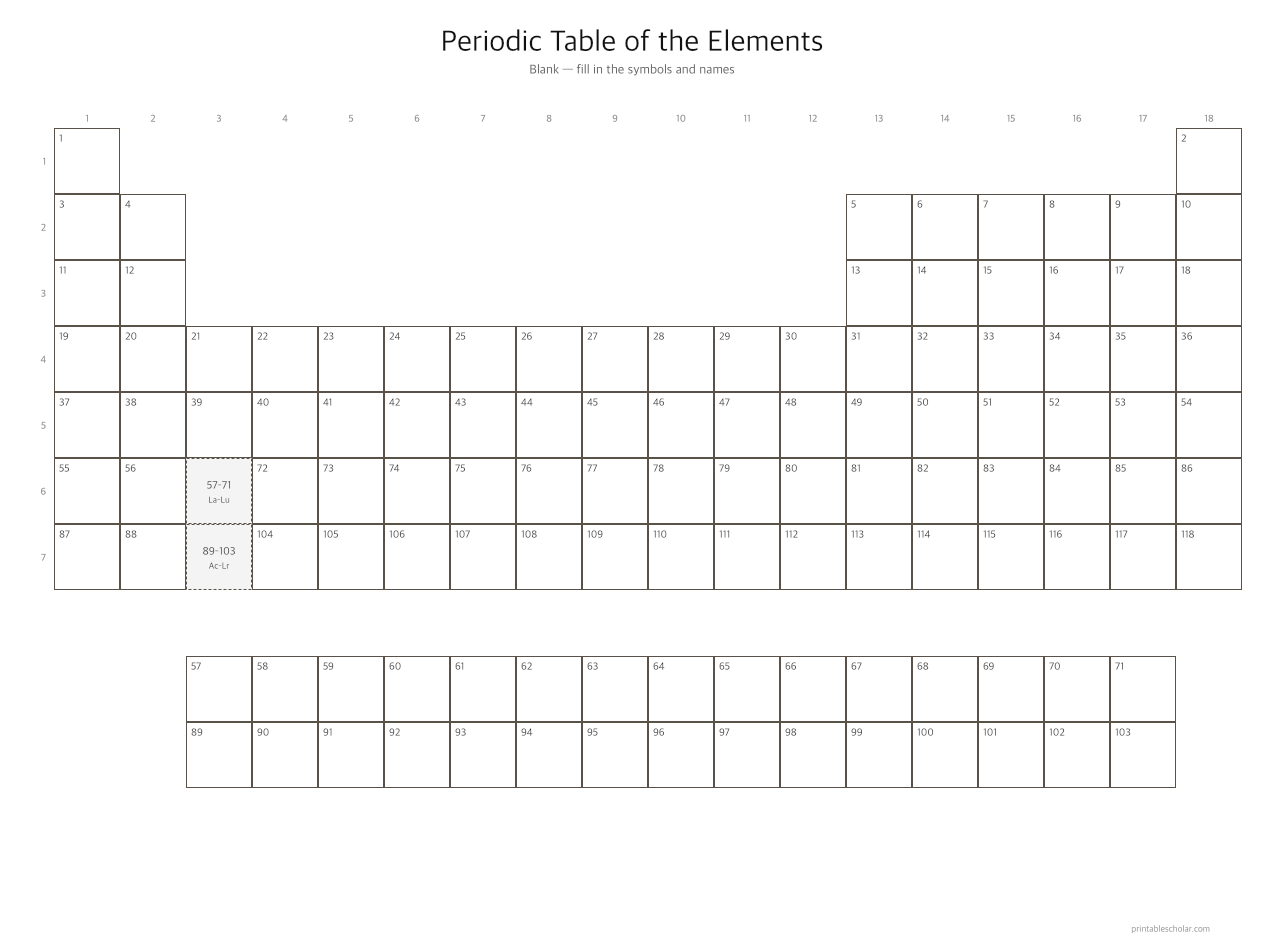
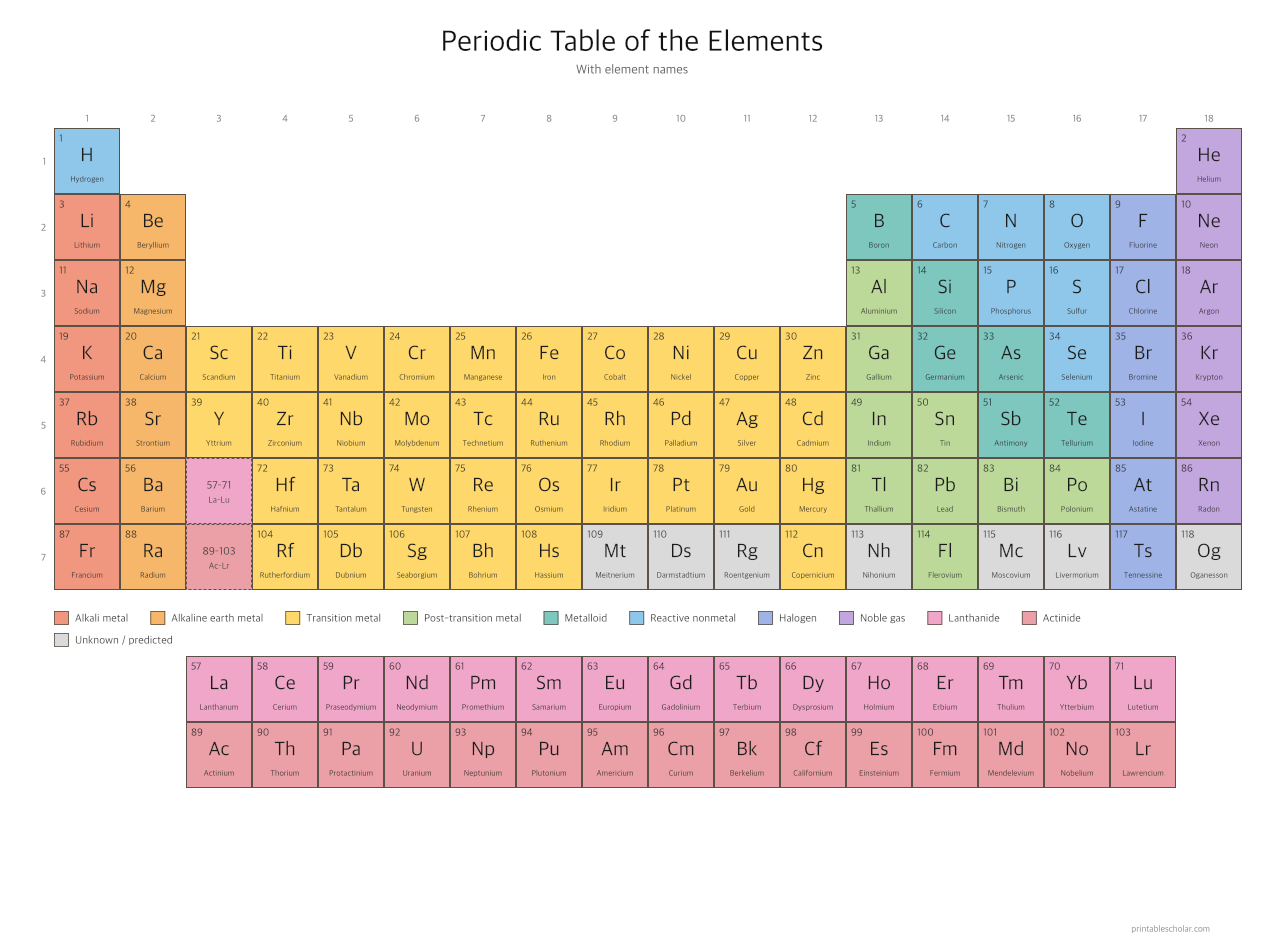
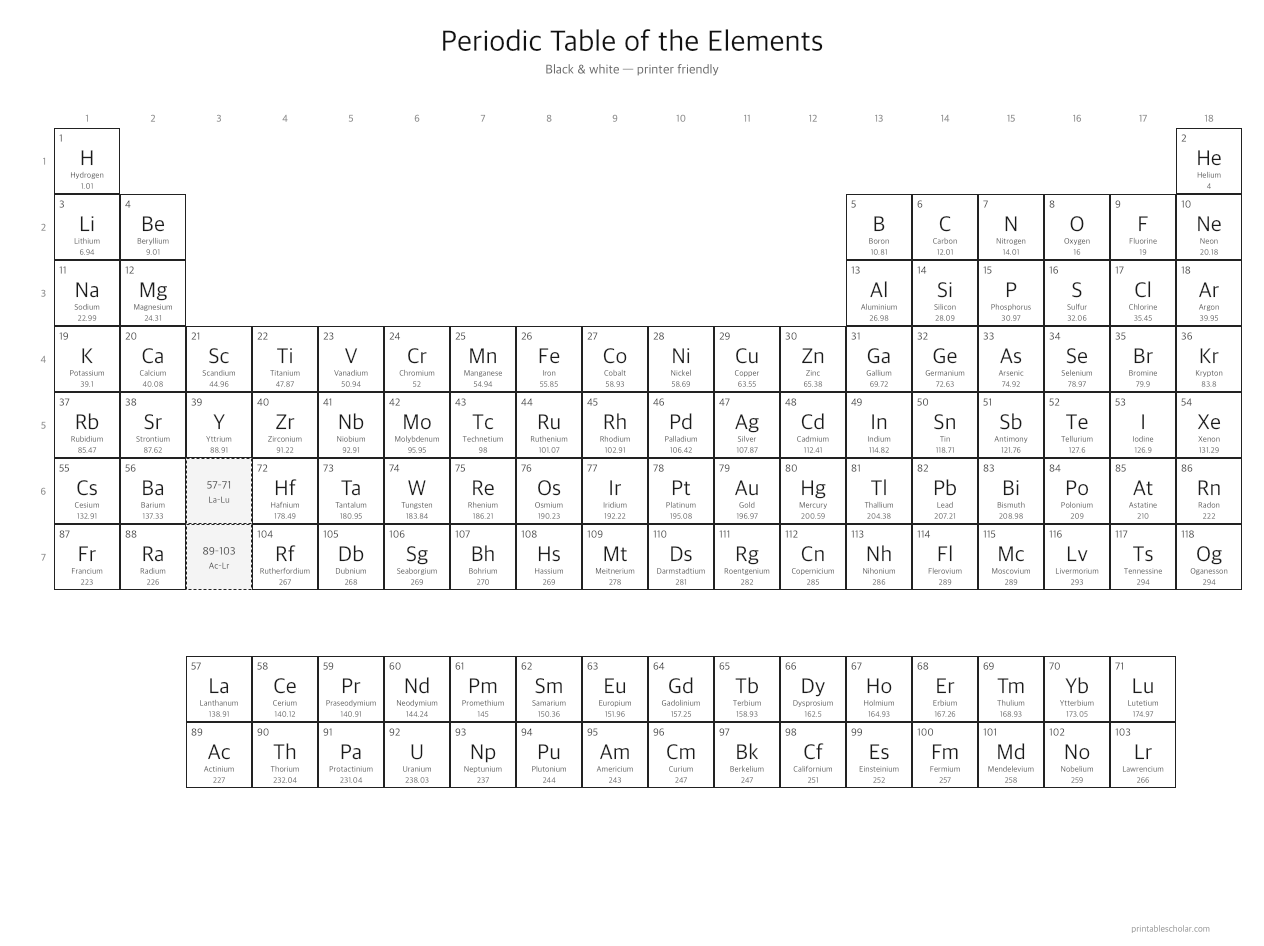
Each element occupies one square showing four things: the atomic number (how many protons the atom has), the element's symbol (one or two letters), its name, and its atomic mass (the average mass of one atom). The columns are called groups — elements in the same group share similar chemical behavior — and the rows are called periods. Reading left to right, top to bottom, follows increasing atomic number.
How to print
Choose Download PDF for a ready-to-print file that automatically fits US Letter paper (8.5 × 11") in landscape orientation, or Download PNG for the high-resolution image. For the sharpest wall poster, print the PDF at 100% scale (not "fit to page shrink") on the largest paper your printer supports.
Other versions
More chemistry printables
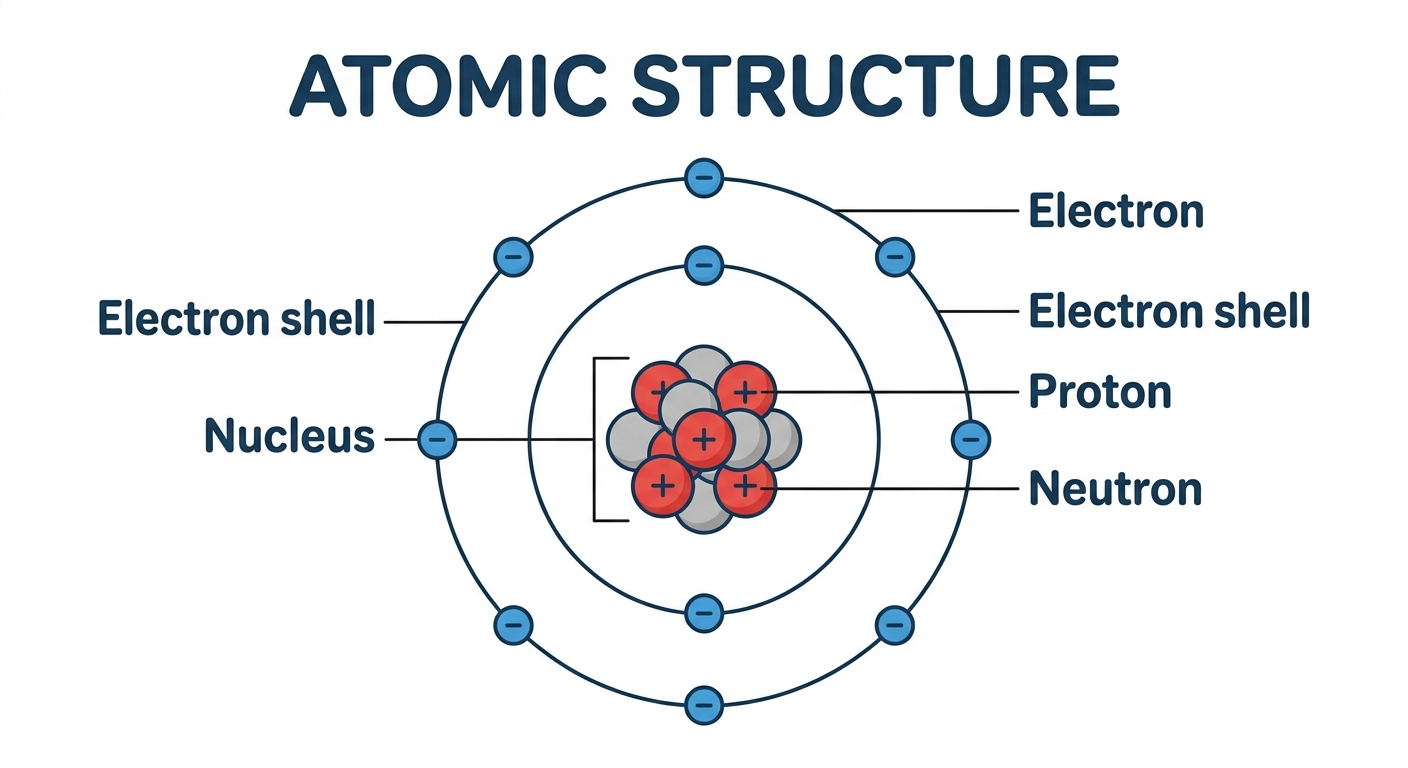
Teaching atoms? The free Parts of an Atom teaching pack has lesson slides and 8 printables with answer keys. See all science printables
Frequently asked questions
What is the periodic table?
The periodic table organizes all 118 known chemical elements by their atomic number and chemical properties. The rows are called periods and the columns are called groups; elements in the same group behave in similar ways.
How do I read the periodic table?
Each square shows the element's atomic number (the number of protons in its nucleus), its one- or two-letter symbol, its name, and its atomic mass (the average mass of one atom). Reading left to right and top to bottom follows increasing atomic number.
What is electronegativity?
Electronegativity is how strongly an atom pulls shared electrons toward itself in a chemical bond. On the Pauling scale fluorine is the highest at 3.98 and francium and cesium are the lowest, around 0.7 to 0.8. It increases from left to right across a period and decreases going down a group.
What paper size should I print this on?
This table is sized for standard US Letter paper (8.5 × 11 inches) in landscape orientation. Click "Download PDF" for a print-ready file that fits the page automatically, or "Download PNG" for the high-resolution image.
How many elements are on the periodic table?
There are 118 confirmed elements, from hydrogen (atomic number 1) to oganesson (atomic number 118).