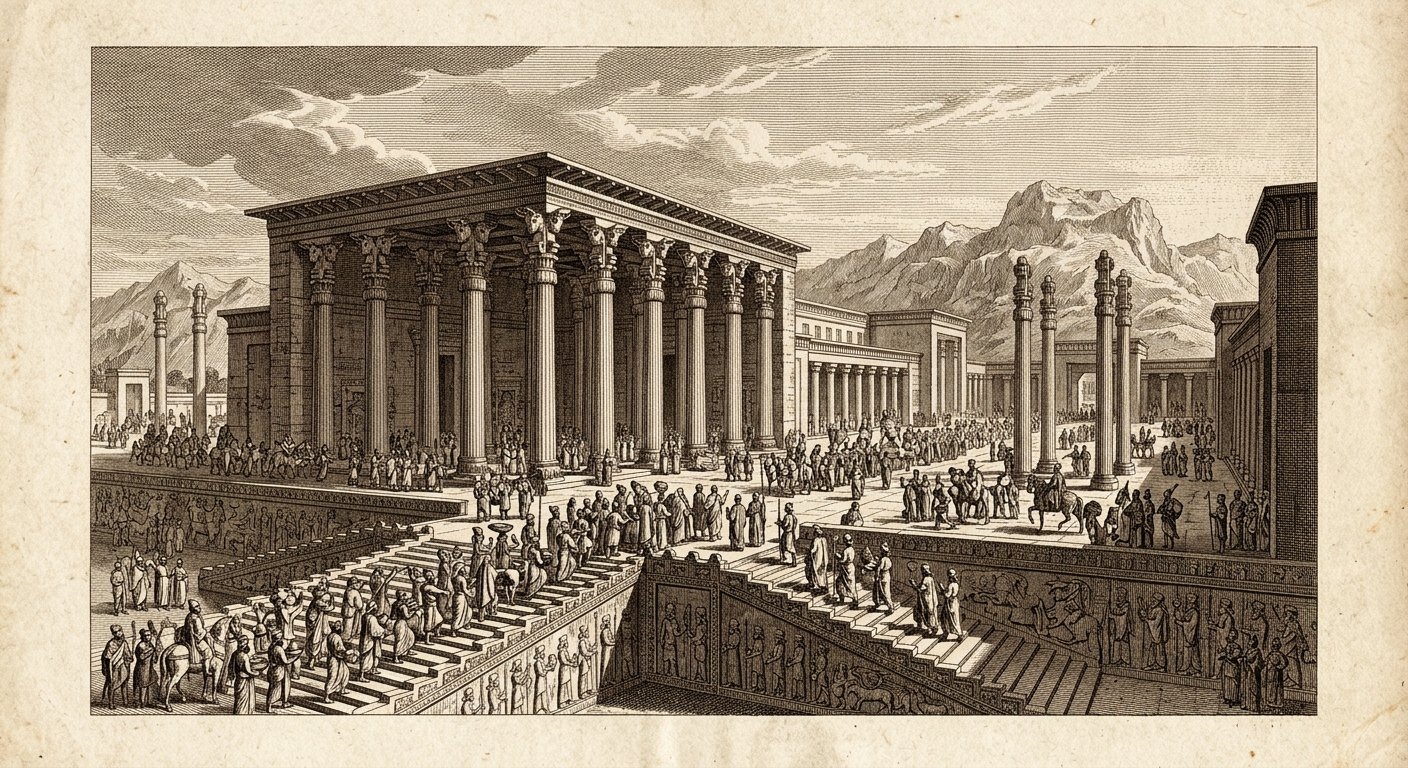
Persian Empire Timeline
The Persian Empire — founded by Cyrus the Great around 550 BC — was the largest empire the ancient world had ever seen, stretching from Greece to India and governed through a revolutionary system of provinces, roads, and religious tolerance.
When Cyrus the Great marched his army out of Persia around 550 BC, he founded something the world had never seen before: an empire that stretched from the Aegean coast to the edges of India, held together not just by force but by a deliberate policy of tolerance. Conquered peoples were allowed to keep their religions, languages, and local rulers. Cyrus even freed the Jews from Babylonian captivity and helped them return to Jerusalem. His successors Cambyses and Darius I pushed the empire further — into Egypt, along the Nile, and up to the doorstep of Greece. Darius built the famous Royal Road, nearly 2,700 kilometers of paved highway that allowed messages to travel from Susa to Sardis in a week. But two clashes with Greece — Marathon and Salamis — stopped Persian expansion westward, and the wars left a lasting rivalry. That rivalry ended dramatically in 334 BC when a Macedonian king named Alexander crossed into Asia and, in just seven years, conquered the entire Persian Empire.
- 550 BC
Cyrus the Great Founds the Empire
The Persian king Cyrus II defeats the Median king Astyages and then conquers the kingdoms of Lydia (in modern Turkey) and the Medes, creating the largest empire the world had yet seen.
Why it mattered: Cyrus's rapid conquests established Persia as the dominant power from the Aegean to Central Asia; his policy of tolerating local customs and religions made the empire far more stable than previous conquests ruled purely by force.
- 539 BC
Cyrus Conquers Babylon
Cyrus captures Babylon — then the most important city in the world — with almost no resistance; he issues the Cyrus Cylinder, a clay tablet declaring that he will respect the city's gods and free peoples deported by the Babylonian kings, including the Jews.
Why it mattered: The Cyrus Cylinder is often called the world's first declaration of human rights; Cyrus's conquest of Babylon gave Persia control of Mesopotamia and earned him a reputation for justice that made other cities more willing to surrender.
- 525 BC
Cambyses Conquers Egypt
Cyrus's son Cambyses II defeats the Egyptian pharaoh at the Battle of Pelusium and absorbs Egypt into the Persian Empire, extending Persian rule across the entire eastern Mediterranean coast.
Why it mattered: Adding Egypt gave Persia its wealthiest province and its Mediterranean coastline, completing the empire's control of the ancient Near East and making it the most powerful state in the world.
- 522–486 BC
Darius I Reorganizes the Empire
Darius I crushes a series of rebellions after Cambyses' death, then reorganizes the empire into 20 provinces called satrapies, each governed by a royal-appointed satrap; he builds the Royal Road from Sardis to Susa and begins construction of Persepolis.
Why it mattered: Darius transformed a collection of conquered territories into a functioning empire with standardized laws, coinage, and communication — the Royal Road's relay messengers could carry a message nearly 2,700 km in a week, giving the emperor unprecedented control over distant provinces.
- 490 BC
Battle of Marathon
A Persian army sent by Darius to punish Athens for supporting a Greek rebellion lands at Marathon and is defeated by a smaller Athenian force, who then famously march back to Athens to prevent a second Persian landing.
Why it mattered: Marathon was a shock — the supposedly invincible Persian army had been defeated by a Greek city-state — and it inspired Greek confidence while humiliating Darius; his son Xerxes would spend a decade planning revenge.
- 480 BC
Xerxes Invades Greece
The Persian king Xerxes leads a massive invasion of Greece; 300 Spartans hold the pass at Thermopylae long enough for Greece to prepare; Xerxes burns Athens, but the Greek navy defeats the Persian fleet at Salamis and Xerxes retreats.
Why it mattered: The battles of Thermopylae and Salamis became defining moments in Western history — Salamis ended Persia's chance of conquering Greece and saved the Greek city-states that would produce Socrates, Plato, and the foundations of Western philosophy and democracy.
- 449 BC
Peace of Callias
Athens and Persia sign the Peace of Callias (or a formal agreement of mutual non-aggression), ending fifty years of conflict and establishing the Aegean Sea and western Anatolia as roughly the boundary between Greek and Persian spheres.
Why it mattered: The peace recognized Persia's failure to conquer Greece and allowed both sides to focus internally; for Athens it signaled the start of its Golden Age — the great age of the Parthenon, Sophocles, and Socrates.
- 334–330 BC
Alexander the Great Conquers Persia
The Macedonian king Alexander III crosses into Anatolia, defeats Persian forces three times — at Granicus (334 BC), Issus (333 BC), and Gaugamela (331 BC) — captures Persepolis and burns it, then pursues the last Persian king Darius III until Darius is killed by his own nobles in 330 BC.
Why it mattered: Alexander's conquest ended the 220-year Achaemenid dynasty and spread Greek language and culture across the entire former Persian Empire — from Egypt to Afghanistan — beginning the Hellenistic Age that shaped the ancient world for the next three centuries.
Persian Empire Quiz
Check what you learned — read on screen, or use the Printable quiz button above for a worksheet version with an answer key.
Who founded the Persian (Achaemenid) Empire around 550 BC?
- A) Darius the Great, who reorganized the provinces
- B) Xerxes, who invaded Greece
- C) Cyrus the Great, who conquered the Medes and Lydians
- D) Cambyses II, who conquered Egypt
What was historically significant about the Cyrus Cylinder?
- A) It was the first map of the Persian Empire
- B) It declared Cyrus's right to rule by divine authority only
- C) It described Cyrus's policy of allowing conquered peoples to keep their religions and customs
- D) It listed the taxes owed to the Persian king by each province
What were the Persian provinces called, each governed by a royal-appointed official?
- A) Prefectures
- B) Satrapies
- C) Cantons
- D) Territories
What happened at the Battle of Marathon in 490 BC?
- A) Xerxes burned Athens after defeating the Greek army
- B) A Persian army was defeated by the Athenians, shocking the Persian world
- C) Sparta and Athens joined forces to defeat Persia for the first time
- D) Darius I personally led his army to victory over the Greeks
Which Persian king led the great invasion of Greece in 480 BC?
- A) Cyrus the Great
- B) Darius I
- C) Cambyses II
- D) Xerxes, son of Darius I
What was the Royal Road built by Darius I?
- A) A ceremonial road connecting Persepolis to Babylon
- B) A nearly 2,700-kilometer road from Sardis to Susa that allowed rapid communication across the empire
- C) A road built to move the Persian army quickly to the Greek frontier
- D) A trade route from Persia to India along the Silk Road
What was Persepolis?
- A) The capital city of ancient Babylon that Cyrus conquered
- B) A Greek city-state that allied with Persia against Athens
- C) The ceremonial capital of the Persian Empire, built by Darius I and burned by Alexander
- D) The port city where the Persian fleet launched its invasion of Greece
Who ended the Persian Empire?
- A) The Roman general Julius Caesar during his eastern campaigns
- B) A coalition of Greek city-states after the Battle of Plataea
- C) Alexander the Great of Macedonia, who conquered Persia between 334 and 330 BC
- D) The Parthians, who rebelled from within the empire
Show answer key
1. C · 2. C · 3. B · 4. B · 5. D · 6. B · 7. C · 8. C
Related timelines
 Ancient Greece Timeline — Ancient Greece gave the world democracy, philosophy, the Olympics, and some of history's greatest art and literature, flourishing in independent city-states along the Mediterranean. Open →
 Ancient Mesopotamia Timeline — Ancient Mesopotamia — the land between the Tigris and Euphrates rivers in present-day Iraq — is called the cradle of civilization, home to the world's first cities, first writing, and first law codes. Open →
How to print
Choose Download PDF for a ready-to-print timeline that fits US Letter paper (8.5 × 11"). The blank fill-in version keeps the dates and gives students empty lines to write each event — great for review and quizzes.
Frequently asked questions
How did the Persian Empire treat conquered peoples?
The Persian approach was remarkably tolerant by ancient standards. Rather than destroying local religions and cultures — as the Assyrians and Babylonians often did — Cyrus and his successors allowed conquered peoples to keep their own gods, languages, and local rulers. Cyrus famously freed the Jewish people from Babylonian captivity and helped them rebuild their temple in Jerusalem. Satraps (provincial governors) were often local nobles rather than Persians. This tolerance made the empire more stable, but also meant it lacked a single unifying culture — a weakness Alexander would exploit when he portrayed himself as a liberator rather than a conqueror.
Why couldn't the Persian Empire conquer Greece?
Geography and Greek unity. Greece's mountainous terrain and many harbors made it difficult to conquer by land. At Marathon, the Greeks proved that disciplined infantry (hoplites in tight formation) could defeat the more lightly armed Persian infantry. At Salamis, the Greeks used their knowledge of local waters to trap and destroy the Persian fleet. But the deepest problem was that Persia's strength — governing huge territories with light administration — became a weakness when facing a small determined enemy on its home terrain. After Salamis, further conquest was simply not worth the cost.
What paper size should I print this on?
The timeline is sized for standard US Letter paper (8.5 × 11 in.). The Download PDF button gives you a print-ready file that fits the page automatically.