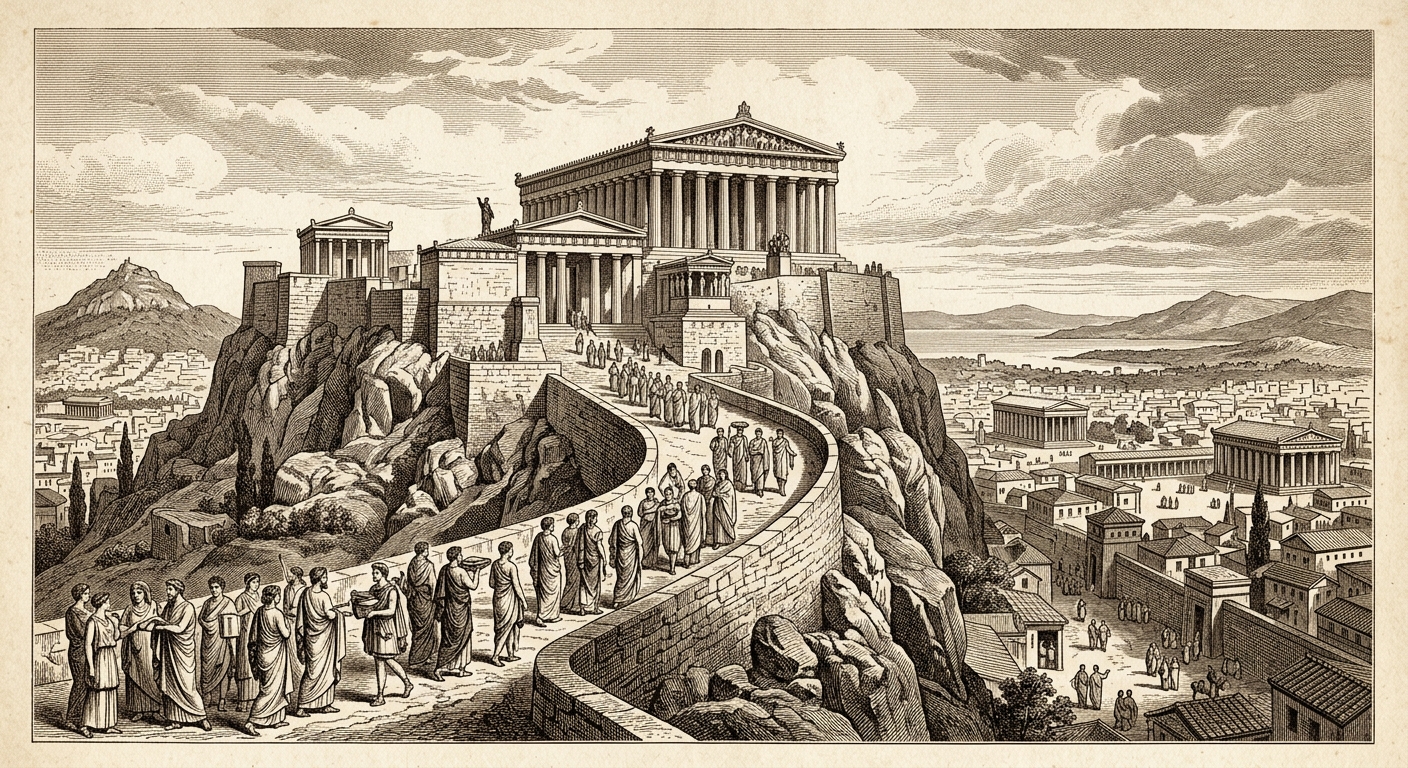
Ancient Greece Timeline
Ancient Greece gave the world democracy, philosophy, the Olympics, and some of history's greatest art and literature, flourishing in independent city-states along the Mediterranean.
Ancient Greece was not one country but a collection of hundreds of independent city-states, each with its own government, identity, and character. The two most famous were Athens, a center of democracy, philosophy, and the arts, and Sparta, famed for its fierce warrior culture. Greek thinkers asked questions about the nature of reality, justice, and the good life that philosophers still wrestle with today. The Greeks were also great storytellers, artists, and scientists — they laid foundations in mathematics, astronomy, and medicine that shaped later civilizations for centuries. Though the age of the independent city-states ended when Alexander the Great united Greece and conquered the known world, Greek ideas lived on inside the Roman Empire and eventually throughout Western civilization.
- 776 BC
First Olympic Games
The first recorded Olympic Games are held at Olympia in honor of Zeus, bringing city-states together in peaceful athletic competition.
Why it mattered: The Olympics united rival Greek city-states every four years in a truce — a tradition the modern world revived in 1896 and still observes today.
- ~750 BC
Homer's Epics Written Down
The oral poems of Homer — the Iliad and the Odyssey — are written down, becoming the foundation of Greek literature.
Why it mattered: Homer's epics shaped Greek culture, values, and identity for centuries — and are still read and taught today as foundational works of Western literature.
- 507 BC
Athenian Democracy
The Athenian leader Cleisthenes introduces democratic reforms giving citizens a direct vote in the government of Athens.
Why it mattered: Athens became the world's first democracy, planting the idea that ordinary citizens — not kings or gods — should govern themselves.
- 490 BC
Battle of Marathon
Athens defeats a much larger Persian invasion force at Marathon; legend says a messenger ran to Athens to announce the victory.
Why it mattered: The victory preserved Greek independence and democracy; the messenger's legendary run gave us the marathon race.
- 480 BC
Battle of Thermopylae
Three hundred Spartan warriors hold a narrow mountain pass against the massive Persian army for three days before being defeated.
Why it mattered: Though the Spartans died to a man, their sacrifice bought time for Greece to regroup — and became one of history's most celebrated acts of courage.
- 461–429 BC
Golden Age of Athens
Under the statesman Pericles, Athens builds the Parthenon, fosters great playwrights and philosophers, and reaches its cultural peak.
Why it mattered: Athens in this era gave the world democracy, the philosophy of Socrates, the plays of Sophocles and Euripides, and architectural masterpieces still admired today.
- 431–404 BC
Peloponnesian War
Athens and Sparta fight a devastating war that tears the Greek world apart and ends with the defeat of Athens.
Why it mattered: The war exhausted the city-states, leaving them weakened and vulnerable — opening the door for Macedon to the north to conquer all of Greece.
- 338 BC
Philip II Conquers Greece
Philip II of Macedon defeats the Greek city-states at the Battle of Chaeronea and unites them under Macedonian control.
Why it mattered: The era of independent city-states ended; Greece became the launching pad for Philip's son Alexander to conquer the ancient world.
- 336–323 BC
Alexander the Great
Alexander conquers Egypt, Persia, and lands as far as India in one of history's greatest military campaigns before dying at age 32.
Why it mattered: Alexander spread Greek language, culture, and ideas across the ancient world — creating the Hellenistic Age, a blending of Greek and Eastern civilization.
- 146 BC
Rome Conquers Greece
Rome defeats the Greek city-states and destroys Corinth, ending Greek independence and making Greece part of the Roman world.
Why it mattered: Greek independence ended, but Greek culture lived on inside Rome — Roman education, literature, and art were so deeply shaped by Greece that the Romans themselves said they had conquered Greece militarily but Greece had conquered them culturally.
Ancient Greece Quiz
Check what you learned — read on screen, or use the Printable quiz button above for a worksheet version with an answer key.
What were the ancient Olympic Games?
- A) Military training competitions held before battles
- B) Athletic competitions held every four years at Olympia, uniting the Greek city-states
- C) A Spartan festival honoring their warrior gods
- D) A competition between Athens and Sparta for political leadership
What made Athens historically significant around 507 BC?
- A) It built the first Olympic stadium
- B) It introduced democracy — giving citizens a direct vote in government
- C) It defeated the Persian army at Marathon
- D) It became the largest city in the ancient world
What happened at the Battle of Marathon in 490 BC?
- A) Sparta held off Persia at a mountain pass
- B) Athens defeated a larger Persian army, protecting Greek independence
- C) Greece fell to Macedonian rule
- D) Alexander the Great began his conquests
Why is the Battle of Thermopylae famous?
- A) Three hundred Spartans held a pass against the Persian army for three days before being defeated
- B) Athens defeated Persia there and ended the invasion
- C) Alexander the Great won his first battle there
- D) It ended the Peloponnesian War
What is Athens' Golden Age known for?
- A) Sparta's military dominance over Athens
- B) The first Olympic Games
- C) Democracy, the philosophy of Socrates, great drama, and the Parthenon
- D) The conquest of Persia
What was the Peloponnesian War?
- A) A war between Greece and Persia
- B) A war between Athens and Sparta that ended with Athens' defeat
- C) Alexander's campaign to conquer Persia
- D) Rome's conquest of Greece
Who was Alexander the Great?
- A) The Athenian leader who introduced democracy
- B) The Spartan king who fought at Thermopylae
- C) The Macedonian king who conquered Egypt, Persia, and lands as far as India
- D) The Roman general who defeated Cleopatra
When did Rome conquer Greece?
- A) 338 BC, when Philip II of Macedon defeated the city-states
- B) 31 BC, when Octavian defeated Cleopatra at Actium
- C) 146 BC, when Rome destroyed Corinth and ended Greek independence
- D) 27 BC, when Augustus became Rome's first emperor
Show answer key
1. B · 2. B · 3. B · 4. A · 5. C · 6. B · 7. C · 8. C
Related timelines
 Ancient Rome Timeline — Ancient Rome grew from a small city on the banks of the Tiber River into the greatest empire of the ancient world, lasting over a thousand years. Open →
 Ancient Egypt Timeline — Ancient Egypt was one of the world's first great civilizations, ruled by pharaohs along the Nile River for more than 3,000 years. Open →
How to print
Choose Download PDF for a ready-to-print timeline that fits US Letter paper (8.5 × 11"). The blank fill-in version keeps the dates and gives students empty lines to write each event — great for review and quizzes.
Frequently asked questions
What is ancient Greece known for?
Ancient Greece is the birthplace of democracy, Western philosophy, the Olympic Games, and foundational ideas in science, mathematics, literature, and art. Thinkers like Socrates, Plato, and Aristotle shaped how later civilizations thought about knowledge, ethics, and government. Greek mythology, architecture, and drama remain part of world culture today.
What were the Greek city-states?
City-states (called poleis) were independent communities, each with its own government, laws, and identity. The most famous were Athens, known for democracy and culture, and Sparta, known for its disciplined warrior society. The city-states sometimes fought each other but united against common threats like the Persian invasions of 490 and 480 BC.
What paper size should I print this on?
The timeline is sized for standard US Letter paper (8.5 × 11 in.). The Download PDF button gives you a print-ready file that fits the page automatically.