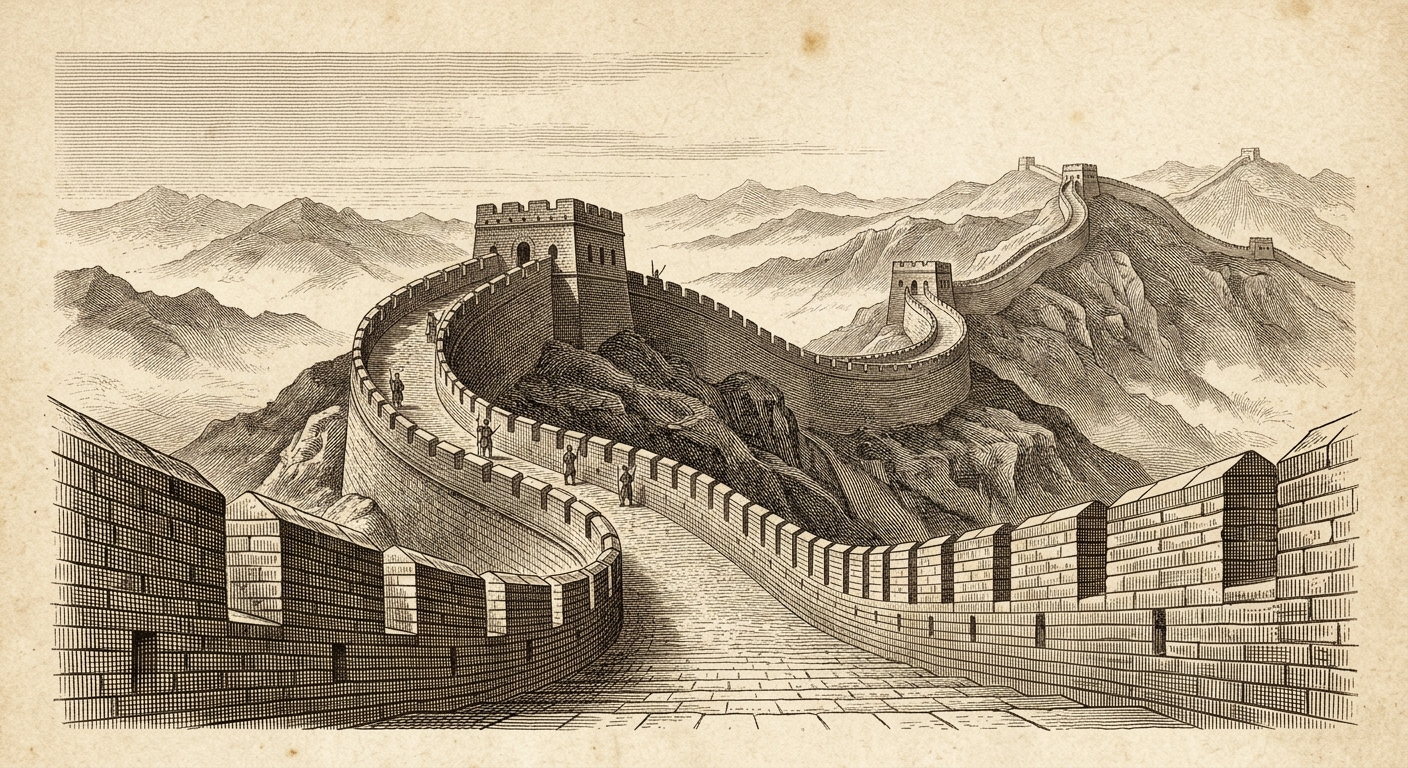
Ancient China Timeline
Ancient China produced some of history's most enduring civilizations, giving the world writing, paper, the Silk Road, and two thousand years of dynastic rule.
Chinese civilization developed along the Yellow River valley over thousands of years, organized around dynasties — royal families that ruled until they were overthrown or collapsed. Each dynasty left something lasting: the Shang gave China its first writing system, the Zhou produced Confucius and the foundations of Chinese philosophy, the Qin unified the country under one emperor and began the Great Wall, and the Han built an empire as large as Rome and opened the Silk Road. Together, these dynasties shaped Chinese culture so deeply that their influence is still felt today — the Chinese people still call themselves Han, after the dynasty that defined so much of what it means to be Chinese.
- ~1600 BC
Shang Dynasty
The Shang Dynasty — the first confirmed by archaeology — rules from cities along the Yellow River, leaving behind bronze vessels, royal tombs, and the first Chinese writing.
Why it mattered: The Shang created oracle bone script — one of the world's earliest writing systems — and established ancestor worship, royal court traditions, and bronze-casting that shaped Chinese culture for millennia.
- 1046 BC
Zhou Dynasty
The Zhou overthrow the Shang and establish the longest-lasting dynasty in Chinese history, ruling for nearly 800 years.
Why it mattered: The Zhou period produced Confucius, Laozi, and the Hundred Schools of Thought — a golden age of philosophy that defined Chinese values, government, and ethics for the next two thousand years.
- 551–479 BC
Confucius
The philosopher Confucius teaches that social harmony comes from respect, duty, and virtuous government rather than force or fear.
Why it mattered: Confucianism became the dominant philosophy of Chinese government and society for over two thousand years — shaping education, family life, and statecraft across East Asia.
- 475–221 BC
Warring States Period
China fractures into seven competing kingdoms that fight for dominance for over 250 years.
Why it mattered: The chaos of the Warring States drove thinkers to seek solutions — producing Legalism, Taoism, and other philosophies — and ultimately forced the military and political innovations that led to unification.
- 221 BC
Qin Shi Huang Unifies China
The king of Qin conquers all rival kingdoms and declares himself the First Emperor — Qin Shi Huang — ruling a unified China.
Why it mattered: Qin Shi Huang standardized weights, measures, writing, and money across China and began building the Great Wall, creating the foundations of a unified Chinese state that has lasted in various forms to the present.
- 210 BC
Terracotta Army
Qin Shi Huang is buried with an army of more than 8,000 life-size terracotta warriors to protect him in the afterlife.
Why it mattered: Discovered in 1974, the Terracotta Army is one of the greatest archaeological finds in history — a vivid snapshot of the military power and ambition of China's first emperor.
- 206 BC
Han Dynasty Founded
Liu Bang overthrows the brutal Qin Dynasty and founds the Han Dynasty, which rules China for over 400 years.
Why it mattered: The Han Empire became one of the greatest powers of the ancient world — as large as the Roman Empire — and gave China so much of its cultural identity that the Chinese people still call themselves Han.
- ~130 BC
The Silk Road Opens
Han Emperor Wu sends diplomat Zhang Qian westward, establishing trade routes that connect China to Central Asia, Persia, and eventually Rome.
Why it mattered: The Silk Road carried silk, spices, and other goods across Eurasia — but also spread religions, technologies, and ideas, making it one of history's most transformative trade networks.
- AD 105
Paper Invented
Cai Lun, a Han court official, refines the papermaking process, producing cheap, light paper from bark, hemp, and rags.
Why it mattered: Paper transformed how knowledge was recorded and shared. It eventually spread westward, reaching Europe and reshaping how the entire world preserved and communicated information.
- AD 220
Han Dynasty Falls
The Han Dynasty collapses after years of internal wars, peasant rebellions, and power struggles among nobles, ending four centuries of unified rule.
Why it mattered: The fall of the Han began four centuries of division — China's equivalent of the Dark Ages — before being reunified under the Sui and Tang dynasties.
Ancient China Quiz
Check what you learned — read on screen, or use the Printable quiz button above for a worksheet version with an answer key.
What was the significance of the Shang Dynasty?
- A) It built the Great Wall of China
- B) It was the first Chinese dynasty confirmed by archaeology, and created China's first writing system
- C) It unified China under one emperor for the first time
- D) It established the Silk Road trade routes to the West
Who was Confucius?
- A) The first emperor of a unified China
- B) A Zhou Dynasty philosopher who taught that social harmony comes from respect, duty, and virtuous government
- C) The Han emperor who opened the Silk Road
- D) The inventor of paper during the Han Dynasty
What did Qin Shi Huang accomplish in 221 BC?
- A) He invented the Chinese writing system
- B) He opened the Silk Road to Central Asia
- C) He conquered all rival kingdoms and became the First Emperor of a unified China
- D) He founded the Han Dynasty after overthrowing the Qin
What is the Terracotta Army?
- A) A Han Dynasty military force that guarded the Silk Road
- B) More than 8,000 life-size clay warriors buried to protect the First Emperor in the afterlife
- C) Shang Dynasty statues placed along the Yellow River
- D) Statues built along the Great Wall to intimidate invaders
Why is the Han Dynasty so important in Chinese history?
- A) It was the first dynasty to use written records
- B) It built the Terracotta Army
- C) It was one of history's greatest empires and gave the Chinese people much of their cultural identity
- D) It invented the Chinese writing system later standardized across the empire
What was the Silk Road?
- A) The road inside the Great Wall used by Chinese armies
- B) Trade routes connecting China to Central Asia, Persia, and Rome, carrying silk and spreading ideas
- C) The path along the Yellow River used for domestic trade within China
- D) The route Qin Shi Huang used to conquer the rival kingdoms
What did Cai Lun develop in AD 105?
- A) A new writing system to replace oracle bone script
- B) The first accurate map of China
- C) A refined papermaking process that produced cheap, light paper
- D) The compass, which helped Chinese navigators explore the seas
What was the Warring States Period?
- A) Wars between China and Rome along the Silk Road
- B) A 250-year period when seven Chinese kingdoms fought for dominance before unification
- C) The civil wars that eventually brought down the Han Dynasty
- D) The conflicts between the Shang and Zhou dynasties
Show answer key
1. B · 2. B · 3. C · 4. B · 5. C · 6. B · 7. C · 8. B
Related timelines
 Ancient Greece Timeline — Ancient Greece gave the world democracy, philosophy, the Olympics, and some of history's greatest art and literature, flourishing in independent city-states along the Mediterranean. Open →
 Mongol Empire Timeline — The Mongol Empire was the largest contiguous land empire in history — built by Genghis Khan and his descendants in just a few decades, stretching from the Pacific Ocean to Eastern Europe and ruling over a third of the world's population at its peak. Open →
How to print
Choose Download PDF for a ready-to-print timeline that fits US Letter paper (8.5 × 11"). The blank fill-in version keeps the dates and gives students empty lines to write each event — great for review and quizzes.
Frequently asked questions
What were the major ancient Chinese dynasties?
China's ancient history was organized around dynasties — ruling families that governed until overthrown or collapsed. The major dynasties in this timeline are the Shang, Zhou, Qin, and Han. The Shang created China's first writing system; the Zhou produced Confucius and foundational Chinese philosophy; the Qin unified China for the first time; and the Han built one of the ancient world's greatest empires and opened the Silk Road.
What is Confucianism?
Confucianism is a philosophy based on the teachings of Confucius (551-479 BC). It emphasizes respect for elders and ancestors, loyalty, duty, and the importance of virtuous government. Confucius believed that a ruler who governed with virtue would earn loyalty naturally, and that social harmony depended on everyone fulfilling their proper role in life. Confucianism became the official philosophy of Chinese government for over two thousand years and still influences East Asian cultures today.
What paper size should I print this on?
The timeline is sized for standard US Letter paper (8.5 × 11 in.). The Download PDF button gives you a print-ready file that fits the page automatically.