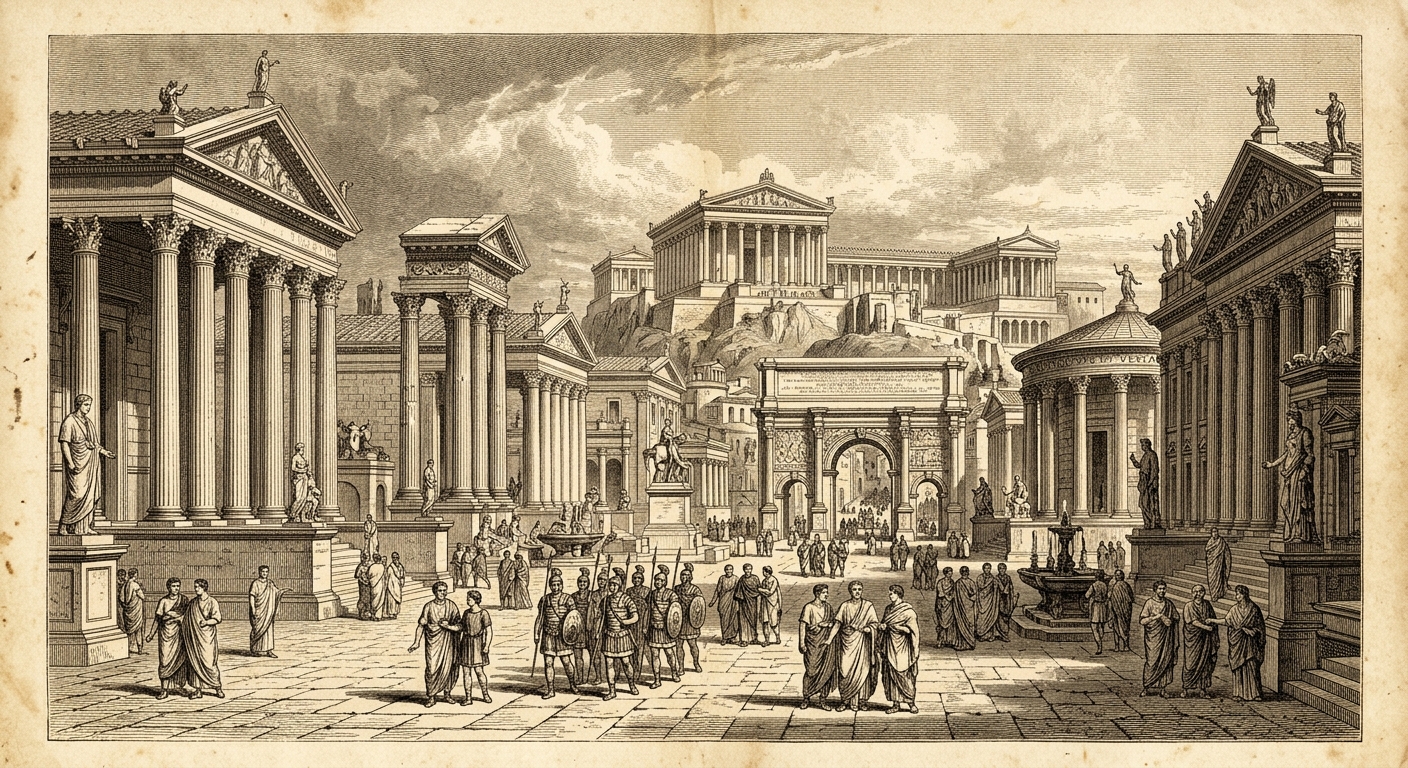
Ancient Rome Timeline
Ancient Rome grew from a small city on the banks of the Tiber River into the greatest empire of the ancient world, lasting over a thousand years.
The story of ancient Rome stretches over more than 1,200 years — from a small hilltop village to an empire that ruled most of Europe, North Africa, and the Middle East. Rome began as a kingdom, then became a republic governed by elected officials and a Senate, and finally became an empire ruled by a single emperor. Roman roads, laws, language, and ideas about government shaped almost every civilization that came after it — including the founders of the United States, who modeled parts of the American system on the Roman Republic.
- 753 BC
Rome Founded
According to Roman tradition, Romulus founds the city of Rome on the Tiber River.
Why it mattered: Whether legend or history, the Romans counted this as the start of their civilization — the beginning of one of the ancient world's greatest powers.
- 509 BC
The Roman Republic
Romans overthrow their last king and form a republic governed by elected officials and a Senate.
Why it mattered: The Republic gave Rome centuries of stable government and became a model that later influenced the founders of the United States.
- 264–146 BC
The Punic Wars
Rome fights three long wars against the powerful North African city of Carthage.
Why it mattered: Victory over Carthage made Rome the dominant power in the western Mediterranean and transformed it from a regional city into a world empire.
- 44 BC
Assassination of Julius Caesar
The popular general and dictator Julius Caesar is stabbed to death in the Senate on March 15.
Why it mattered: Caesar's murder ended the Republic — the civil wars that followed replaced elected government with one-man rule under an emperor.
- 27 BC
Augustus Becomes First Emperor
Caesar's heir Octavian, renamed Augustus, becomes Rome's first emperor, beginning the Roman Empire.
Why it mattered: Augustus launched two centuries of relative peace and prosperity known as the Pax Romana, during which Roman power and culture reached their peak.
- AD 79
Mount Vesuvius Erupts
The volcano Vesuvius erupts and buries the Roman city of Pompeii in ash and rock in a single day.
Why it mattered: Preserved almost perfectly under the ash, Pompeii was excavated centuries later and gave historians an extraordinary snapshot of Roman daily life.
- AD 313
Edict of Milan
Emperor Constantine declares that Christians may worship freely throughout the Roman Empire.
Why it mattered: Christianity, once persecuted by Roman authorities, began its rise to become the empire's dominant religion, reshaping Western civilization for centuries.
- AD 380
Christianity Becomes Official
Emperor Theodosius makes Christianity the Roman Empire's official religion.
Why it mattered: The empire's embrace of Christianity helped spread the faith across Europe and deeply shaped the history of the Western world.
- AD 395
Empire Splits in Two
The Roman Empire permanently divides into the Western Roman Empire and the Eastern Roman Empire.
Why it mattered: The weaker Western half would fall within a century; the Eastern Empire survived as the Byzantine Empire for another thousand years.
- AD 476
Fall of Western Rome
The last Western Roman emperor is deposed by a Germanic leader, ending the Western Roman Empire.
Why it mattered: Rome's fall marked the end of the ancient world and the beginning of the Middle Ages — a civilization that had lasted over twelve centuries was gone.
Ancient Rome Quiz
Check what you learned — read on screen, or use the Printable quiz button above for a worksheet version with an answer key.
What kind of government did Romans create in 509 BC?
- A) A monarchy with a king
- B) A republic governed by elected officials and a Senate
- C) A democracy where all citizens voted directly
- D) An empire ruled by an emperor
What were the Punic Wars?
- A) Wars between Rome and Greece
- B) Three wars between Rome and Carthage that made Rome a Mediterranean power
- C) The wars that overthrew the Roman Republic
- D) Battles against Germanic tribes
What happened on March 15, 44 BC?
- A) Rome was founded
- B) Augustus became emperor
- C) Julius Caesar was assassinated in the Senate
- D) Rome fell to invaders
What was the Pax Romana?
- A) A peace treaty with Carthage
- B) Two centuries of relative peace during the early Roman Empire
- C) The division of the empire into East and West
- D) The fall of the Western Empire
What did the eruption of Mount Vesuvius do in AD 79?
- A) It destroyed the city of Rome
- B) It buried Pompeii in ash, preserving it for centuries
- C) It forced the empire to split in two
- D) It drove Constantine to adopt Christianity
What did the Edict of Milan in AD 313 do?
- A) Made Christianity the official religion of Rome
- B) Divided the empire in two
- C) Declared that Christians could worship freely
- D) Ended the Punic Wars
What happened in AD 395?
- A) Rome was founded
- B) Constantine became emperor
- C) The empire divided permanently into Western and Eastern halves
- D) Rome fell to Germanic invaders
What does the fall of the Western Roman Empire in AD 476 mark?
- A) The beginning of the Roman Republic
- B) The end of the Punic Wars
- C) The end of the ancient world and the beginning of the Middle Ages
- D) The reign of Augustus
Show answer key
1. B · 2. B · 3. C · 4. B · 5. B · 6. C · 7. C · 8. C
See it on the map
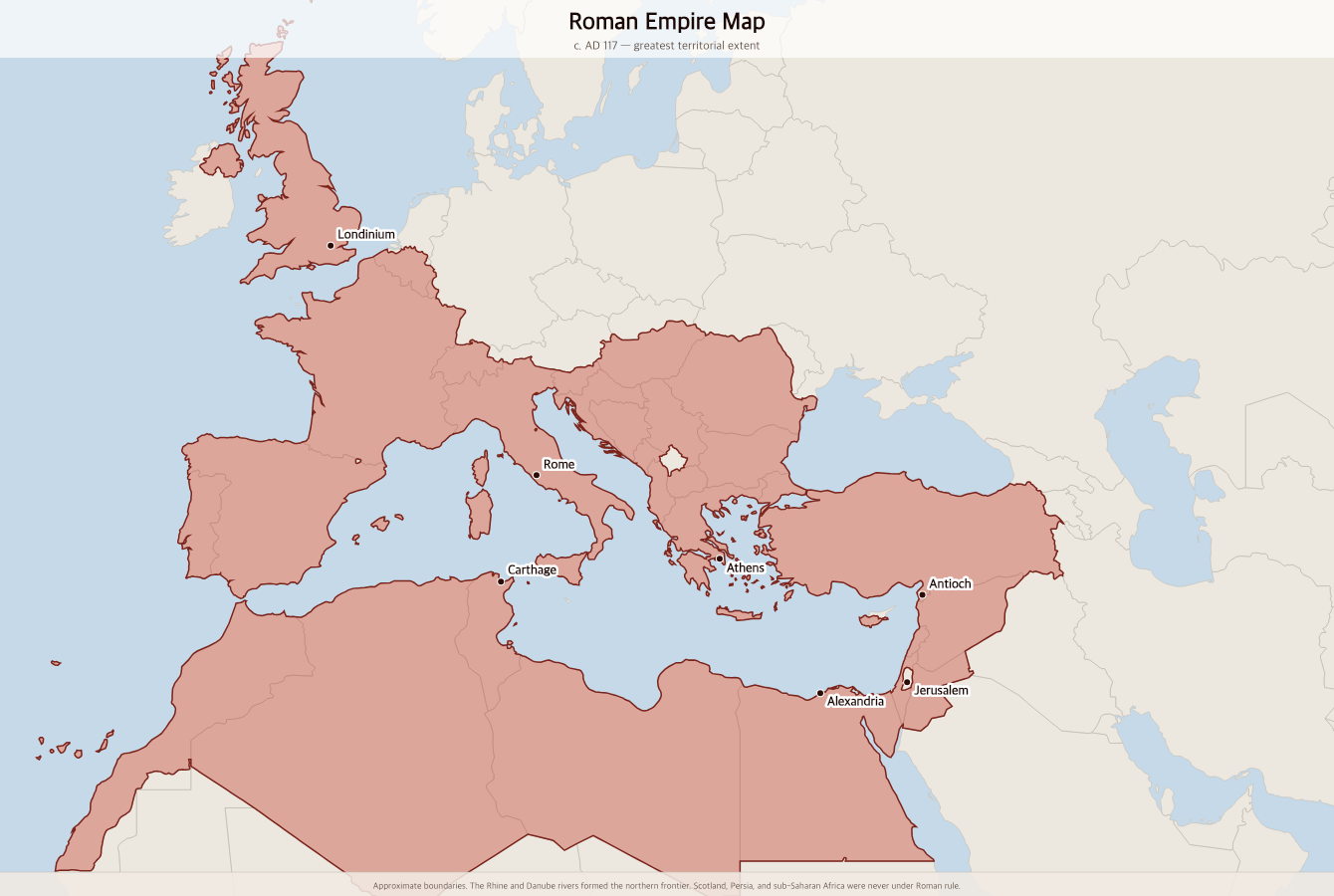 Pair this timeline with our printable The Roman Empire map — real historical geography — see the empire's full reach from Britain to Egypt. Open the map →
Related timelines
 Ancient Greece Timeline — Ancient Greece gave the world democracy, philosophy, the Olympics, and some of history's greatest art and literature, flourishing in independent city-states along the Mediterranean. Open →
 Ancient Egypt Timeline — Ancient Egypt was one of the world's first great civilizations, ruled by pharaohs along the Nile River for more than 3,000 years. Open →
How to print
Choose Download PDF for a ready-to-print timeline that fits US Letter paper (8.5 × 11"). The blank fill-in version keeps the dates and gives students empty lines to write each event — great for review and quizzes.
Frequently asked questions
How long did the Roman Empire last?
The traditional dates for Roman civilization span from the legendary founding of Rome in 753 BC to the fall of the Western Empire in AD 476 — over 1,200 years. The Eastern Roman Empire, based in Constantinople, survived for another thousand years, finally falling in 1453.
Why did the Roman Empire fall?
Historians debate the causes, but common factors include pressure from Germanic peoples pushing in from the north, military overstretch, economic problems, political instability, and the difficulty of governing such a vast territory. The Western Empire weakened over decades and finally collapsed when its last emperor was deposed in AD 476.
What paper size should I print this on?
The timeline is sized for standard US Letter paper (8.5 × 11 in.). The Download PDF button gives you a print-ready file that fits the page automatically.