 Printable Scholar
Circuit Builder
Snap pieces onto the board and make a loop from the battery and back. Light bulbs, spin fans, play tunes.
Loading one replaces your board. Undo brings yours back.
How to play
Drag a piece from the tray onto the pegboard (or tap it to drop it in the middle). Pieces join wherever their metal snaps sit on the same peg. Tap a piece on the board to turn it round or take it off, or drag it off the board. Tap a switch to flip it, hold the press button down, tap the test spot to change the object on it and tap the dimmer to turn it up or down. A burnt-out bulb or a blown fuse can be tapped to put in a new one. Press ⚡ Circuits for ready-made boards, Show power to watch the electricity move, and Share to send your board as a link. Build a loop from the + end of the battery, through your bulbs, fans and boxes, back to the − end, and it comes to life.
Things to try
- Light the bulb, then add a switch so you can turn it on and off.
- Put two bulbs in a row. Then put two bulbs side by side. Which way are they brighter?
- Make the fan spin with the press button, then let go fast.
- Put two batteries in a row. What happens to the bulb?
- Make a red light come on. Then turn it round.
- Play a tune and flash a light at the same time with one switch.
- Make one switch for the bulb and a different switch for the siren.
- Put the test spot in a circuit and find out which objects let electricity through.
- Light a coloured light with lemons. How many lemons does it take?
- Add a third battery with a fuse in the loop, and then without one.
- Build an electromagnet that picks up the paper clips when you flip a switch.
- Press Show power and watch where the power splits in a side-by-side circuit.
Teaching electric circuits?
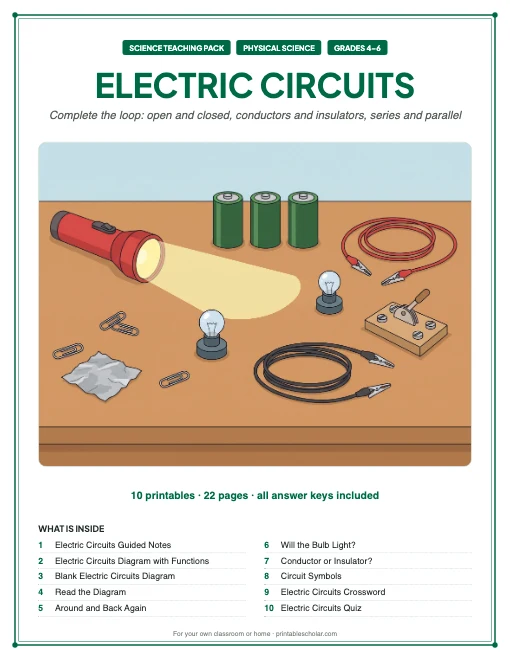
The Electric Circuits teaching pack has lesson slides, a labeled circuit diagram, practice sheets and every answer key for grades 4 to 6. Use this game as the warm-up or the hands-on part. The electric circuit diagram and the blank one to label are free.
Questions
What is an electric circuit?
A circuit is a loop that electricity can travel all the way around. The power leaves one end of the battery, goes through the wires and the things it runs (a bulb, a fan, a music box) and comes back into the other end. If the loop has a gap anywhere, nothing works.
Why do two bulbs in a row glow dimmer?
When bulbs are in a row (in series), the power has to push through both of them, one after the other, so each one gets less and both glow dim. When bulbs are side by side (in parallel), each one has its own path back to the battery, so both glow bright. Try both on the board.
What is a short circuit?
A short circuit is when the power can go straight from one end of the battery to the other with nothing in the way, only wire. All the power rushes through, the battery gets hot and nothing else works. In the game the battery turns red and shakes. With real batteries it can be dangerous, so always put a bulb or another part in the loop.
What does the switch do?
A switch makes a gap in the circuit when it is off and closes the gap when it is on. The press button only closes the gap while you hold it down, like a doorbell.
Why does the coloured light only work one way?
The coloured lights are LEDs (light-emitting diodes). An LED only lets electricity through in one direction, which is the way its arrow points. Turn it round and it stays dark.
Which things conduct electricity?
Metals do: a coin, a paper clip, a key and foil all let electricity through, so they are conductors. An eraser, a plastic spoon, a wooden stick and a rubber band do not, so they are insulators. Put the test spot in a circuit and tap it to try each one.
What does a fuse do?
A fuse is a thin wire that melts on purpose when too much electricity flows, which breaks the circuit before anything else gets damaged. Homes have fuses or circuit breakers for the same reason. In the game, three batteries burn out a bulb, but with a fuse in the loop the fuse blows instead and the bulb is saved.
Can a lemon really make electricity?
Yes. A copper coin and a zinc nail pushed into a lemon make a very weak battery. One lemon is not enough to light anything, but a few in a row can light a small LED or play a music chip. They can never light an ordinary bulb.
What is an electromagnet?
An electromagnet is a nail (or other iron) with wire coiled around it. When electricity flows through the coil, the nail becomes a magnet and picks up paper clips. Switch it off and the magnetism is gone, so the clips drop.
Is it really free?
Yes. No sign-up, no ads. Your board is saved on this device so you can carry on next time.