Parts of the Ear Diagram
Free printable parts of the ear diagram — a labeled cross-section showing the pinna, ear canal, eardrum, the three tiny bones, cochlea and more. Download PDF or PNG for Letter paper.
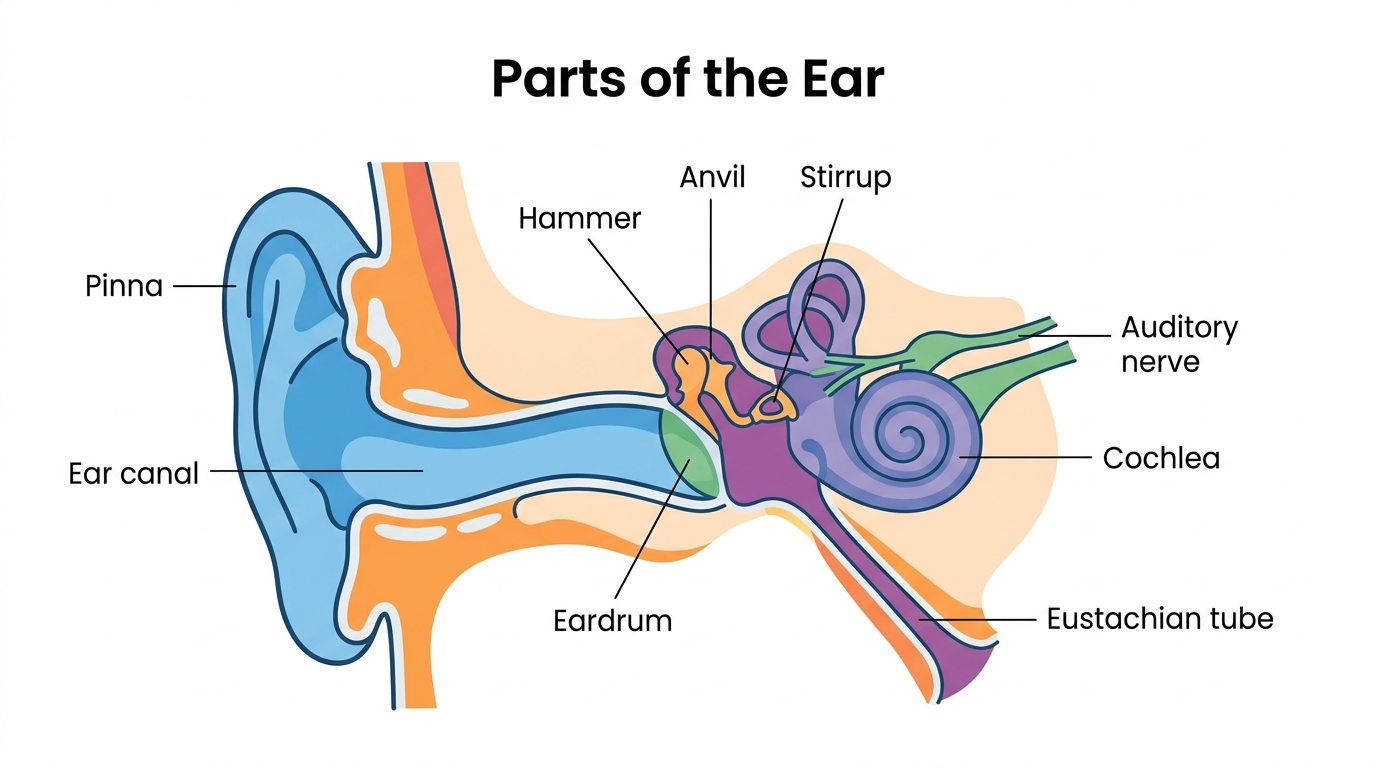
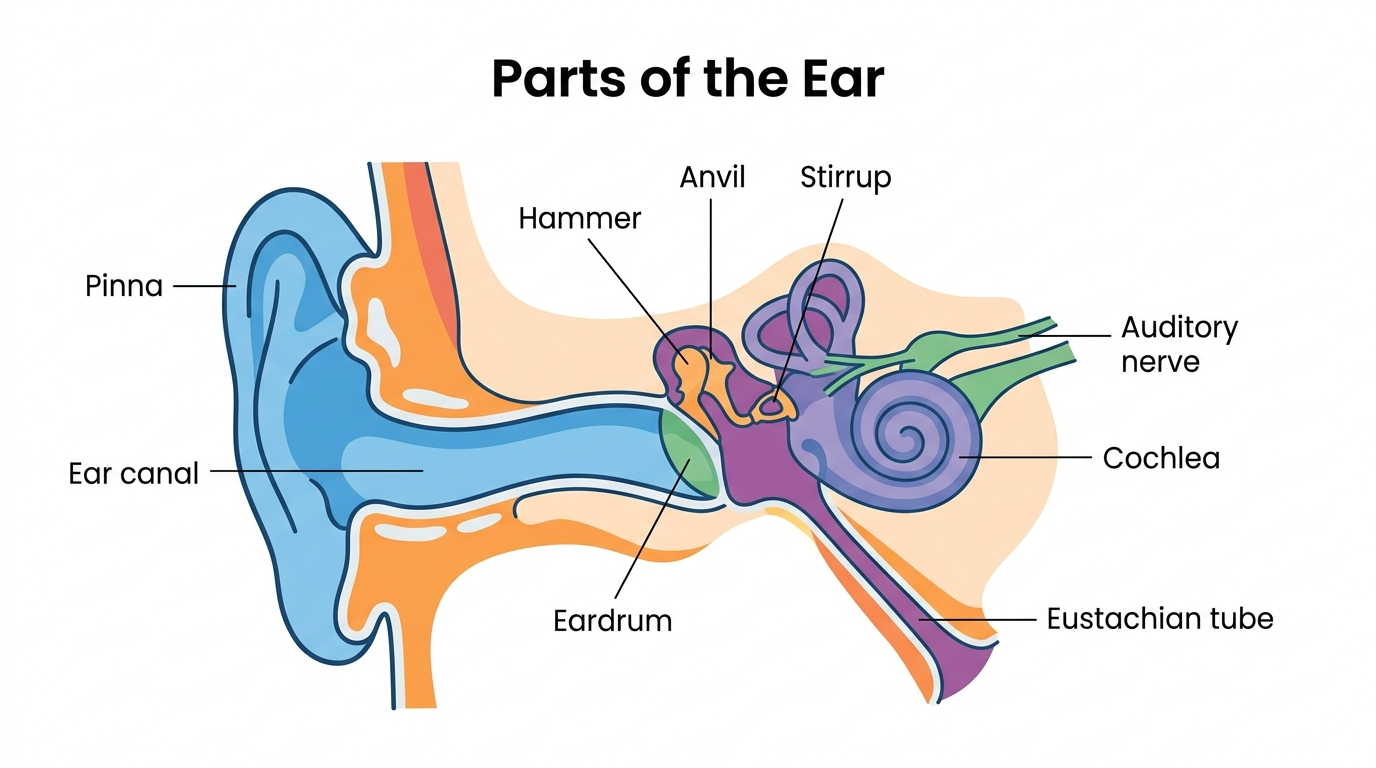
The parts of the ear
The ear collects sound and turns it into signals the brain can understand. Here is what happens at each labeled part of the diagram:
| Part | What it does | Why it matters |
|---|---|---|
| Pinna | The outer part of the ear that catches sound waves. | Its curved, ridged shape is not accidental — those folds scatter sound in slightly different ways depending on whether it comes from in front of you, behind you, or above, giving your brain the clues it needs to locate where a sound is coming from. Cup your hand behind your ear and you'll instantly notice how much louder everything gets, which is exactly what the pinna does on its own. |
| Ear canal | The tube that carries sound to the eardrum. | This narrow tube does more than route sound — its length and shape actually amplify frequencies around 3,000 Hz, which happens to be the range of a human voice, making speech easier to hear. It also stays warm and slightly waxy to keep dust and insects from reaching the delicate eardrum at the other end. |
| Eardrum | A thin membrane that vibrates when sound hits it. | A sound wave in air carries very little energy on its own, and without the eardrum converting it into physical vibration, the fluid-filled chambers deeper in the ear would barely respond to it at all. If the eardrum is torn — by a loud blast or an infection — sounds become muffled and distorted, because the conversion step is broken. |
| Hammer | The first of three tiny bones; it passes the vibrations along. | Bridging the gap between the eardrum and the rest of the ear, the hammer makes sure none of the vibration energy is wasted — it presses directly against the eardrum and rocks in sync with every tiny movement. Without it, the motion would dead-end at the eardrum and never travel further inward. |
| Anvil | The middle bone that carries vibrations to the stirrup. | Sandwiched between the hammer and stirrup, the anvil acts as a precise mechanical relay, keeping the vibration chain moving without adding noise or distortion of its own. Its exact size and angle help match the energy level of the incoming vibration to what the fluid-filled cochlea can actually use. |
| Stirrup | The smallest bone in the body; it passes vibrations to the cochlea. | At roughly 3 millimeters long, it is the smallest bone in the entire human body — yet it performs one of the most critical handoffs in hearing, pressing against a membrane window into the cochlea. Its tiny surface area concentrates the vibration energy, essentially amplifying it before it enters the fluid inside. |
| Cochlea | A spiral tube that turns vibrations into nerve signals. | Different parts of the cochlea's spiral respond to different pitches — high notes trigger cells near the entrance, low notes trigger cells deep inside — which is why you can distinguish a whistle from a bass drum at the same moment. Damage to these hair cells from loud music or explosions is permanent, because they do not grow back. |
| Auditory nerve | Carries the signals from the cochlea to the brain. | All the mechanical work the ear has done up to this point means nothing until the nerve fires — it is the moment vibration becomes information. If this nerve is damaged, a person can have a perfectly intact ear and still be profoundly deaf, because the signal has no road into the brain. |
| Eustachian tube | Connects the middle ear to the throat and balances air pressure. | You feel this tube doing its job every time your ears pop on an airplane or in an elevator — it is equalizing the air pressure on both sides of your eardrum so it can vibrate freely. When a cold swells the tube shut, sounds go dull and muffled, because the eardrum is either pushed in or bowed out and can no longer move properly. |
Companion worksheet
A free fill-in worksheet with an answer key, built from the labels above — students match each part to its description, then answer a couple of short questions. Great for a quick check after using the diagram.
How to print
Choose Download PDF for a ready-to-print file that fits US Letter paper (8.5 × 11") in landscape, or Download PNG for the high-resolution image.
Frequently asked questions
What are the parts of the ear?
The ear has an outer part (pinna, ear canal), a middle part (eardrum and the hammer, anvil and stirrup bones) and an inner part (cochlea and auditory nerve).
What are the three tiny bones in the ear?
They are the hammer, the anvil and the stirrup — the three smallest bones in the body.
What paper size should I print this on?
The diagram is sized for standard US Letter paper (8.5 × 11") in landscape orientation. Use "Download PDF" for a print-ready file that fits the page automatically.