About the Equivalent Fractions Lesson
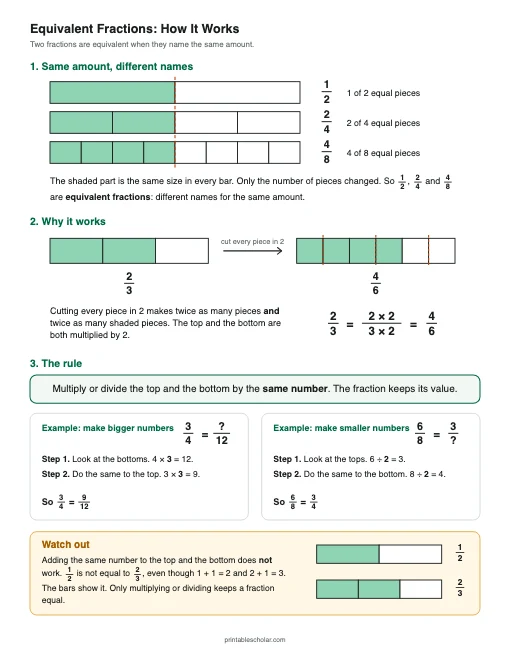
Equivalent fractions are fractions that look different but name the same amount. One half, two fourths and four eighths all cover the same part of a whole. The pieces are a different size in each one, and that is the only difference.
The How It Works sheet starts with that picture and then shows where the rule comes from. Cutting every piece of a bar in two gives twice as many pieces and twice as many shaded pieces, so the top and the bottom of the fraction are both multiplied by 2. Students who see this are less likely to treat "multiply the top and the bottom" as a trick to memorize.
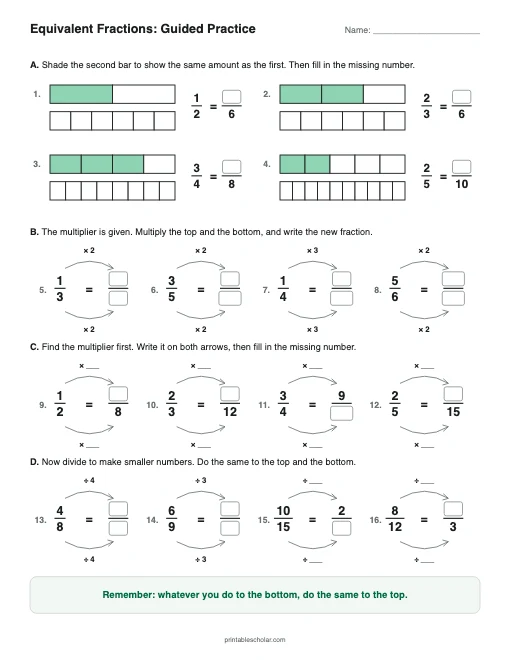
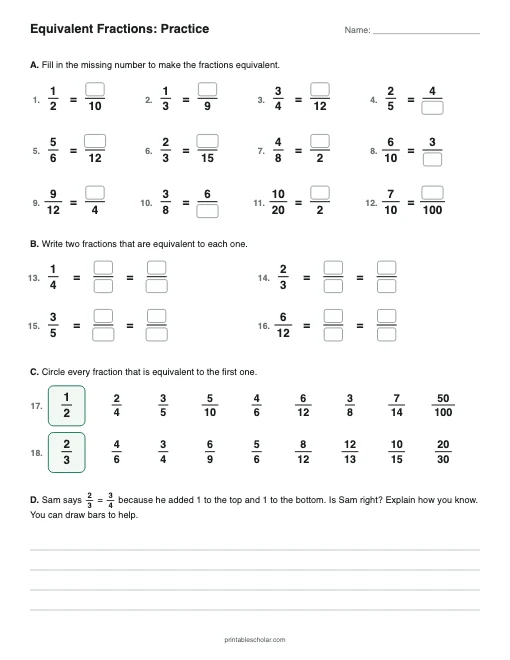
The guided practice sheet moves in small steps. Students shade bars first, then multiply with the multiplier given, then find the multiplier themselves, and last divide to make smaller numbers. The independent practice sheet mixes all of it and ends with a common mistake to explain: adding the same number to the top and the bottom.
For hands-on work, pair the lesson with the fraction strips, and keep the fraction chart nearby for checking answers. More practice is on the fractions worksheets page.
Frequently Asked Questions
What are equivalent fractions?
Equivalent fractions are different fractions that name the same amount. For example, 1/2, 2/4 and 4/8 are equivalent. Each one covers the same part of a whole, cut into a different number of pieces.
How do you find an equivalent fraction?
Multiply or divide the numerator and the denominator by the same number. To change 3/4 into twelfths, multiply both by 3 to get 9/12. To make 6/8 simpler, divide both by 2 to get 3/4.
Why does multiplying the top and bottom by the same number work?
Multiplying both by 2 is the same as cutting every piece in two. There are twice as many pieces in the whole and twice as many pieces shaded, so the shaded amount has not changed.
Can you add the same number to the top and bottom?
No. Adding changes the value of the fraction. 1/2 is not equal to 2/3, even though 1 was added to both numbers. Only multiplying or dividing by the same number keeps the fraction equal.
What grade learns equivalent fractions?
Students first meet equivalent fractions with pictures and number lines in 3rd grade. In 4th grade they learn the multiplying rule and use it to compare fractions. In 5th grade they use it to add and subtract fractions with different denominators.