About the Fraction Chart
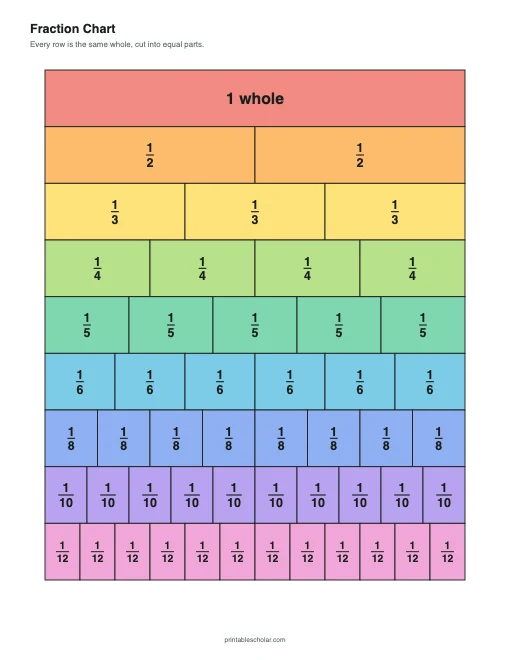
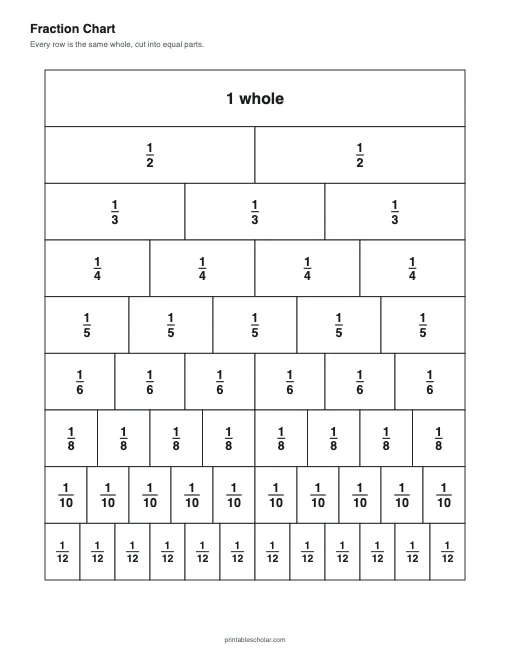
The main chart is a fraction wall: nine rows of the same width, cut into 1, 2, 3, 4, 5, 6, 8, 10 and 12 equal parts. Because every row is the same whole, pieces that line up are equal. Two fourths end exactly where one half ends, and so do three sixths and six twelfths.
That makes the chart useful for three things students find hard at first: comparing fractions with different denominators (1/3 is longer than 1/4), finding equivalent fractions, and seeing why a bigger denominator means a smaller piece.
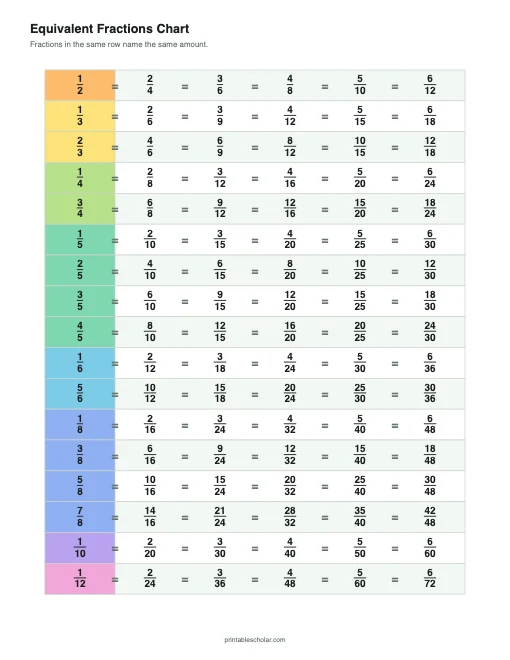
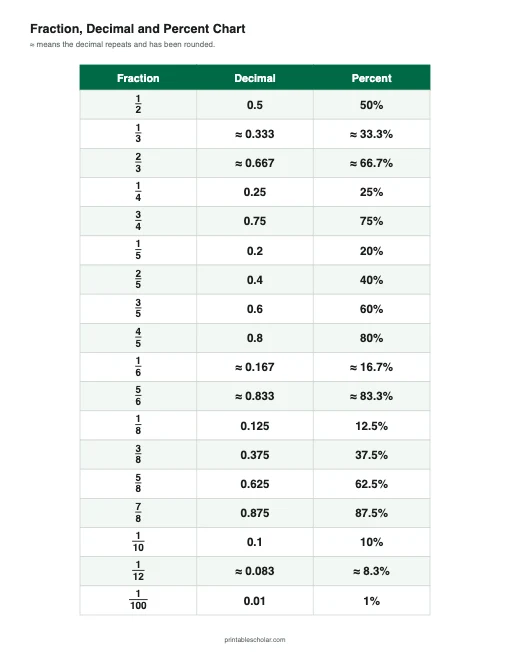
The equivalent fractions chart lists the same idea as numbers: each row multiplies the numerator and denominator by 2, 3, 4, 5 and 6. The fraction, decimal and percent chart is for upper elementary and middle school, when students start moving between the three forms.
Frequently Asked Questions
What is a fraction chart?
A fraction chart, also called a fraction wall, is a set of equal-length bars. The top bar is one whole and each bar below is divided into more equal parts: halves, thirds, fourths and so on. Students use it to compare fractions and find equivalent fractions by seeing which pieces line up.
Which fractions are on this chart?
One whole, halves, thirds, fourths, fifths, sixths, eighths, tenths and twelfths. Those are the denominators used in most elementary fraction work.
What grade is a fraction chart for?
Fractions are introduced in grades 1 and 2 as halves and fourths, and become a major topic in grades 3 to 5. The fraction, decimal and percent chart fits grades 4 to 6.
How do I use the chart to find equivalent fractions?
Pick a fraction and find where its piece ends. Any piece in another row that ends at the same place is equivalent. A ruler or the edge of a sheet of paper held straight down the chart makes this easy to see.