About the Comparing Fractions Lesson
Comparing fractions means deciding which of two fractions is the larger amount. It trips students up because the whole-number habit points the wrong way: 8 is more than 4, but one eighth is less than one fourth.
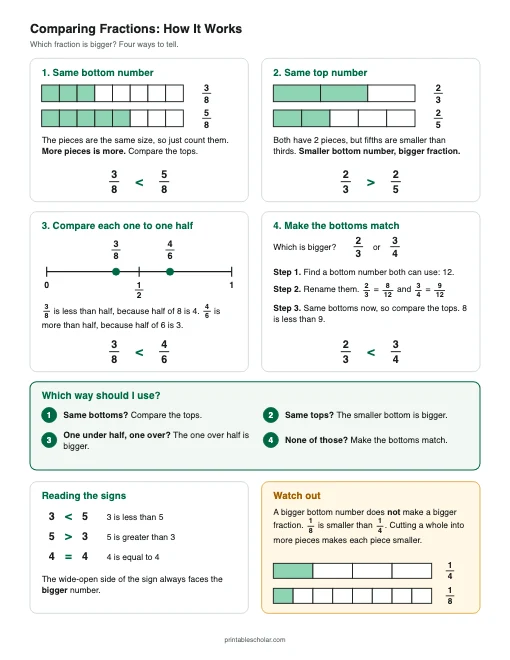
The How It Works sheet gives four ways to compare, from quickest to slowest. When the bottom numbers match, compare the tops. When the top numbers match, the fraction with the smaller bottom number is bigger, because its pieces are bigger. When one fraction is under one half and the other is over, no more work is needed. When none of those apply, rename the fractions so the bottoms match.
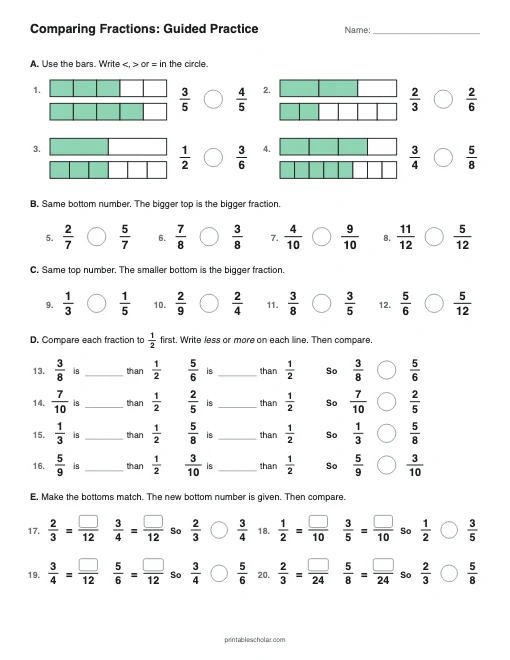
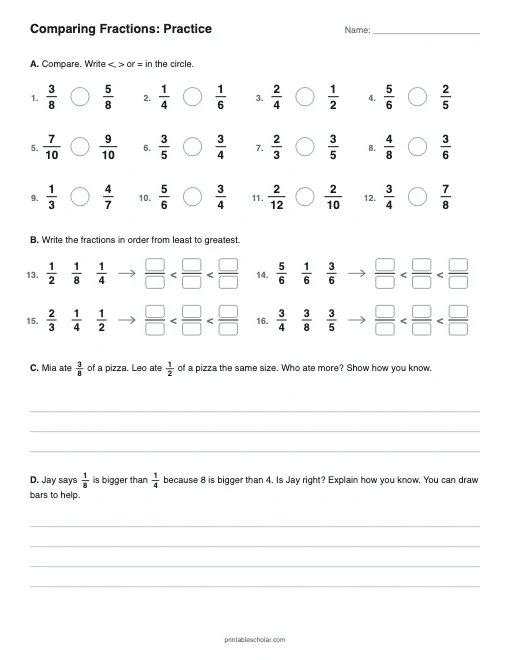
The guided practice sheet takes those four ways one at a time, starting with shaded bars. The independent practice sheet mixes them so students have to choose a method, and its answer key names the method that fits each problem.
The last method depends on equivalent fractions, so do that lesson first if renaming a fraction is new. The fraction strips are a good hands-on check, and more practice is on the fractions worksheets page.
Frequently Asked Questions
How do you compare two fractions?
If the denominators are the same, the fraction with the larger numerator is larger. If the numerators are the same, the fraction with the smaller denominator is larger. Otherwise, rename both fractions with the same denominator and compare the numerators.
Why is 1/8 smaller than 1/4 when 8 is bigger than 4?
The denominator tells how many equal pieces the whole is cut into. Cutting a whole into 8 pieces makes smaller pieces than cutting it into 4, so one eighth is a smaller amount than one fourth.
What does it mean to use one half as a benchmark?
Check each fraction against one half. A fraction is less than one half when its numerator is less than half its denominator. If one fraction is below one half and the other is above, the one above is larger. For example, 3/8 is below one half and 4/6 is above, so 3/8 is less than 4/6.
How do you compare fractions with different denominators?
Find a denominator both fractions can use, and rename each fraction. To compare 2/3 and 3/4, use twelfths: 2/3 is 8/12 and 3/4 is 9/12. Since 8 is less than 9, 2/3 is less than 3/4.
What grade learns to compare fractions?
In 3rd grade students compare fractions that have the same numerator or the same denominator. In 4th grade they compare any two fractions using a benchmark such as one half or a common denominator.