About the Adding and Subtracting Mixed Numbers Worksheets
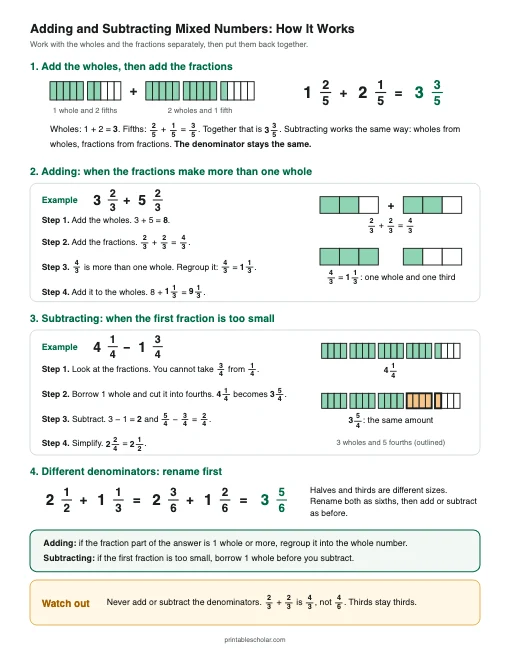
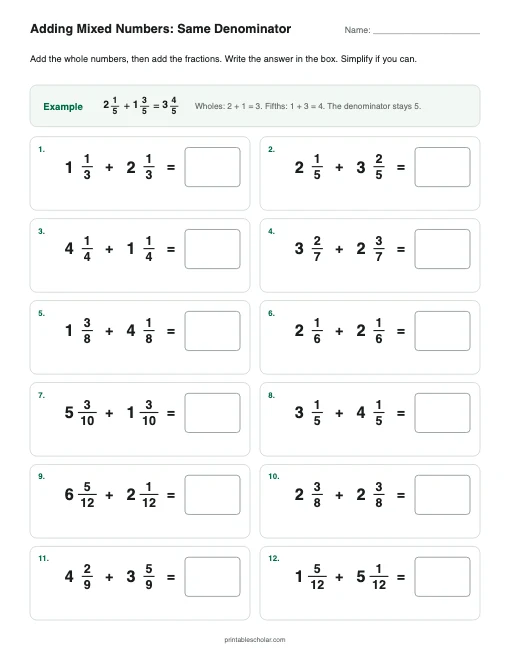
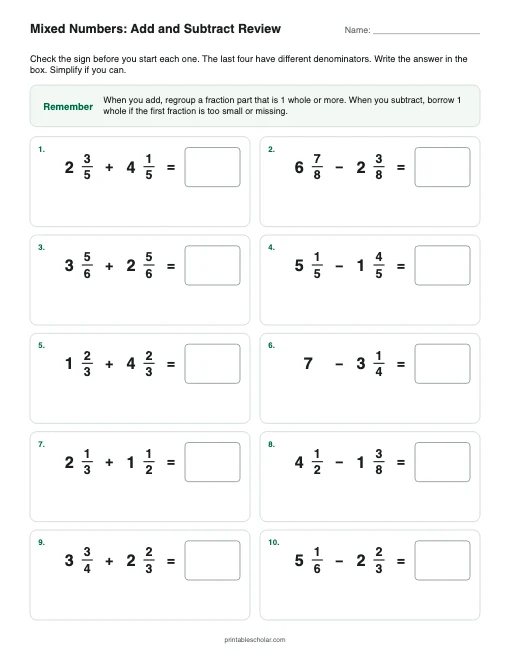
To add or subtract mixed numbers, work with the whole numbers and the fractions separately, then put the two parts back together. For 2 1/5 + 3 2/5, the wholes make 5 and the fifths make 3/5, so the answer is 5 3/5. The two same-denominator sheets practice only that.
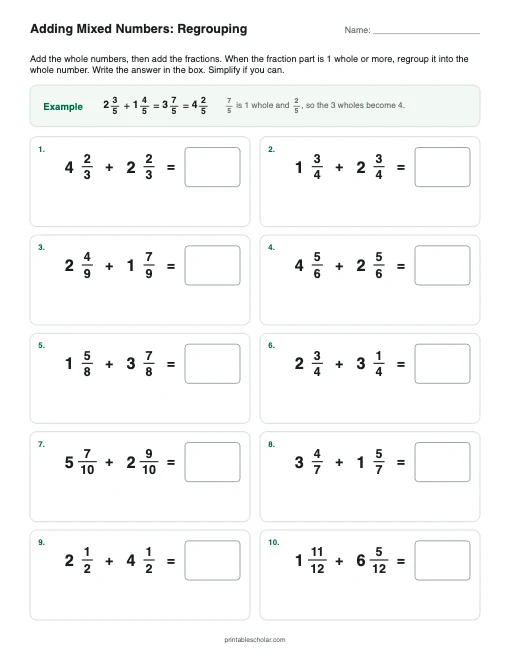
Regrouping is the step that trips students up. In 3 2/3 + 5 2/3 the wholes make 8 and the thirds make 4/3, which is more than one whole. Four thirds is 1 1/3, so the answer is 9 1/3. The regrouping sheet has ten of these, including two where the fractions add to exactly one whole.
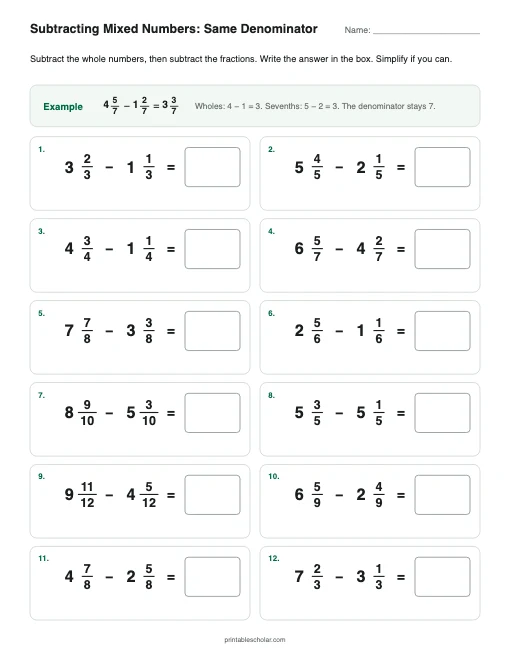
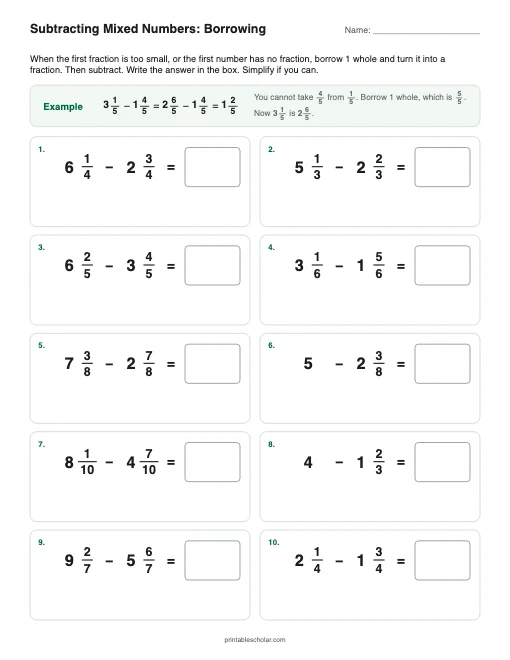
Borrowing is the same idea in reverse. In 4 1/4 − 1 3/4 there are not enough fourths to take 3/4 away, so one whole is traded for four fourths: 4 1/4 becomes 3 5/4. Then 3 5/4 − 1 3/4 = 2 2/4, which simplifies to 2 1/2.
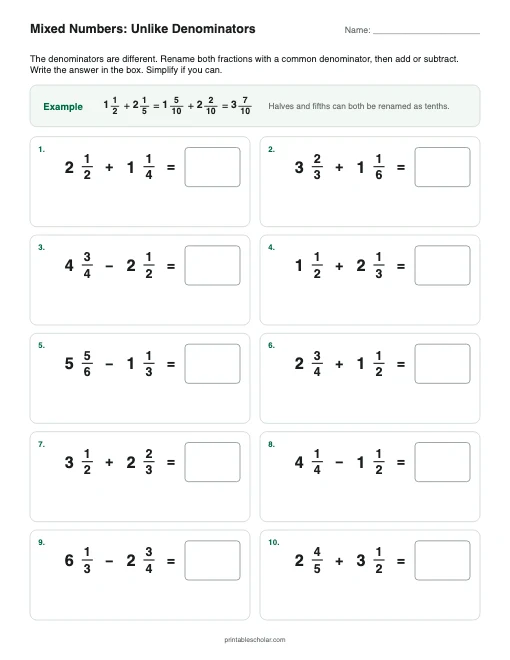
The unlike denominators sheet is 5th grade work: rename both fractions with a common denominator first, then add or subtract as before. Each answer key shows the steps between the problem and the answer, so a wrong answer can be traced to the step that went wrong.
If changing between the two forms is still shaky, start with the lesson on improper fractions and mixed numbers. For renaming fractions, see equivalent fractions, and for adding plain fractions see the fractions worksheets.
Frequently Asked Questions
How do you add mixed numbers?
Add the whole numbers, then add the fractions. If the fraction part of the answer is one whole or more, regroup it into the whole number. For 3 2/3 + 5 2/3, the wholes make 8 and the fractions make 4/3, which is 1 1/3, so the answer is 9 1/3.
How do you subtract mixed numbers when the first fraction is smaller?
Borrow one whole from the whole number and turn it into a fraction. For 4 1/4 − 1 3/4, rename 4 1/4 as 3 5/4. Then subtract: 3 − 1 = 2 and 5/4 − 3/4 = 2/4, so the answer is 2 2/4, or 2 1/2.
Can you change the mixed numbers to improper fractions instead?
Yes. Change both mixed numbers to improper fractions, add or subtract, then change the answer back to a mixed number. For 4 1/4 − 1 3/4, that is 17/4 − 7/4 = 10/4, which is 2 1/2. Both methods give the same answer.
How do you add mixed numbers with different denominators?
Rename the fractions with a common denominator first. For 2 1/2 + 1 1/3, use sixths: 2 3/6 + 1 2/6 = 3 5/6.
What grade learns to add and subtract mixed numbers?
Adding and subtracting mixed numbers with the same denominator is a 4th grade standard. Mixed numbers with different denominators are taught in 5th grade.
Do the worksheets have answer keys?
Yes. Every practice sheet is a two-page PDF with the answer key on the second page. On the regrouping, borrowing and unlike denominator sheets the key shows the steps as well as the answer.