About the Adding and Subtracting Fractions Worksheets
Fractions can only be added or subtracted when they are cut into pieces of the same size. One half plus one third is not two of anything until both are renamed: as sixths, they are 3/6 and 2/6, which make 5/6. The whole skill is that renaming step, and it is where 5th graders most often go wrong.
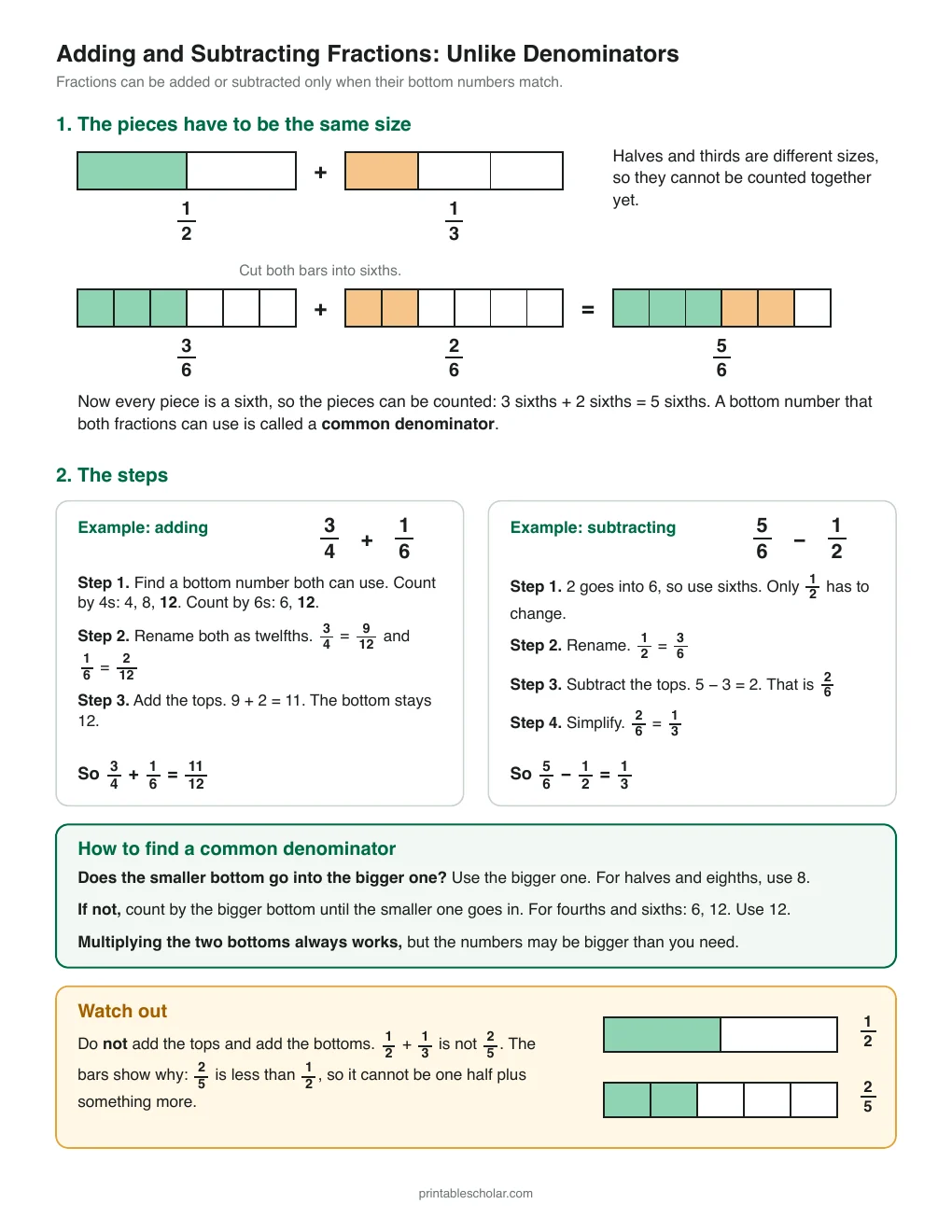
The How It Works sheet starts with that picture, two bars cut into different pieces and then into the same pieces. It then works 3/4 + 1/6 and 5/6 − 1/2 one step at a time: find a common denominator, rename, add or subtract the tops, simplify. A box lists three ways to find a common denominator, from quickest to slowest.
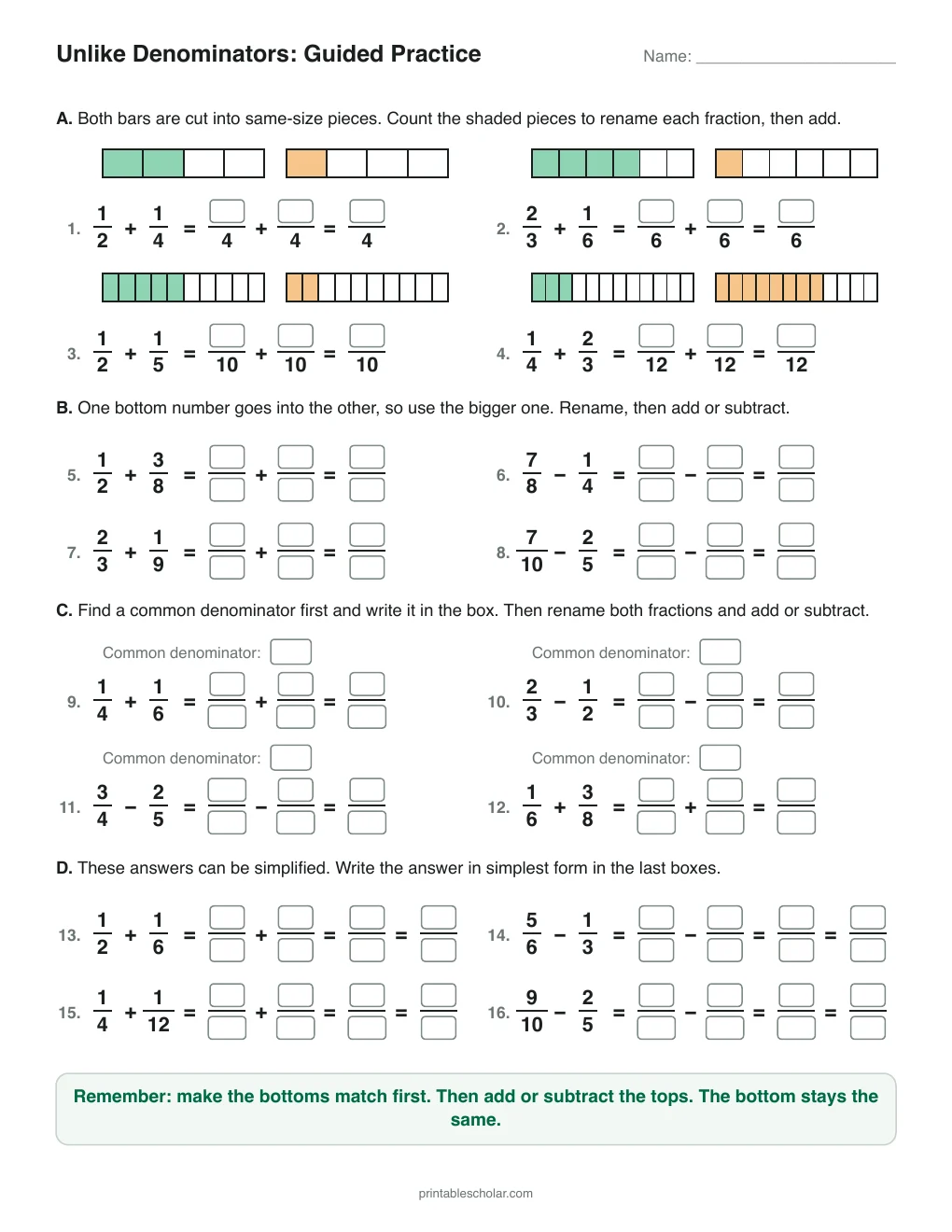
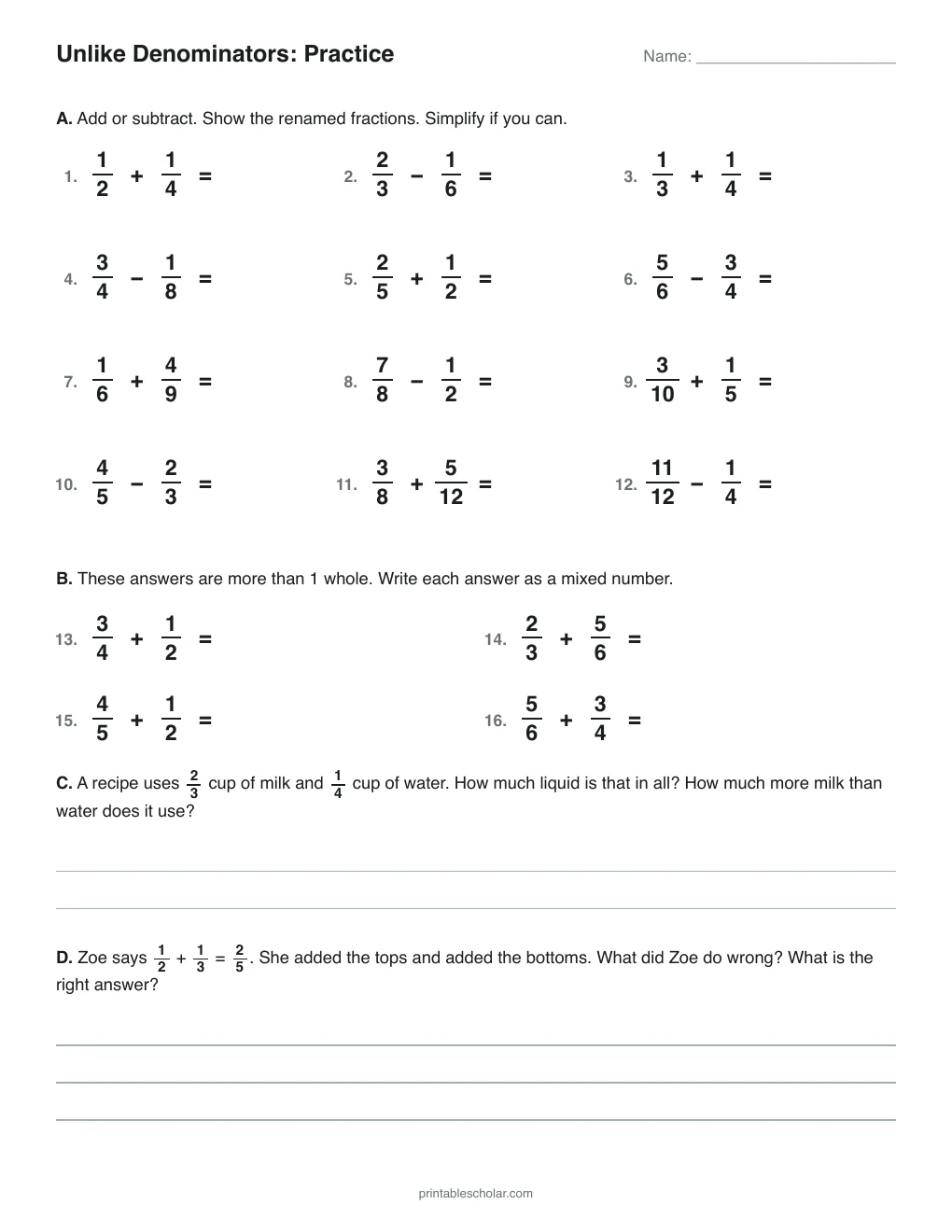
The guided practice sheet gives a box for every number a student has to write. It begins with bars, moves to problems where only one fraction has to change, then to problems where both change, and ends with answers that need simplifying. The independent practice sheet takes the boxes away and adds sums greater than one whole, a word problem, and a wrong answer to explain.
Renaming depends on equivalent fractions, so do that lesson first if it is shaky. Sums over one whole use improper fractions and mixed numbers. Adding and subtracting with the same denominator is on the fractions worksheets page, and the next step after this one is adding and subtracting mixed numbers.
Frequently Asked Questions
How do you add fractions with unlike denominators?
Find a denominator both fractions can use, rename each fraction with that denominator, then add the numerators and keep the denominator. For 3/4 + 1/6, use twelfths: 9/12 + 2/12 = 11/12.
How do you subtract fractions with unlike denominators?
The same way as adding. Rename both fractions with a common denominator, then subtract the numerators. For 5/6 − 1/2, rename 1/2 as 3/6. Then 5/6 − 3/6 = 2/6, which simplifies to 1/3.
How do you find a common denominator?
If the smaller denominator divides evenly into the larger one, use the larger one. If not, count by the larger denominator until you reach a number the smaller one divides into. For fourths and sixths that is 12. Multiplying the two denominators always gives a common denominator, though not always the smallest.
Why can you not just add the tops and add the bottoms?
Because the pieces are different sizes. Adding tops and bottoms gives 1/2 + 1/3 = 2/5, but 2/5 is less than 1/2, so it cannot be the sum of one half and something more. The correct answer is 5/6.
Do you have to use the least common denominator?
No. Any common denominator gives a correct answer. The least common denominator keeps the numbers small and often saves a simplifying step at the end.
What grade learns to add and subtract fractions with unlike denominators?
It is a 5th grade standard. In 4th grade students add and subtract fractions with the same denominator and learn to make equivalent fractions, which is the skill this lesson depends on.