About the Geometry Formula Sheet
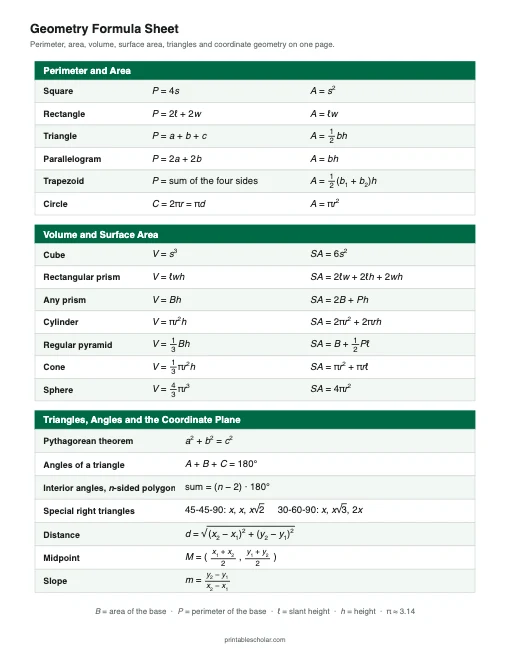
The one-page formula sheet is the one to keep in a binder. It has three tables: perimeter and area for six flat shapes, volume and surface area for seven solids, and a third table for triangles, angle sums and the coordinate plane.
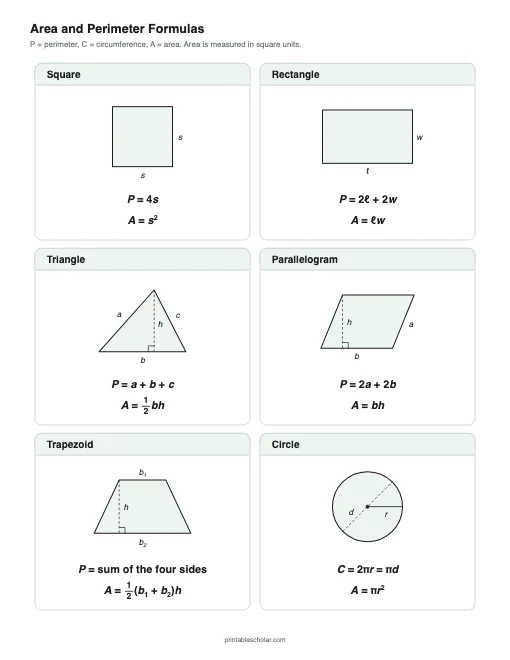
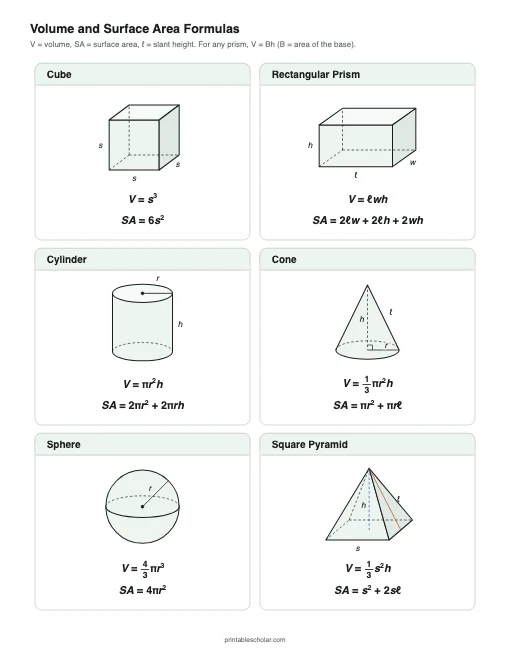
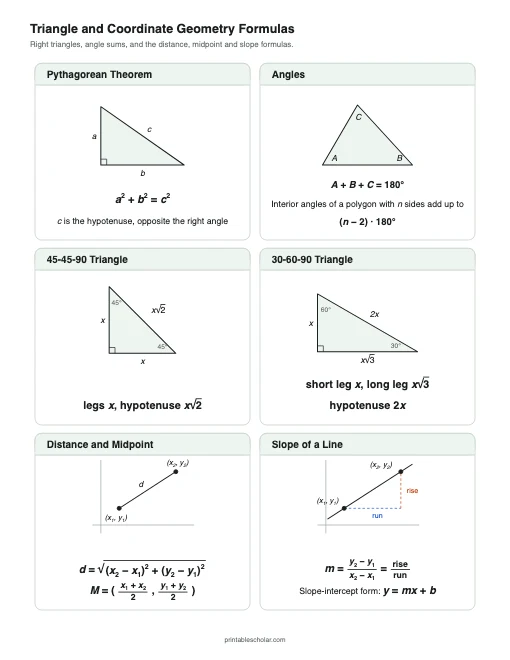
The three illustrated sheets are better for learning the formulas in the first place, because each one sits under a diagram with the same letters. On the area sheet, for example, the height of the triangle is drawn as a dashed line at a right angle to the base, which is the detail students most often get wrong.
A few letters mean the same thing on every sheet: b is a base and h is the height measured at a right angle to it, r is a radius, l on a cone or pyramid is the slant height, and capital B is the area of a solid's base. Area answers are in square units and volume answers are in cubic units.
Frequently Asked Questions
What formulas are on a geometry formula sheet?
Perimeter and area of the square, rectangle, triangle, parallelogram, trapezoid and circle. Volume and surface area of the cube, rectangular prism, cylinder, pyramid, cone and sphere. The Pythagorean theorem, angle sums, special right triangles, and the distance, midpoint and slope formulas.
What is the difference between area and perimeter?
Perimeter is the distance around a shape and is measured in units of length, such as centimeters. Area is the amount of surface inside the shape and is measured in square units, such as square centimeters.
What is the difference between volume and surface area?
Volume is the space inside a solid, measured in cubic units. Surface area is the total area of all the faces on the outside, measured in square units.
What does slant height mean?
On a cone or pyramid, the slant height is the distance from the top point down the side to the edge of the base. It is longer than the height, which is measured straight down from the top to the center of the base.