Unit conversion worksheets for 4th and 5th grade. The page opens with a one-page lesson, How Unit Conversions Work, and a guided practice sheet. The chart puts the facts for length, weight, liquid volume and time on one page. The worksheets change a larger unit into a smaller one: feet to inches, kilometers to meters, pounds to ounces, hours to minutes. They use tables first, then single conversions, then measurements such as 3 feet 5 inches. The 5th grade worksheets convert both ways: smaller units to larger ones, metric units with decimals, customary units with fractions, and multi-step stories. Every worksheet has its answer key on the second page.

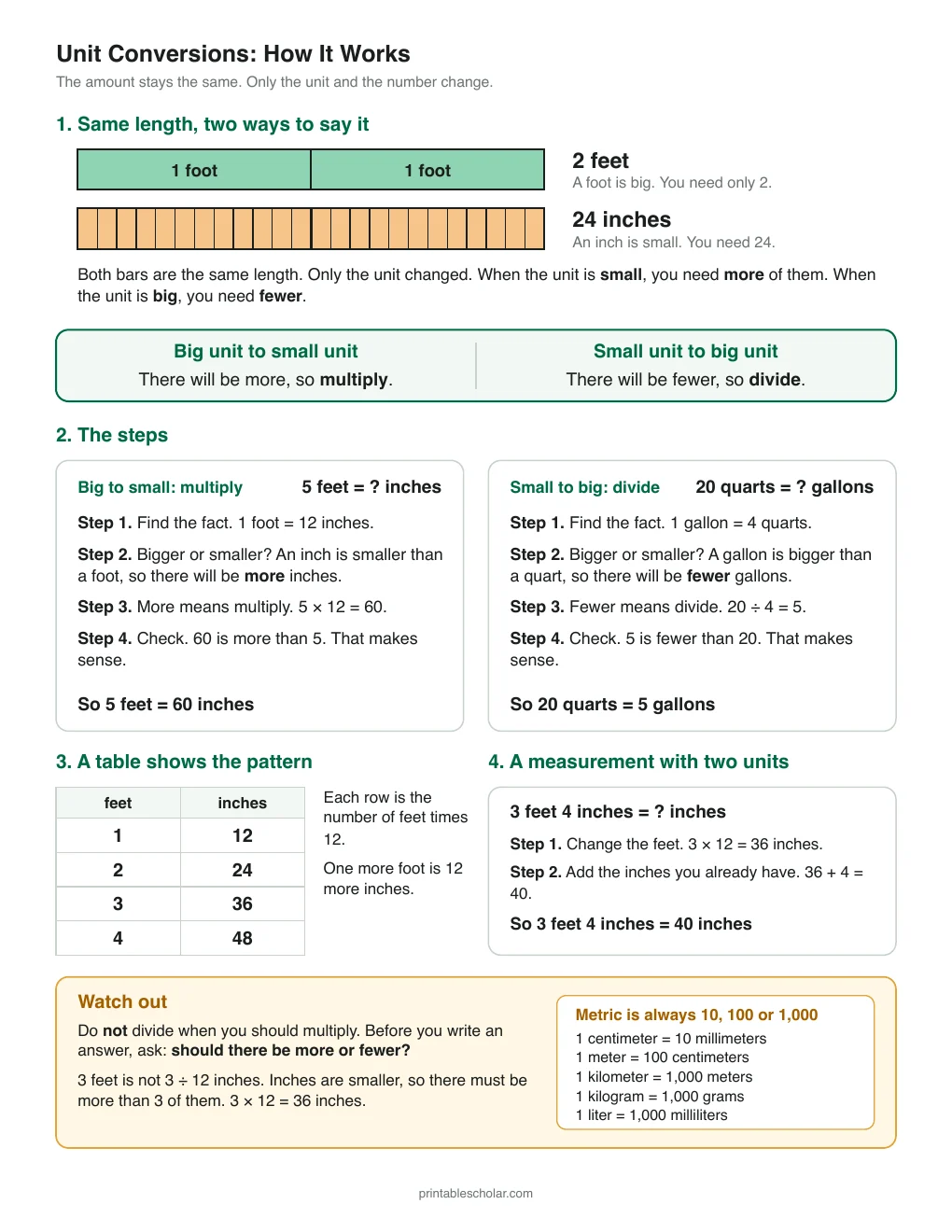
A one-page lesson on when to multiply and when to divide. A bar shows 2 feet as 24 inches, then come a worked example each way, a feet-to-inches table, and 3 feet 4 inches in inches.
Download PDF
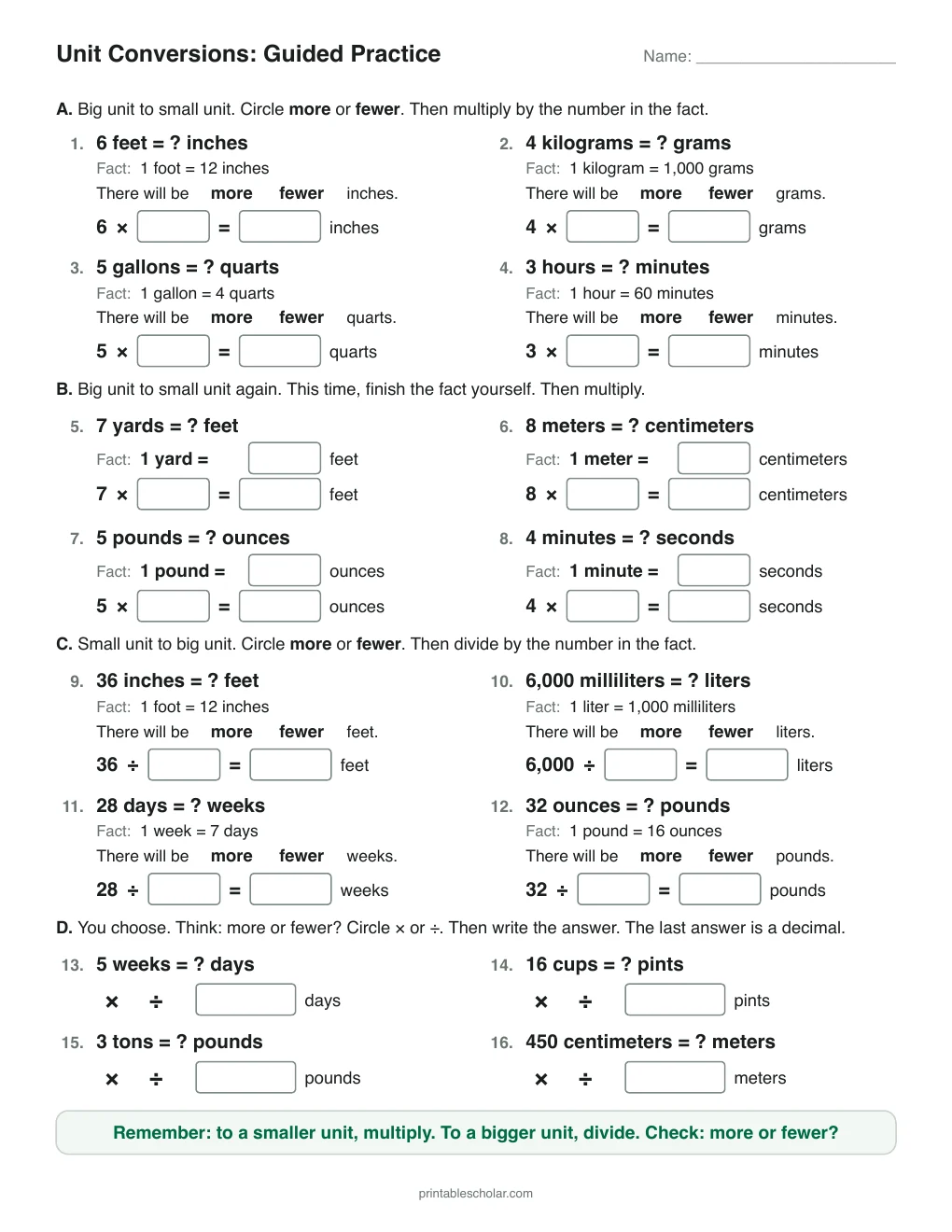
Sixteen conversions with the steps laid out in boxes: circle more or fewer, then multiply or divide. The last section leaves the child to choose × or ÷. Includes answer key.
Download PDF
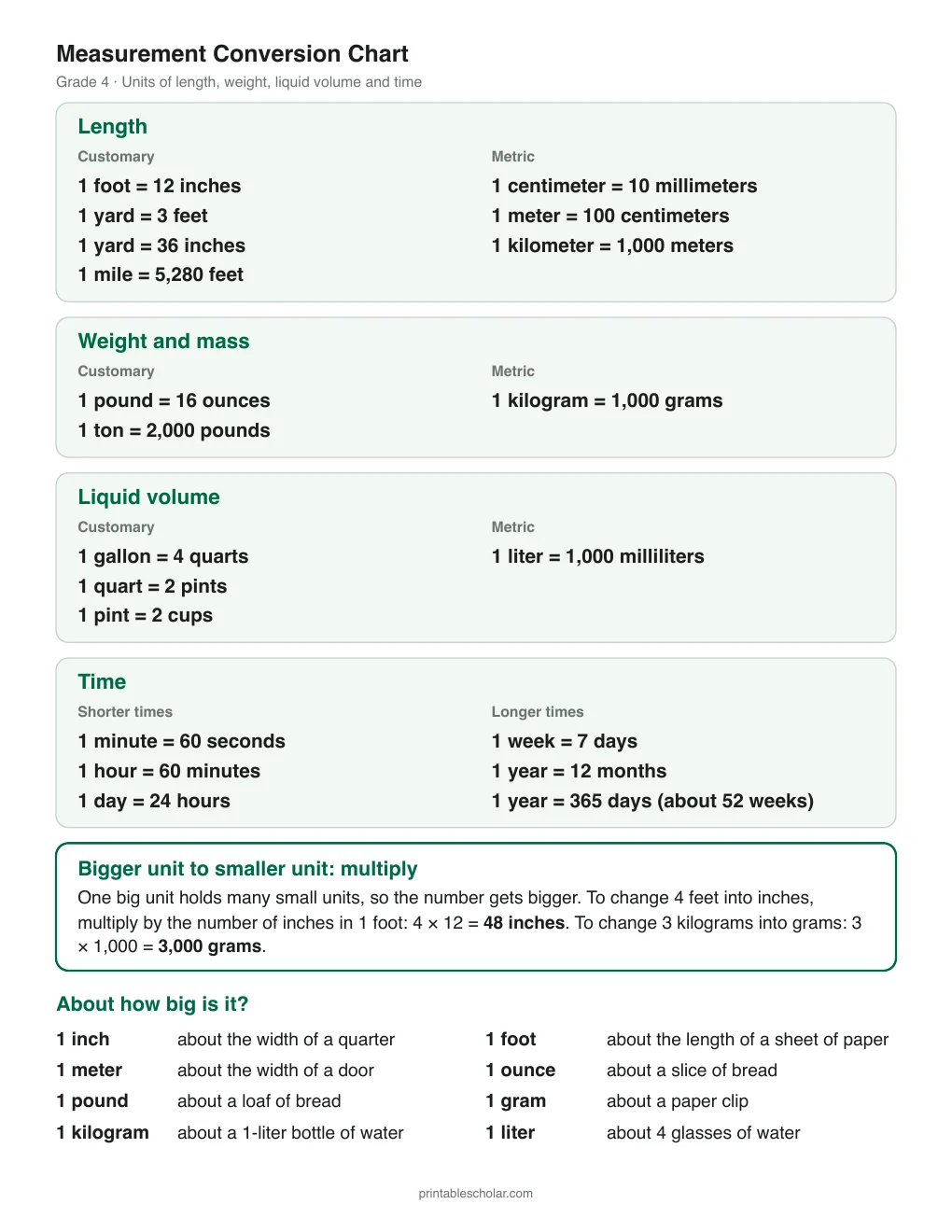
One page of facts for length, weight, liquid volume and time, customary and metric, with the multiply rule and eight everyday sizes to picture.
Download PDF
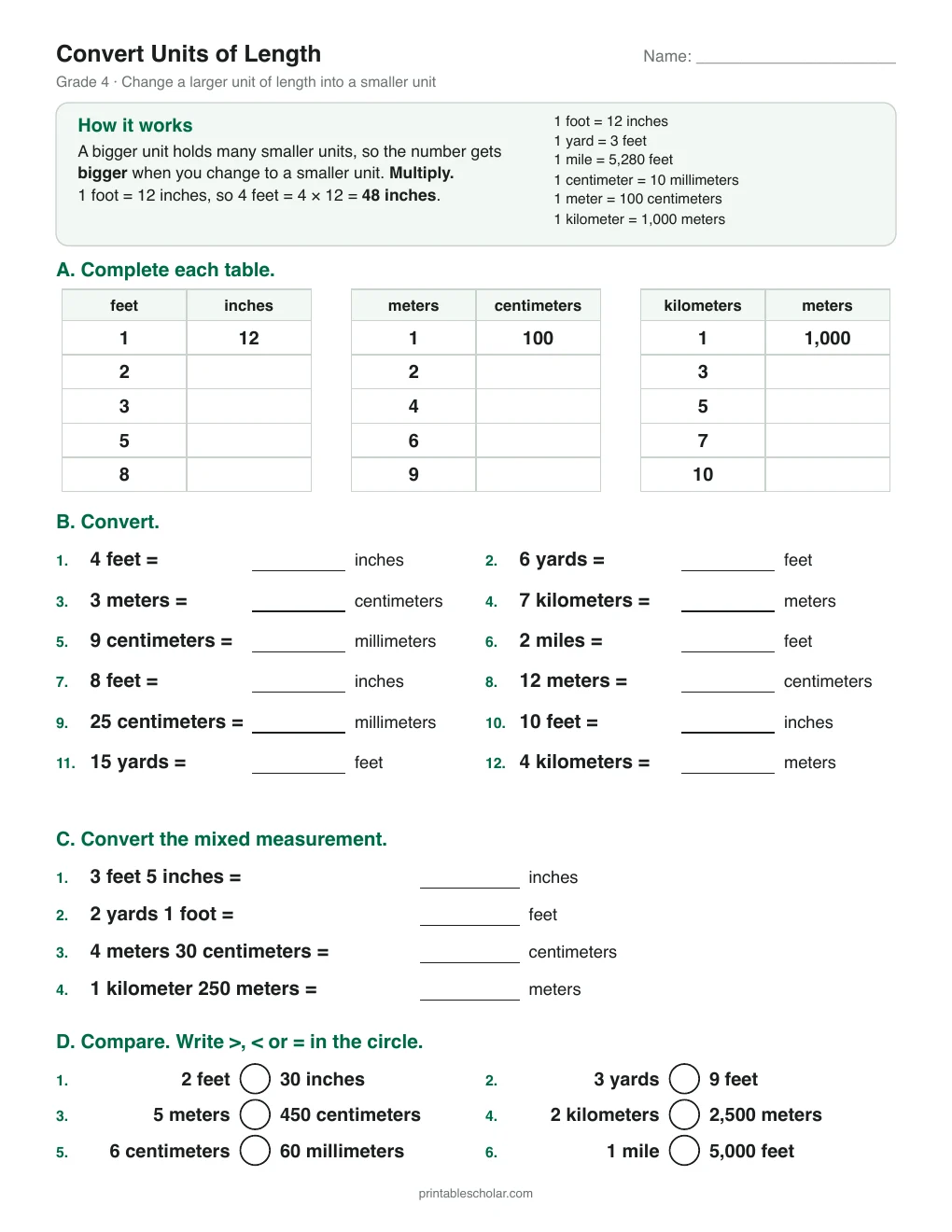
Three tables, twelve conversions such as 6 yards to feet and 7 kilometers to meters, four mixed measurements and six comparisons. Includes answer key.
Download PDF
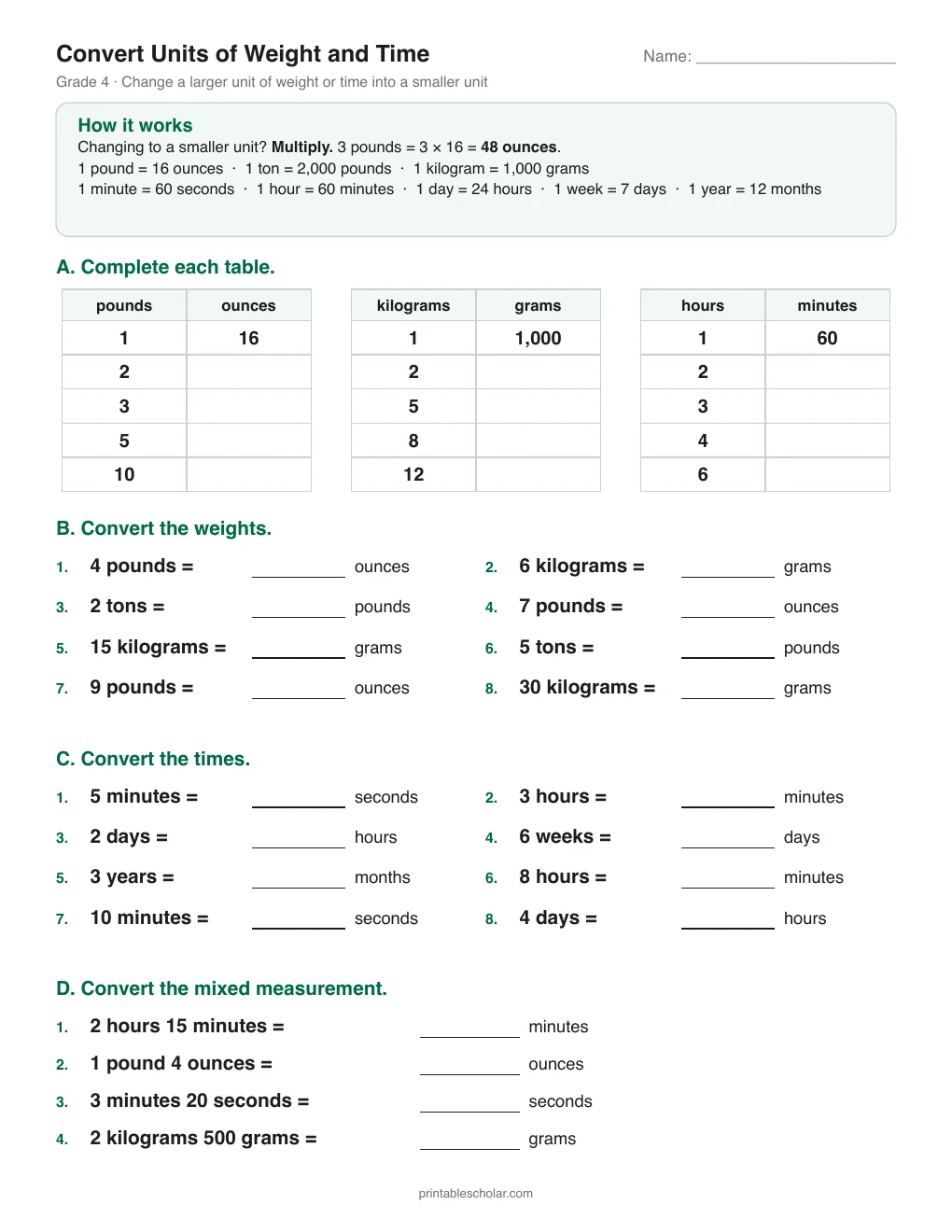
Three tables, eight weight conversions, eight time conversions, and four mixed measurements such as 2 hours 15 minutes. Includes answer key.
Download PDF
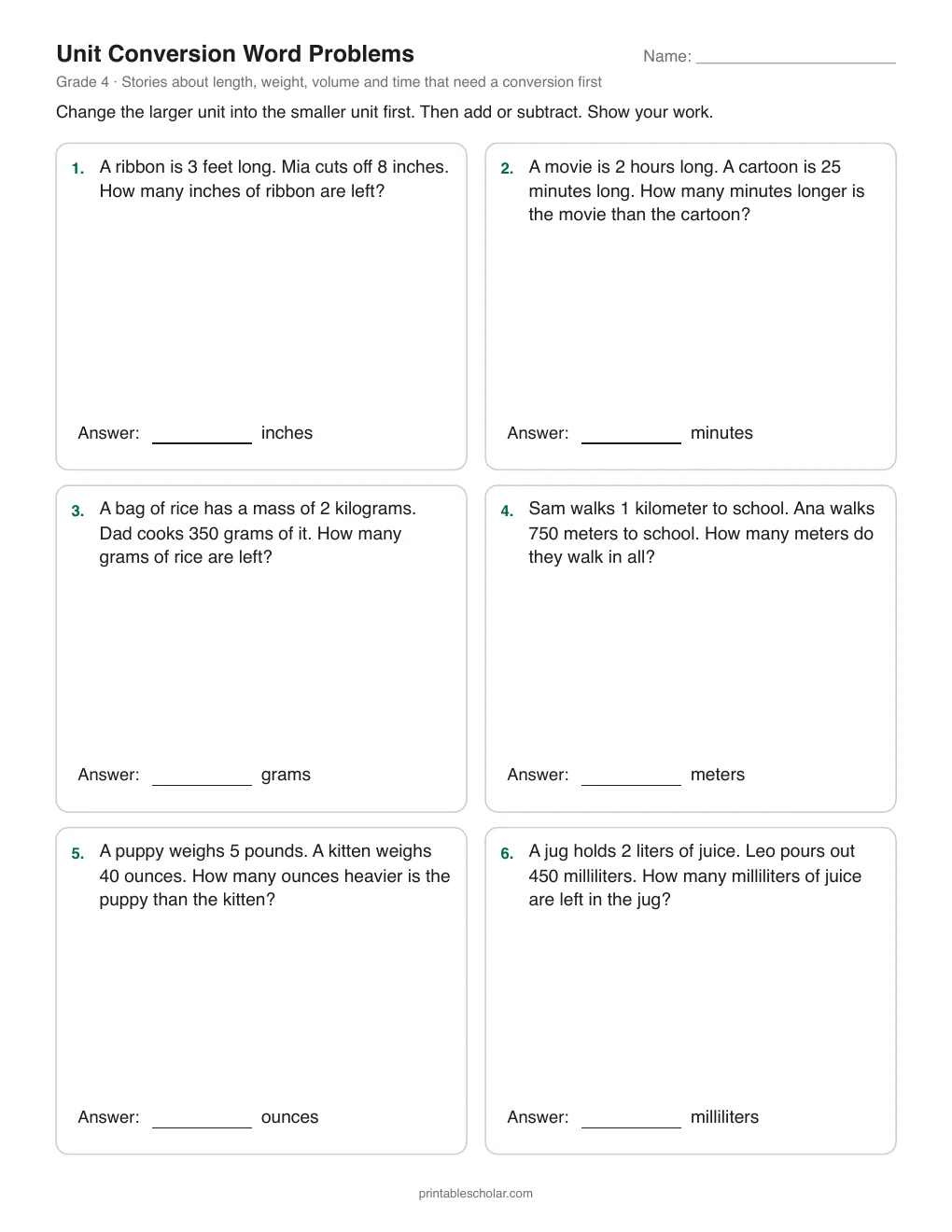
Six stories where one amount has to be changed into the smaller unit before adding or subtracting. The key shows both steps.
Download PDF
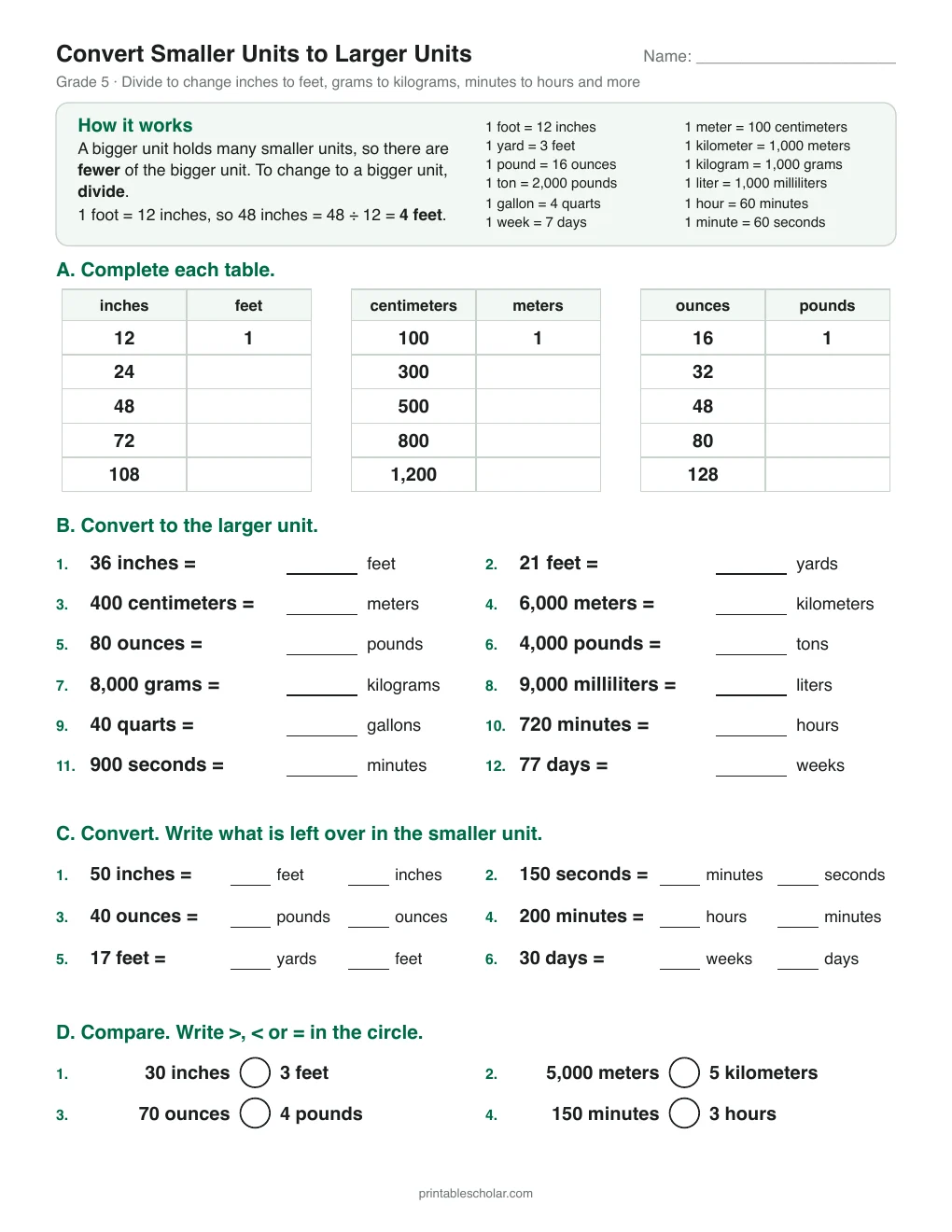
Three tables, twelve conversions such as 36 inches to feet, six with a leftover such as 50 inches, and four comparisons. Includes answer key.
Download PDF
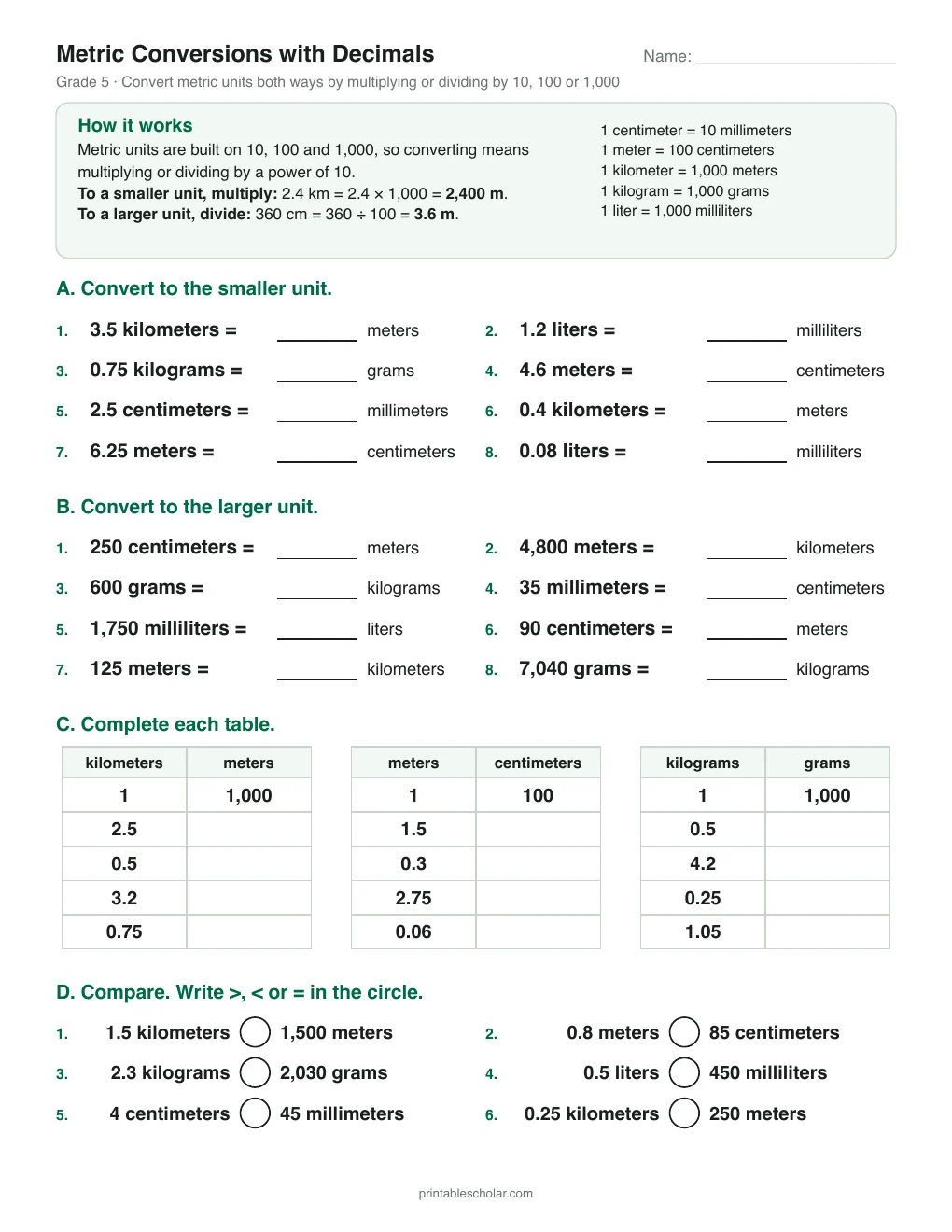
Sixteen conversions both ways, such as 3.5 km to meters and 250 cm to meters, three tables and six comparisons. Includes answer key.
Download PDF
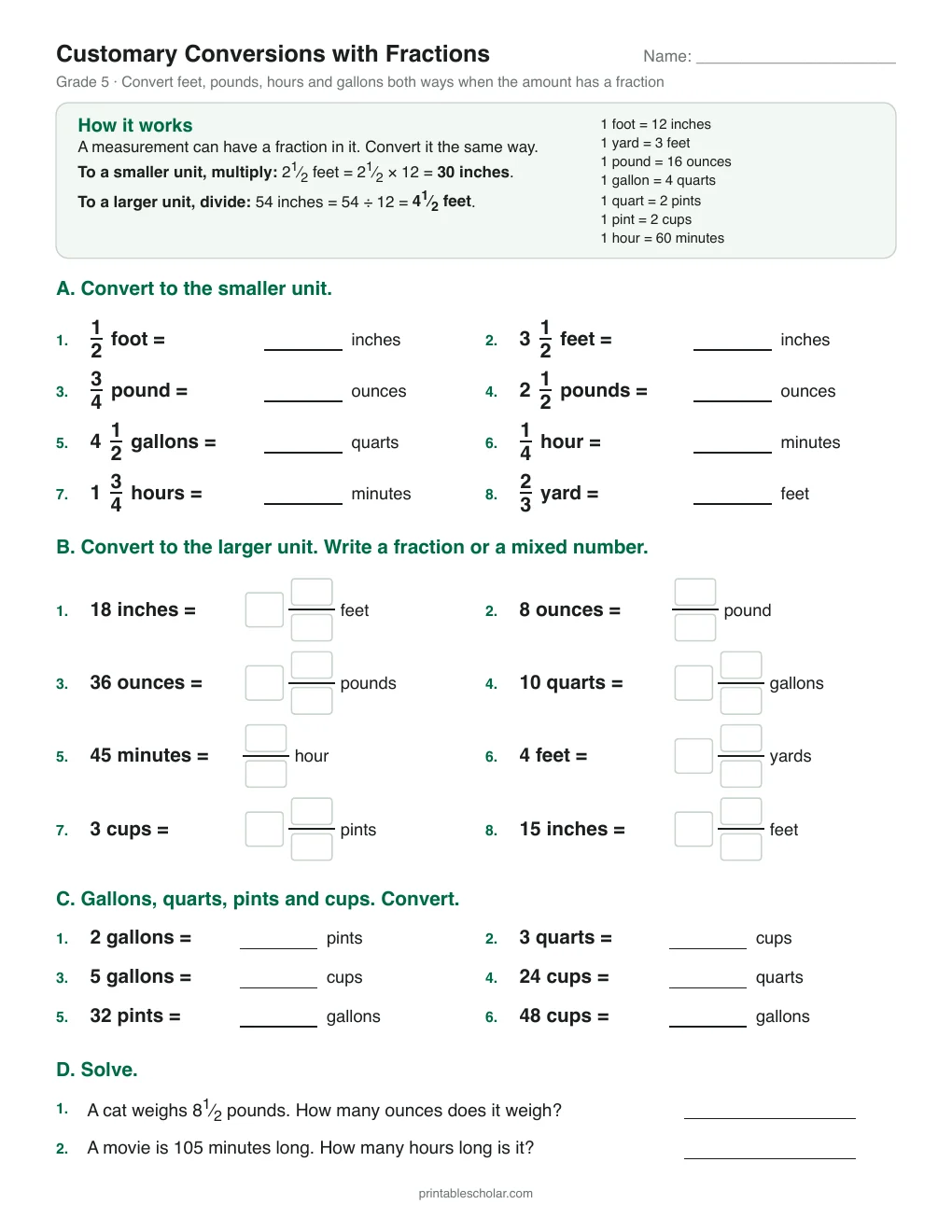
Convert amounts such as 3 1/2 feet and 36 ounces both ways, then gallons, quarts, pints and cups. Includes answer key.
Download PDF
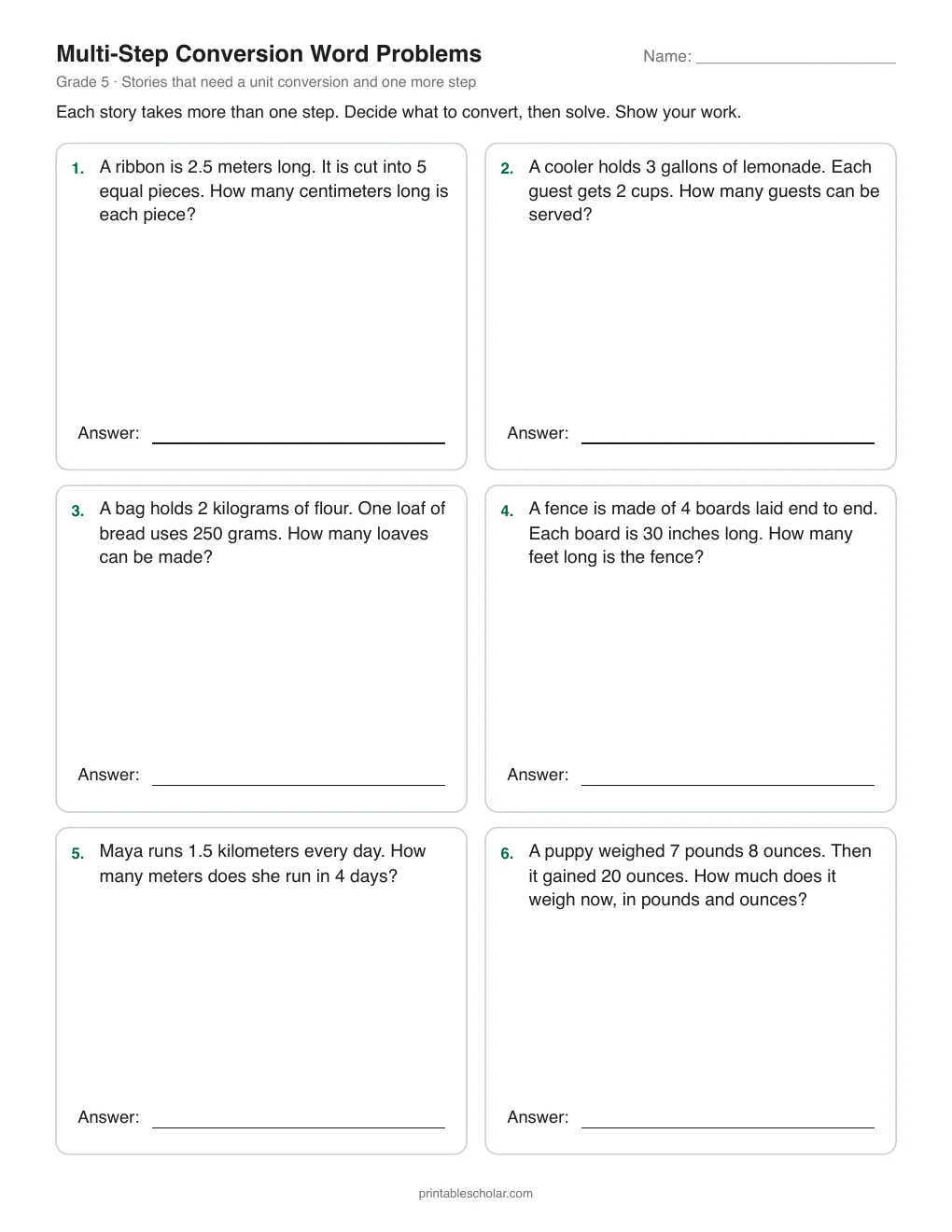
Six stories that need a conversion and one more step, with room to work. The key shows both steps.
Download PDFThe page opens with a lesson on the one idea children get stuck on: when to multiply and when to divide. How Unit Conversions Work draws the same length as 2 feet and as 24 inches. A small unit means you need more of them, so changing to a smaller unit is multiplication. A big unit means you need fewer, so changing to a bigger unit is division. It works one example each way in four steps: find the fact, decide bigger or smaller, multiply or divide, and check that the answer makes sense. Unit Conversions: Guided Practice follows the same steps. The first sections print the fact and ask the child to circle more or fewer before writing anything. The last section leaves the choice of × or ÷ to the child, across length, weight, liquid volume and time.
In 4th grade, converting units means going one way: from a larger unit to a smaller unit. There are more of the small unit, so the number gets bigger, and the operation is always multiplication. 4 feet is 4 × 12 inches. 3 kilograms is 3 × 1,000 grams.
The Measurement Conversion Chart is the reference page. It lists the facts children are expected to know for length, weight, liquid volume and time, with customary and metric units side by side, and gives an everyday size for each unit so the numbers mean something.
Convert Units of Length and Convert Units of Weight and Time both open with two-column tables, which is how the standard asks for conversions to be recorded: 1 foot is 12 inches, 2 feet is 24 inches, 3 feet is 36 inches. Then come single conversions and mixed measurements such as 3 feet 5 inches, where the feet are converted and the inches are added on.
In 5th grade conversions go both ways. Convert Smaller Units to Larger Units is the division side: 48 inches is 48 ÷ 12 feet. Metric Conversions with Decimals uses the fact that metric units are built on powers of 10, so 3.5 kilometers is 3,500 meters and 250 centimeters is 2.5 meters. Customary Conversions with Fractions does the same with halves and quarters, and the multi-step word problems put a conversion inside a longer problem.
The word problems each give one amount in a large unit and one in a small unit. Nothing can be added or subtracted until both are in the same unit. For measuring with a ruler and liquid measures, see the measurement worksheets. For hours and minutes on a clock, see elapsed time.