The front of every sheet in the pack, with the topic each week teaches. The weeks follow the order most U.S. math programs teach 4th grade (the sequence used by enVision and Go Math).
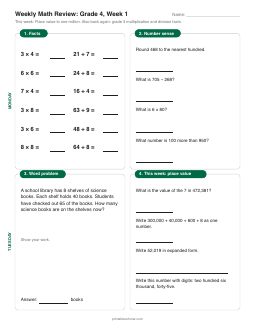
Week 1: Place value to one millionfree
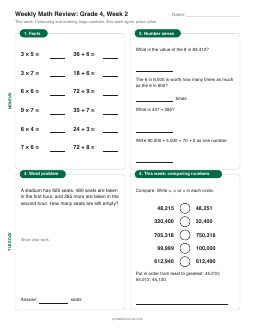
Week 2: Comparing and ordering large numbersfree
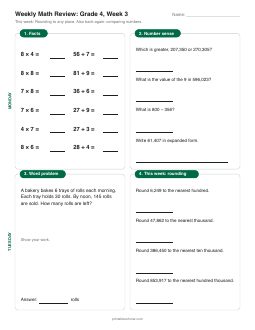
Week 3: Rounding to any placefree
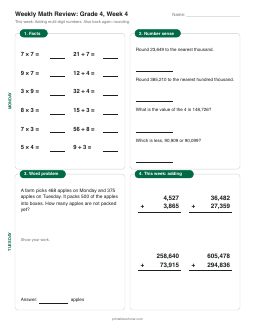
Week 4: Adding multi-digit numbersfree
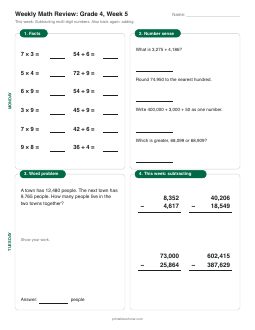
Week 5: Subtracting multi-digit numbers
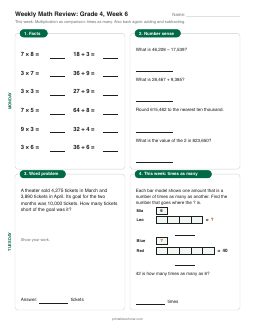
Week 6: Multiplication as comparison: times as many
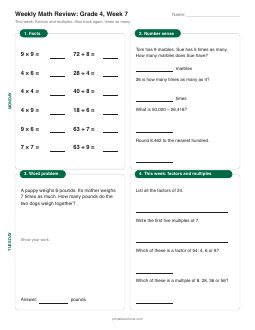
Week 7: Factors and multiples
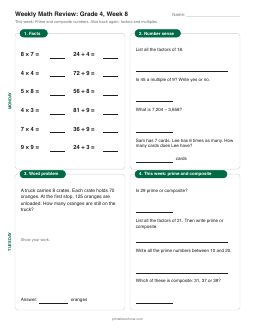
Week 8: Prime and composite numbers
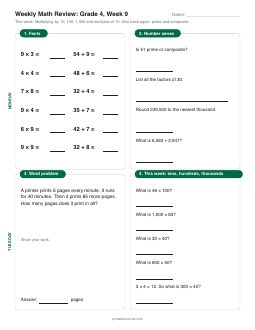
Week 9: Multiplying by 10, 100, 1,000 and multiples of 10
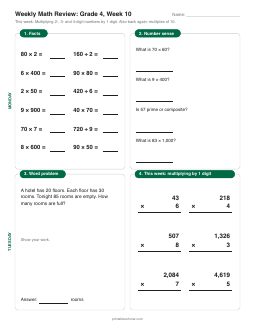
Week 10: Multiplying 2-, 3- and 4-digit numbers by 1 digit
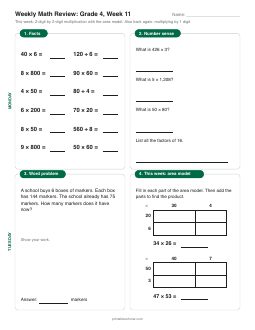
Week 11: 2-digit by 2-digit multiplication with the area model
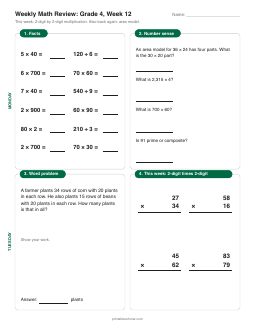
Week 12: 2-digit by 2-digit multiplication
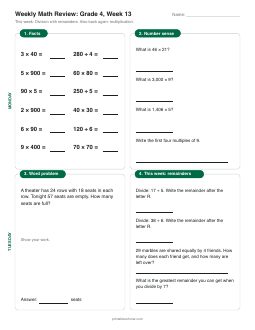
Week 13: Division with remainders
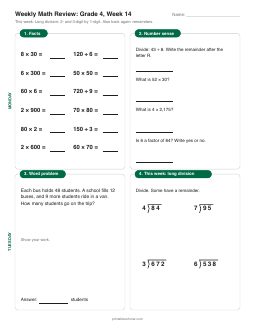
Week 14: Long division: 2- and 3-digit by 1-digit
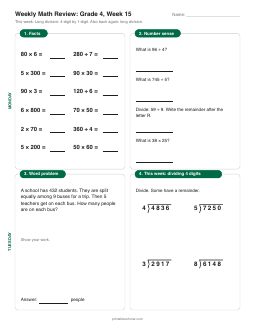
Week 15: Long division: 4-digit by 1-digit
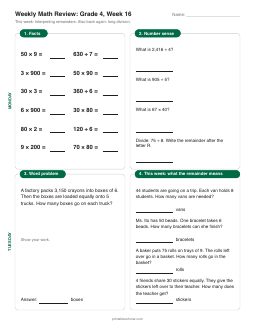
Week 16: Interpreting remainders
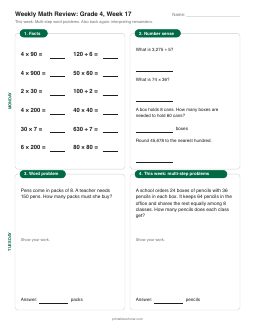
Week 17: Multi-step word problems
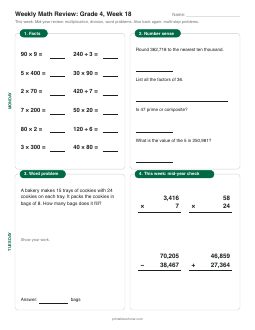
Week 18: Mid-year review: multiplication, division, word problems
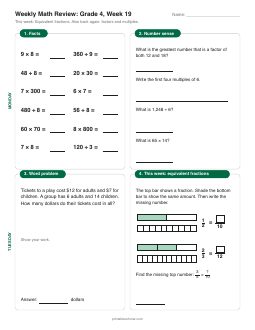
Week 19: Equivalent fractions
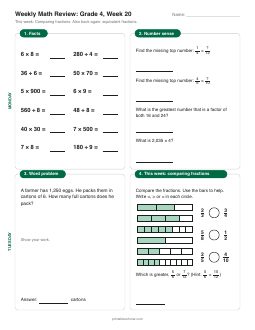
Week 20: Comparing fractions
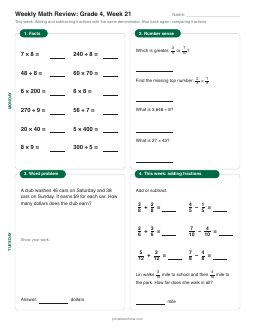
Week 21: Adding and subtracting fractions with the same denominator
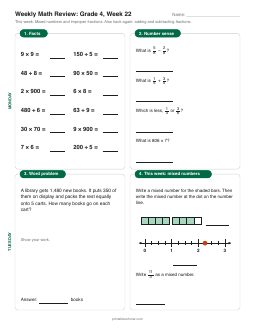
Week 22: Mixed numbers and improper fractions
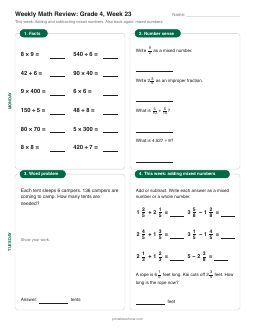
Week 23: Adding and subtracting mixed numbers
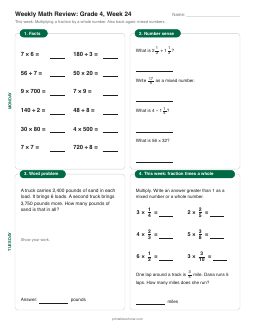
Week 24: Multiplying a fraction by a whole number
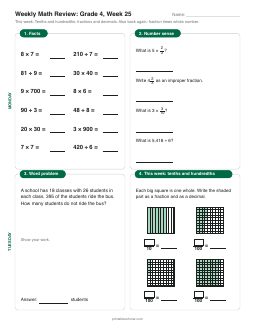
Week 25: Tenths and hundredths: fractions and decimals
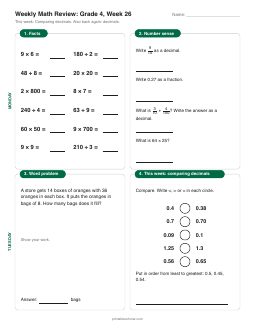
Week 26: Comparing decimals
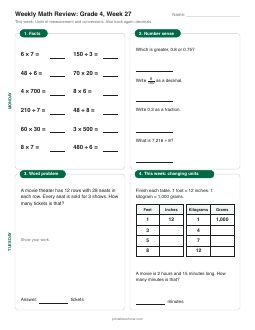
Week 27: Units of measurement and conversions
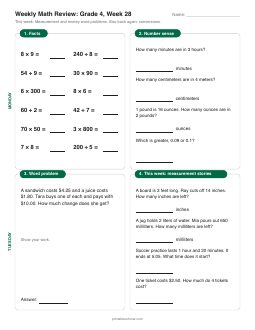
Week 28: Measurement and money word problems
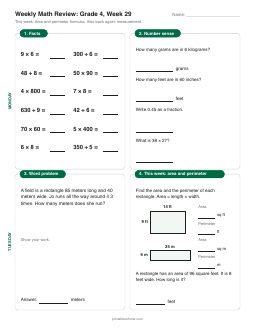
Week 29: Area and perimeter formulas
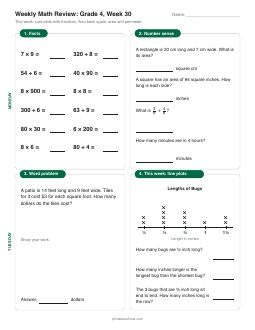
Week 30: Line plots with fractions
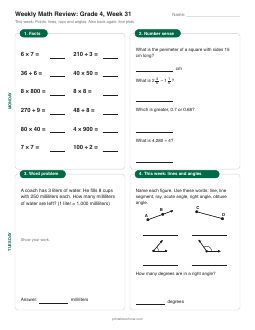
Week 31: Points, lines, rays and angles
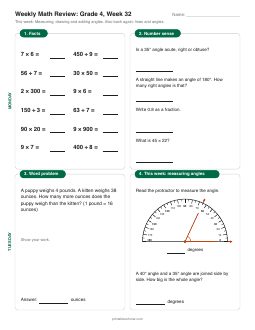
Week 32: Measuring, drawing and adding angles
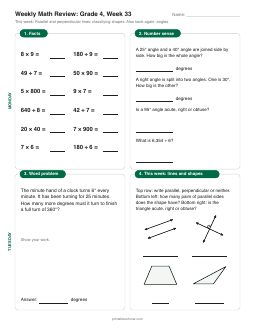
Week 33: Parallel and perpendicular lines; classifying shapes
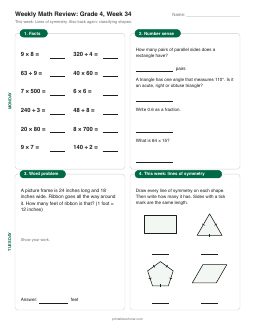
Week 34: Lines of symmetry
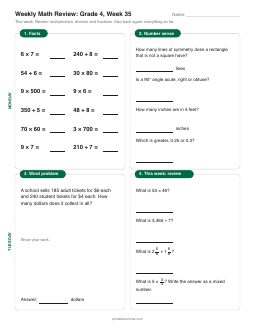
Week 35: Review: multiplication, division and fractions
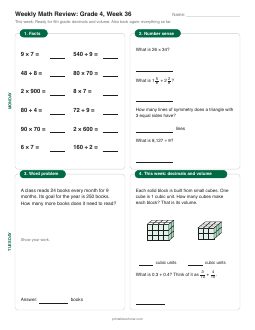
Week 36: Ready for 5th grade: decimals and volume
What each week teaches, what it brings back, and the Common Core standard its focus box practices. If your program teaches a topic at a different time, pick the week that matches.
As morning work
Two boxes a day, Monday to Thursday, about ten minutes a day. Go over the answers together on Friday.
As homework or a weekly check
The front one night and the back the next, or the whole sheet in one sitting of 20 to 30 minutes.
At home
Let your child work alone first. A box they cannot do tells you what to go back over.
Four on the front and four on the back, in the same places every week, so students know what to do without being told.
- 1
Facts Quick problems to keep recall fast.
- 2
Number sense Place value, comparing, rounding and mental math.
- 3
Word problem One story problem with room to show the work.
- 4
This week's focus The new topic for the week. The line under the title names it.
- 5
Mixed skills A different skill each week: time, money, measurement, graphs, shapes or fractions, whichever earlier weeks have taught.
- 6
Patterns Number patterns, rules and tables.
- 7
Puzzle A riddle or a problem that takes some thinking.
- 8
Find the mistake Two children give two answers. The student says who is right and what the other one did wrong.


