The front of every sheet in the pack, with the topic each week teaches. The weeks follow the order most U.S. math programs teach 1st grade (the sequence used by enVision and Go Math).
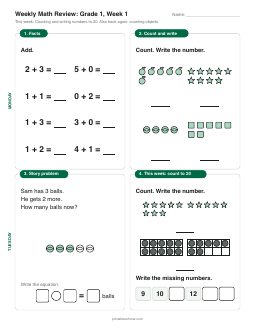
Week 1: Counting and writing numbers to 20free
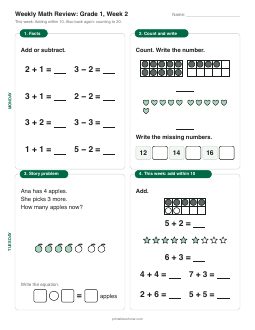
Week 2: Adding within 10free
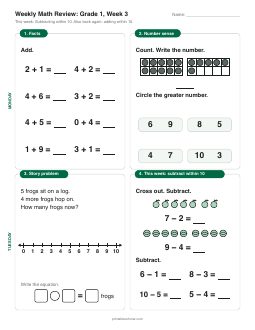
Week 3: Subtracting within 10free
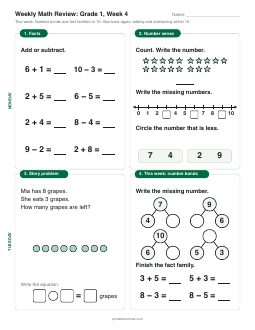
Week 4: Number bonds and fact families to 10free
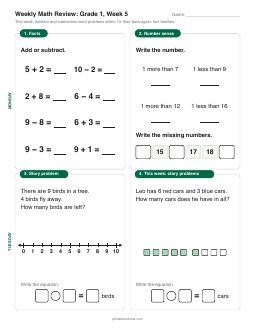
Week 5: Addition and subtraction word problems within 10
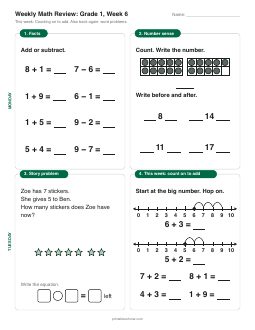
Week 6: Counting on to add
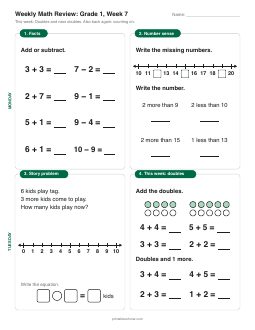
Week 7: Doubles and near doubles
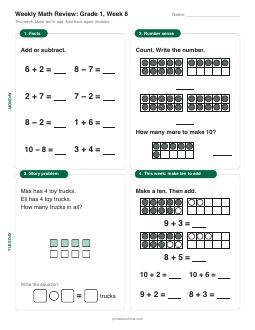
Week 8: Make ten to add
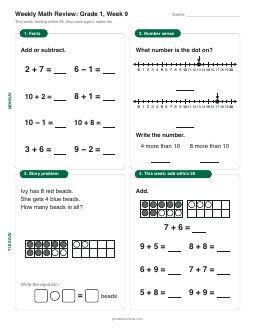
Week 9: Adding within 20
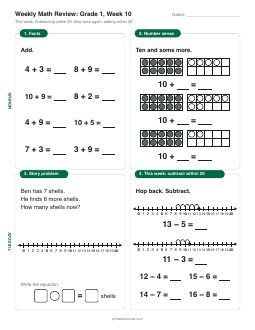
Week 10: Subtracting within 20
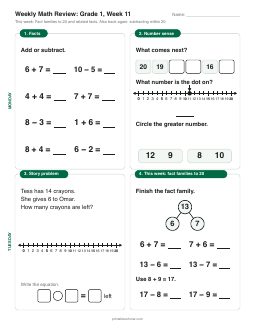
Week 11: Fact families to 20 and related facts
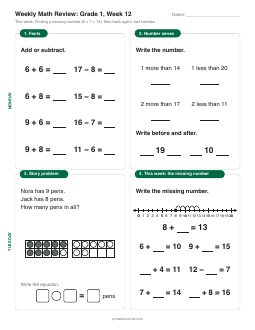
Week 12: Finding a missing number (8 + ? = 13)
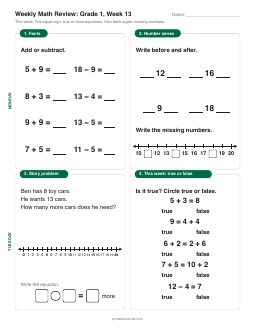
Week 13: The equal sign: true or false equations
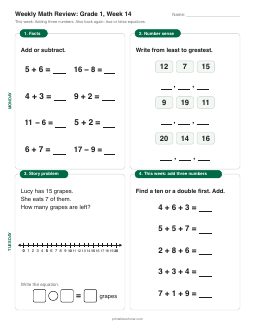
Week 14: Adding three numbers
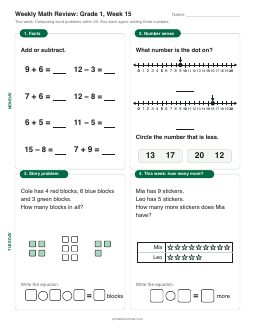
Week 15: Comparing word problems within 20
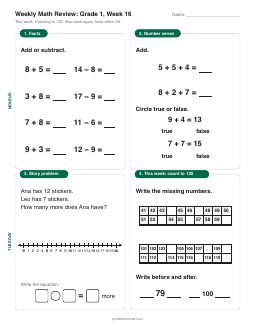
Week 16: Counting to 120
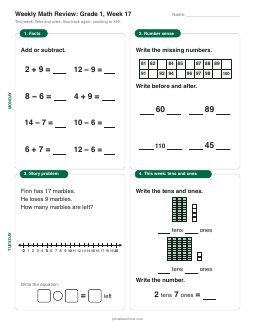
Week 17: Tens and ones
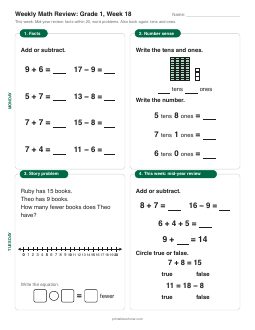
Week 18: Mid-year review: facts within 20, word problems
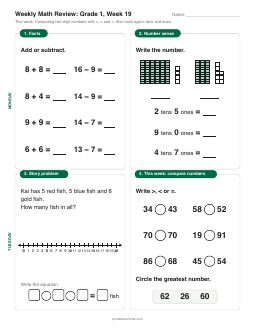
Week 19: Comparing two-digit numbers with <, > and =
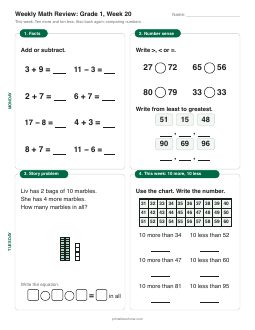
Week 20: Ten more and ten less
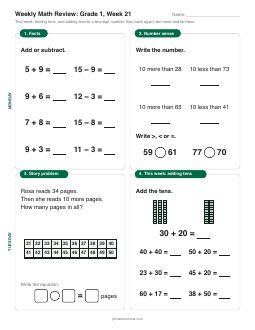
Week 21: Adding tens, and adding tens to a two-digit number
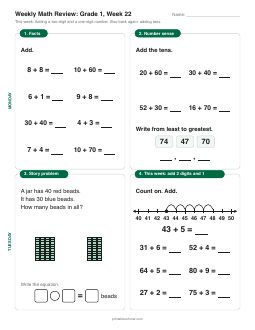
Week 22: Adding a two-digit and a one-digit number
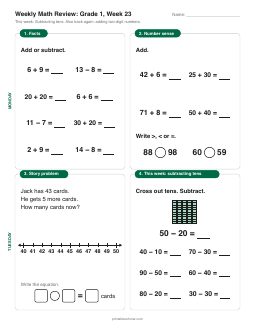
Week 23: Subtracting tens
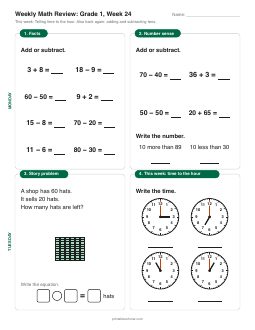
Week 24: Telling time to the hour
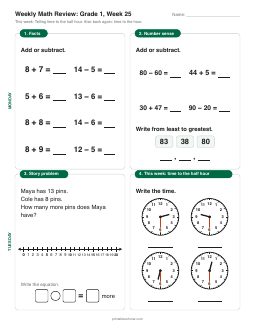
Week 25: Telling time to the half hour
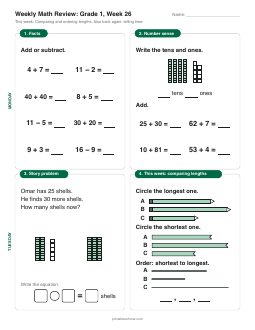
Week 26: Comparing and ordering lengths
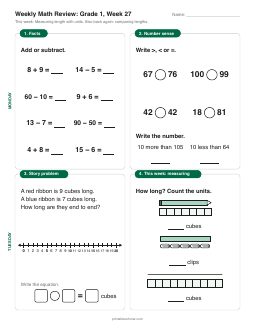
Week 27: Measuring length with units
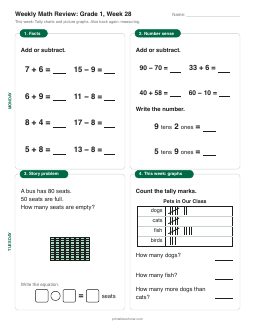
Week 28: Tally charts and picture graphs
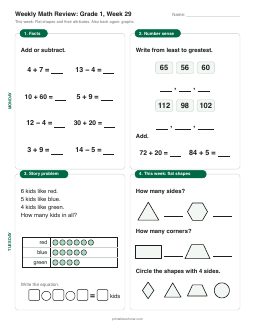
Week 29: Flat shapes and their attributes
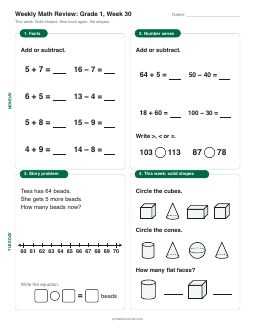
Week 30: Solid shapes
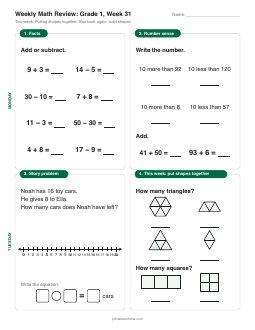
Week 31: Putting shapes together
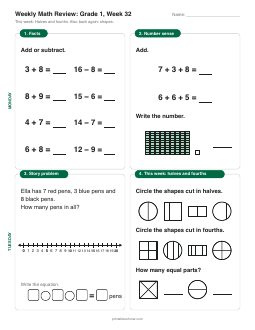
Week 32: Halves and fourths
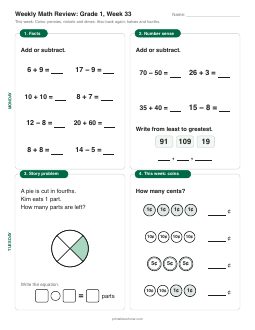
Week 33: Coins: pennies, nickels and dimes
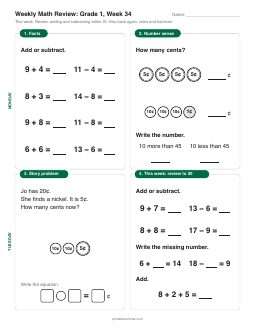
Week 34: Review: adding and subtracting within 20
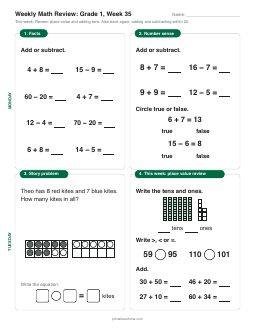
Week 35: Review: place value and adding tens
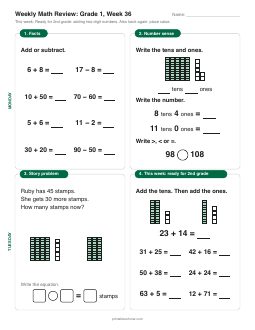
Week 36: Ready for 2nd grade: adding two-digit numbers
What each week teaches, what it brings back, and the Common Core standard its focus box practices. If your program teaches a topic at a different time, pick the week that matches.
As morning work
Two boxes a day, Monday to Thursday, about ten minutes a day. Go over the answers together on Friday.
As homework or a weekly check
The front one night and the back the next, or the whole sheet in one sitting of 20 to 30 minutes.
At home
Read each instruction aloud once, then let your child work. The pictures carry most of the problem.
Four on the front and four on the back, in the same places every week, so students know what to do without being told.
- 1
Facts Quick adding and subtracting facts, in big type.
- 2
Count and write Counting, writing and comparing numbers.
- 3
Story problem One short story problem with a picture and an equation to fill in.
- 4
This week's focus The new topic for the week. The line under the title names it.
- 5
Mixed skills A different skill each week: time, money, measurement, graphs, shapes or fractions, whichever earlier weeks have taught.
- 6
Patterns What comes next, in numbers and in shapes.
- 7
Puzzle A riddle or a problem that takes some thinking.
- 8
Find the mistake Two children give two answers. The student circles who is right.


