About the 2D and 3D Shapes Worksheets
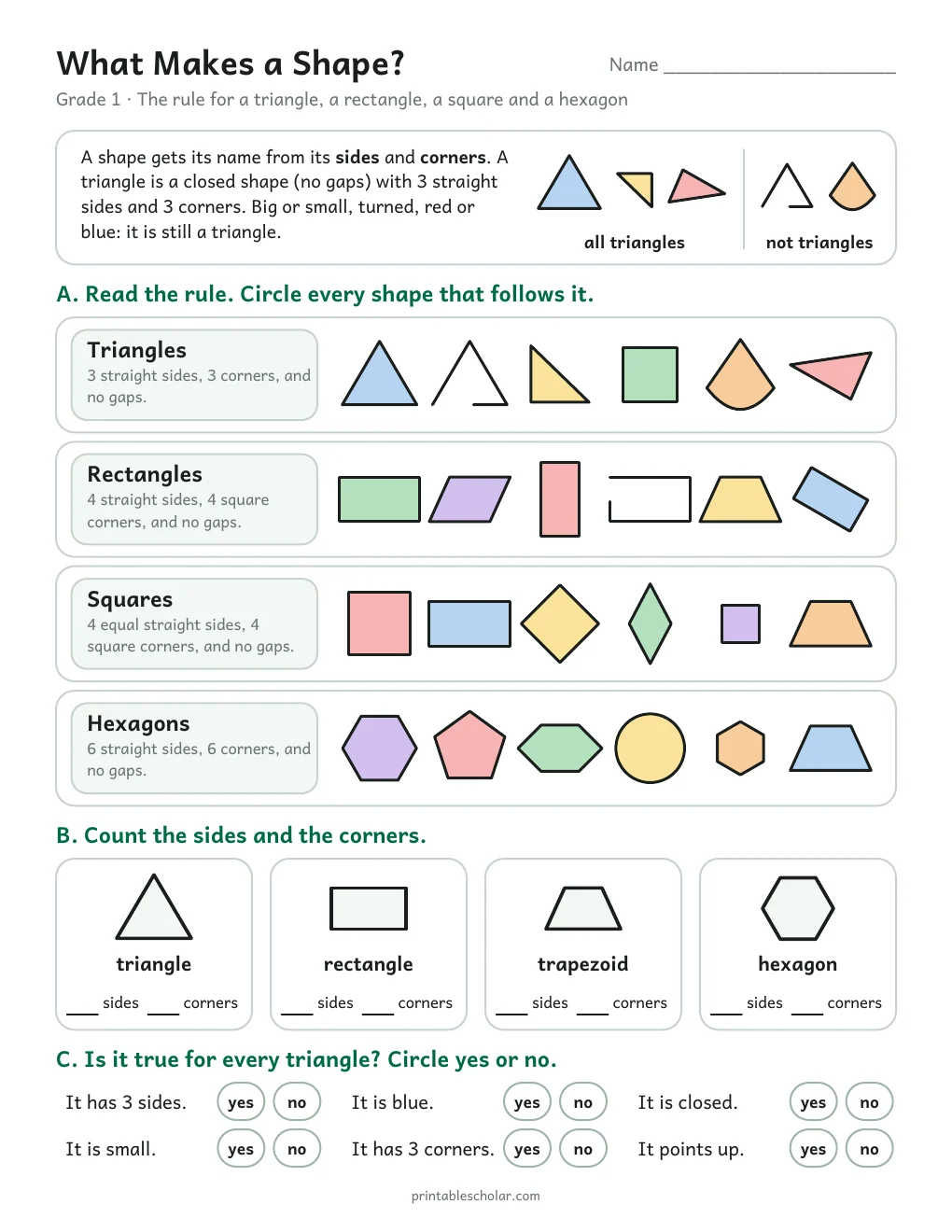
In kindergarten children learn the names of shapes. In 1st grade they learn why a shape has its name. A triangle is a closed shape with three straight sides and three corners. That is the rule, and nothing else matters: not its color, not its size, not which way it points.
What Makes a Shape? puts the rule to work. Each row mixes shapes that follow the rule with ones that nearly do: a triangle with a gap in one side, a triangle with a curved side, a four-sided shape whose corners are not square. A square turned on its corner is still a square, and a long thin hexagon is still a hexagon.
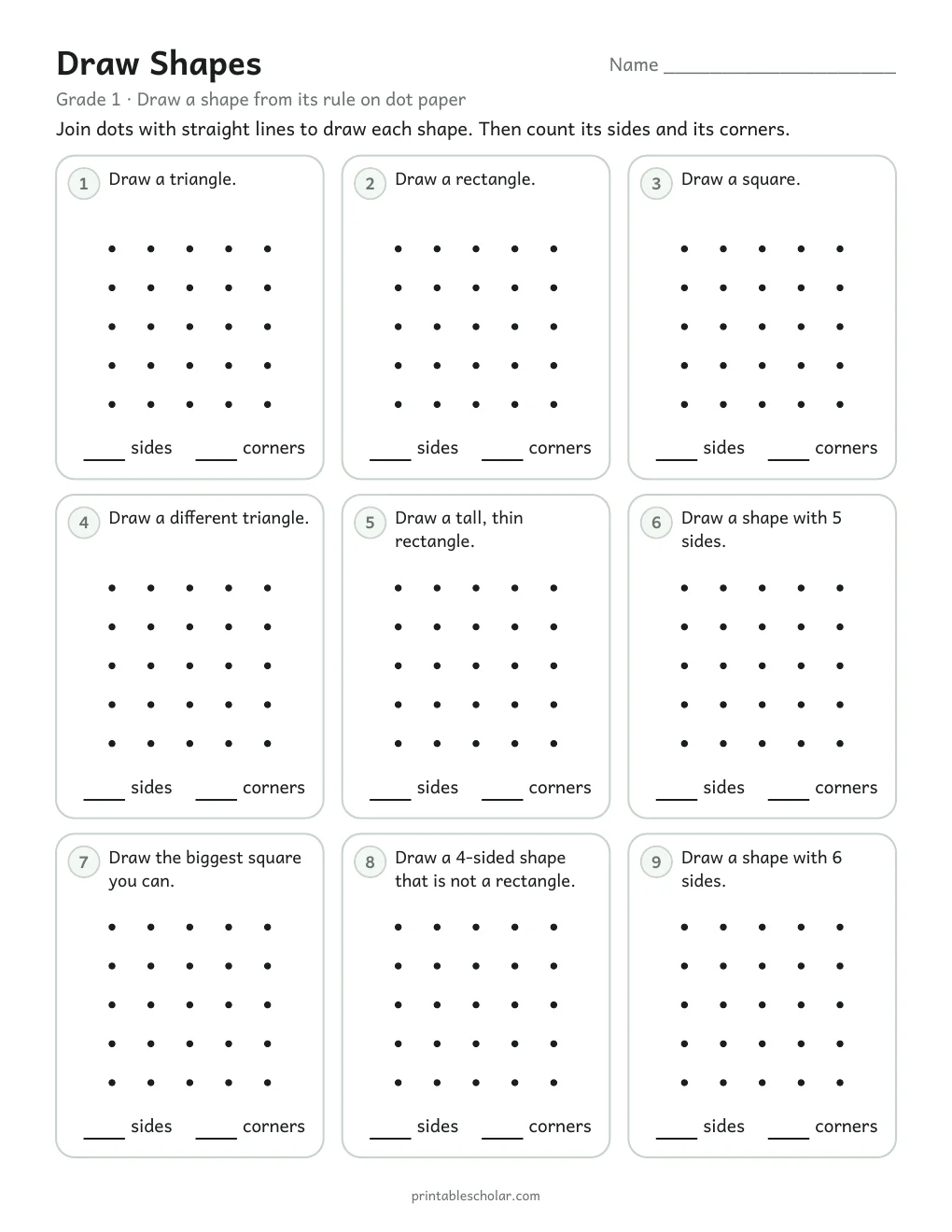
Draw Shapes turns it around. The child reads a rule and draws a shape that fits it on dot paper. There are many right answers for each one, so the key shows one way and the rule is the check.
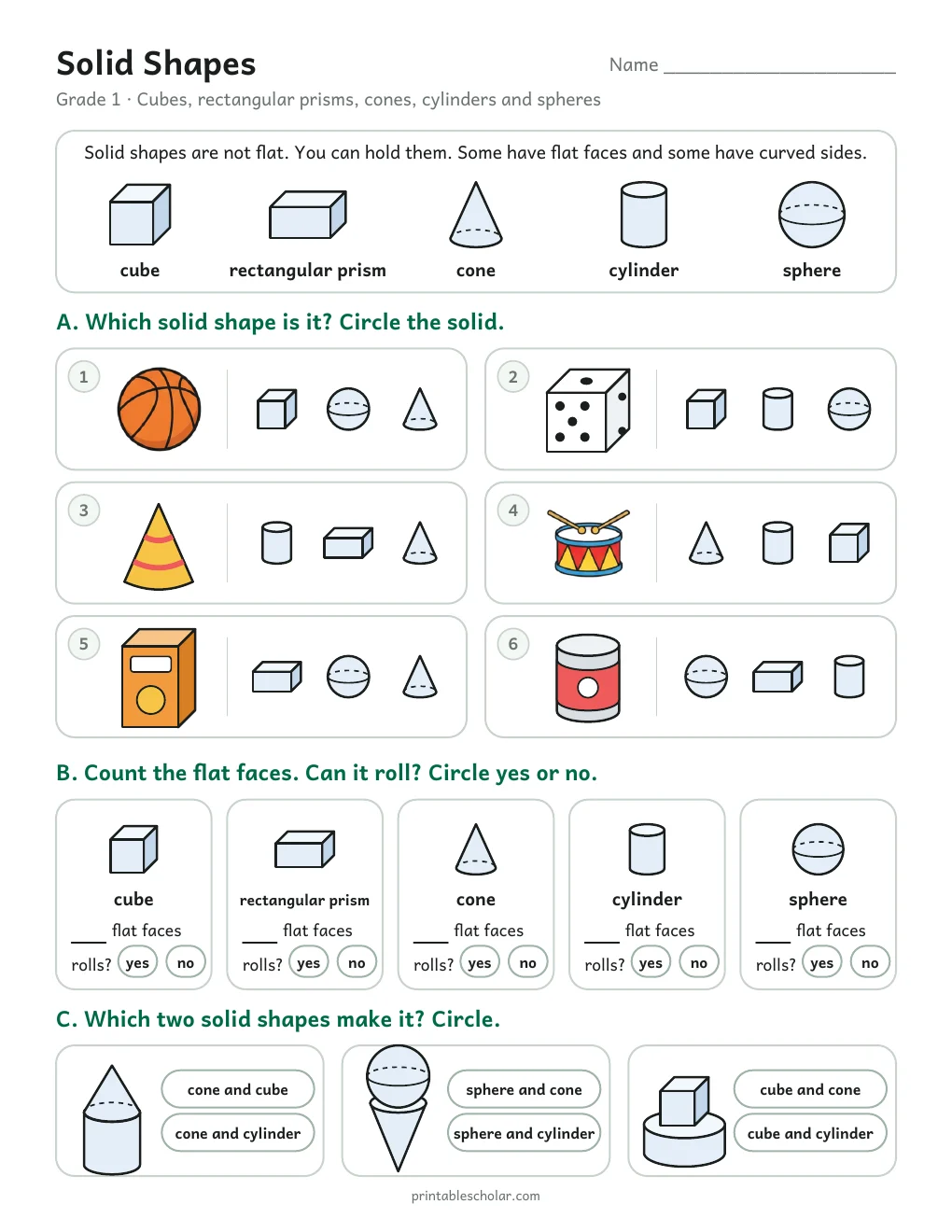
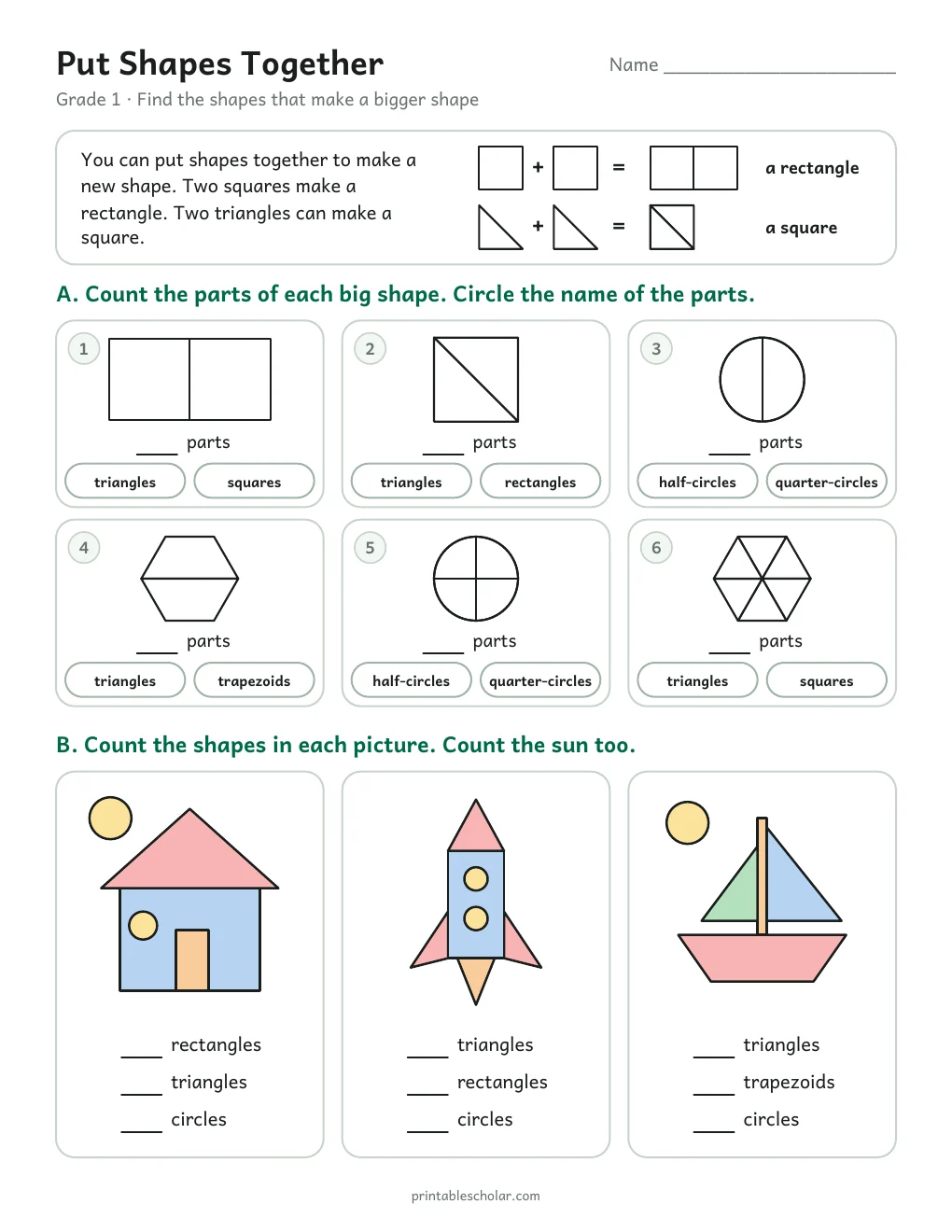
Solid Shapes covers the five solids 1st graders name: cube, rectangular prism, cone, cylinder and sphere. Children match them to everyday things, count the flat faces and decide which ones roll. Put Shapes Together shows that two squares make a rectangle, two trapezoids make a hexagon and four quarter-circles make a circle, then asks children to find the shapes inside a house, a rocket and a boat.
For naming and matching the basic shapes first, see the kindergarten shapes worksheets. Cutting shapes into halves and fourths is on the equal parts worksheets page, and older children can go on to the geometry worksheets.
Frequently Asked Questions
What shapes do 1st graders learn?
Flat shapes: triangles, rectangles, squares, trapezoids, hexagons, circles, half-circles and quarter-circles. Solid shapes: cubes, rectangular prisms, cones and cylinders, and usually spheres. They also learn to put shapes together to make new ones.
What is the difference between 2D and 3D shapes?
A 2D shape is flat, like a drawing on paper: a circle, a square, a triangle. A 3D shape is solid and takes up space, so you can hold it: a ball is a sphere, a box is a rectangular prism, a can is a cylinder.
What makes a shape a triangle?
Three straight sides, three corners, and no gaps. Size, color and position do not matter. A shape with a curved side or an open side is not a triangle, even if it looks close.
How many flat faces does each solid shape have?
A cube and a rectangular prism each have 6 flat faces. A cylinder has 2, a cone has 1, and a sphere has none. Solids with a curved side can roll.
Is a square a rectangle?
Yes. A rectangle is a closed shape with four straight sides and four square corners, and a square has all of that. A square is a rectangle whose sides are all the same length. These worksheets keep squares out of the rectangle row so the question does not come up before a child is ready for it.
Do the worksheets have answer keys?
Yes. Every worksheet is a two-page PDF with the answer key on the second page.