About the Perimeter Worksheets
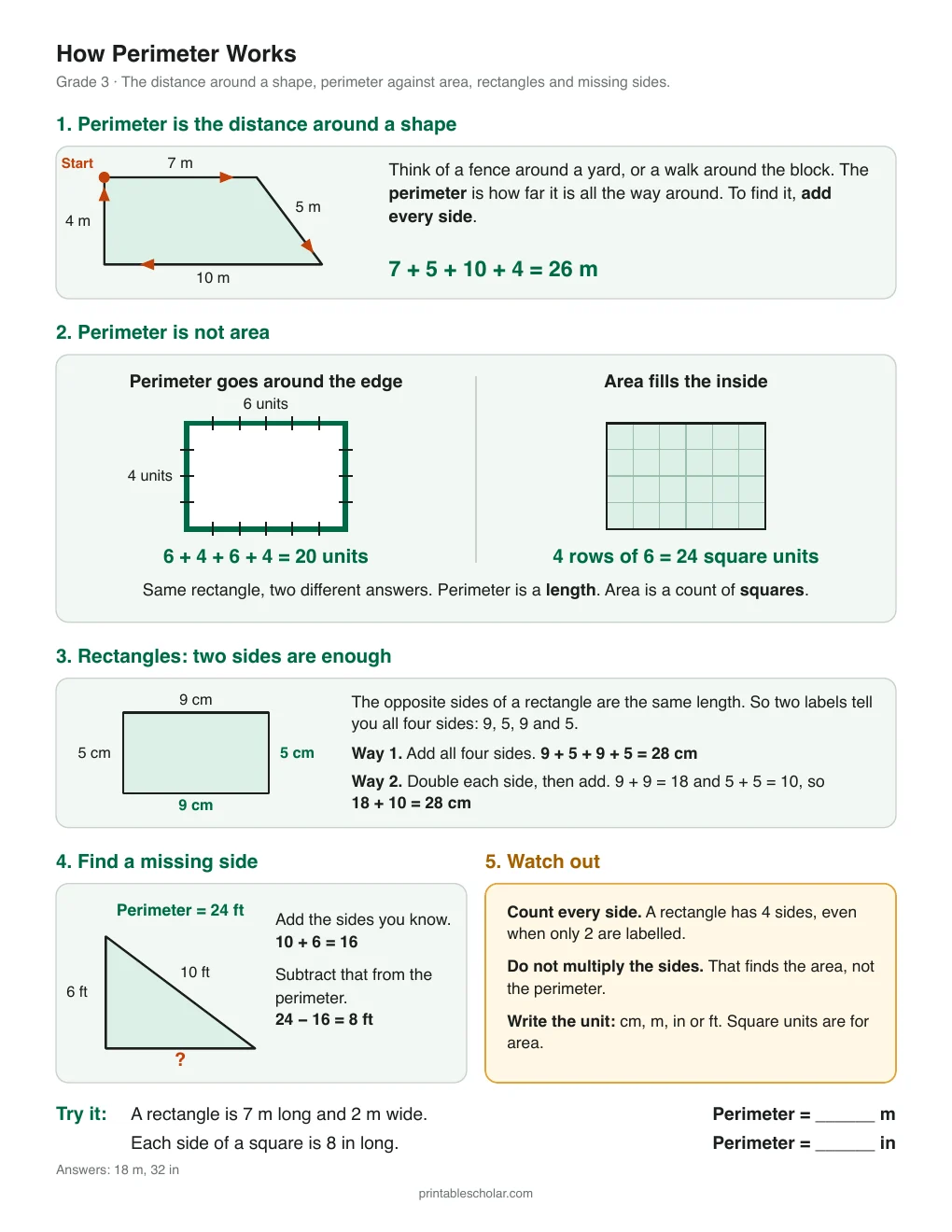
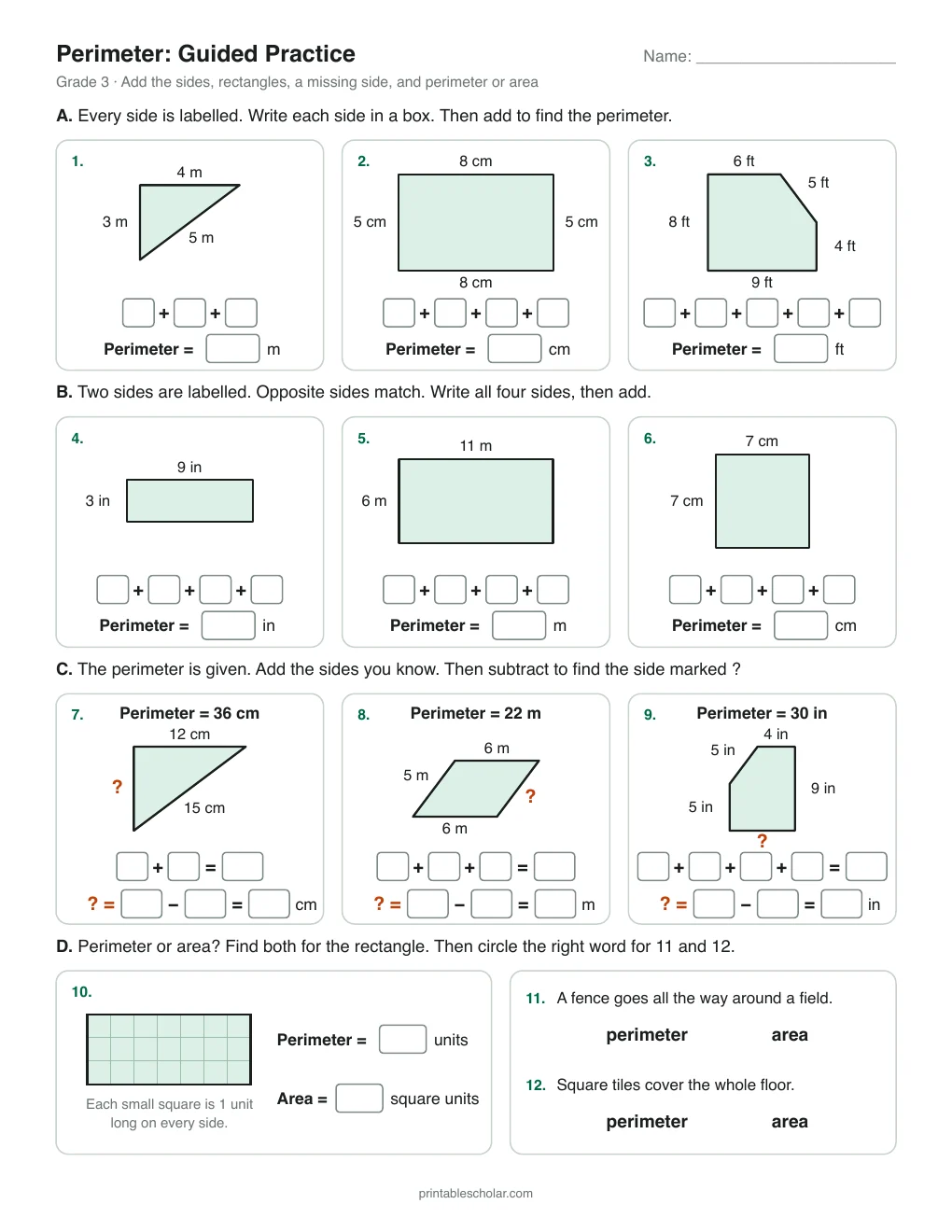
Start with How Perimeter Works. It shows perimeter as the distance all the way around a shape, like a fence around a yard, then draws the same rectangle twice: once with its edge traced (20 units) and once filled with squares (24 square units), because mixing up perimeter and area is the most common mistake. It also covers the two ways to find the perimeter of a rectangle, how to find a missing side, and three things to watch out for. Perimeter: Guided Practice follows the same order with a write-in box for each step: three shapes with every side labelled, three rectangles with two sides labelled, three missing sides, and a last section that asks for perimeter or area.
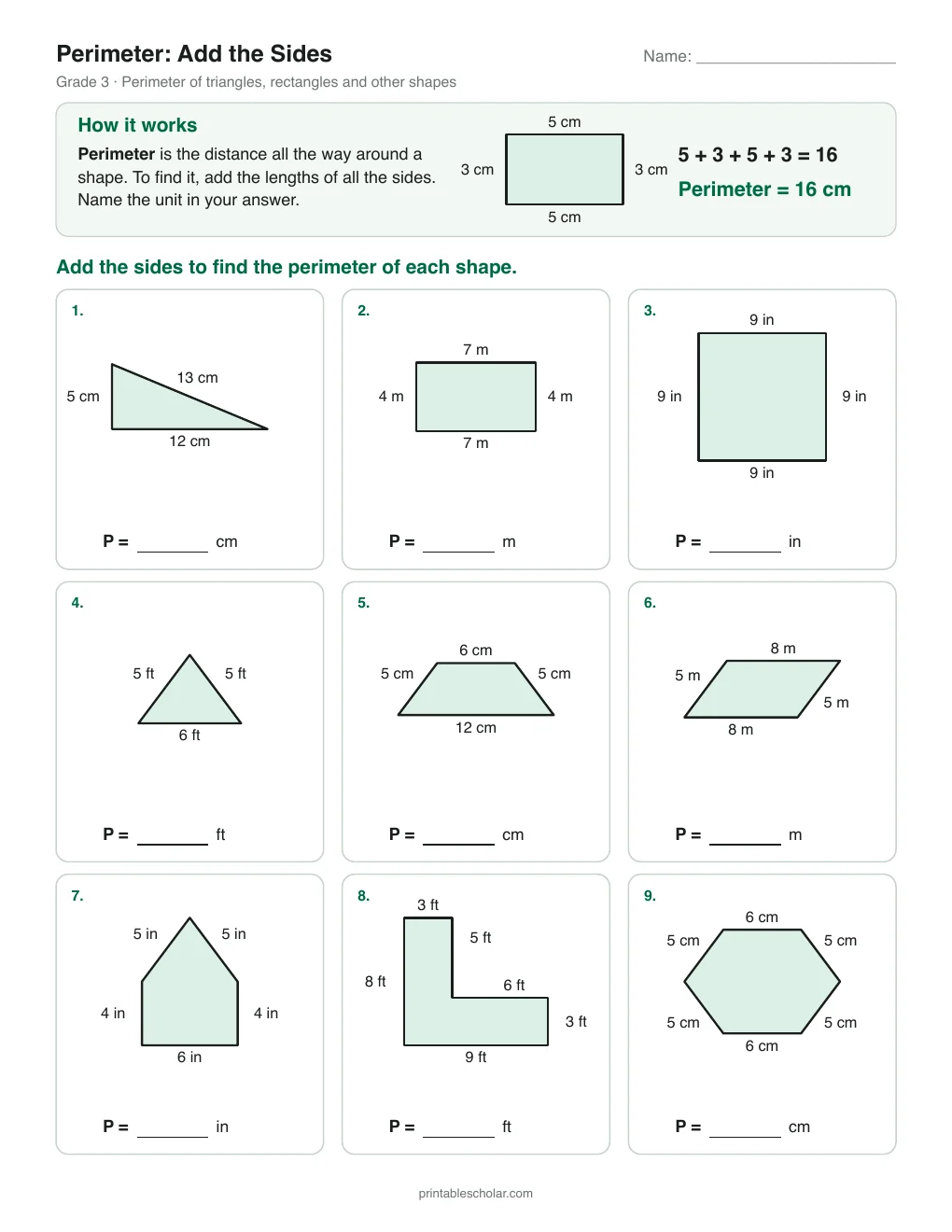
Perimeter is the distance all the way around a shape. To find it, add the lengths of all the sides. The first sheet does only that, with every side labelled, so the idea is settled before any shortcuts.
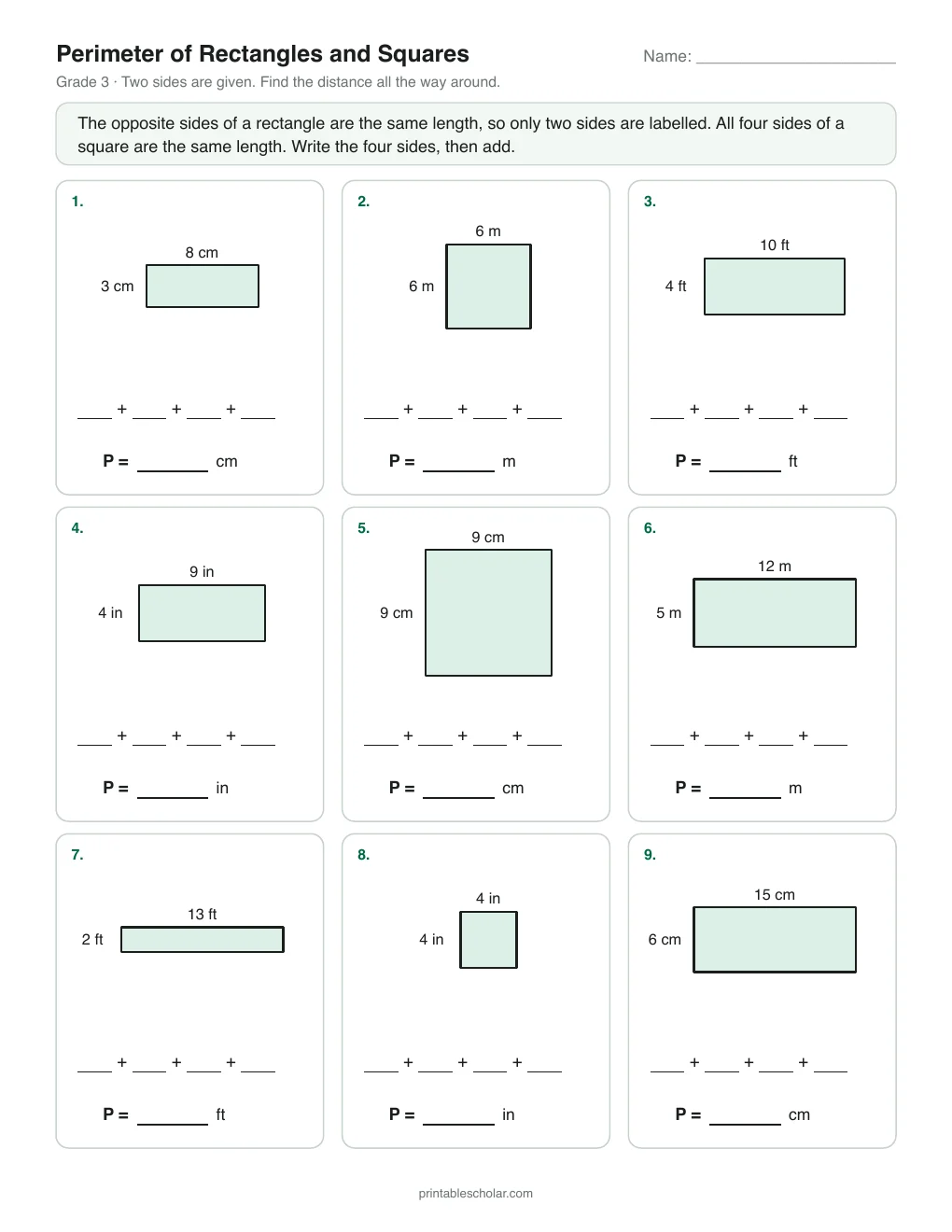
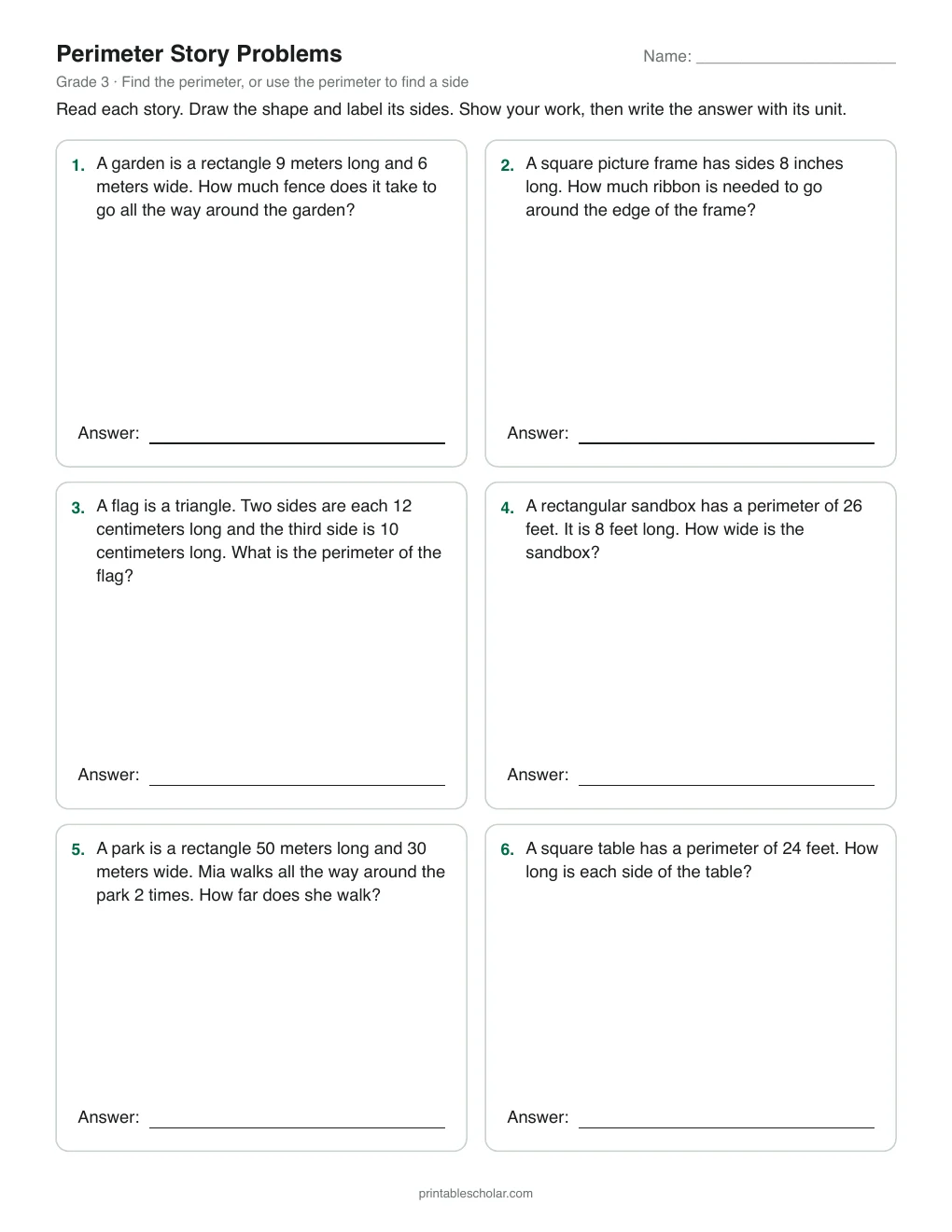
On the rectangles and squares sheet only two sides are labelled. Children have to use what they know about the shape: opposite sides of a rectangle match, and all four sides of a square match. Writing out all four sides before adding prevents the most common mistake, which is adding only the two numbers they can see.
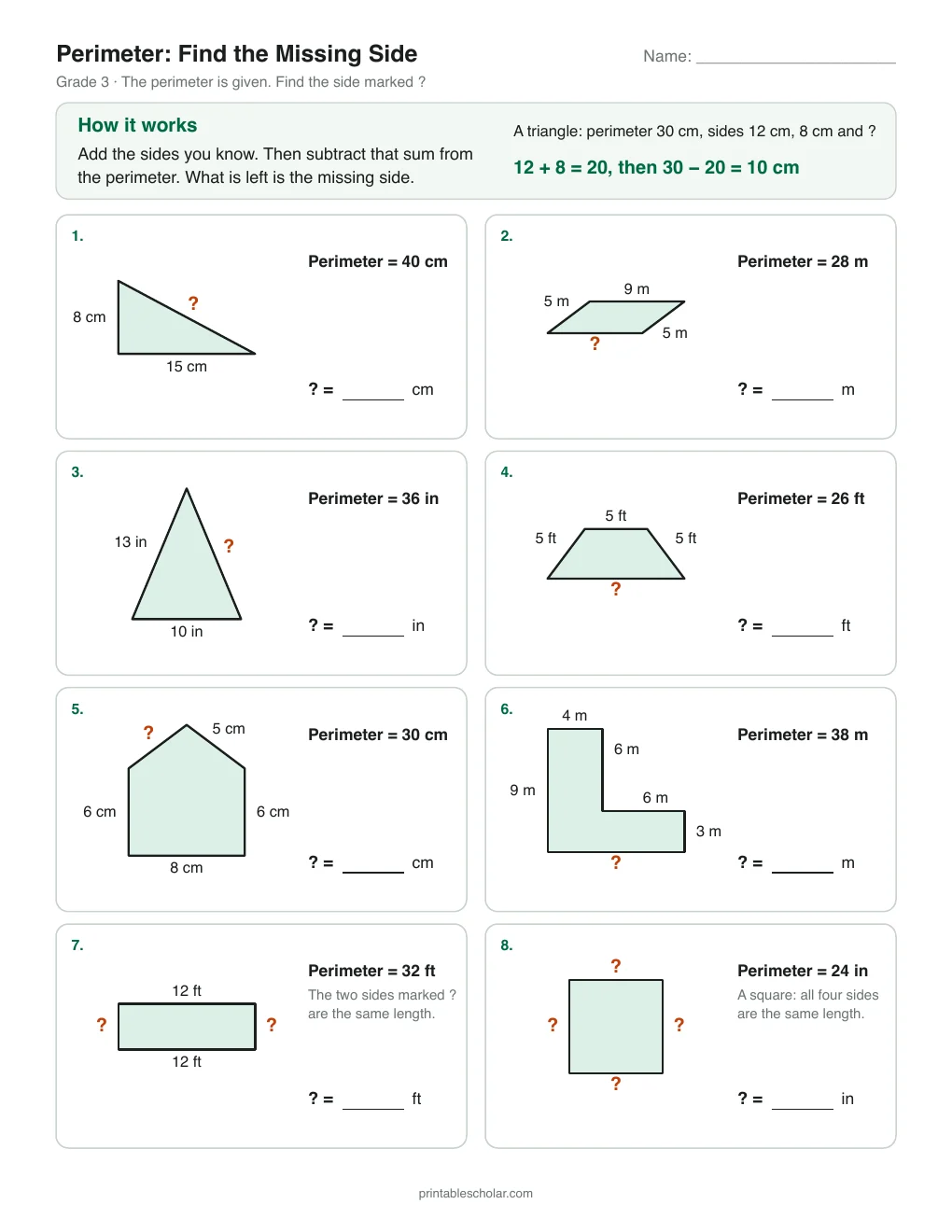
Find the Missing Side works backward. The perimeter is given, so add the sides you know and subtract from the perimeter. The last two problems hide two or four equal sides, which adds a division step.
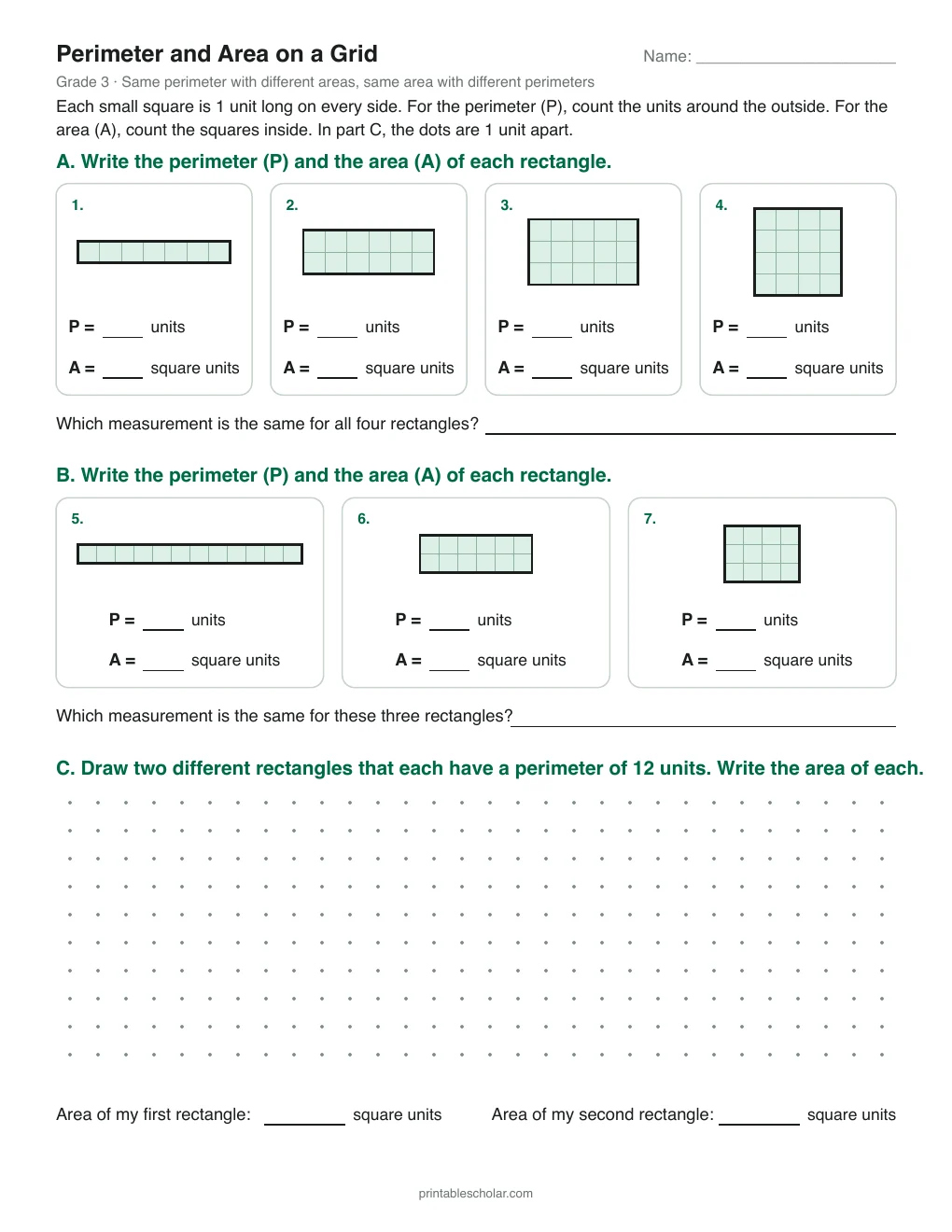
Perimeter and Area on a Grid shows that the two measurements do not go together: rectangles with the same perimeter can have different areas, and rectangles with the same area can have different perimeters. For more on the space inside a shape, see the area worksheets, which include a sheet that asks for both. For every formula on one page, see the geometry formula sheet.
Frequently Asked Questions
What is perimeter?
Perimeter is the distance around the outside of a flat shape. Add the lengths of all the sides. A triangle with sides of 6 cm, 8 cm and 10 cm has a perimeter of 24 cm.
How do you find the perimeter of a rectangle?
Add all four sides. A rectangle has two lengths and two widths, so a rectangle 8 cm long and 3 cm wide has a perimeter of 8 + 3 + 8 + 3 = 22 cm. Later this is written as 2 × length + 2 × width.
How do you find a missing side when you know the perimeter?
Add the sides you know and subtract that total from the perimeter. If a triangle has a perimeter of 24 cm and two of its sides are 6 cm and 8 cm, the third side is 24 − 14 = 10 cm.
What is the difference between perimeter and area?
Perimeter is the distance around a shape and is measured in units of length, such as centimeters. Area is the space inside and is measured in square units. Two rectangles can have the same perimeter and different areas: a 4 by 4 square and a 7 by 1 rectangle both have a perimeter of 16 units, but their areas are 16 and 7 square units.
What grade learns perimeter?
Third grade. Children find the perimeter of polygons, find a missing side from the perimeter, and compare rectangles with the same perimeter and different areas. Fourth grade adds the formula for a rectangle.
Do the worksheets have answer keys?
Yes. Every sheet is a two-page PDF with the answer key on the second page.