About the Regrouping Worksheets
Regrouping is trading between places: ten ones for one ten when adding, and one ten for ten ones when subtracting. It is the same idea older worksheets call carrying and borrowing. It is the first written method children learn, and it only makes sense if they can see that the trade does not change the number.
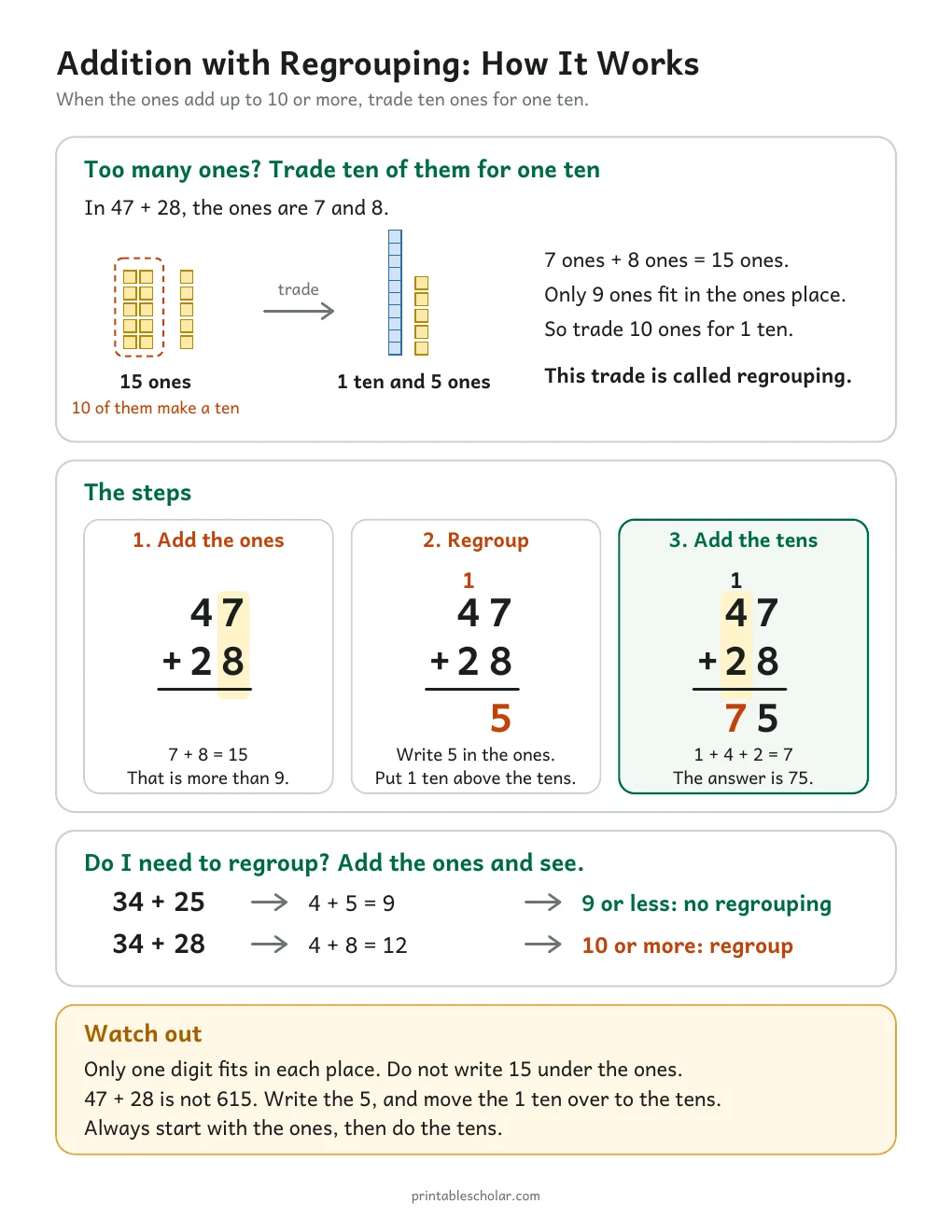
The addition sheet starts with blocks. Seven ones and eight ones make fifteen ones, which is too many for the ones place, so ten of them are traded for a ten. The same problem, 47 + 28, is then worked on paper in three steps, each one adding only the next thing to write.
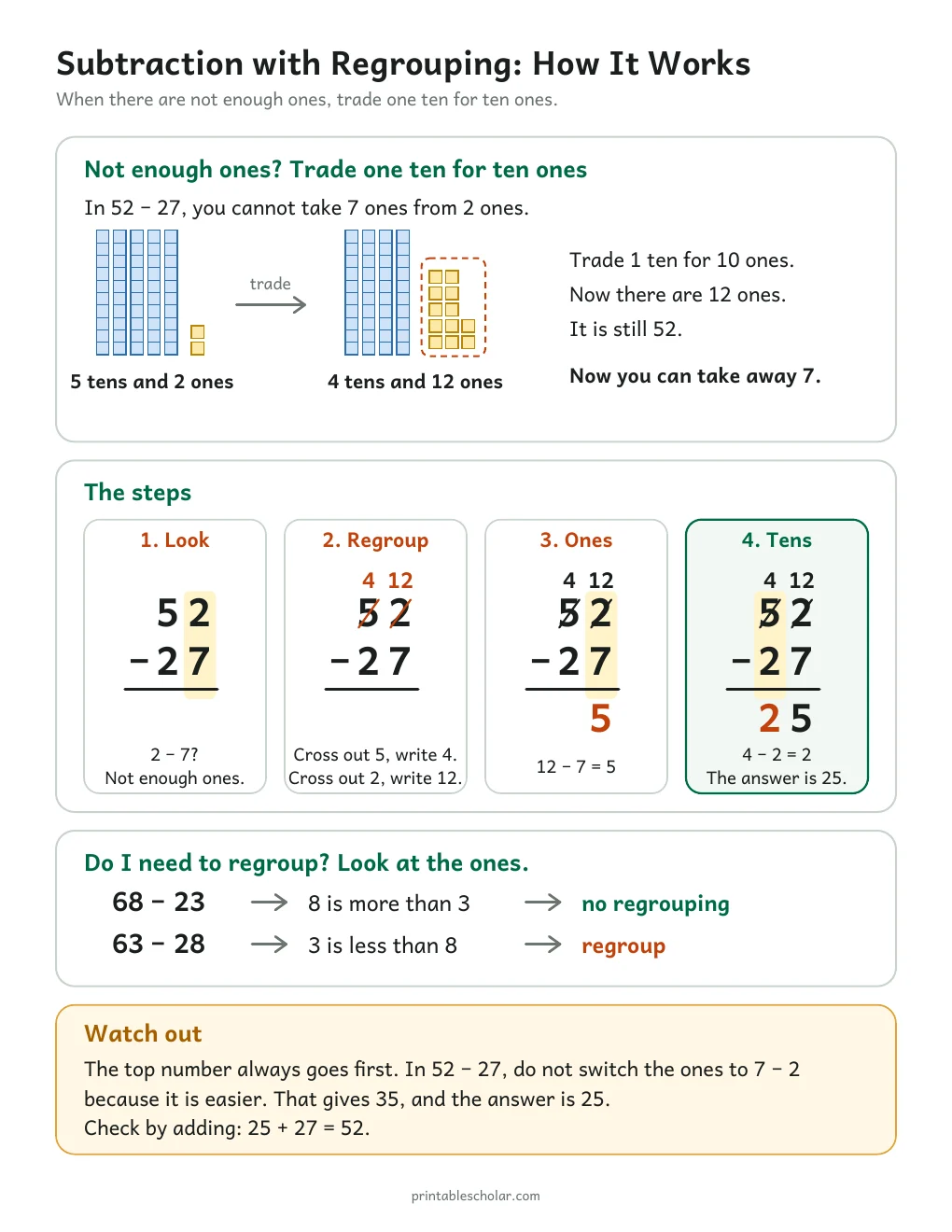
The subtraction sheet does the reverse with 52 − 27. There are not enough ones to take seven away, so one ten is traded for ten ones: 5 tens and 2 ones become 4 tens and 12 ones. Four pictures show the crossing out and the two subtractions. Both sheets end with a quick test for whether a problem needs regrouping at all, and the mistake teachers see most.
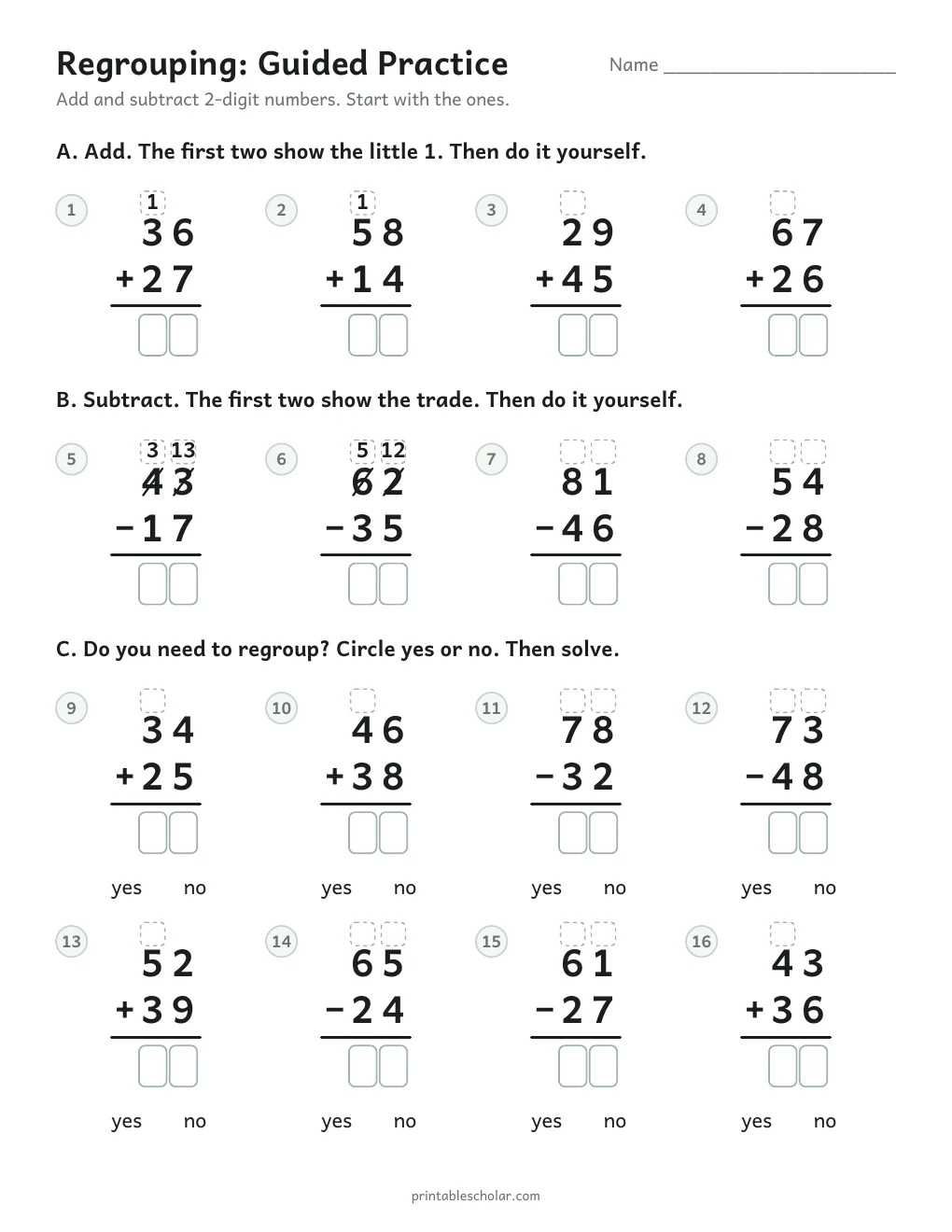
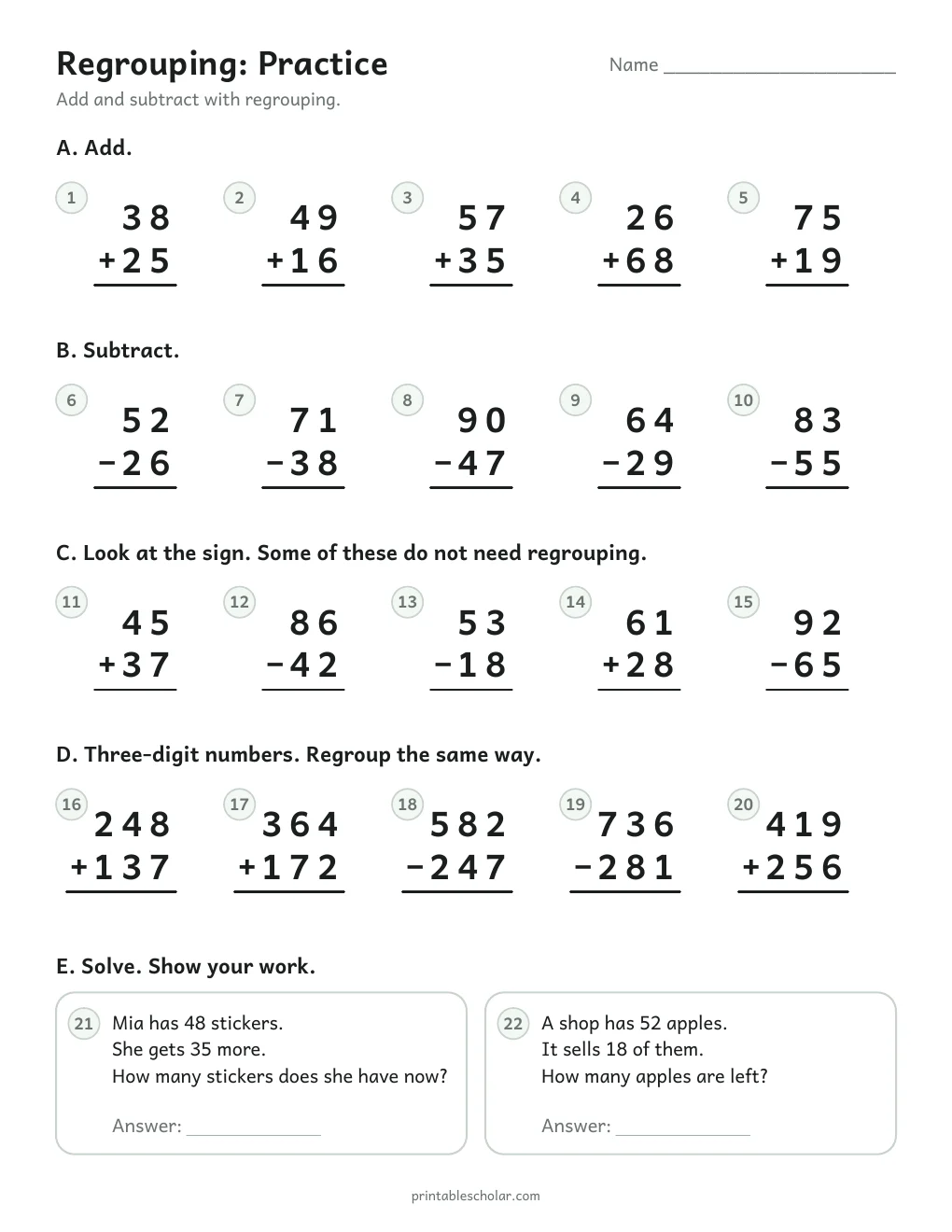
The guided practice sheet has a box for each answer digit and a dashed box for each regrouping mark, so nothing gets written in the wrong place. The independent practice sheet takes the boxes away. For more problems, see the addition worksheets and subtraction worksheets. If tens and ones are still shaky, start with place value.
Frequently Asked Questions
What is regrouping in math?
Regrouping is trading ten of one place for one of the next place, or the other way around. In addition, ten ones are regrouped as one ten. In subtraction, one ten is regrouped as ten ones. The number stays the same, only the way it is grouped changes.
Is regrouping the same as carrying and borrowing?
Yes. Carrying is regrouping in addition, and borrowing is regrouping in subtraction. Schools now use the word regrouping because it describes what happens: nothing is borrowed and given back, the number is just grouped differently.
How do you know when to regroup in addition?
Add the ones first. If they total 10 or more, regroup. In 34 + 28 the ones are 4 + 8 = 12, so write the 2 in the ones place and move 1 ten to the tens column.
How do you know when to regroup in subtraction?
Look at the ones. If the top digit is smaller than the bottom digit, regroup. In 63 − 28, 3 is less than 8, so trade one ten for ten ones: 63 becomes 5 tens and 13 ones, and 13 − 8 = 5.
What grade learns regrouping?
Addition and subtraction with regrouping within 100 is taught in 2nd grade, and within 1,000 by the end of 2nd grade and into 3rd. Students are expected to be fluent with the written method in 4th grade.
How do you check a subtraction answer?
Add the answer to the number you took away. You should get the number you started with. For 52 − 27 = 25, check that 25 + 27 = 52.