About the Improper Fractions and Mixed Numbers Lesson
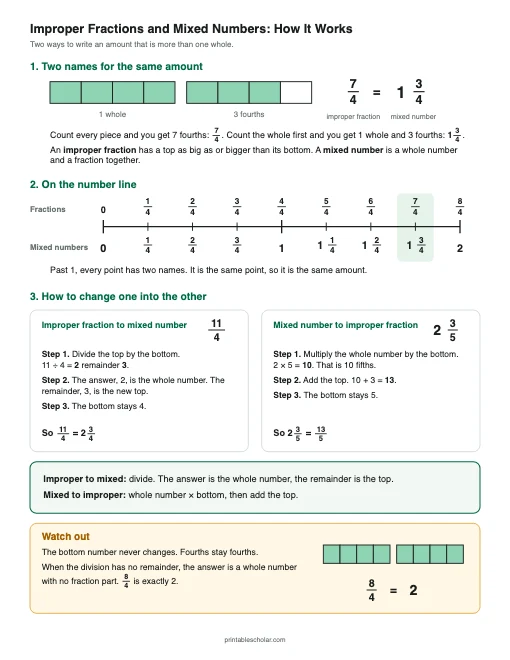
An improper fraction is a fraction whose top number is as big as or bigger than its bottom number, such as 7/4. A mixed number is a whole number and a fraction written together, such as 1 3/4. They are two ways of writing the same amount. Seven fourths is one whole and three more fourths.
The How It Works sheet shows that first with shaded bars and then on a number line where every point past 1 carries both names. Only after that does it give the two procedures: divide to go from an improper fraction to a mixed number, and multiply then add to go back.
Each procedure is tied to the picture. Dividing 11 by 4 asks how many groups of four fourths fit in eleven fourths. Multiplying the whole number by the bottom turns the wholes into pieces, so two wholes become ten fifths before the extra fifths are added on.
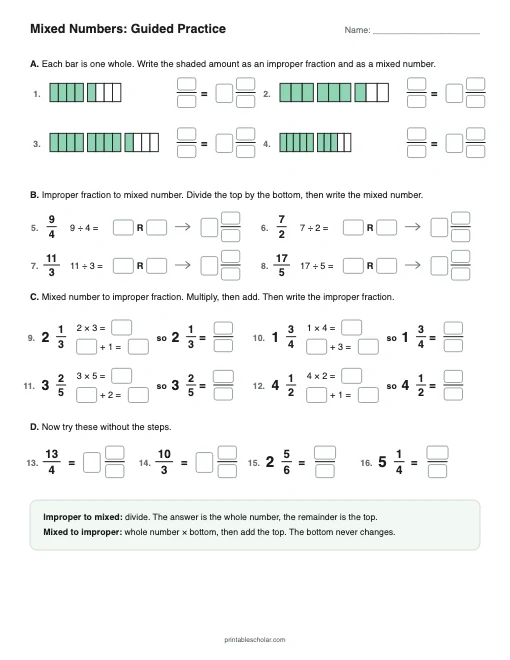
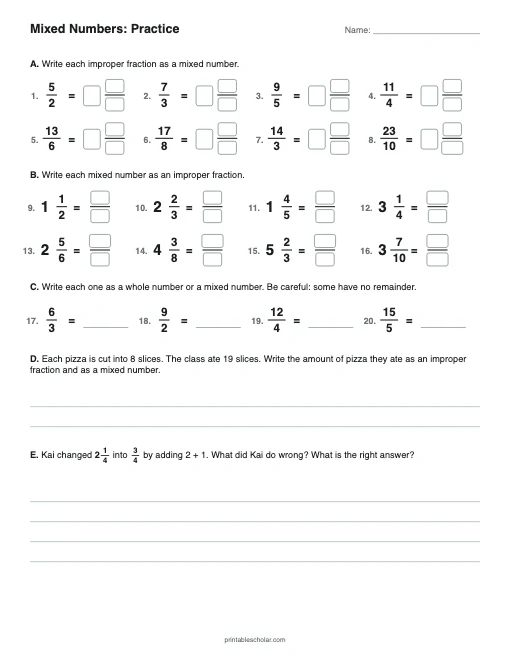
The guided practice sheet lays those steps out with boxes to fill in. The independent practice sheet drops the boxes and adds fractions that come out to whole numbers. Earlier lessons in this series are equivalent fractions and comparing fractions, and more practice is on the fractions worksheets page.
Frequently Asked Questions
What is an improper fraction?
An improper fraction is a fraction whose numerator is equal to or greater than its denominator, such as 5/4 or 9/2. It names an amount that is one whole or more.
What is a mixed number?
A mixed number is a whole number and a fraction written together, such as 2 3/4. It means two wholes and three fourths more.
How do you change an improper fraction to a mixed number?
Divide the numerator by the denominator. The quotient is the whole number, the remainder is the new numerator, and the denominator stays the same. For 11/4, 11 divided by 4 is 2 remainder 3, so 11/4 is 2 3/4.
How do you change a mixed number to an improper fraction?
Multiply the whole number by the denominator, then add the numerator. That total is the new numerator, and the denominator stays the same. For 2 3/5, 2 times 5 is 10, plus 3 is 13, so 2 3/5 is 13/5.
Is an improper fraction wrong?
No. The name is misleading. An improper fraction is a correct way to write an amount, and it is often the easier form to use when multiplying or dividing fractions. Mixed numbers are usually easier to picture and to use in measuring.
What grade learns improper fractions and mixed numbers?
Students see fractions greater than one on number lines in 3rd grade. Converting between improper fractions and mixed numbers is taught in 4th grade and used throughout 5th grade fraction work.