Coordinate grids for plotting points, graphing lines and drawing shapes. Print a single large four-quadrant plane, a first-quadrant grid for beginners, or a page with several small planes for a problem set. Two grade 5 worksheets, with answer keys, make two number patterns from two rules and graph them as ordered pairs.
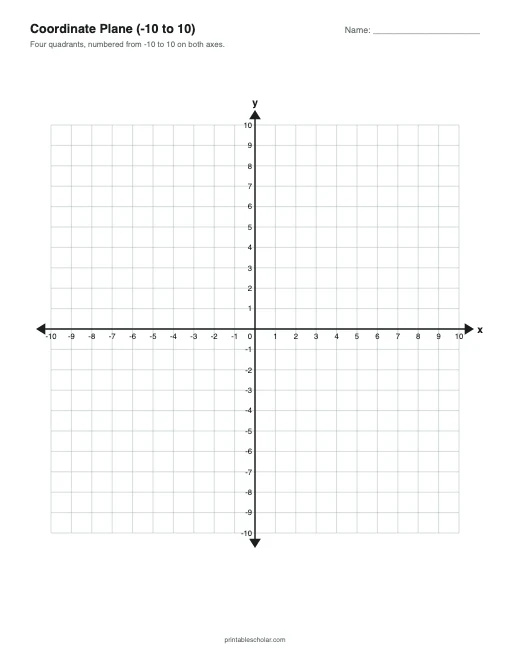
One large four-quadrant plane with every unit numbered.
Download PDF
Four quadrants with axes but no numbers, so you can set your own scale.
Download PDF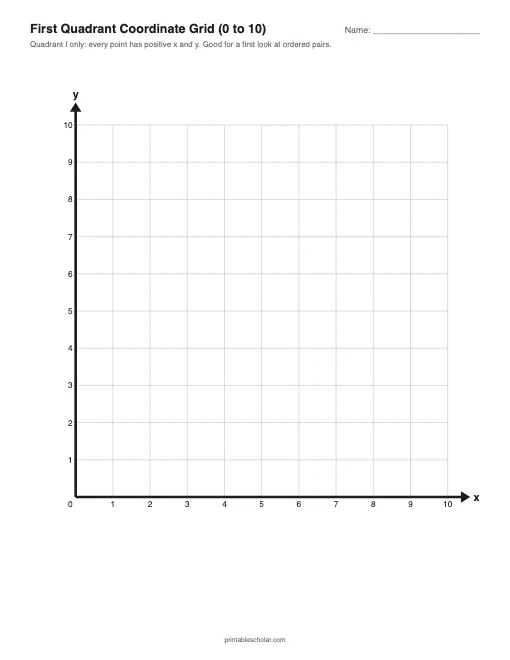
Quadrant I only, with large squares. A first grid for ordered pairs.
Download PDF
Four planes from −10 to 10, labeled at every 5.
Download PDF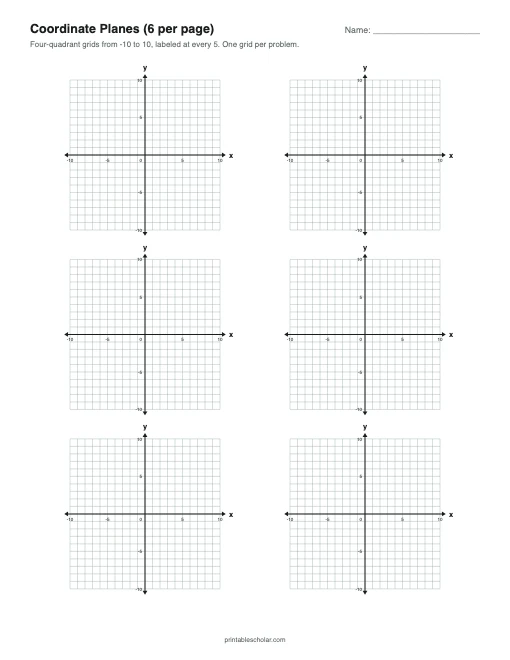
Six small planes for homework sets, one graph per problem.
Download PDF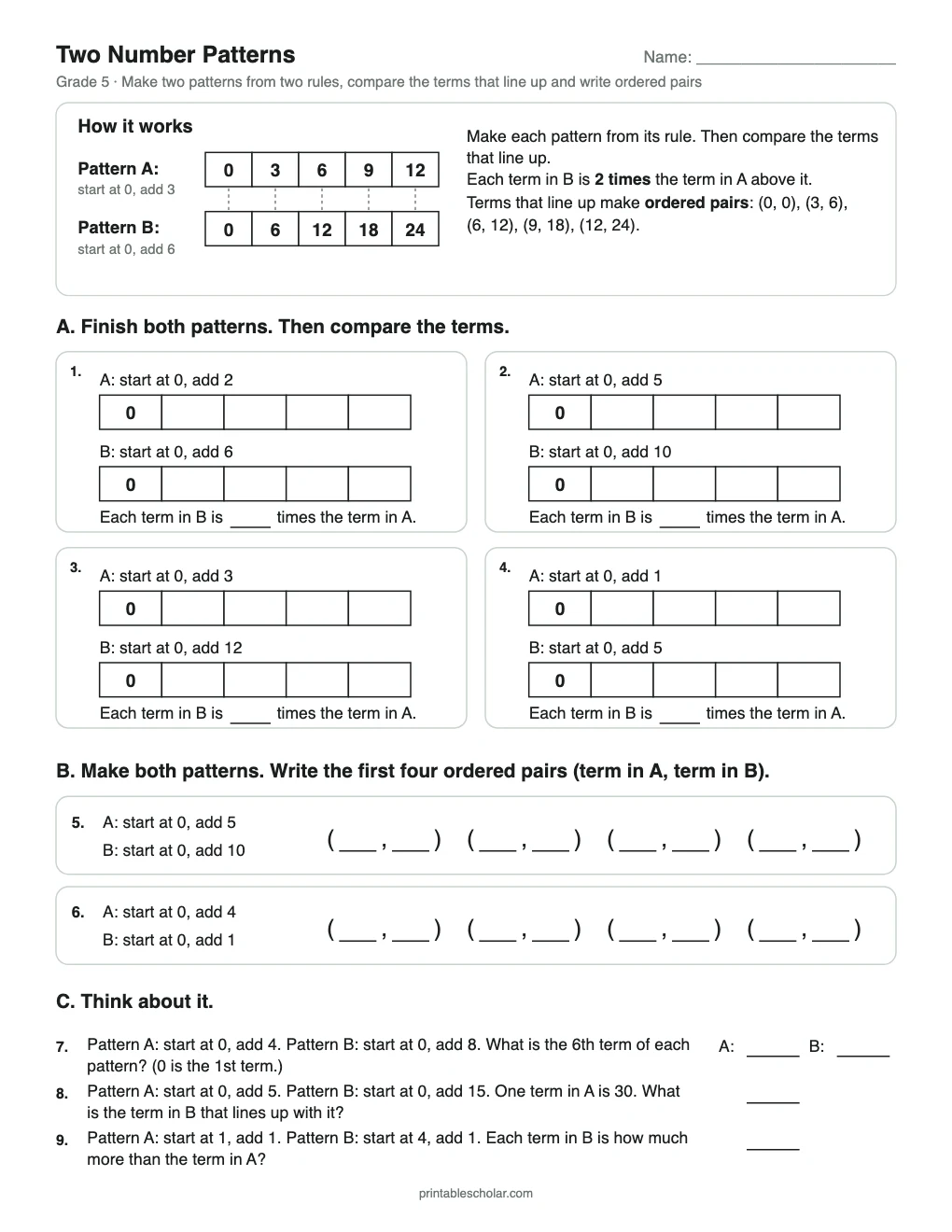
Make two patterns from two rules, such as add 3 and add 6, see that each term in one is 2 times the term in the other, and write the ordered pairs. Includes answer key.
Download PDF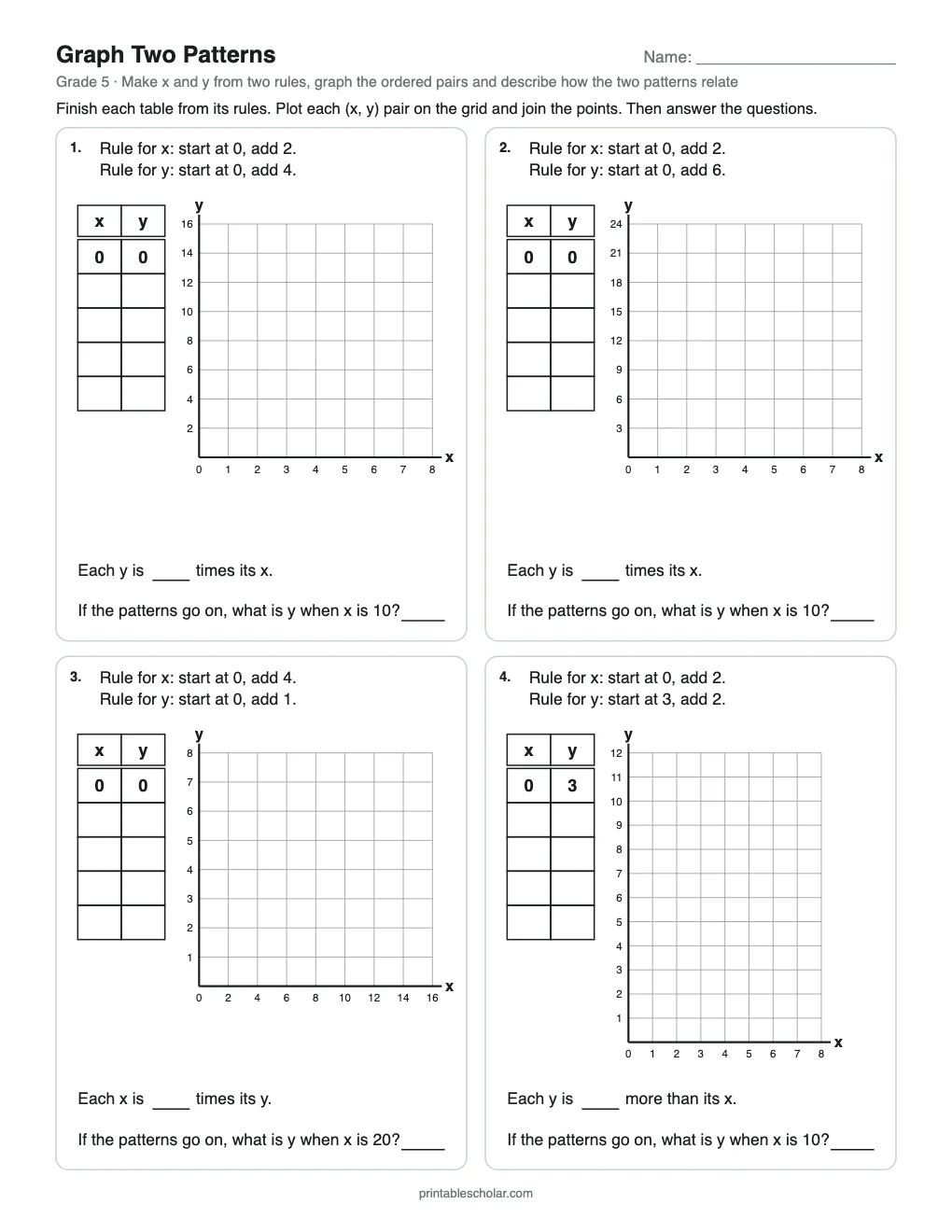
Four tables made from a rule for x and a rule for y: finish each table, plot the ordered pairs, and say how y relates to x. Includes answer key.
Download PDFA coordinate plane is two number lines that cross at zero: the horizontal x-axis and the vertical y-axis. Every point is named by an ordered pair (x, y). Go across first, then up or down. For practice that turns plotted points into a picture, try the coordinate graphing mystery pictures.
The axes split the plane into four quadrants, numbered I to IV counterclockwise from the top right. In 5th grade students work only in quadrant I, where both numbers are positive. Negative coordinates and all four quadrants come in 6th grade.
In 5th grade the plane is also where two number patterns meet. Two Number Patterns makes a pattern from each of two rules, such as start at 0 and add 3, and start at 0 and add 6, then lines the terms up: each term in the second pattern is 2 times the term above it, and the pairs (0, 0), (3, 6), (6, 12) are ordered pairs. Graph Two Patterns makes x from one rule and y from the other, plots the pairs on a first-quadrant grid, and asks how y relates to x. Every set of points falls on a straight line.
Use the numbered plane for plotting points and graphing linear equations. Use the blank plane when the numbers are large or small and you need each square to stand for 2, 5 or 10. The multi-plane pages save paper on problem sets where each question needs its own graph.
 Printable Scholar