Free Printable Multiplying Fractions Worksheets

Multiplying fractions worksheets for 4th and 5th grade. The page opens with a one-page lesson, How Multiplying Fractions Works, and a guided practice sheet. The 4th grade sheets start where the standard starts: a whole number times a fraction, with bar models, the rule and word problems. The 5th grade sheets go on to a fraction times a fraction with area models, mixed numbers, and multiplication as scaling: telling whether a product will be bigger or smaller before working it out. Every worksheet has its answer key on the second page.

How Multiplying Fractions Works printable preview

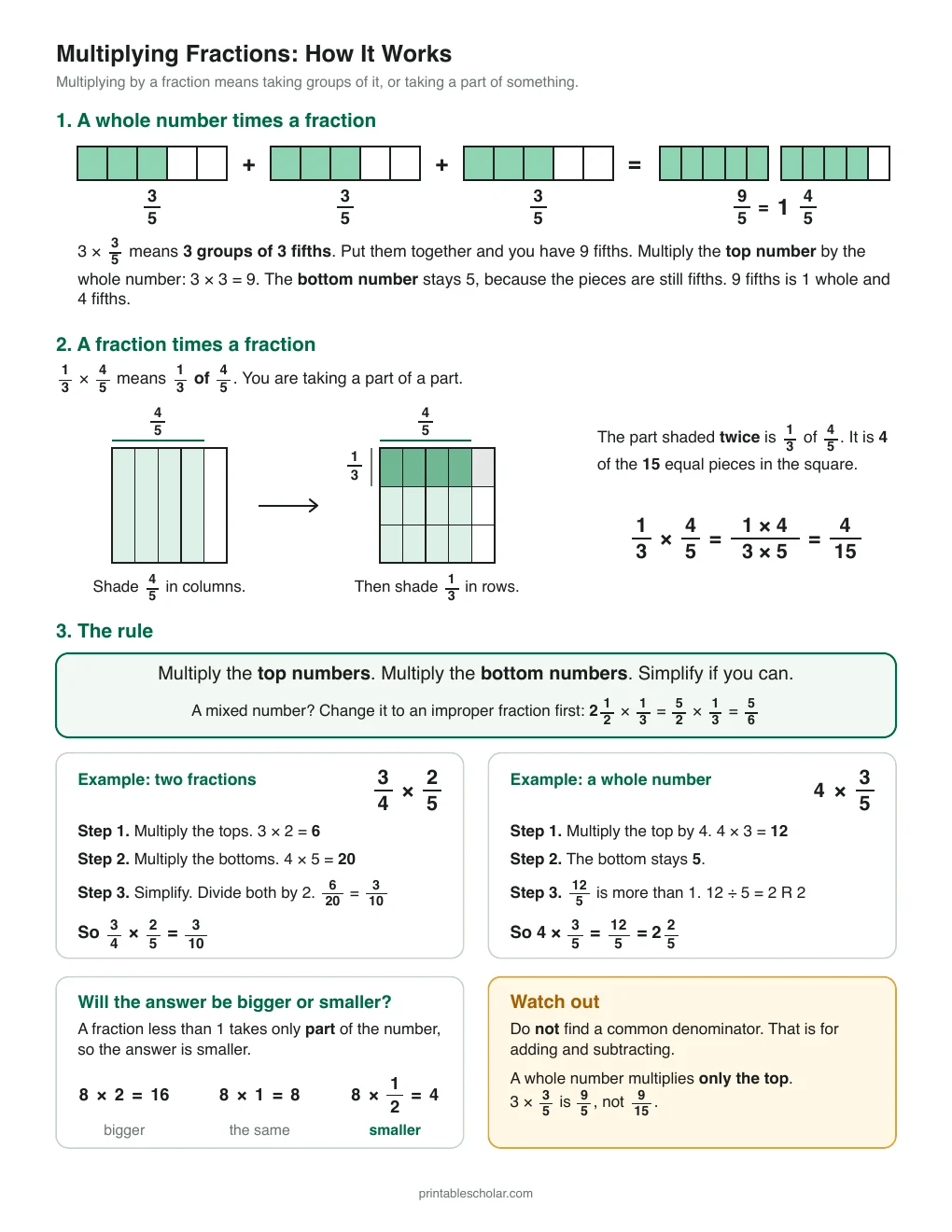
How Multiplying Fractions Works

Grades 4–5

A one-page lesson: 3 × 3/5 as three groups on bars, 1/3 of 4/5 on a square shaded two ways, the rule with two worked examples, and why multiplying by a fraction less than 1 gives a smaller answer.

Download PDF
Multiplying Fractions: Guided Practice printable preview

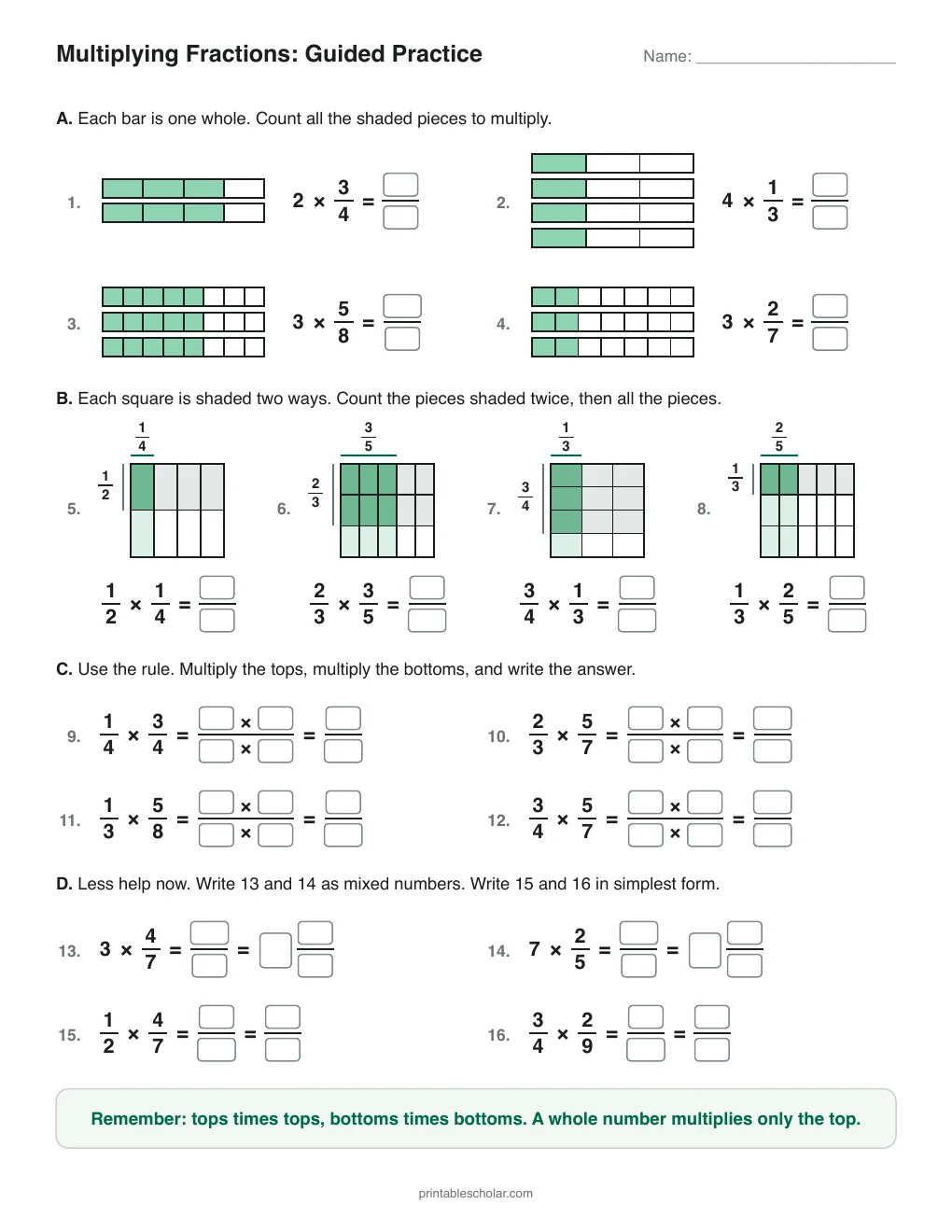
Multiplying Fractions: Guided Practice

Grades 4–5

Sixteen problems that start with bars and shaded squares to count, then set the rule out in boxes, then finish with mixed numbers and simplest form. Includes answer key.

Download PDF
Multiply a Fraction by a Whole Number: Models printable preview

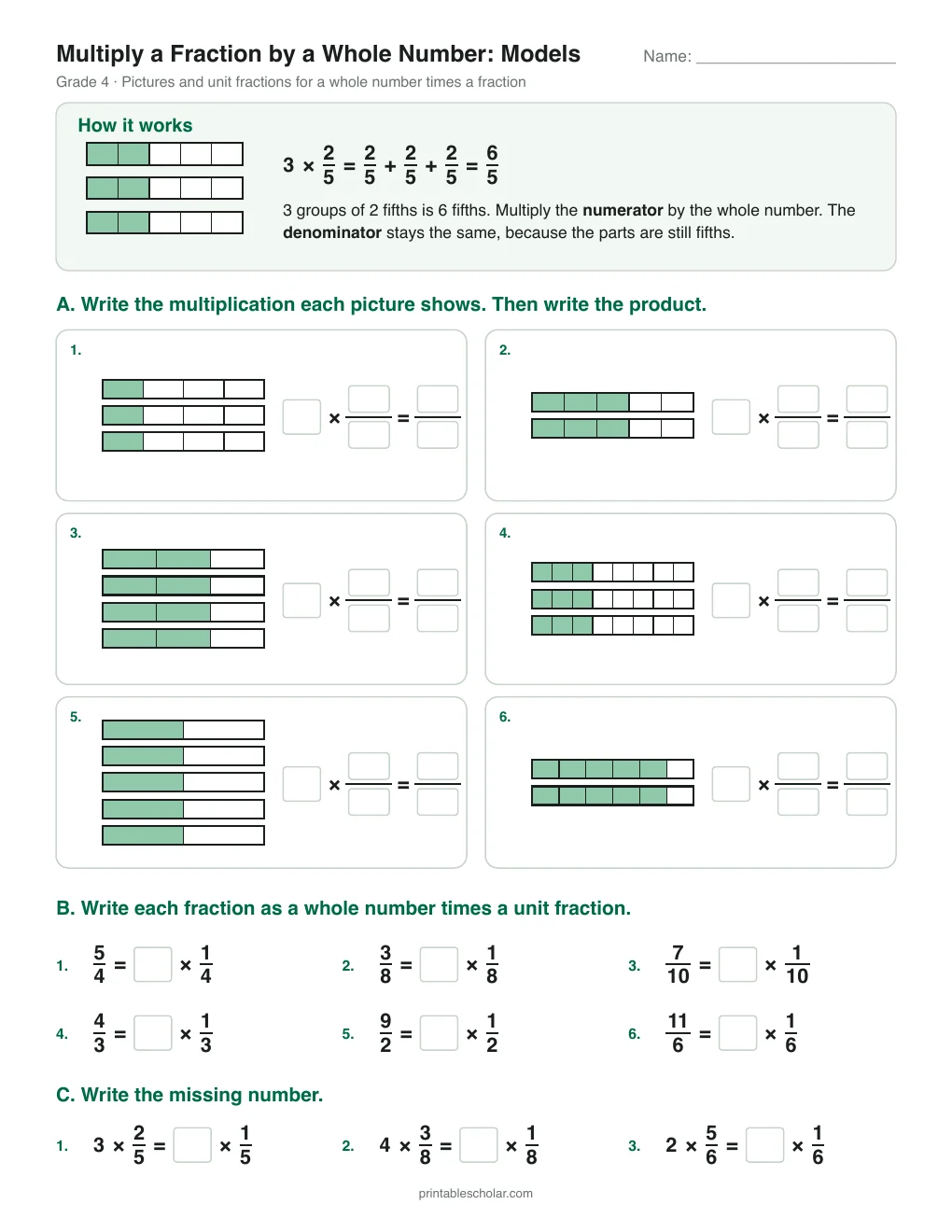
Multiply a Fraction by a Whole Number: Models

Grade 4

Six bar models to write as a multiplication, six fractions to write as a whole number times a unit fraction, and three missing numbers. Includes answer key.

Download PDF
Multiply Fractions by Whole Numbers printable preview

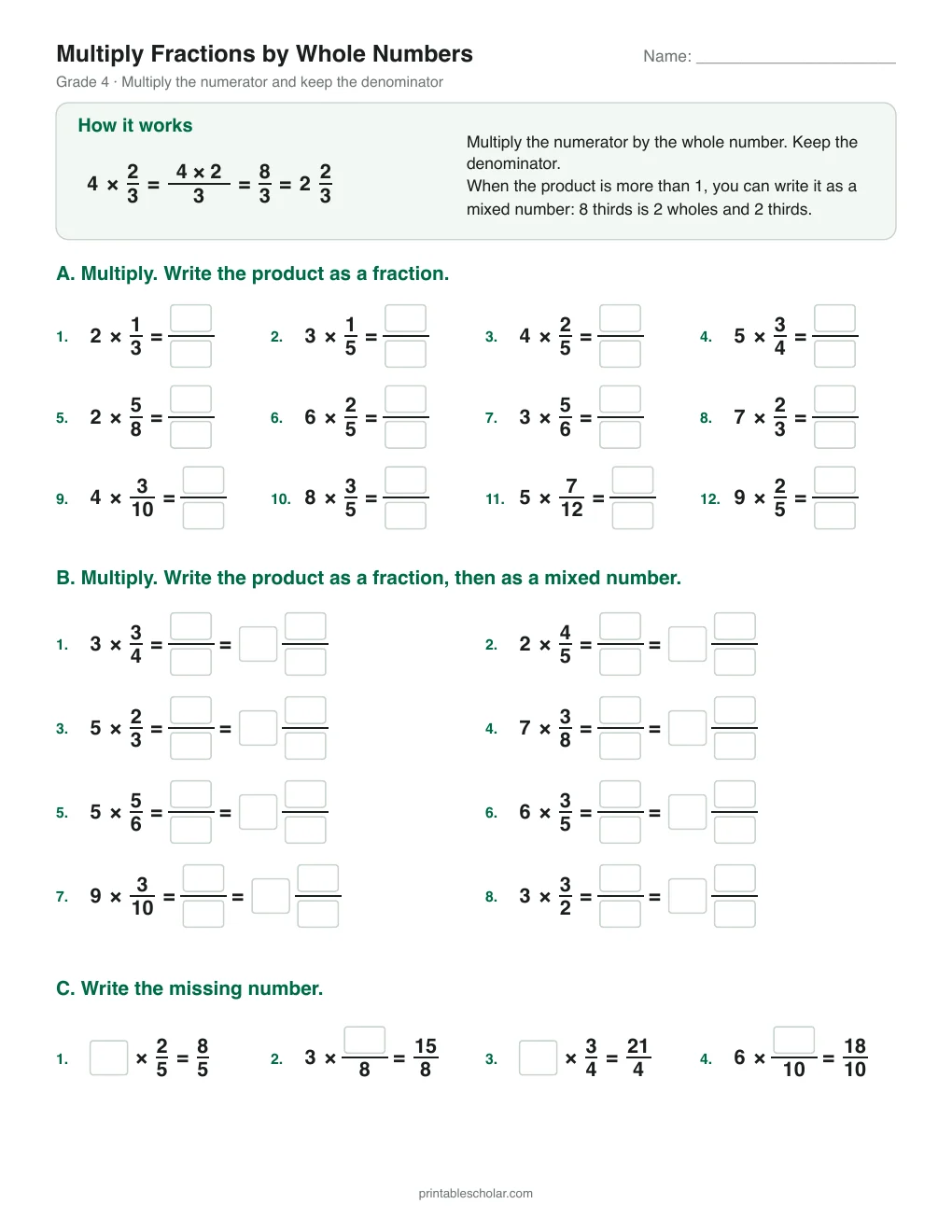
Multiply Fractions by Whole Numbers

Grade 4

Twelve products such as 5 × 3/4, eight more to write as mixed numbers, and four missing-number problems. Includes answer key.

Download PDF
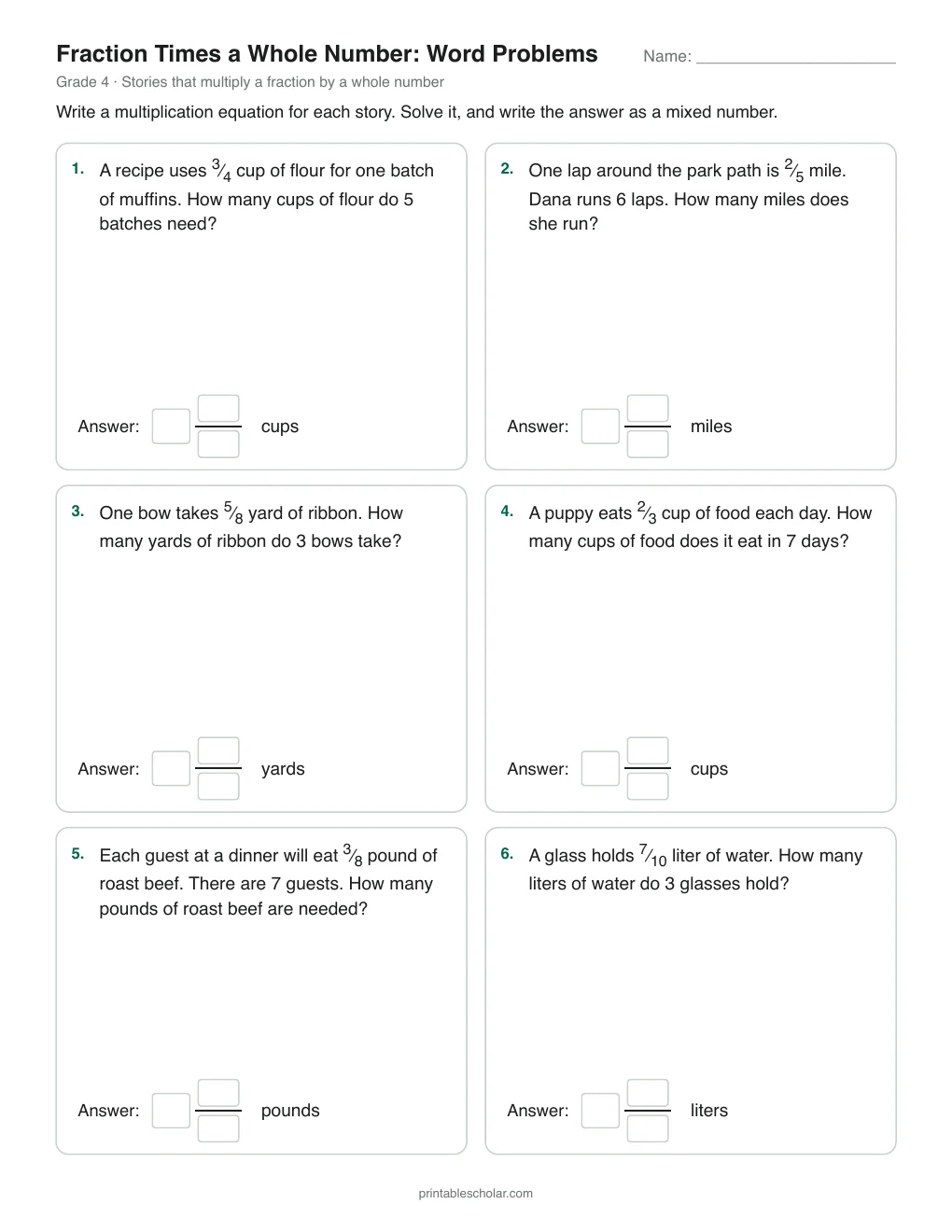
Fraction Times a Whole Number: Word Problems printable preview

Fraction Times a Whole Number: Word Problems

Grade 4

Six stories with room to work, such as 5 batches that each use 3/4 cup of flour. The key shows each equation and the mixed number.

Download PDF
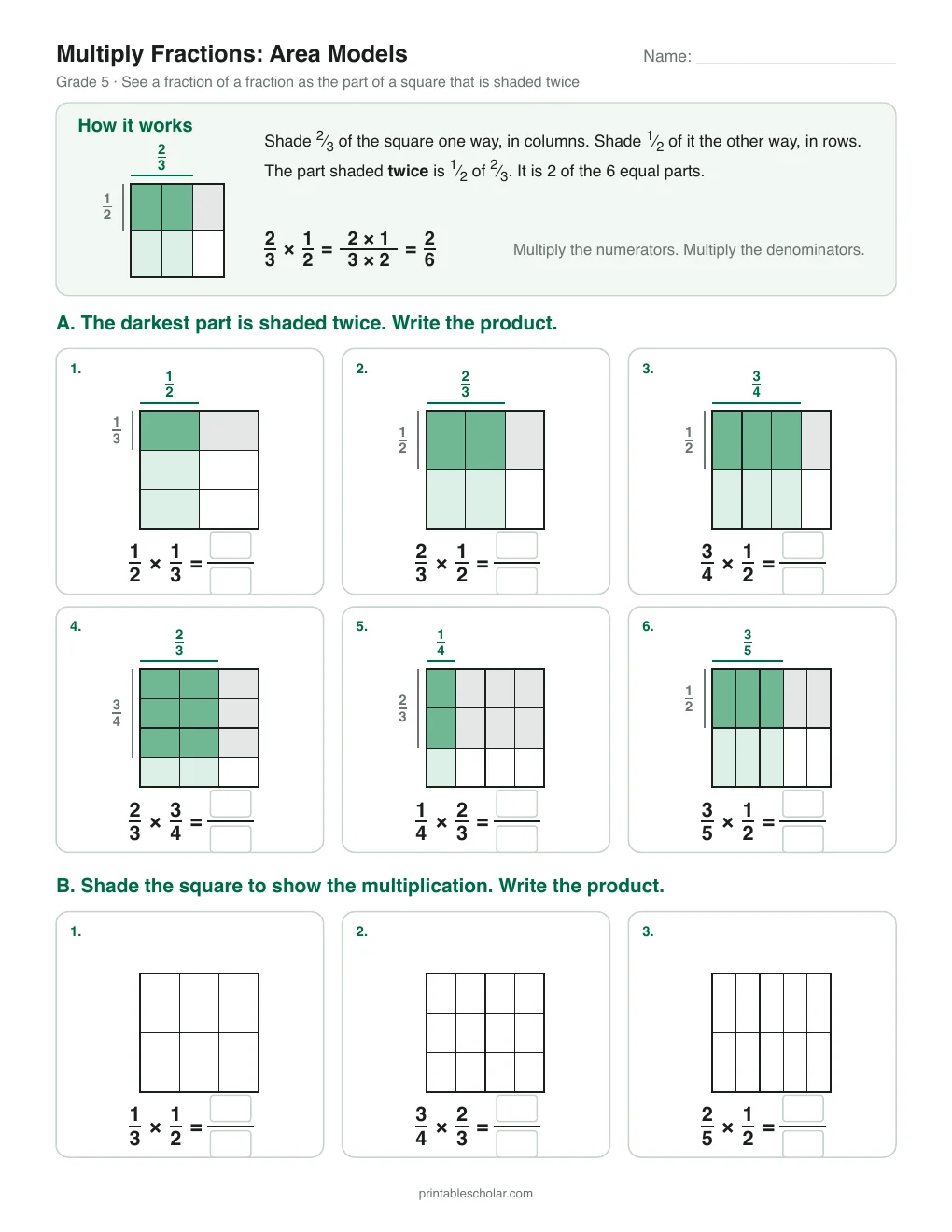
Multiply Fractions: Area Models printable preview

Multiply Fractions: Area Models

Grade 5

Six squares shaded two ways, where the part shaded twice is the product, then three to shade yourself. Includes answer key.

Download PDF
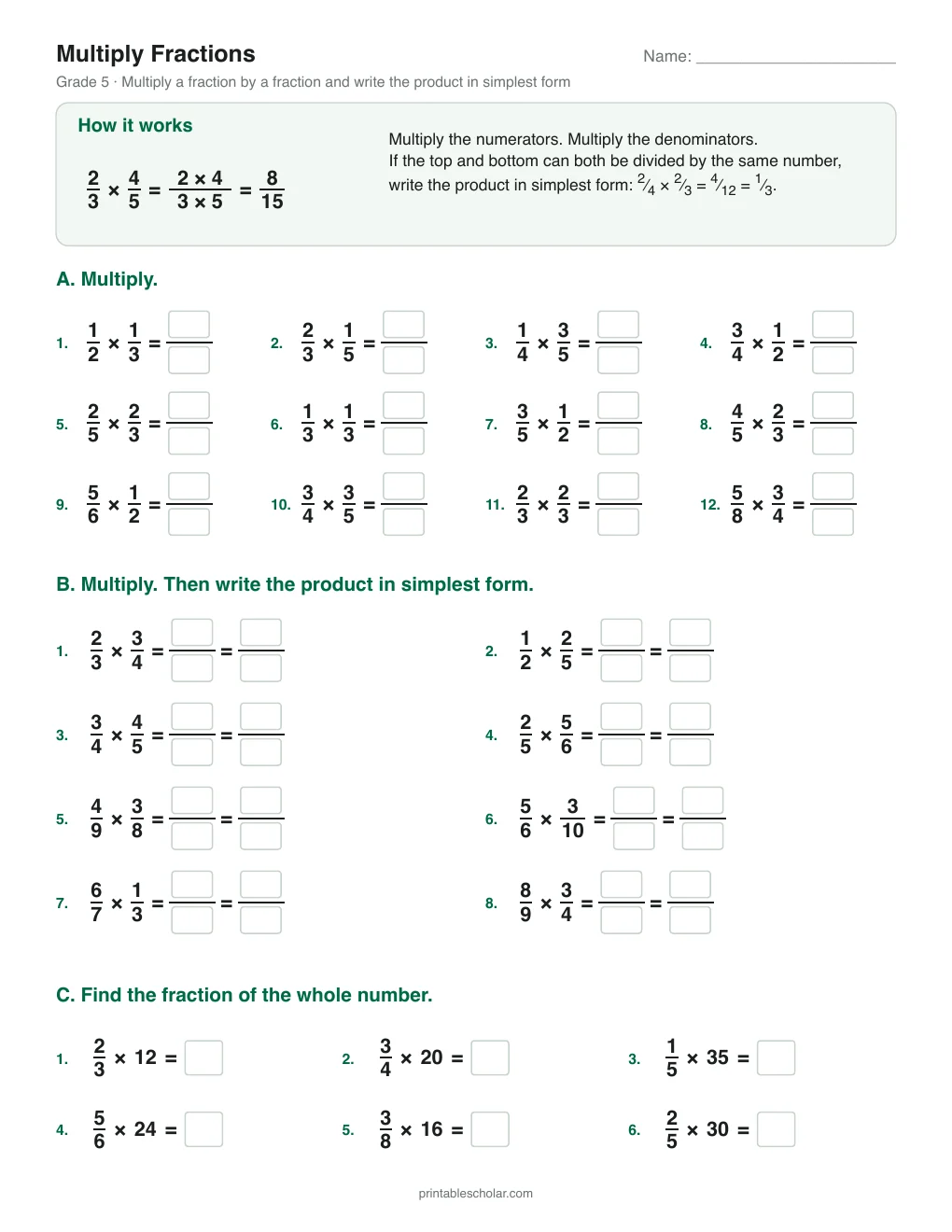
Multiply Fractions printable preview

Multiply Fractions

Grade 5

Twelve products such as 2/3 × 4/5, eight more to write in simplest form, and six fractions of a whole number. Includes answer key.

Download PDF
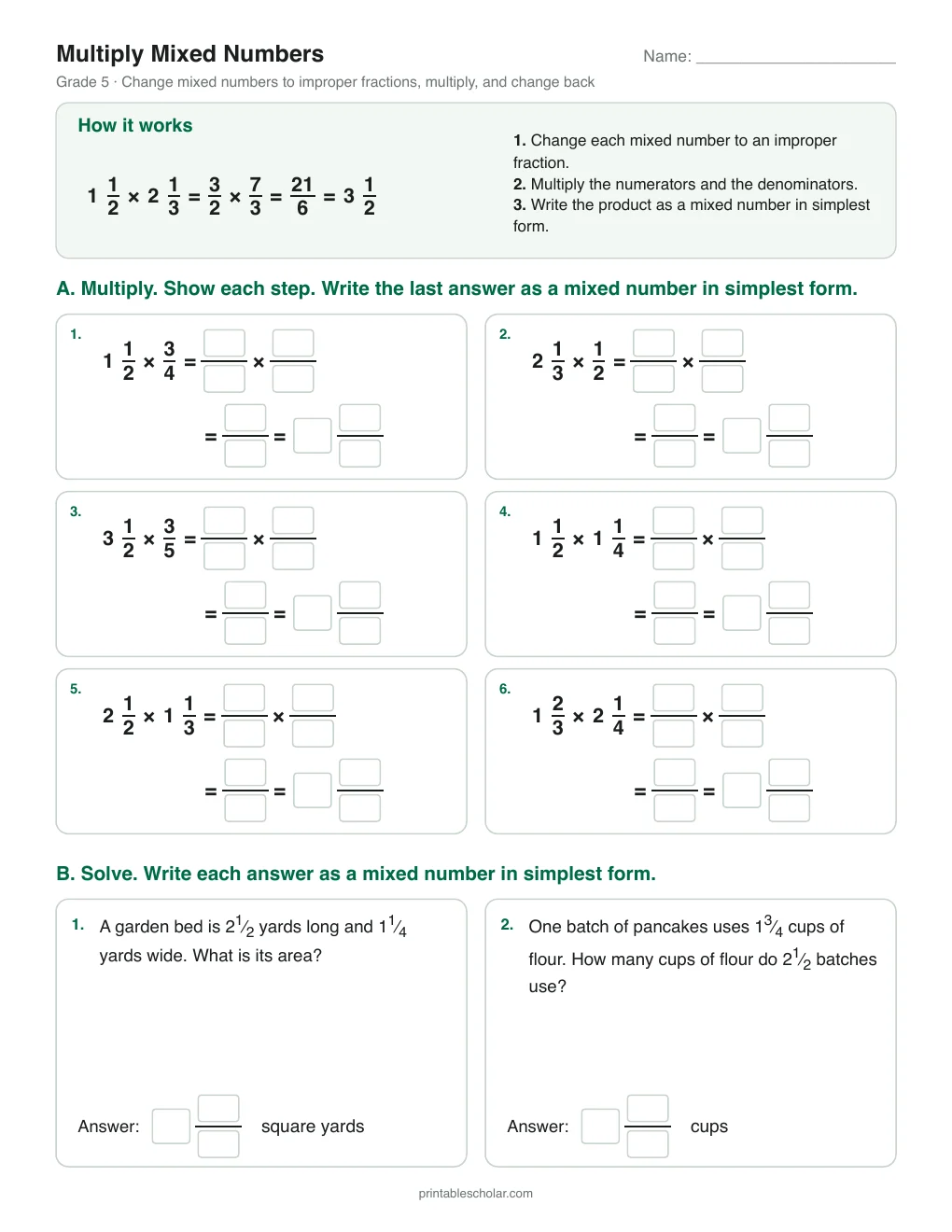
Multiply Mixed Numbers printable preview

Multiply Mixed Numbers

Grade 5

Six products such as 2 1/2 × 1 1/3 set out step by step, and two stories. The key shows every step.

Download PDF
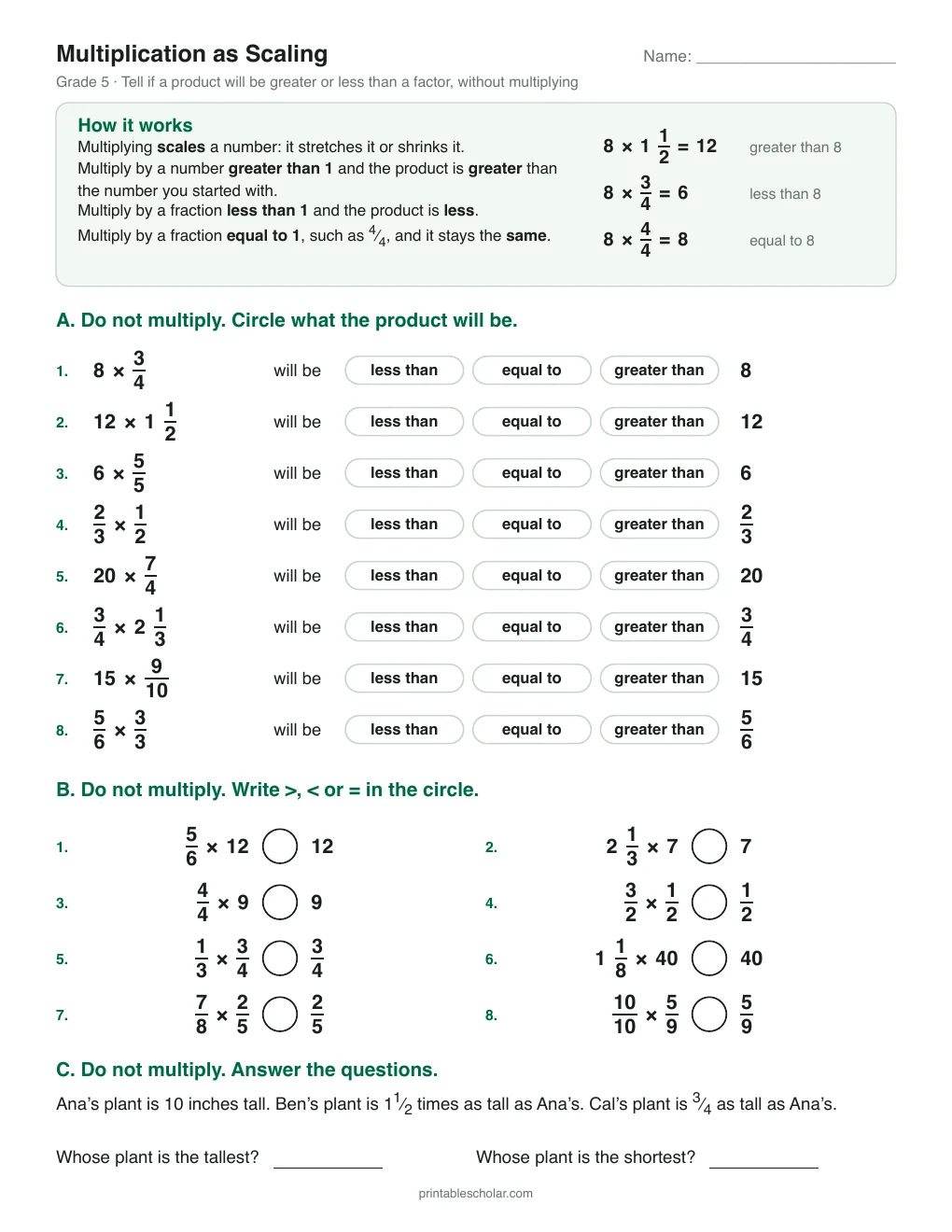
Multiplication as Scaling printable preview

Multiplication as Scaling

Grade 5

Without multiplying, decide if a product will be greater than, less than or equal to the number you started with. Includes answer key.

Download PDF
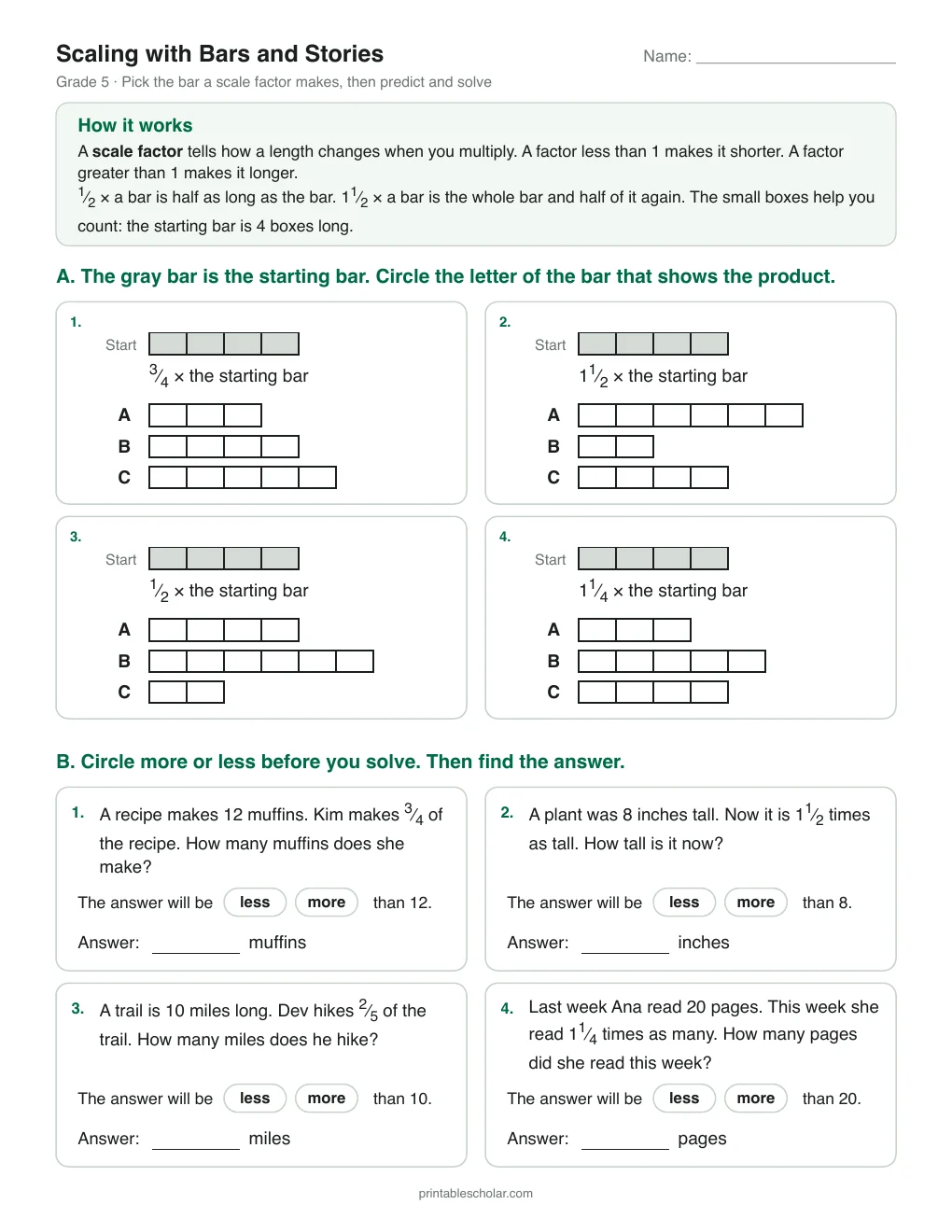
Scaling with Bars and Stories printable preview

Scaling with Bars and Stories

Grade 5

Pick the bar that a scale factor such as 3/4 or 1 1/2 makes, then predict more or less and solve four stories. Includes answer key.

Download PDF

About the Multiplying Fractions Worksheets

Start with How Multiplying Fractions Works. It shows 3 × 3/5 as three groups of three fifths on bars, then 1/3 × 4/5 as one third of four fifths on a square shaded two ways, where the part shaded twice is the answer. The rule follows, with one worked example for two fractions and one for a whole number, a note on why multiplying by a fraction less than 1 gives a smaller answer, and a warning about the usual mistakes: looking for a common denominator, or multiplying the bottom number by the whole number. Multiplying Fractions: Guided Practice then takes sixteen problems from pictures to count, to the rule set out in boxes, to mixed numbers and simplest form with less help.

Fourth graders meet fraction multiplication in its simplest form: a whole number times a fraction. It is repeated addition, the same idea as whole-number multiplication. 3 × 2/5 means 2/5 + 2/5 + 2/5, which is 6/5.

Multiply a Fraction by a Whole Number: Models starts with pictures. Each bar is one whole, cut into equal parts with some shaded, and the number of bars is the whole number. Children write the multiplication they see. The second half of the sheet is the idea underneath it: every fraction is a multiple of a unit fraction, so 5/4 is 5 × 1/4.

Multiply Fractions by Whole Numbers is the rule on its own: multiply the numerator, keep the denominator. The first twelve answers stay as fractions. The next eight are written as mixed numbers too, and each was chosen so the fraction part needs no simplifying.

In 5th grade both numbers can be fractions. Multiply Fractions: Area Models shows 2/3 × 1/2 as a square shaded two ways: the part shaded twice is the product. Multiply Fractions is the rule, numerators times numerators and denominators times denominators, and Multiply Mixed Numbers adds the step of changing to improper fractions first.

Multiplication as Scaling and Scaling with Bars and Stories are about size, not calculating. Multiplying by a number greater than 1 makes a number bigger, multiplying by a fraction less than 1 makes it smaller, and students decide which before they work anything out. For the next step, see dividing fractions.

The word problems are the kind the standard names: so much per batch, per lap or per guest, times a number of them. For the skills before this, see fractions worksheets, equivalent fractions and improper fractions and mixed numbers.

Frequently Asked Questions

How do you multiply a fraction by a whole number?
Multiply the numerator by the whole number and keep the denominator the same. 4 × 2/3 is 8/3, because four groups of two thirds is eight thirds. If the answer is more than 1 you can write it as a mixed number: 8/3 is 2 2/3.
Why does the denominator stay the same?
The denominator says what size the parts are. Multiplying by a whole number gives you more of those parts, but each part is still the same size. Three groups of two fifths is six fifths, not six fifteenths.
How do you multiply a fraction by a fraction?
Multiply the numerators, then multiply the denominators. 2/3 × 4/5 is 8/15. If the top and bottom share a factor, simplify: 2/4 × 2/3 is 4/12, which is 1/3.
Does multiplying always make a number bigger?
No. Multiplying by a fraction less than 1 makes a number smaller: 8 × 3/4 is 6. Multiplying by a number greater than 1 makes it bigger, and multiplying by a fraction equal to 1, such as 4/4, leaves it the same.
What grade learns to multiply fractions?
In 4th grade students multiply a fraction by a whole number. In 5th grade they multiply a fraction by a fraction and work with mixed numbers.
What is a unit fraction?
A unit fraction has a 1 on top, such as 1/4 or 1/8. Any fraction is a number of unit fractions: 5/4 is five copies of 1/4, or 5 × 1/4.
Do the worksheets have answer keys?
Yes. Every worksheet is a two-page PDF with the answer key on the second page.