About the Quadrilateral Chart
Most trouble with quadrilaterals comes from one idea: a shape can have more than one name. A square is the usual example. It has four right angles, so it is a rectangle. It has four equal sides, so it is a rhombus. Its opposite sides are parallel, so it is a parallelogram. All of those are true at once.
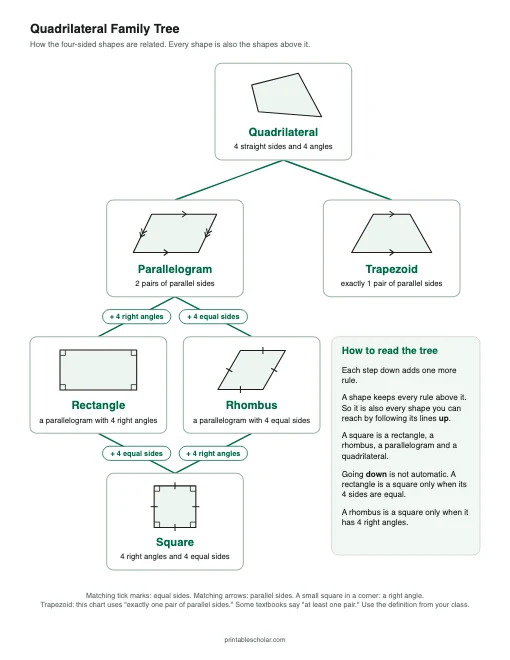
The family tree shows this as a picture. Each step down the tree adds one rule, and a shape keeps every rule above it. Follow the lines up from any shape to read off all of its names. Going down does not work the same way: a rectangle is a square only when its four sides happen to be equal.
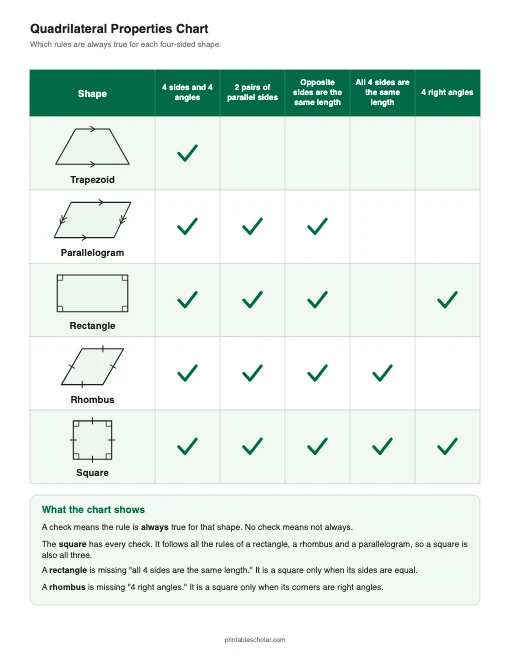
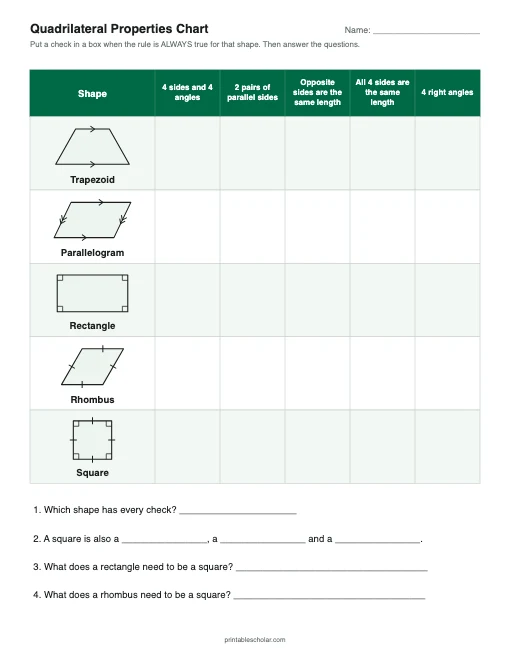
The properties chart shows the same thing as a table of checks. The square has a check in every column, which is why it belongs to every family. The blank version makes a good first activity, because students who fill in the checks themselves usually spot the pattern without being told.
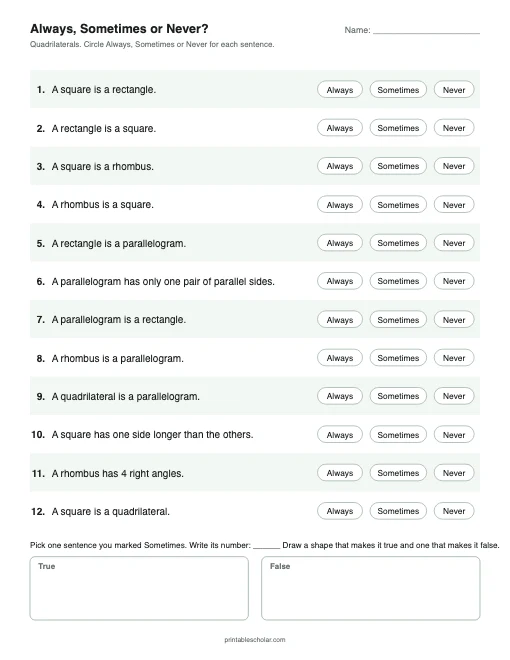
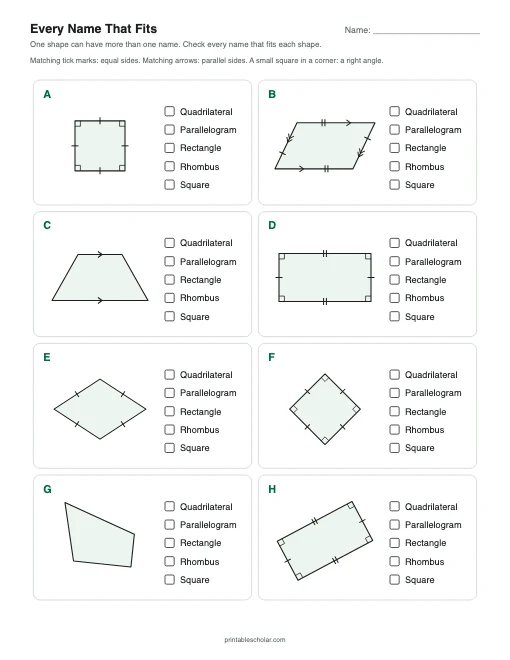
The two worksheets practice classifying quadrilaterals with the questions that show up on tests. One asks whether a sentence is always, sometimes or never true. The other shows a shape, including a square turned on its corner, and asks for every name that fits.
Frequently Asked Questions
Is a square a rectangle?
Yes, always. A rectangle is a four-sided shape with four right angles. A square has four right angles, so every square is a rectangle. It is a special rectangle whose sides are all the same length.
Is a rectangle a square?
Only sometimes. A square needs four right angles and four equal sides. A rectangle always has the right angles, but its sides are equal only in the special case where it is a square.
Is a rhombus a square?
Only sometimes. A rhombus has four equal sides. It is a square only when it also has four right angles. Going the other way, every square is a rhombus, because every square has four equal sides.
Is a square a parallelogram?
Yes. A parallelogram has two pairs of parallel sides, and so does a square. Rectangles and rhombuses are parallelograms too.
Is a trapezoid a parallelogram?
It depends on the definition your textbook uses. Many elementary books say a trapezoid has exactly one pair of parallel sides, and under that definition a trapezoid is never a parallelogram. Other books say at least one pair, which makes every parallelogram a trapezoid as well. These sheets use exactly one pair on the family tree, and the worksheets avoid questions where the two definitions give different answers.
What grade learns to classify quadrilaterals?
Students meet rhombuses, rectangles and squares as kinds of quadrilaterals in 3rd grade, sort shapes by parallel sides and right angles in 4th grade, and work with the full hierarchy in 5th grade.