About the Factors and Multiples Worksheets
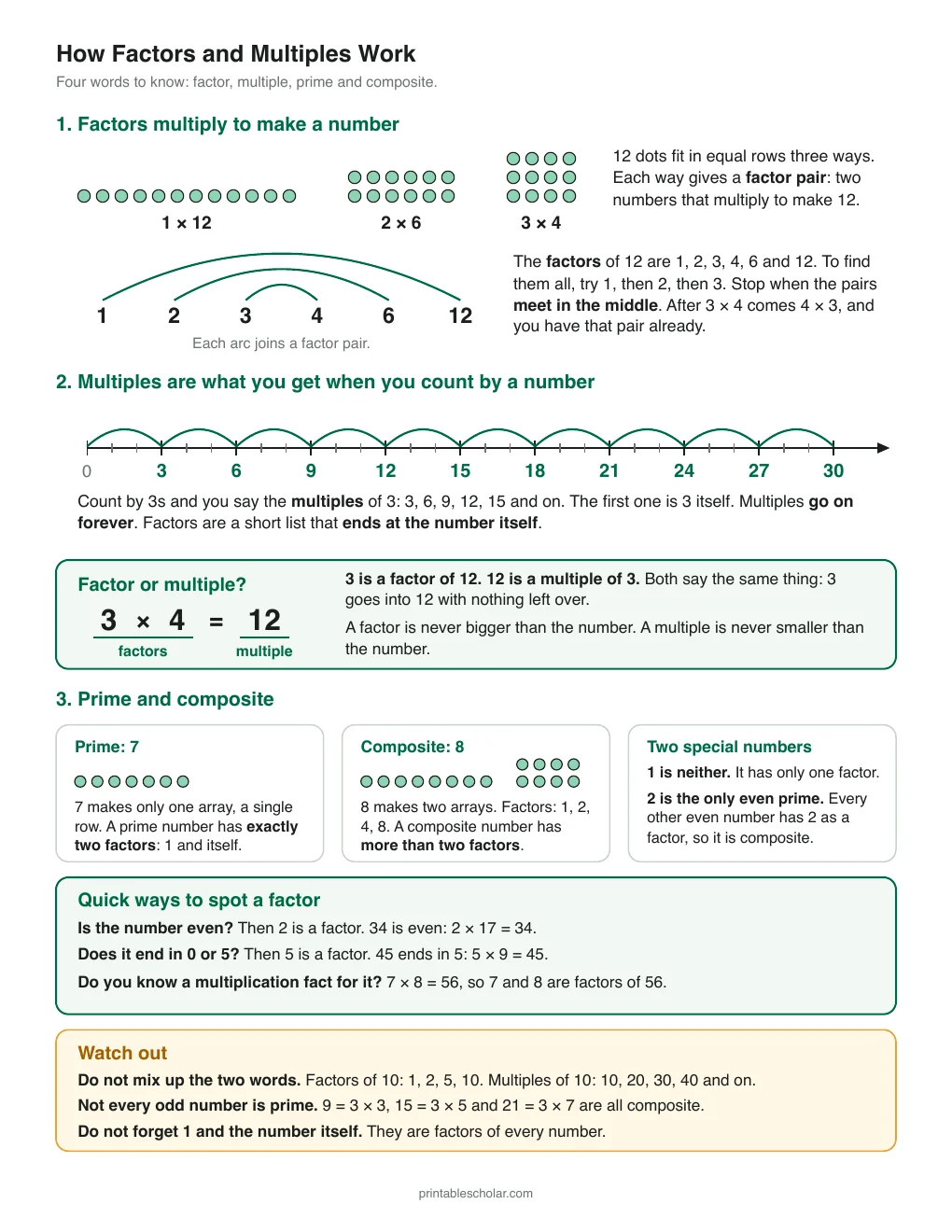
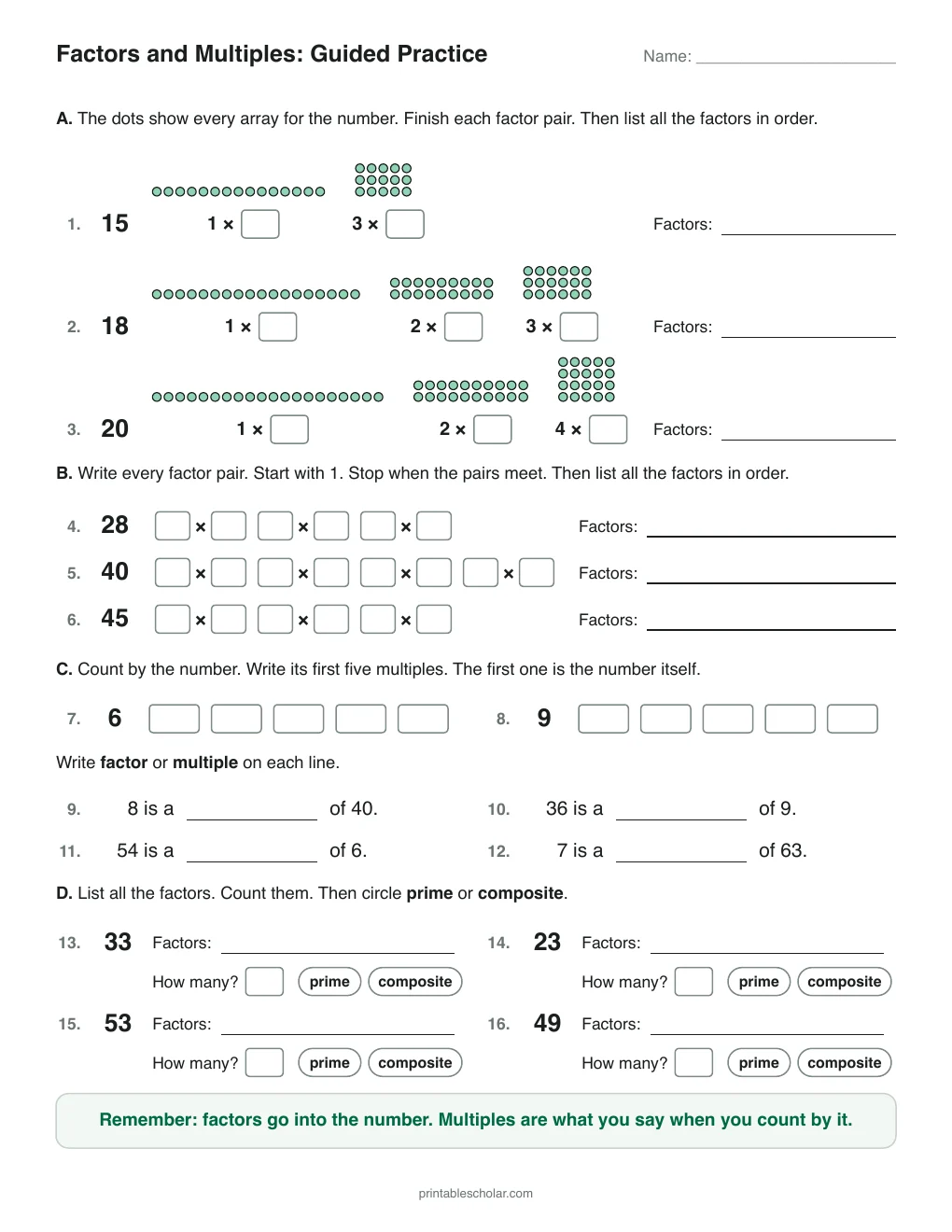
Start with How Factors and Multiples Work. It shows the three arrays that 12 dots can make, then joins the factor pairs in a rainbow so children can see when to stop: the pairs meet in the middle. A number line counts by 3s to show that multiples go on forever, while factors are a short list that ends at the number itself. One box ties the two words together (3 is a factor of 12, and 12 is a multiple of 3), and the last part shows why 7 is prime, why 8 is composite, why 1 is neither and why 2 is the only even prime. Factors and Multiples: Guided Practice then gives the support step by step: arrays with half of each pair filled in, boxes for every pair, and a count of the factors before deciding prime or composite.
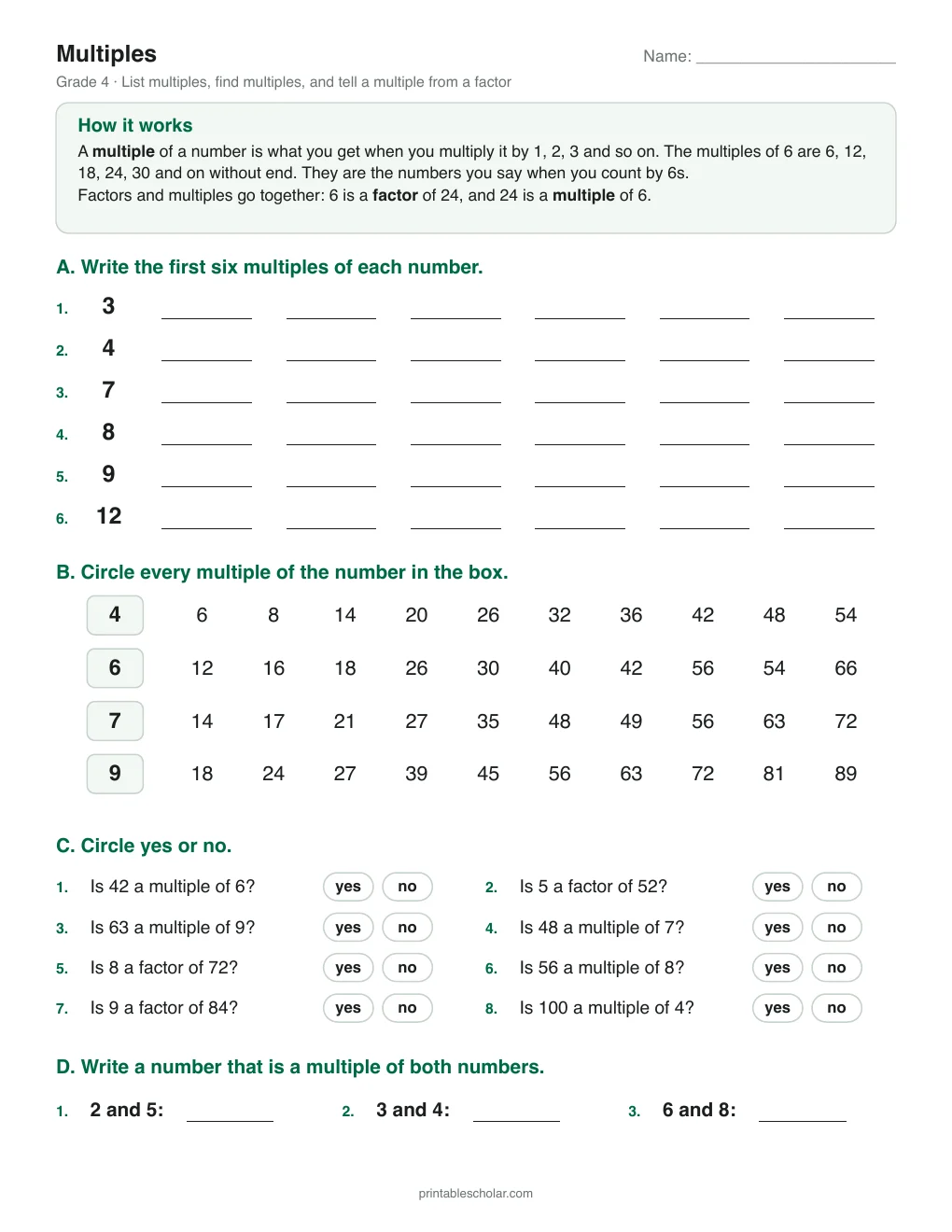
A factor of a number divides it exactly. A multiple of a number is what you get by multiplying it. They are the same fact seen from two sides: 6 is a factor of 24, and 24 is a multiple of 6. Children mix the two words up for a long time, so the Multiples sheet asks both kinds of question side by side.
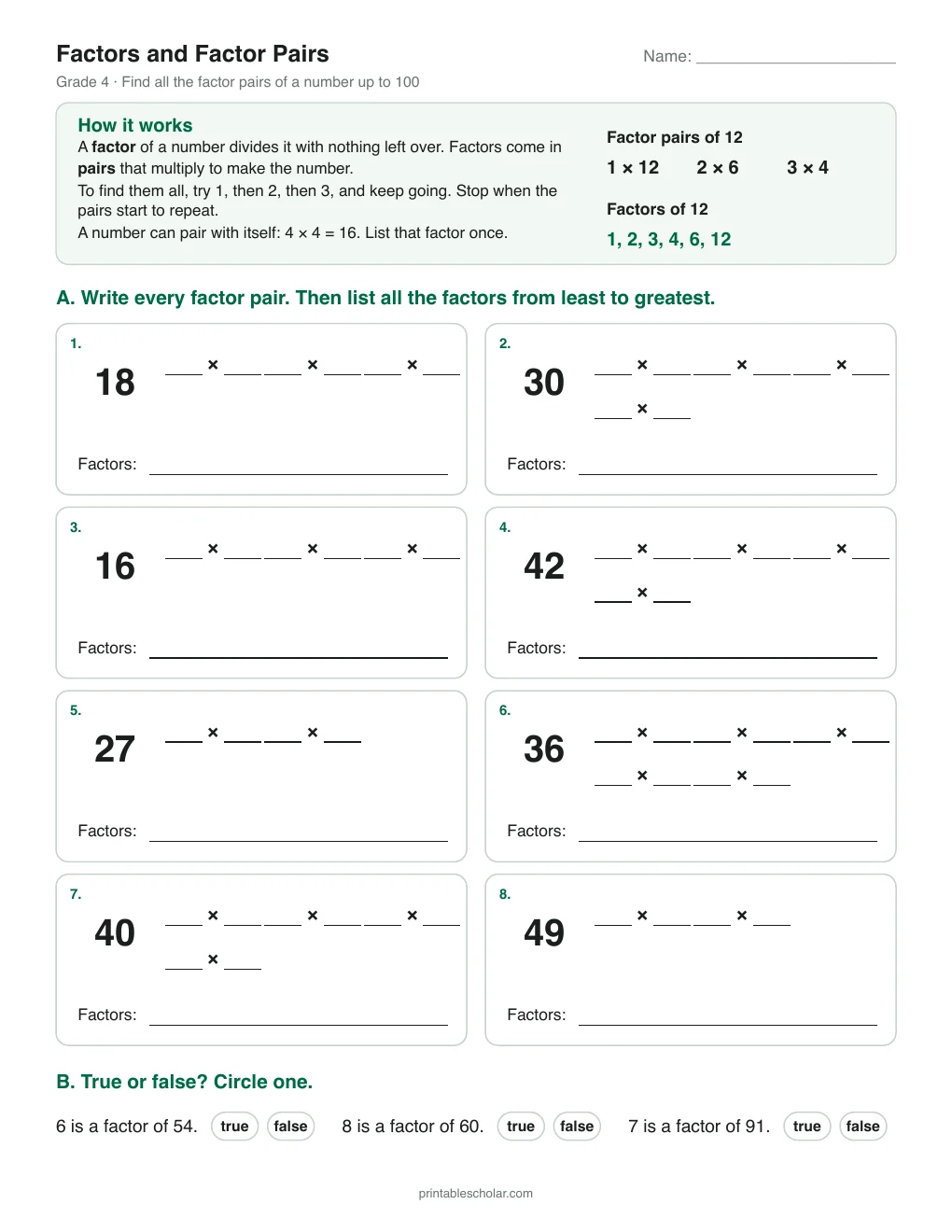
Factors and Factor Pairs teaches a method. Start at 1 and try each number in turn, writing the factor with its partner: 1 × 36, 2 × 18, 3 × 12, 4 × 9, 6 × 6. When the pairs start to repeat, every factor has been found. Three of the numbers, 16, 36 and 49, have a pair where both factors are the same.
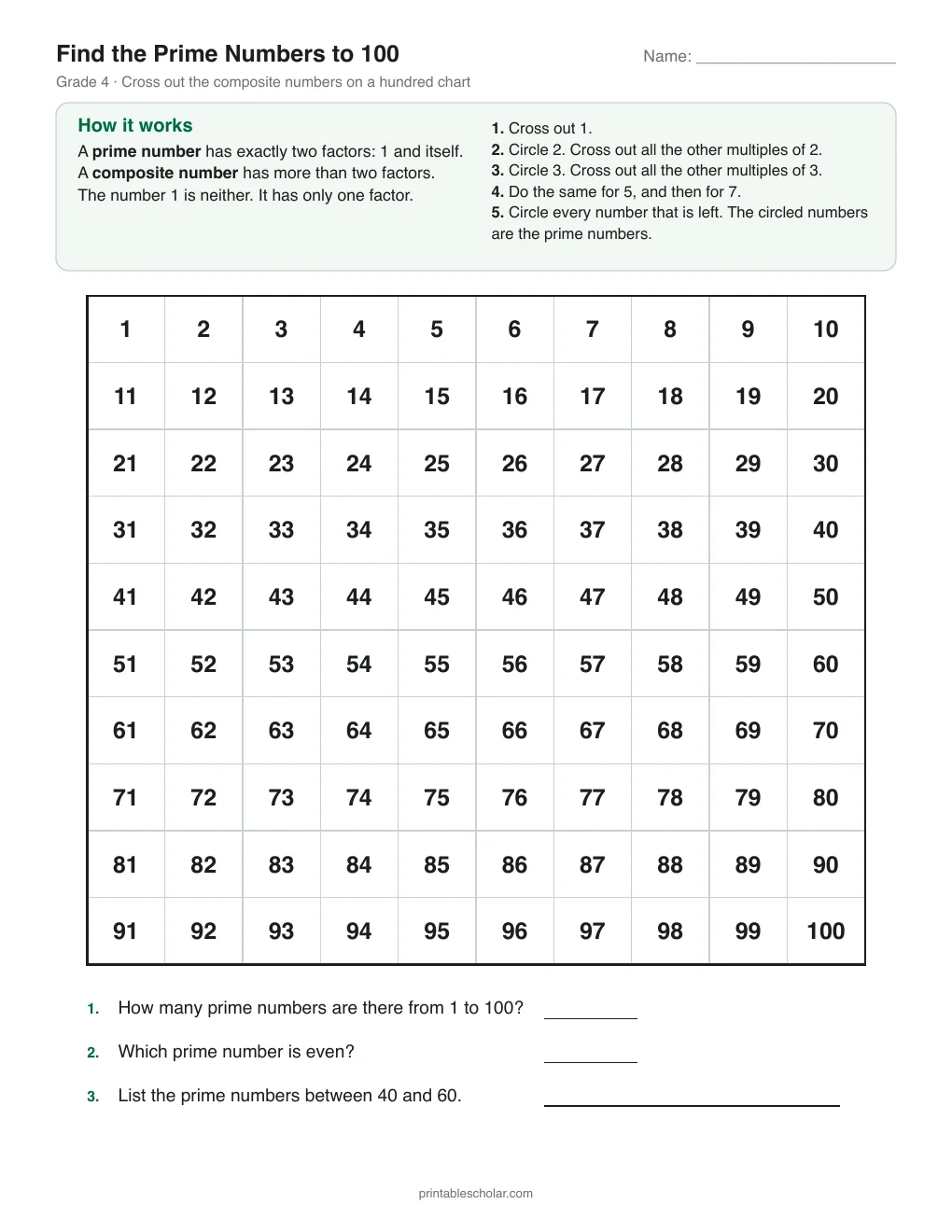
Find the Prime Numbers to 100 is the classic sieve. Cross out the multiples of 2, 3, 5 and 7, and the 25 numbers left standing are the primes. It shows why a prime is prime: nothing smaller divides it.
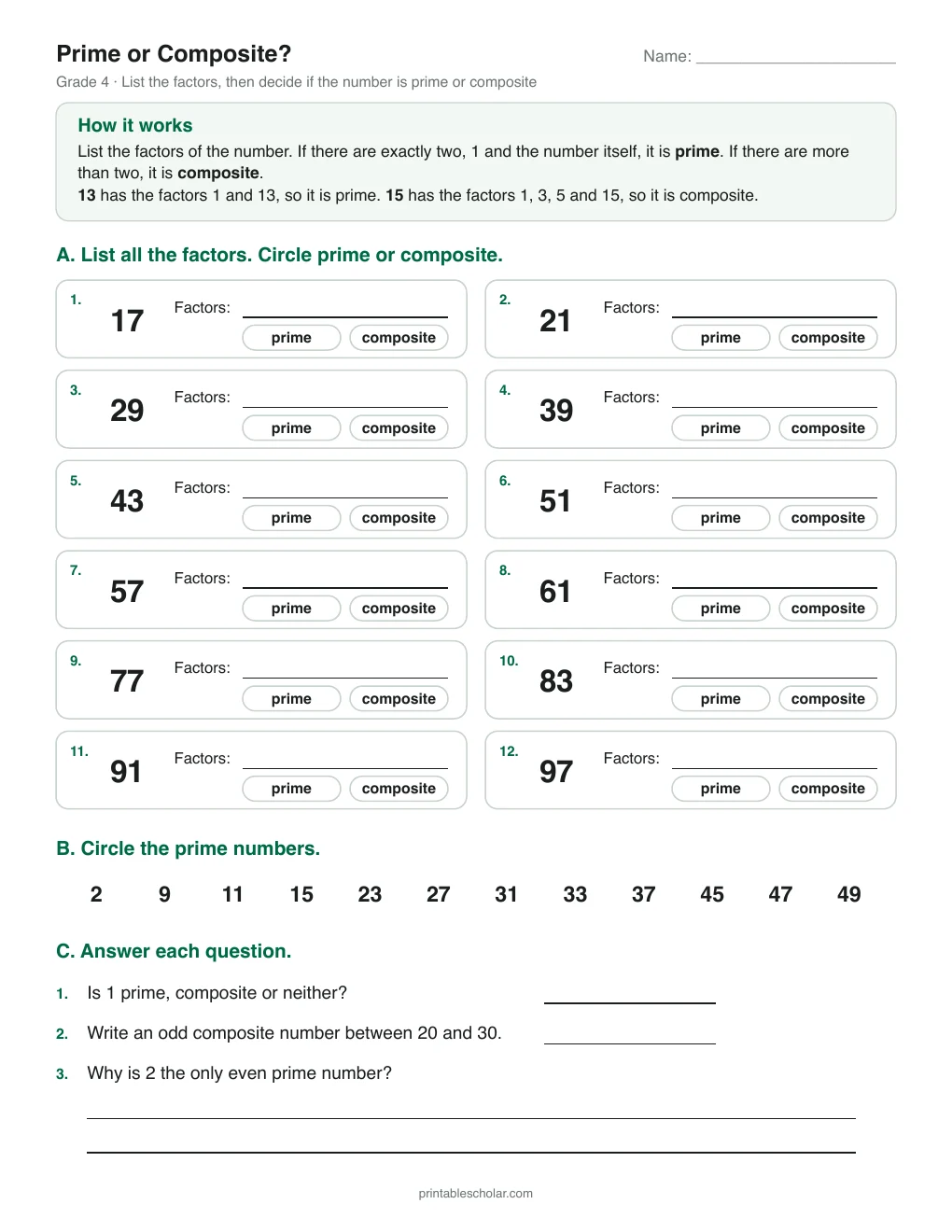
Prime or Composite? uses numbers that look prime and are not. 51 is 3 × 17, 57 is 3 × 19 and 91 is 7 × 13. Listing the factors is the only way to be sure. For the multiplication facts behind all of this, see the multiplication worksheets and the multiplication chart, and for sharing out, the division worksheets.
Frequently Asked Questions
What is the difference between a factor and a multiple?
A factor divides a number exactly. A multiple is the result of multiplying a number by a whole number. The factors of 12 are 1, 2, 3, 4, 6 and 12. The multiples of 12 are 12, 24, 36, 48 and so on. A number has a fixed list of factors, but its multiples go on forever.
How do you find all the factors of a number?
Work through the numbers in order, starting at 1. Each time one divides exactly, write it down with its partner. For 30: 1 and 30, 2 and 15, 3 and 10, 5 and 6. When the next pair would repeat one you already have, you are done.
What is a prime number?
A prime number is a whole number greater than 1 with exactly two factors: 1 and itself. The first few are 2, 3, 5, 7, 11 and 13. A number with more than two factors is composite.
Is 1 a prime number?
No. A prime number has exactly two factors, and 1 has only one. It is neither prime nor composite.
How many prime numbers are there under 100?
There are 25: 2, 3, 5, 7, 11, 13, 17, 19, 23, 29, 31, 37, 41, 43, 47, 53, 59, 61, 67, 71, 73, 79, 83, 89 and 97.
What grade learns factors and multiples?
Fourth grade. Students find all the factor pairs of numbers up to 100, recognize multiples of one-digit numbers, and tell whether a number up to 100 is prime or composite.
Do the worksheets have answer keys?
Yes. Every worksheet is a two-page PDF with the answer key on the second page.