About the Types of Triangles Lesson
Every triangle has two names. One comes from its sides and one comes from its angles. Students often learn the six words as a single list and then mix them up. It is easier to keep them as two separate questions: how many sides match, and how big is the biggest angle?
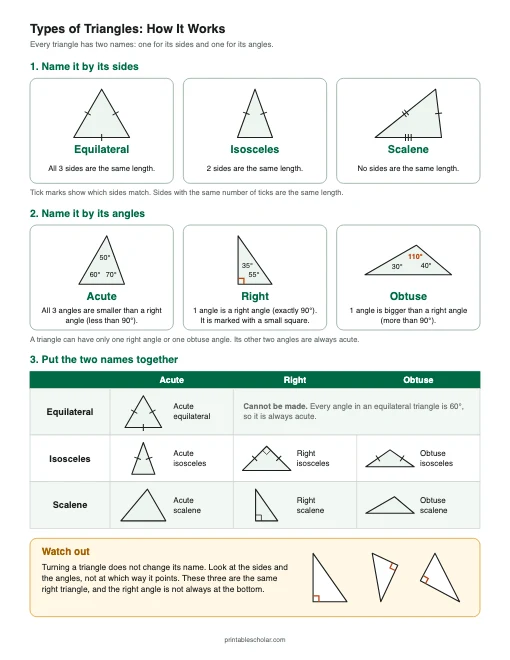
The How It Works sheet takes the questions one at a time. By sides, a triangle is equilateral (all three sides the same length), isosceles (two the same) or scalene (none the same). By angles, it is acute (all three angles smaller than a right angle), right (one right angle) or obtuse (one angle bigger than a right angle).
The chart in the third part puts the two names together. It shows seven kinds of triangle, such as a right isosceles triangle or an obtuse scalene triangle. It also shows the two that cannot be made. Every angle of an equilateral triangle is 60°, so an equilateral triangle is never right and never obtuse.
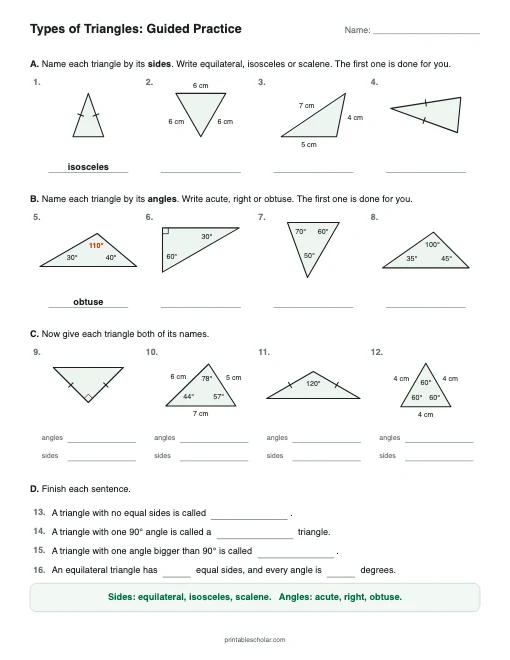
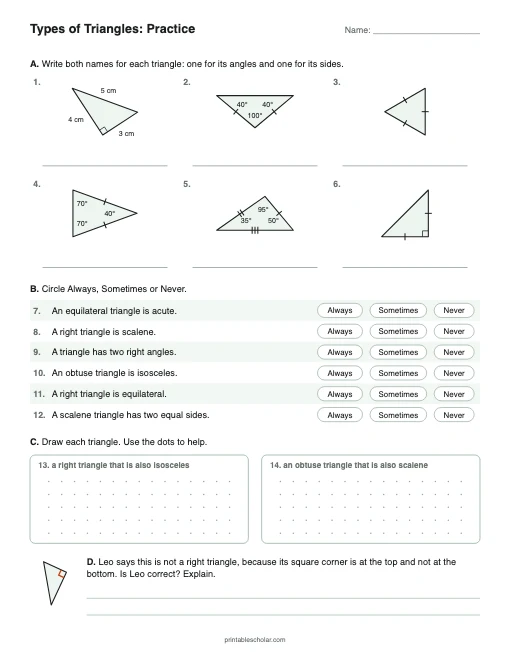
The guided practice sheet asks for the side name only, then the angle name only, then both. The independent practice sheet turns the triangles in different directions, because many students think a right triangle has to sit on its right angle. The types of quadrilaterals lesson does the same job for four-sided shapes, and a printable protractor is useful for checking angles.
Frequently Asked Questions
What are the types of triangles?
There are three types by sides and three by angles. By sides: equilateral (three equal sides), isosceles (two equal sides) and scalene (no equal sides). By angles: acute (all angles less than 90°), right (one 90° angle) and obtuse (one angle greater than 90°). Every triangle has one name from each group.
What is the difference between isosceles and scalene?
An isosceles triangle has two sides that are the same length. A scalene triangle has three sides that are all different lengths.
Can a triangle be both right and isosceles?
Yes. A right isosceles triangle has one 90° angle, and the two sides that form it are the same length. Its other two angles are 45° each. Cutting a square in half from corner to corner makes two of them.
Can a triangle have two right angles?
No. The three angles of a triangle add up to 180°. Two right angles already make 180°, which leaves nothing for the third angle. For the same reason a triangle can have only one obtuse angle.
Is an equilateral triangle also isosceles?
It depends on the definition your textbook uses. Many elementary books say an isosceles triangle has exactly two equal sides, and under that definition an equilateral triangle is not isosceles. Other books say at least two equal sides, which makes every equilateral triangle isosceles as well. These sheets say two sides are the same length, and the worksheets avoid questions where the two definitions give different answers.
What grade learns the types of triangles?
Students sort triangles by their angles, including right triangles, in 4th grade. In 5th grade they classify shapes by their properties in a hierarchy. The words equilateral, isosceles and scalene are usually taught in 4th or 5th grade.