 Printable Scholar
Indiana Physical Map
Indiana’s glacial history left the north flat and the south rumpled with hills and karst caves.
Rendered from SRTM 30m elevation data + Natural Earth rivers/lakes + US Census state boundary. Four versions below, all free.
Highest Point
Hoosier Hill
1,257 ft
Lowest Point
Ohio River
320 ft

Choose your version
Two maps, two versions of each.
The same Indiana terrain as a classroom map and as wall art. All four are free PDFs.
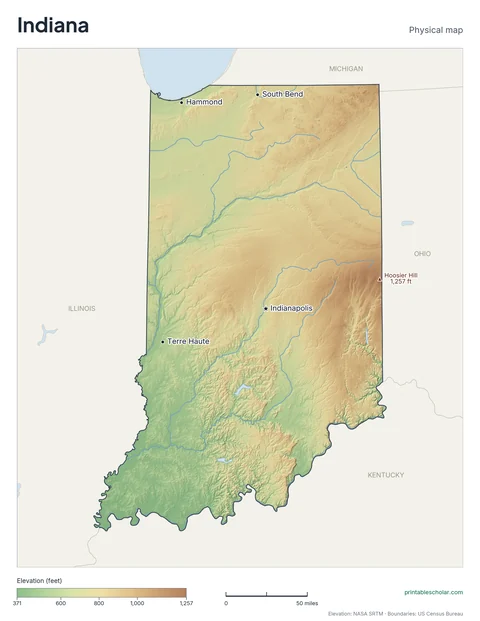
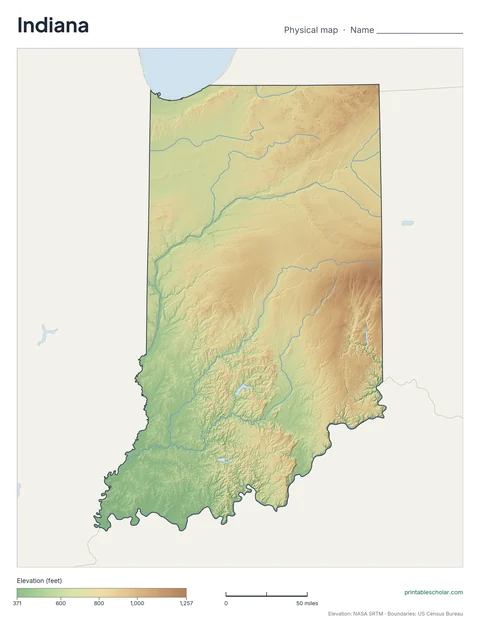
Indiana physical map for the classroom
Elevation in color with shaded relief, plus the surrounding states and water for context. The labeled version marks the capital, major cities and the highest point. The blank version leaves them off so students can label the map themselves.
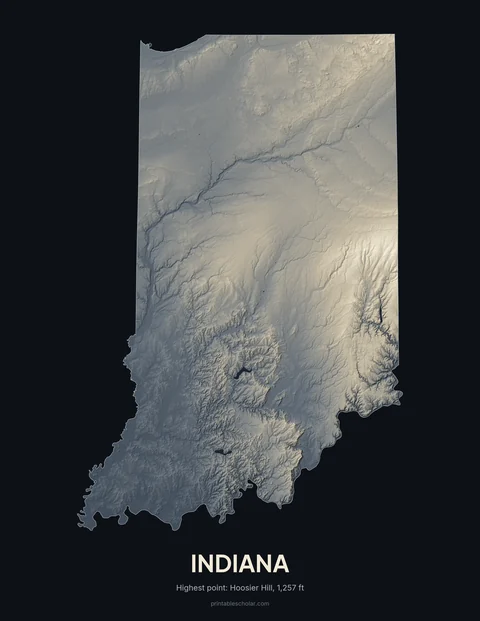
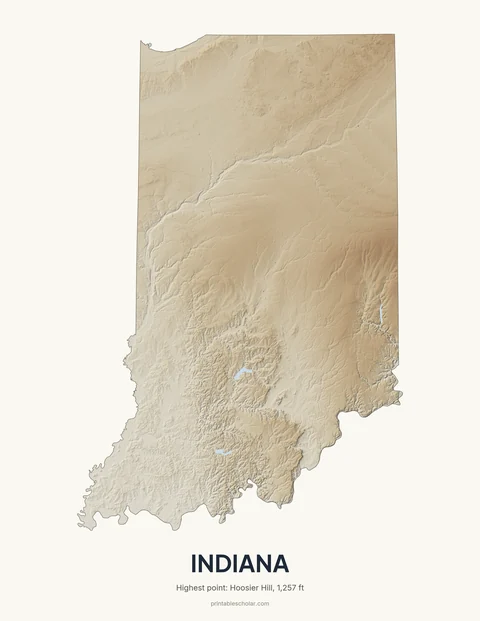
Indiana relief wall art
Indiana on its own, with strong shaded relief and no labels. The dark version has the most contrast. The light version uses far less ink on a home printer.
The physical geography of Indiana
Glaciers shaped the northern two-thirds of Indiana. The north has low moraines, small lakes and sand dunes along Lake Michigan. The center is the Tipton Till Plain, one of the flattest parts of the Midwest, and Hoosier Hill, the highest point, is a gentle rise near the Ohio border. The ice never reached the south-central part of the state, which is a land of steep hills, sinkholes and caves. The Ohio River forms the southern border and the Wabash forms part of the western one.
Major rivers
- Wabash
- Ohio
- White
- Kankakee
- Tippecanoe
Find it on the map
- The flat center of the state
- Rougher hills in the south-central part
- The Wabash River crossing the state and then forming the western border
Built from real data, not stock images.
Every Indiana physical map on this page was rendered from NASA SRTM 30-meter elevation data, with hydrography from Natural Earth and the shoreline-clipped state outline from the US Census Bureau. Each map is colored over that state’s own elevation range, and the relief shading is exaggerated so gentle terrain still shows.
Read full methodology arrow_forwardPair with
More State Maps
States that border Indiana
Physical maps of the 4 states that share a border with Indiana.


The region and the whole country
Physical maps for every state
- Alabama
- Alaska
- Arizona
- Arkansas
- California
- Colorado
- Connecticut
- Delaware
- Florida
- Georgia
- Hawaii
- Idaho
- Illinois
- Indiana
- Iowa
- Kansas
- Kentucky
- Louisiana
- Maine
- Maryland
- Massachusetts
- Michigan
- Minnesota
- Mississippi
- Missouri
- Montana
- Nebraska
- Nevada
- New Hampshire
- New Jersey
- New Mexico
- New York
- North Carolina
- North Dakota
- Ohio
- Oklahoma
- Oregon
- Pennsylvania
- Rhode Island
- South Carolina
- South Dakota
- Tennessee
- Texas
- Utah
- Vermont
- Virginia
- Washington
- West Virginia
- Wisconsin
- Wyoming