 Printable Scholar
Roman Numerals
Romans wrote numbers with seven letters: I, V, X, L, C, D and M. Line them up, biggest first, and add them together. Put a smaller one in front of a bigger one and it is taken away instead. Print the chart from 1 to 100 and a practice worksheet with its answer key, or use the converter to turn any number from 1 to 3,999 into Roman numerals and back.
Free to print
The chart from 1 to 100, and a practice worksheet
PDFs sized for US Letter paper, in color and black and white.
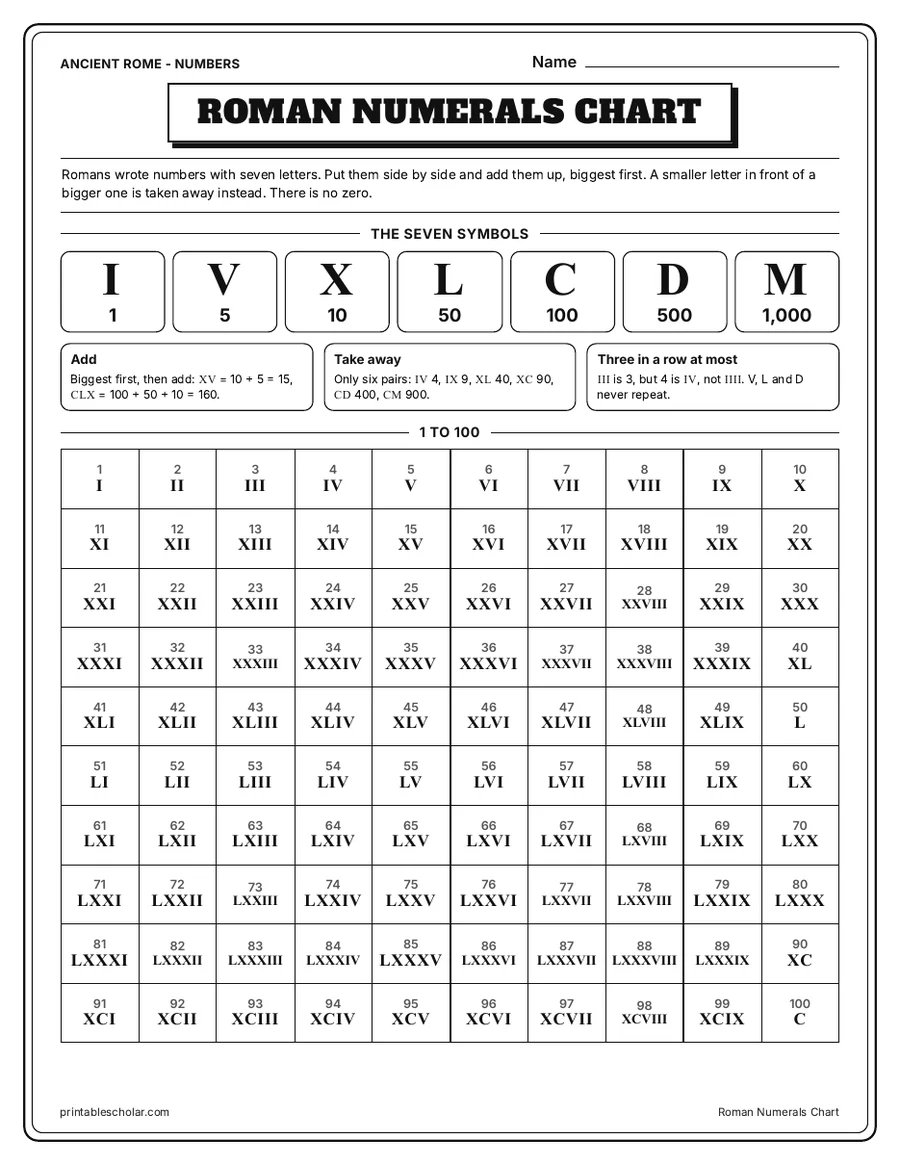
Roman Numerals Chart
The seven symbols and their values, the add and take-away rules, and every number from 1 to 100 in a 10 by 10 grid.
Download PDF Black and white
Roman Numerals Practice
Read numerals, write numbers as numerals, numerals in real life (clocks, years, the Super Bowl) and fix-the-mistake. Page 2 is the answer key.
Download PDF Black and whiteTry it
Roman numeral converter
Type a number to see it in Roman numerals, broken into its parts, or type a Roman numeral to read it. Works from 1 to 3,999.
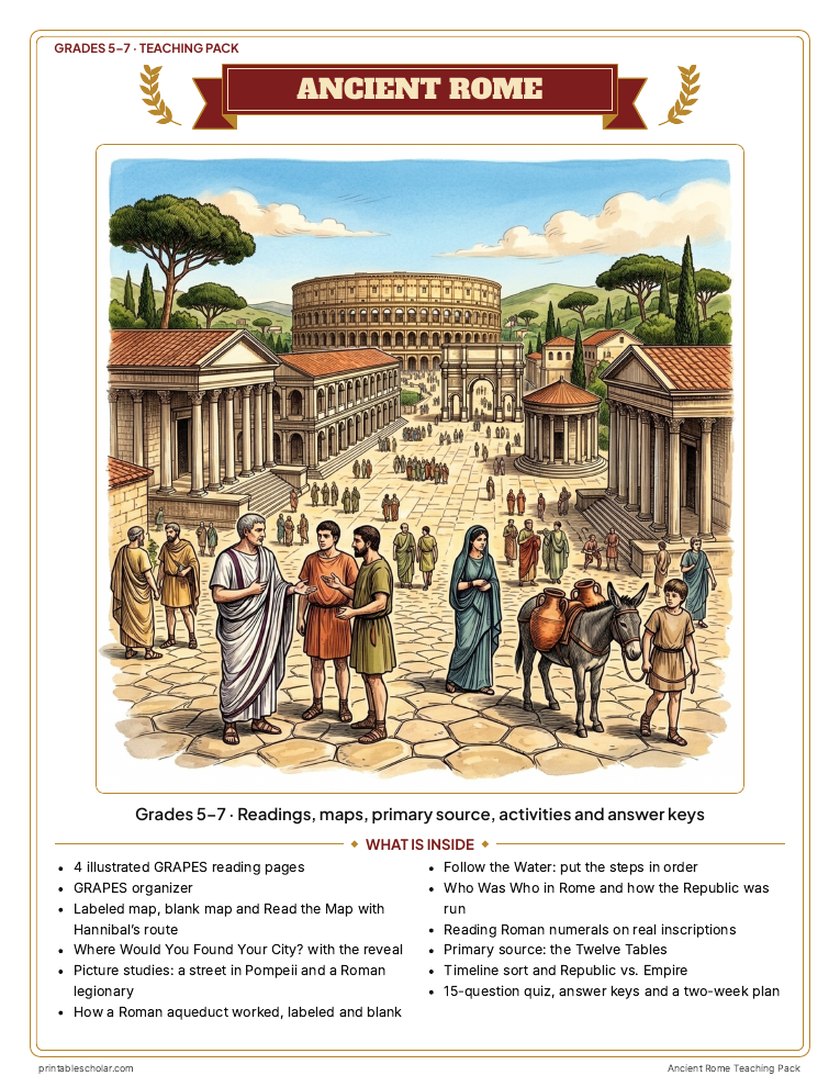
Teaching pack · Grades 5–7
Teaching Ancient Rome? The whole unit, ready to teach.
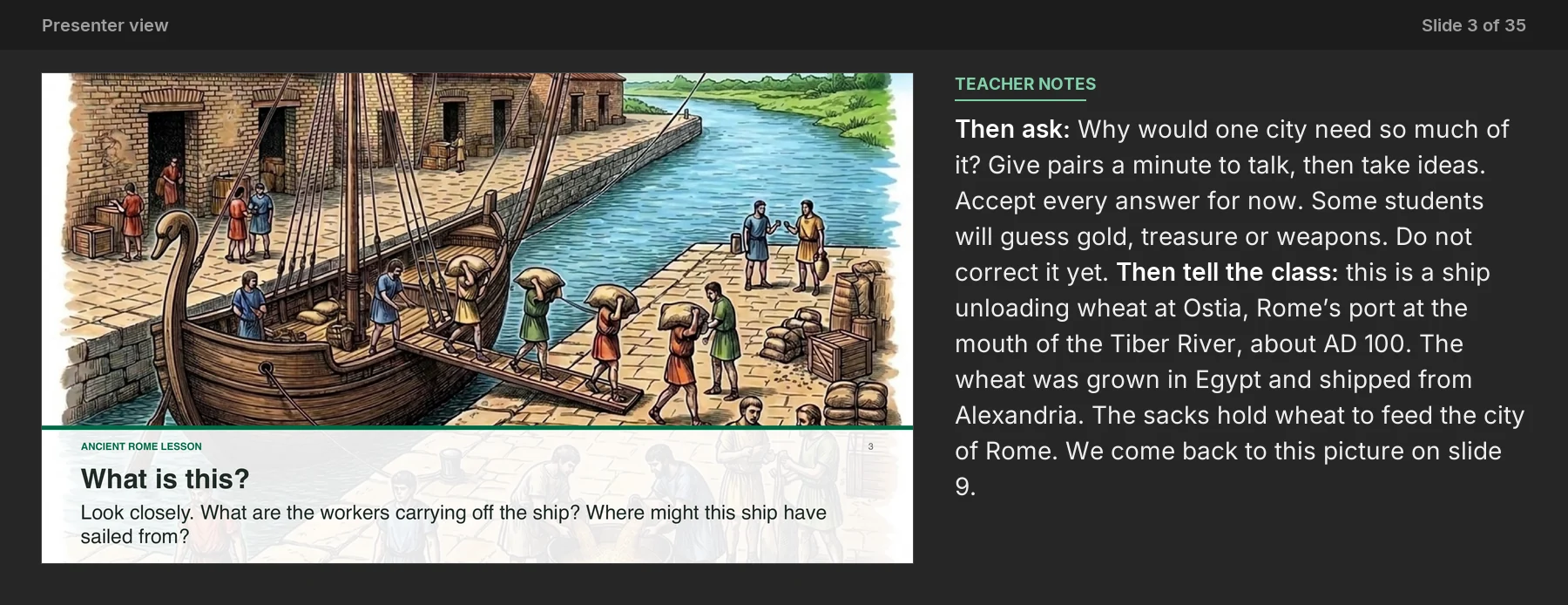
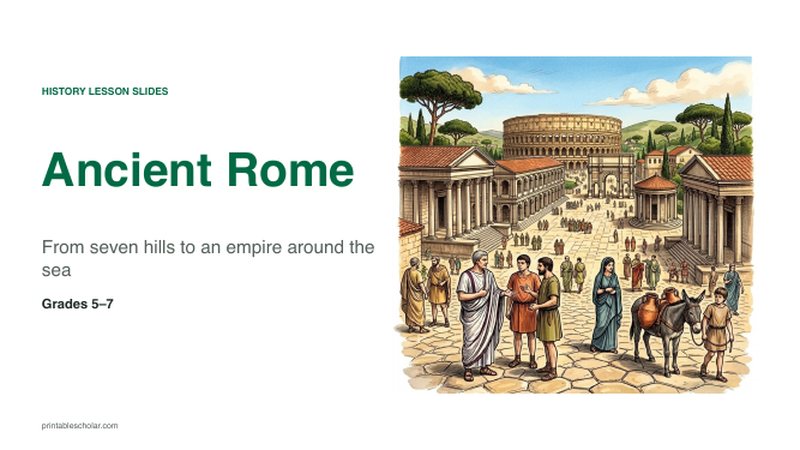
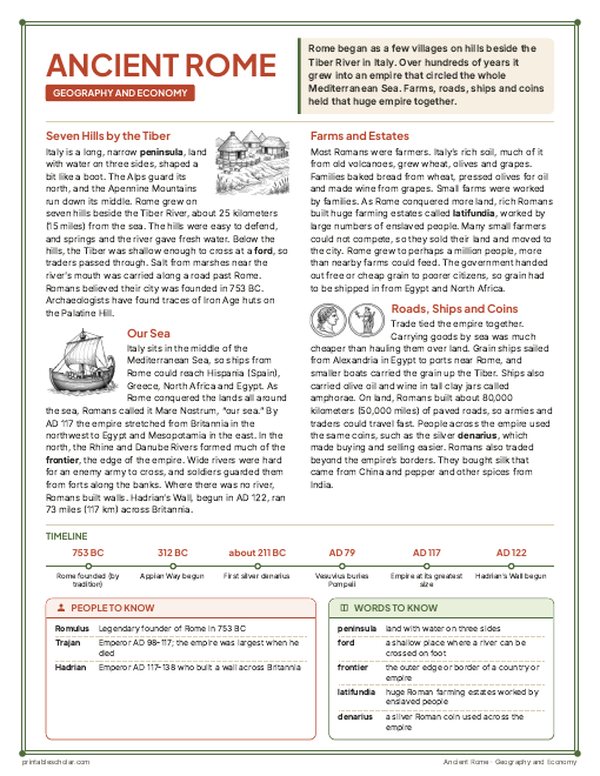
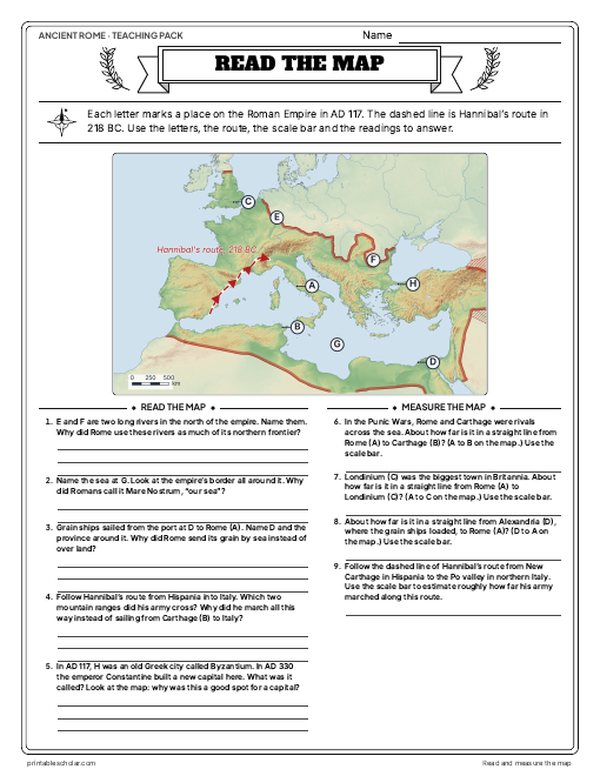
Two weeks of lessons in one download: slides to present, notes for students to fill in, and printable pages that use these maps and pictures.
Every slide comes with teacher notes: what to say, what to ask, and sample answers.
- 35 lesson slides (PowerPoint you can edit) and 2 pages of guided notes
- 4 illustrated reading pages and a GRAPES organizer
- Maps: labeled, blank, Read and Measure the Map with Hannibal's route, and a "Where would you found your city?" decision with the reveal
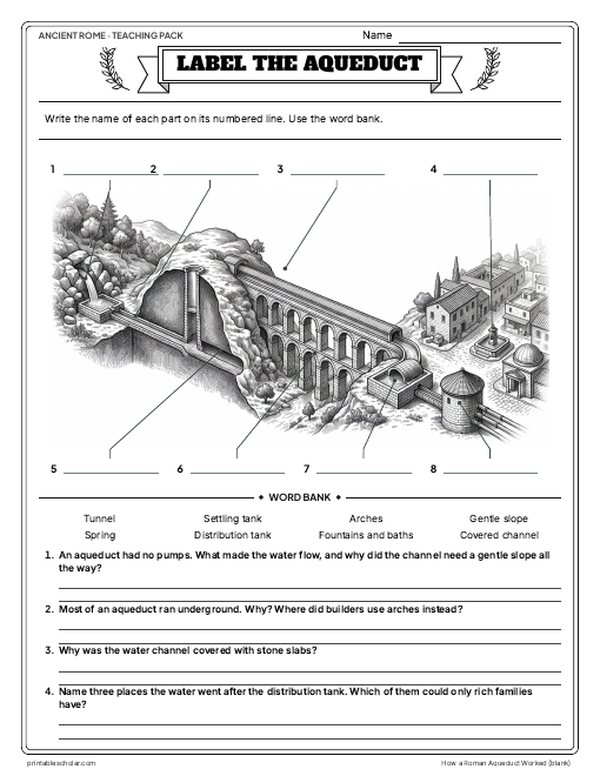
- Activities: picture studies of a Pompeii street and a Roman legionary, how an aqueduct worked (labeled, blank and the steps), who was who in Rome and how the Republic was run, Roman numerals on real inscriptions, the Twelve Tables, a timeline sort and Republic vs. Empire
- A 15-question quiz, a teacher guide with a two-week plan, and answer keys for everything
Every answer is in the pack. The readings, slides, maps and pictures teach everything the sheets and quiz ask, so no textbook is needed.
Get the Ancient Rome pack for $7Teaching more than one? Get all eight ancient history packs (Early Humans, Egypt, Mesopotamia, the Persian Empire, Greece, Rome, China and India) for $39: about sixteen weeks of lessons.
Get all 8 packs for $39See all eight packsOr get every history pack (27) in one download:Get all 27 for $49
One-time purchase. Instant download. Color and ink-saving black-and-white editions. Secure checkout by Stripe.
The 10-day plan
10 lessons, each planned for one class period of about 45 to 50 minutes, straight from the teacher guide. Some days are fuller than others; the note below shows how to even them out.
- Day 1Hook: Found a city, then Italy and the legend
- Day 2Geography, economy and measuring the map
- Day 3The blank map and where Rome spread
- Day 4The Republic: Who belonged and how it ran
- Day 5Primary source: The Twelve Tables
- Day 6Gods, faiths, building and the Roman aqueduct
- Day 7A street in Pompeii and Roman numerals
- Day 8Republic to Empire, the fall and a legionary
- Day 9Republic vs. Empire and the timeline sort
- Day 10Review and the 15-question quiz
Fitting it to your schedule: Days 1, 4 and 6 are the fullest and Days 5 and 9 the lightest. With 10 periods, move How the Roman Republic Was Run and the run-the-Republic activity from Day 4 to Day 5, beside the Twelve Tables. With 8 periods, give the blank map as homework after Day 2 and compare the Day 1 city choices at the end of Day 2, then give the Republic vs. Empire chart and its argument as homework after Day 8 and open the short Day 10 review with the timeline sort.
See the full day-by-day plan
- Day 1
- Before any reading (the readings and slides give the answer away): Where Would You Found Your City? Students choose and argue in pairs. Then lesson slides 1-12 on Italy, the Tiber, the sea and the frontier, farms and trade, and Roman fast food, with guided notes page 1, and read What Really Happened: the Romulus and Remus legend vs. what archaeology shows.
- Day 2
- Reading 1: Geography and Economy. Fill the G and E boxes of the GRAPES organizer. Read and Measure the Map, including Hannibal's route and the scale-bar distances.
- Day 3
- Labeled map with the What Happened strip; students fill in the blank map with the word bank. Compare their Day 1 city choices with where Rome's roads and provinces spread.
- Day 4
- Lesson slides 13-19 on the Republic, who belonged and the gladiator myth, with guided notes page 1. Reading 2: Politics and Social Structure. Fill the P and S boxes. Who Was Who in Rome and How the Roman Republic Was Run; run the Republic for a day.
- Day 5
- Primary source: the Twelve Tables. Read aloud with the gloss, answer the document questions, then write a classroom Twelve Tables.
- Day 6
- Lesson slides 20-25 on gods, Judaism and Christianity, and Roman building, with guided notes page 2. Reading 3: Religion and Achievements. Fill the R and A boxes. How a Roman Aqueduct Worked (labeled and blank) and Follow the Water; build an aqueduct or an arch.
- Day 7
- Picture study: A Street in Pompeii, Look Closely questions. Reading Roman Numerals with the real inscriptions; start the numeral hunt.
- Day 8
- Lesson slides 26-32 on Carthage, Caesar, Augustus and the fall, with guided notes page 2. Reading 4: From Republic to Empire, and the Fall; add to the P box. Picture study: A Roman Legionary.
- Day 9
- Republic vs. Empire chart and question as a short written argument. Timeline sort into the Kingdom, Republic and Empire with the BC/AD box.
- Day 10
- Slides 33-35: the Who am I? riddle and the exit question on guided notes page 2. Check the GRAPES organizer, then the 15-question quiz.
How Roman numerals work
The seven symbols
I is 1, V is 5, X is 10, L is 50, C is 100, D is 500 and M is 1,000. Every Roman numeral is built from these seven letters. There is no symbol for zero: Romans counted things, and had no need to write nothing.
Adding
When the letters run from biggest to smallest, add them up. VIII is 5 + 1 + 1 + 1 = 8, and MDCLXVI is 1,000 + 500 + 100 + 50 + 10 + 5 + 1 = 1,666. A letter can repeat up to three times in a row: III is 3 and XXX is 30. V, L and D are never repeated, because VV would just be X.
Taking away
A smaller letter in front of a bigger one is subtracted. Only six pairs are used: IV is 4, IX is 9, XL is 40, XC is 90, CD is 400 and CM is 900. So 49 is XLIX (40 + 9), not IL, and 99 is XCIX (90 + 9), not IC.
Writing a big number
Split the number by place value and write each part: 1,969 is 1,000 + 900 + 60 + 9, so it is M + CM + LX + IX = MCMLXIX. The converter on this page shows those parts for any number.
Where we still use them
Clock faces, the years carved on buildings and shown at the end of films, the names of kings, queens and popes (Elizabeth II), chapter and volume numbers, outlines, and the Super Bowl, which reached Super Bowl LX in 2026.
How the Romans really wrote them
The rules on this page are the standard modern ones. Romans were less strict: they often wrote IIII for 4 or VIIII for 9, and many clocks still show IIII. For numbers in the thousands they sometimes drew a bar over a numeral to multiply it by 1,000.
Frequently asked questions
What is 4 in Roman numerals?
IV, which is 1 taken away from 5. Many clock faces show IIII instead, an older form the Romans also used.
Is there a zero in Roman numerals?
No. Roman numerals have no symbol for zero. Medieval writers sometimes used the Latin word nulla, meaning none.
What is the biggest Roman numeral?
In the standard form, MMMCMXCIX, which is 3,999. Bigger numbers were shown with a bar over a numeral, which multiplies it by 1,000.
How do you write 2026 in Roman numerals?
MMXXVI: 2,000 (MM) + 20 (XX) + 6 (VI).
What grade learns Roman numerals?
Many US students meet Roman numerals in grade 3 or 4, often while learning place value, and see them again in grade 6 when they study Ancient Rome.