 Printable Scholar
How Roman Aqueducts Worked
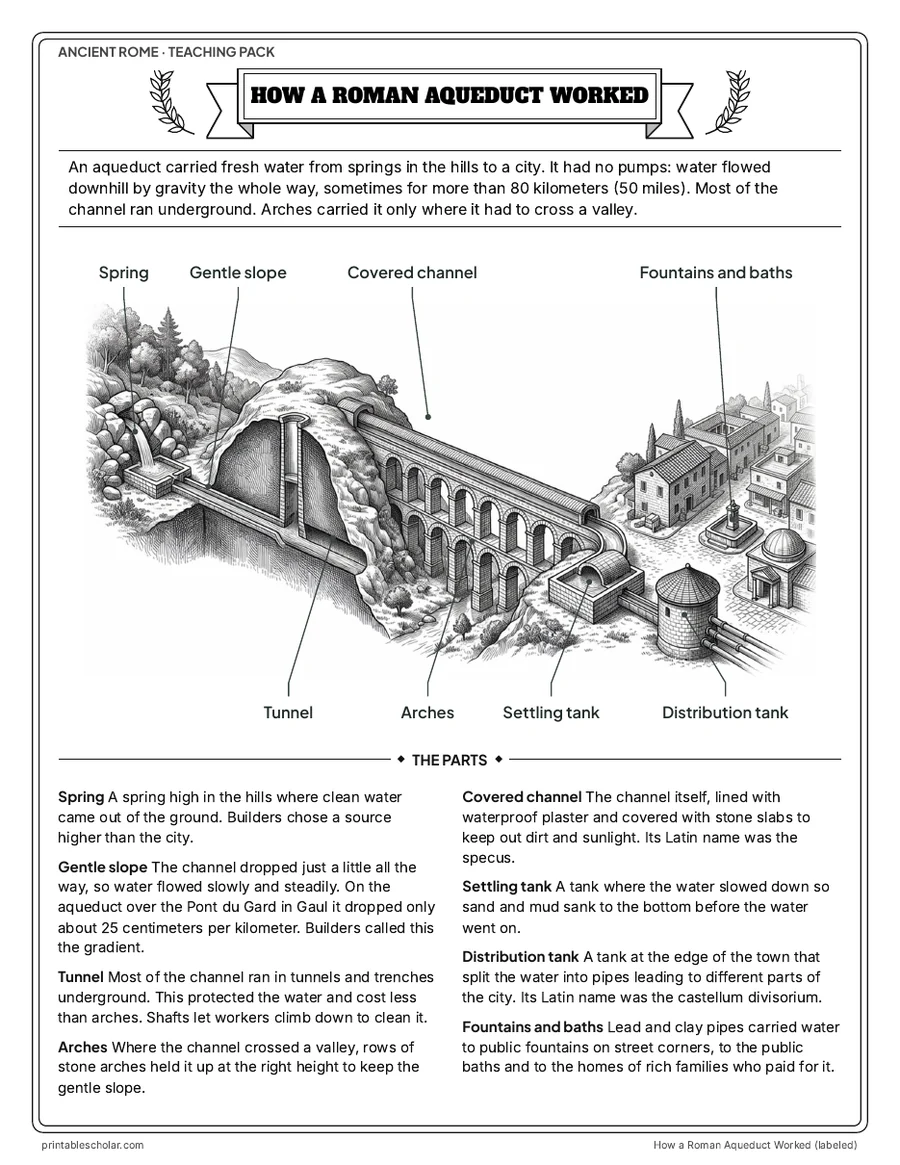
An aqueduct carried fresh water from springs in the hills to a city. It had no pumps: water flowed downhill by gravity the whole way, sometimes for more than 80 kilometers (50 miles). Most of the channel ran underground. Arches carried it only where it had to cross a valley. Rome itself was fed by eleven aqueducts by the AD 200s.
Free to print
A labeled aqueduct, a blank one to label, and the steps to put in order
PDFs sized for US Letter paper, in color and black and white.
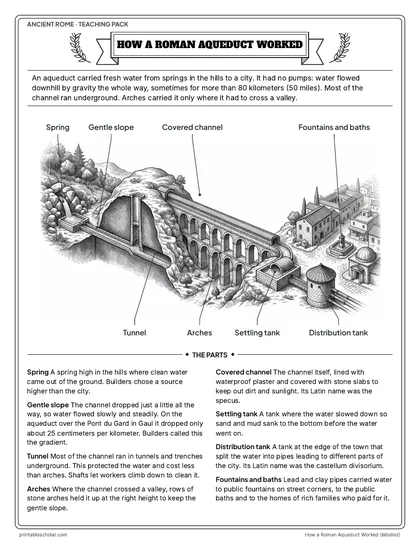
How a Roman aqueduct worked, labeled
The eight parts of an aqueduct with leader lines, from the spring in the hills to the fountains in town, and what each part did.
Download PDF Black and white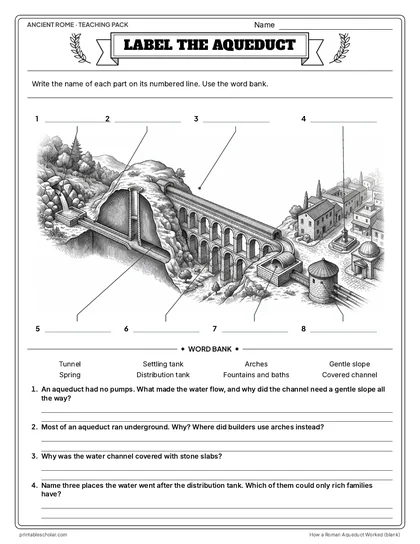
Label the Aqueduct
The same aqueduct with numbered blanks, a word bank and questions.
Download PDF Black and white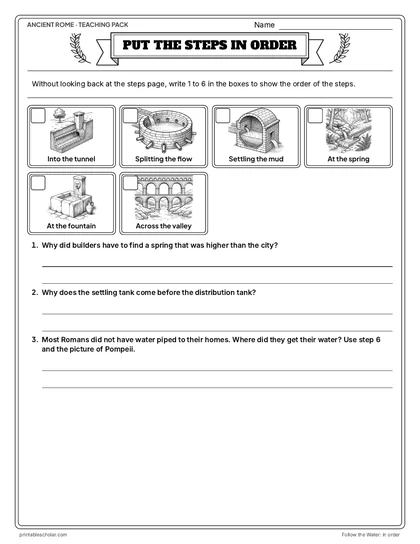
Follow the Water: put the steps in order
Six steps of the water’s journey, out of order, with three questions.
Download PDF Black and white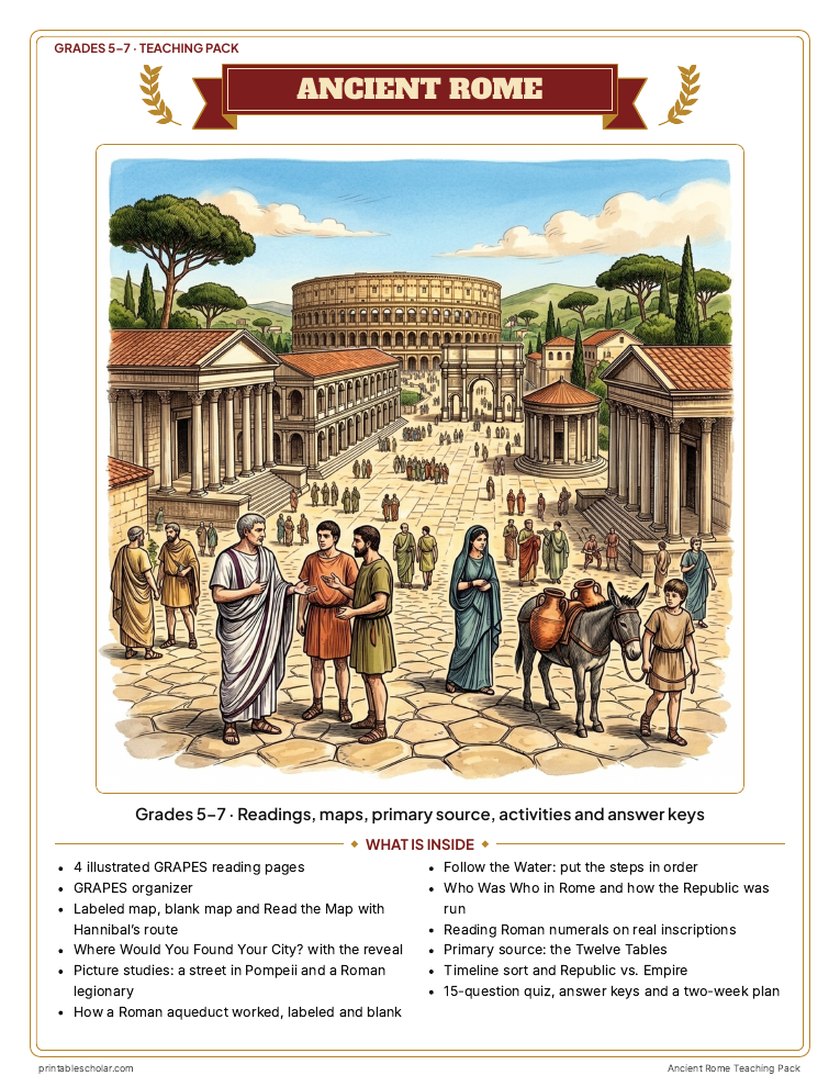
Teaching pack · Grades 5–7
Teaching Ancient Rome? The whole unit, ready to teach.
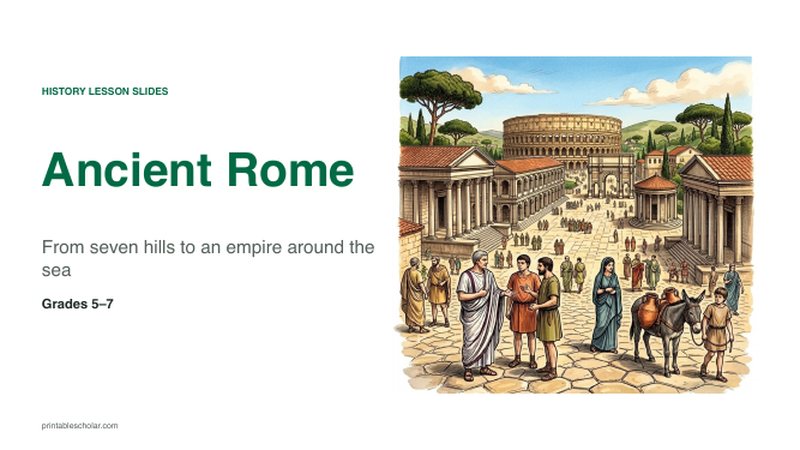
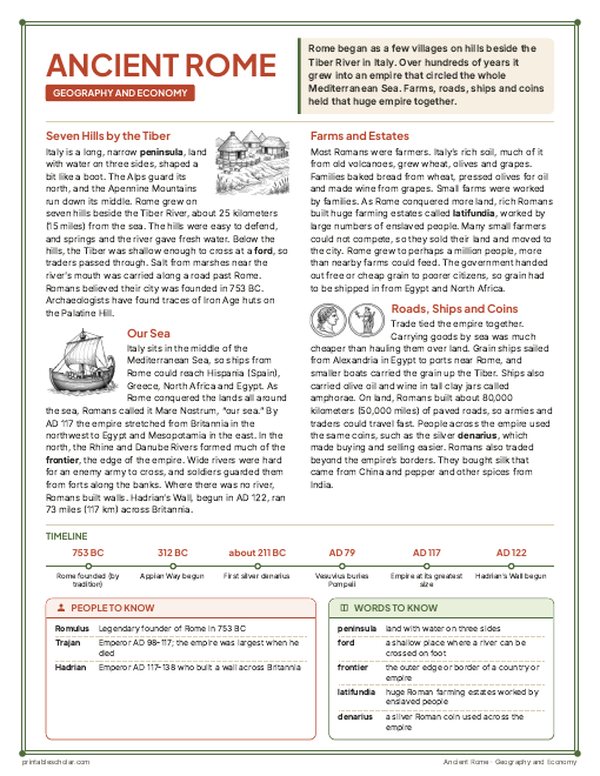
Two weeks of lessons in one download: slides to present, notes for students to fill in, and printable pages that use these maps and pictures.
- 20 lesson slides (PowerPoint you can edit, teacher notes on every slide) and 2 pages of guided notes
- 4 illustrated reading pages and a GRAPES organizer
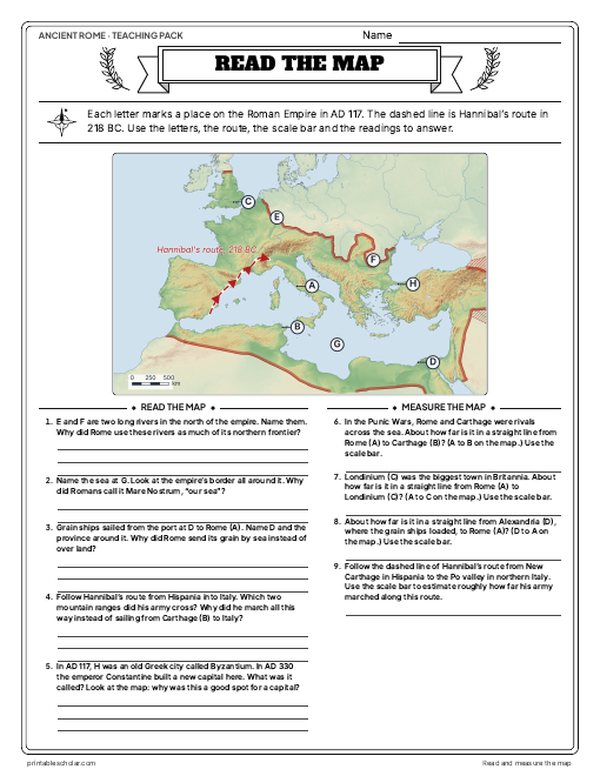
- Maps: labeled, blank, Read and Measure the Map with Hannibal's route, and a "Where would you found your city?" decision with the reveal
- Activities: picture studies of a Pompeii street and a Roman legionary, how an aqueduct worked (labeled, blank and the steps), who was who in Rome and how the Republic was run, Roman numerals on real inscriptions, the Twelve Tables, a timeline sort and Republic vs. Empire
- A 15-question quiz, a teacher guide with a two-week plan, and answer keys for everything
Every answer is in the pack. The readings, slides, maps and pictures teach everything the sheets and quiz ask, so no textbook is needed.
Get the Ancient Rome pack for $7One-time purchase. Instant download. Color and ink-saving black-and-white editions. Secure checkout by Stripe.
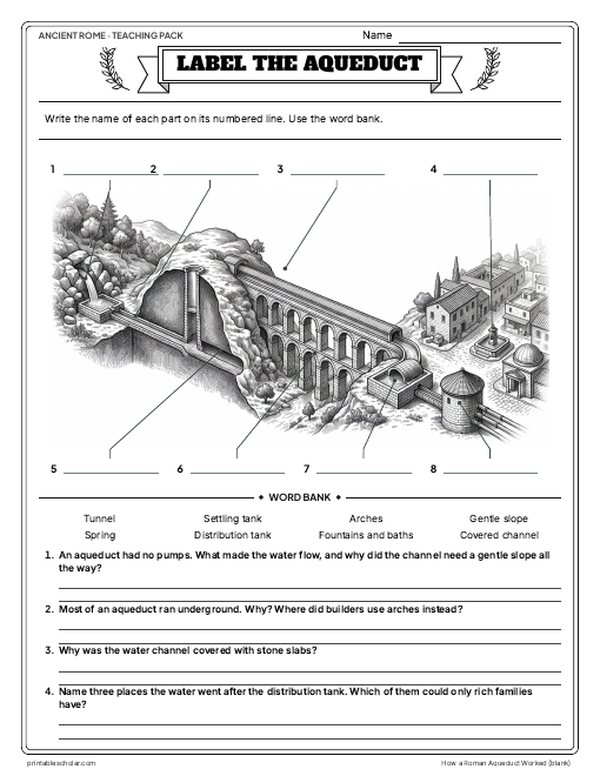
The parts of an aqueduct, in order
Spring
A spring high in the hills where clean water came out of the ground. Builders chose a source higher than the city.
Gentle slope
The channel dropped just a little all the way, so water flowed slowly and steadily. On the aqueduct over the Pont du Gard in Gaul it dropped only about 25 centimeters per kilometer. Builders called this the gradient.
Tunnel
Most of the channel ran in tunnels and trenches underground. This protected the water and cost less than arches. Shafts let workers climb down to clean it.
Arches
Where the channel crossed a valley, rows of stone arches held it up at the right height to keep the gentle slope.
Covered channel
The channel itself, lined with waterproof plaster and covered with stone slabs to keep out dirt and sunlight. Its Latin name was the specus.
Settling tank
A tank where the water slowed down so sand and mud sank to the bottom before the water went on.
Distribution tank
A tank at the edge of the town that split the water into pipes leading to different parts of the city. Its Latin name was the castellum divisorium.
Fountains and baths
Lead and clay pipes carried water to public fountains on street corners, to the public baths and to the homes of rich families who paid for it.
Frequently asked questions
How did Roman aqueducts move water without pumps?
By gravity. The channel started at a spring higher than the city and sloped gently downhill the whole way, so the water flowed on its own.
Why did Roman aqueducts have arches?
Arches carried the channel across valleys at the right height to keep its gentle downhill slope. Most of an aqueduct actually ran underground in tunnels and trenches; the arches were only where the land dipped.
Where did the water go when it reached the city?
Into a settling tank, where mud sank, then a distribution tank (the castellum divisorium) that split it into lead and clay pipes running to public fountains, public baths and the homes of rich families who paid for it.