 Printable Scholar
Hieroglyphics Alphabet
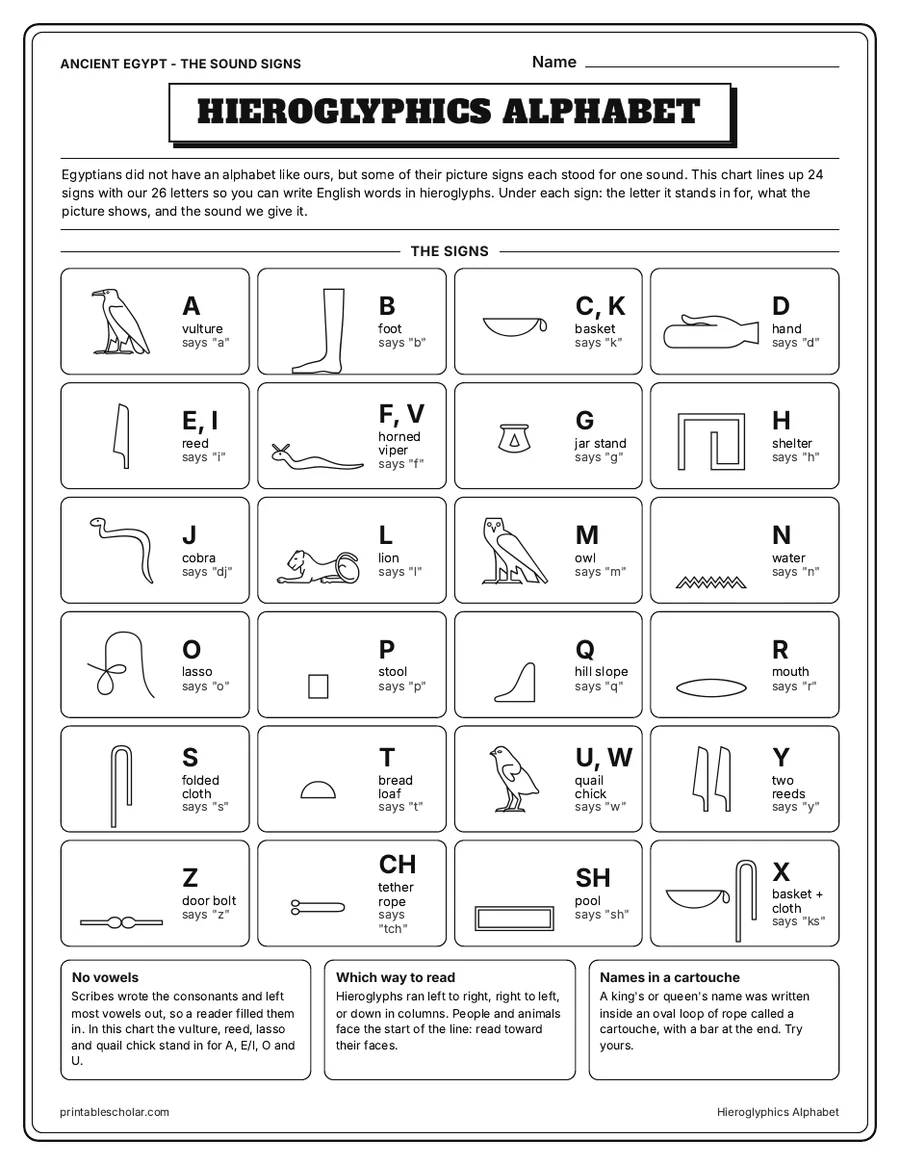
Ancient Egyptians wrote with hundreds of picture signs, and about 24 of them each stood for a single sound. Lined up with our letters, those sound signs make a hieroglyphics alphabet you can write with. The chart below uses real hieroglyphs, set from a hieroglyph font rather than drawn by hand, with the picture each sign shows and the sound it had. Type your name to see it in a cartouche, or print the chart and a decode-the-message worksheet with its answer key.
Free to print
The alphabet chart, and a message to decode
PDFs sized for US Letter paper, in color and black and white.
Hieroglyphics Alphabet Chart
24 signs lined up with our 26 letters, with what each picture shows and the sound we give it, plus notes on vowels, reading direction and cartouches.
Download PDF Black and white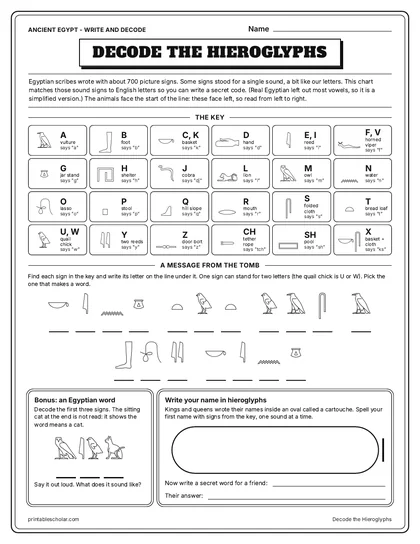
Decode the Hieroglyphs
Decode a message from the tomb, read a real Egyptian word, and write your name in a cartouche. Page 2 is the answer key.
Download PDF Black and whiteTry it
Write your name in hieroglyphs
Type a name to see it in a cartouche, the oval Egyptians drew around royal names. Turn it up and down like a temple column, then save the picture or print it.
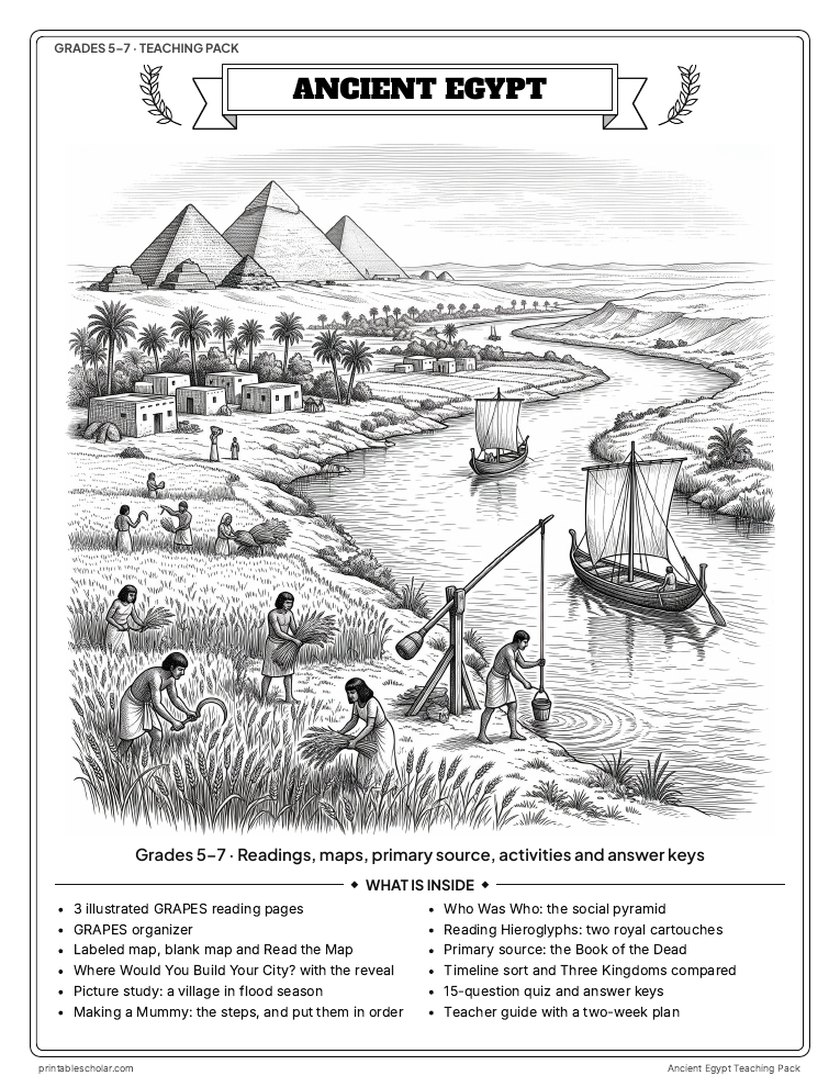
Teaching pack · Grades 5–7
Teaching Ancient Egypt? The whole unit, ready to teach.
Two weeks of lessons in one download: slides to present, notes for students to fill in, and printable pages that use these maps and pictures.
Every slide comes with teacher notes: what to say, what to ask, and sample answers.
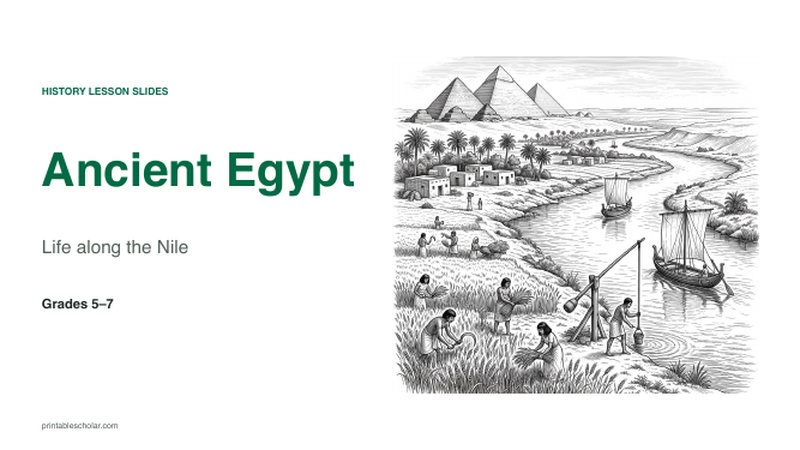
- 27 lesson slides (PowerPoint you can edit) and 2 pages of guided notes
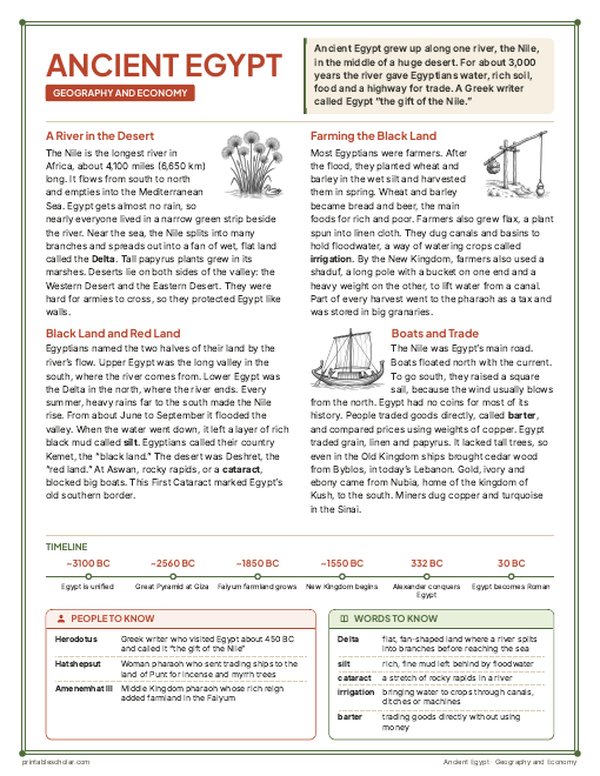
- 3 illustrated reading pages and a GRAPES organizer
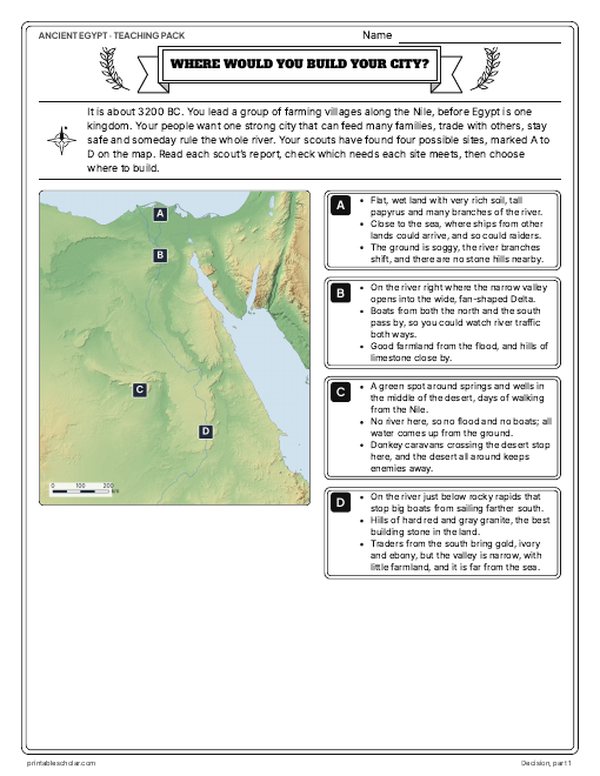
- Maps: labeled, blank, Read and Measure the Map, and a "Where would you build your city?" decision with the reveal
- Activities: a picture study, the steps of making a mummy, the social pyramid, reading hieroglyphs, a primary source and a timeline sort
- A 15-question quiz, a teacher guide with a two-week plan, and answer keys for everything
Every answer is in the pack. The readings, slides, maps and pictures teach everything the sheets and quiz ask, so no textbook is needed.
Get the Ancient Egypt pack for $7Teaching more than one? Get all eight ancient history packs (Early Humans, Egypt, Mesopotamia, the Persian Empire, Greece, Rome, China and India) for $39: about sixteen weeks of lessons.
Get all 8 packs for $39See all eight packsOr get every history pack (26) in one download:Get all 26 for $49
One-time purchase. Instant download. Color and ink-saving black-and-white editions. Secure checkout by Stripe.
The 10-day plan
10 lessons, each planned for one class period of about 45 to 50 minutes, straight from the teacher guide. Some days are fuller than others; the note below shows how to even them out.
- Day 1The Nile, the flood and the map
- Day 2Geography, economy and measuring the map
- Day 3Where would you build your city?
- Day 4Flood-season picture study and the flood tray
- Day 5Pharaohs, the social pyramid and Who Was Who
- Day 6The three kingdoms: Timeline sort and compare chart
- Day 7Gods, the afterlife, pyramids and making a mummy
- Day 8Primary source: The Book of the Dead confession
- Day 9Hieroglyphs, the Rosetta Stone and name cartouches
- Day 10Review and the 15-question quiz
Fitting it to your schedule: Days 5 and 7 are the fullest and Days 3 and 8 the lightest. With 10 periods, move Making a Mummy from Day 7 to Day 8, beside the Book of the Dead. With 8 periods, do the flood-season picture study right after the city choice on Day 3 (skip the flood tray), and teach slide 21 and the timeline sort after the Book of the Dead on Day 8, with the Three Kingdoms Compared chart as homework.
See the full day-by-day plan
- Day 1
- Slides 1-10 (the Nile, the flood, farming and trade, then a quick check) with guided notes page 1, questions 1-11; show slide 24 to introduce the six GRAPES questions. Labeled map with the What Happened strip; students fill in the blank map with the word bank.
- Day 2
- Reading 1: Geography and Economy. Fill the G and E boxes of the GRAPES organizer. Read and Measure the Map, including the scale-bar distances.
- Day 3
- Where Would You Build Your City? Students choose and argue in pairs, then read What Really Happened and discuss why Memphis became the capital.
- Day 4
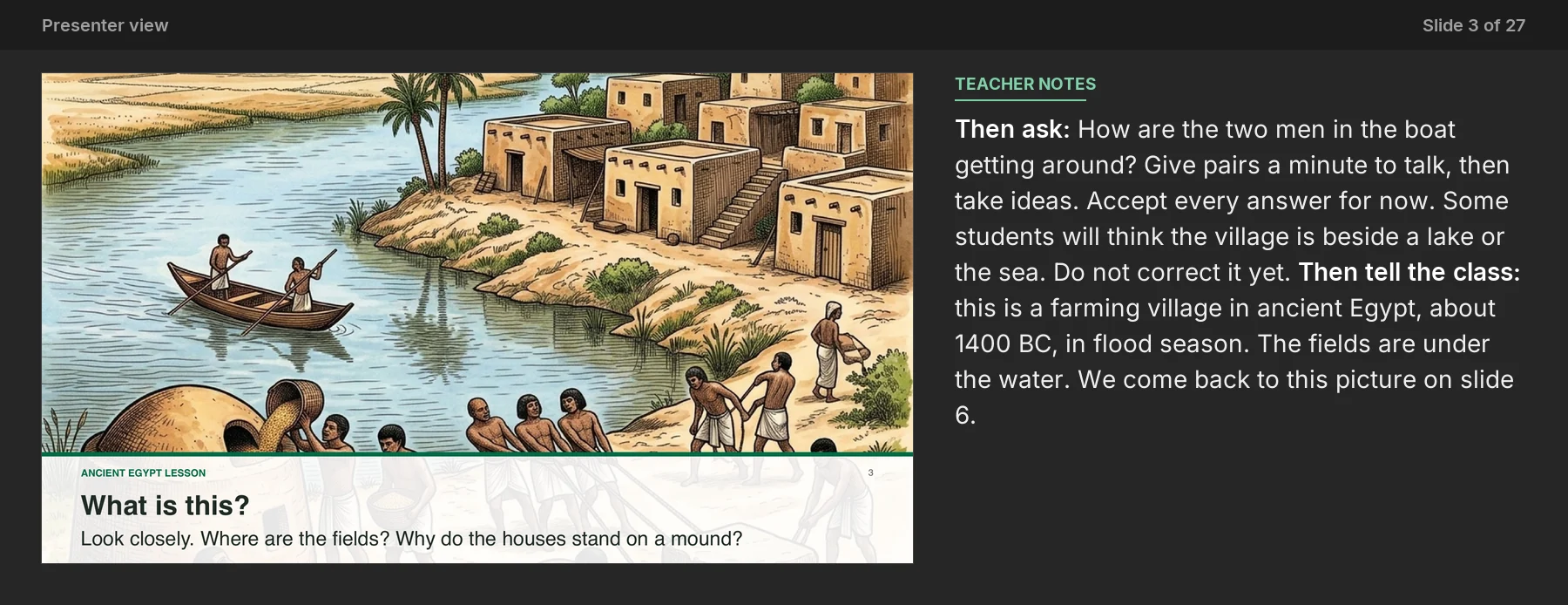
- Picture study: A Village in Flood Season. Look Closely questions, then try the flood tray or shaduf activity.
- Day 5
- Slides 11-13 (the pharaoh, the social pyramid and a turn and talk) with guided notes page 2, questions 12-15. Reading 2: Politics and Social Structure. Fill the P and S boxes. Complete Who Was Who in Ancient Egypt (social pyramid).
- Day 6
- Slide 21 (the three kingdoms), guided notes question 22. Timeline sort into the Old, Middle and New Kingdoms with the BC counting box, then the Three Kingdoms Compared chart.
- Day 7
- Slides 14-19 (gods and the afterlife, mummies, a turn and talk, pyramids, Myth vs. Fact, Weird but True) with guided notes questions 16-19. Reading 3: Religion and Achievements. Fill the R and A boxes. Making a Mummy steps and the put-in-order questions.
- Day 8
- Primary source: the Book of the Dead negative confession. Read aloud, use the gloss, answer the document questions.
- Day 9
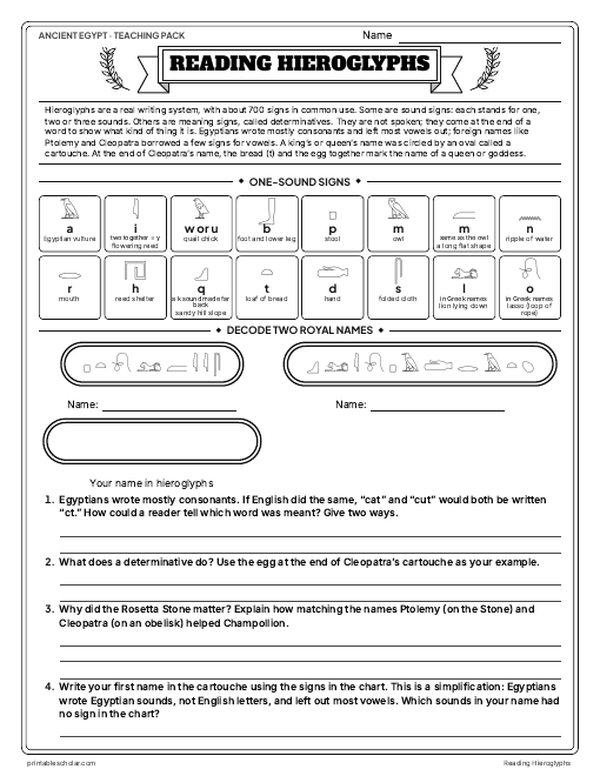
- Slide 20 (hieroglyphs and the Rosetta Stone), guided notes questions 20-21. Reading Hieroglyphs: sound signs, determinatives and cartouches; decode Ptolemy and Cleopatra and write a name cartouche.
- Day 10
- Review slides 22-27 (quick check, GRAPES review, the Who am I? riddle and the exit question); look back at Myth vs. Fact (slide 18) and Weird but True (slide 19). Students answer the exit question at the bottom of guided notes page 2. Check the GRAPES organizer, then the 15-question quiz.
How the hieroglyphics alphabet works
Is there really a hieroglyphic alphabet?
Not the way English has one. Egyptian scribes used about 700 signs in the classic period. Some stood for whole words, some for two or three sounds, and some were silent hints about meaning. About 24 signs stood for one sound each, and those are the ones on this chart. Teachers and museums match them to English letters so students can write with them.
Three kinds of signs
Sound signs spell out how a word is said. Word signs are pictures of the thing itself, such as a drawing of the sun for the word sun. Determinatives come at the end of a word and are not read aloud: they show what kind of thing the word means. In the worksheet’s bonus word, a sitting cat at the end shows that the word miw means cat.
Why the vowels look odd
Egyptian writing showed consonants and left most vowels out, so readers filled them in from the words they knew. The vulture, reed, lasso and quail chick did not stand for vowels in Egyptian, but they are the closest match for A, E or I, O and U, so classroom charts use them that way. A few other signs are simplified too: the lion really stood for an r or l sound, and Egyptian had some sounds English lacks. That is why this is a classroom version.
Which way to read
Hieroglyphs could run from left to right, from right to left, or in columns from top to bottom. To find the start, look at the people and animals: they face the beginning of the line. The signs on this chart face left, so they read from left to right.
What is a cartouche?
A cartouche is an oval loop of rope with a bar at one end, drawn around the name of a king or queen. It showed the name was royal. The Egyptian word for it was shenu. The name cartouche, French for a gun cartridge, came from Napoleon’s soldiers in Egypt, because the shape reminded them of one.
How hieroglyphs were cracked
For about 1,400 years nobody could read hieroglyphs. The Rosetta Stone, carved in 196 BC, repeats the same decree in hieroglyphs, a later Egyptian script called demotic, and ancient Greek. Using it and other inscriptions, the French scholar Jean-François Champollion worked out how the signs worked and announced it in 1822. The names in cartouches, such as Ptolemy and Cleopatra, were his first clues.
Frequently asked questions
How many letters are in the hieroglyphic alphabet?
About 24 Egyptian signs each stood for one sound, though not all of them match an English letter. Classroom charts like this one line up 24 signs with our 26 letters, so a few signs share letters: the reed is E or I, the quail chick is U or W, and the basket is C or K.
How do I write my name in hieroglyphs?
Sound your name out, then find the sign for each sound on the chart and write them in order inside a cartouche. Letters that sound alike share a sign, and a doubled letter is written once. The name maker on this page does it for you.
Did Egyptians write vowels?
Mostly not. Egyptian writing showed the consonants and left readers to fill in the vowels, which is why we are not sure how many Egyptian words sounded.
Who deciphered hieroglyphs?
Jean-François Champollion, a French scholar, announced in 1822 how hieroglyphs worked. The Rosetta Stone, which repeats one text in hieroglyphs, demotic and Greek, was his key.
When did Egyptians stop writing hieroglyphs?
Hieroglyphs were used for about 3,500 years. The last known inscription was carved at the temple of Philae in AD 394.