 Printable Scholar
European Explorers Chart
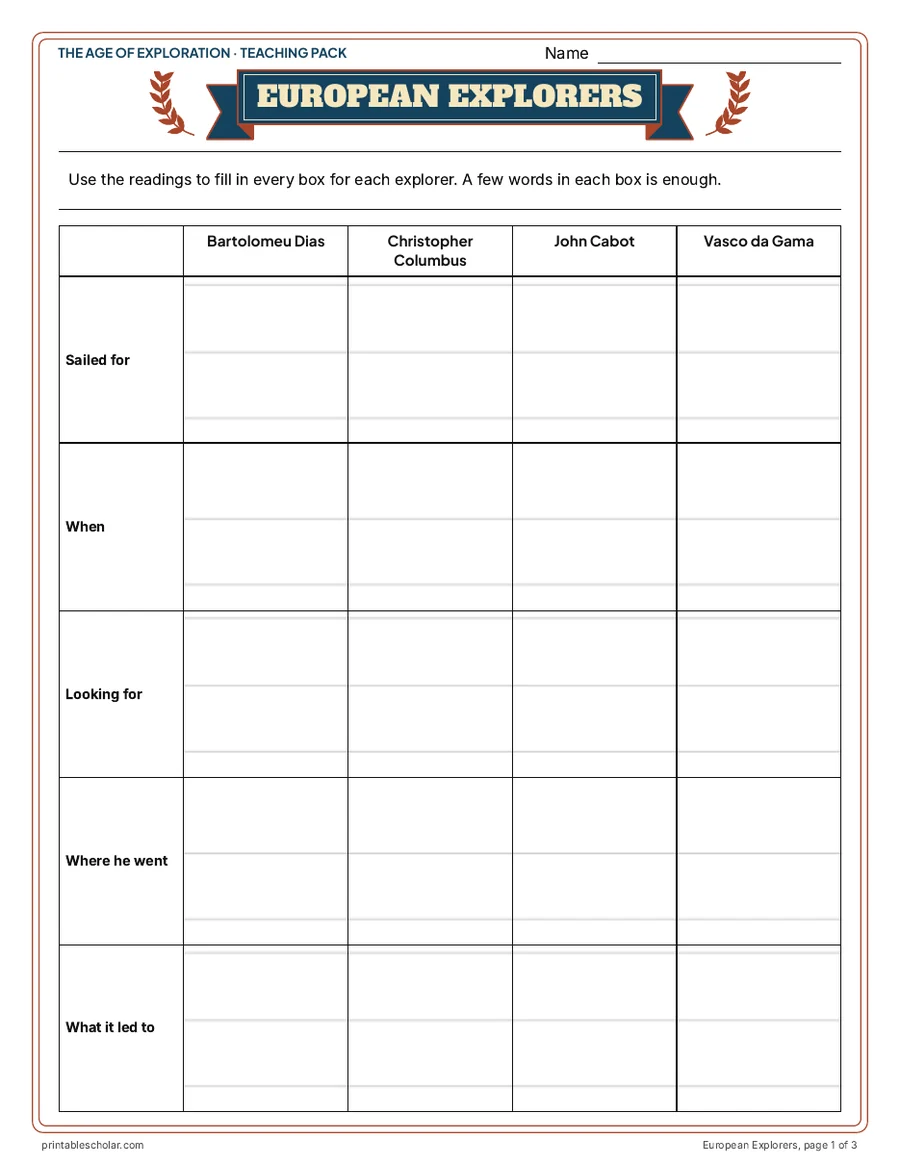
Between 1487 and 1611, sailors and soldiers sent by Portugal, Spain, England, France and the Netherlands made voyages that changed the world. They were looking for sea routes to the spices of Asia, for gold and land, and for a way around or through the Americas. They reached lands where people already lived, from the Taino of the Caribbean to the Aztecs, the Inca and the Iroquoian towns on the St. Lawrence. This free chart lists twelve explorers students meet in a grade 5 to 8 unit, with five rows to fill in for each: who he sailed for, when, what he was looking for, where he went, and what it led to.
Free to print
The European explorers chart and its answer key
PDFs sized for US Letter paper, in color and black and white.
European Explorers chart (3 pages)
Twelve explorers in date order, four to a page, with five rows to fill in: sailed for, when, looking for, where he went, and what it led to.
Download PDF Black and white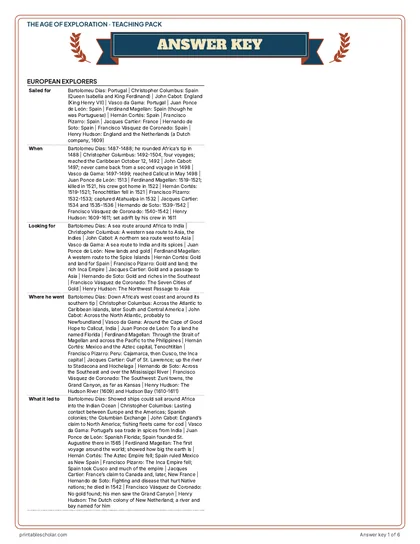
Answer key
Model answers for every box, for quick checking.
Download PDF Black and white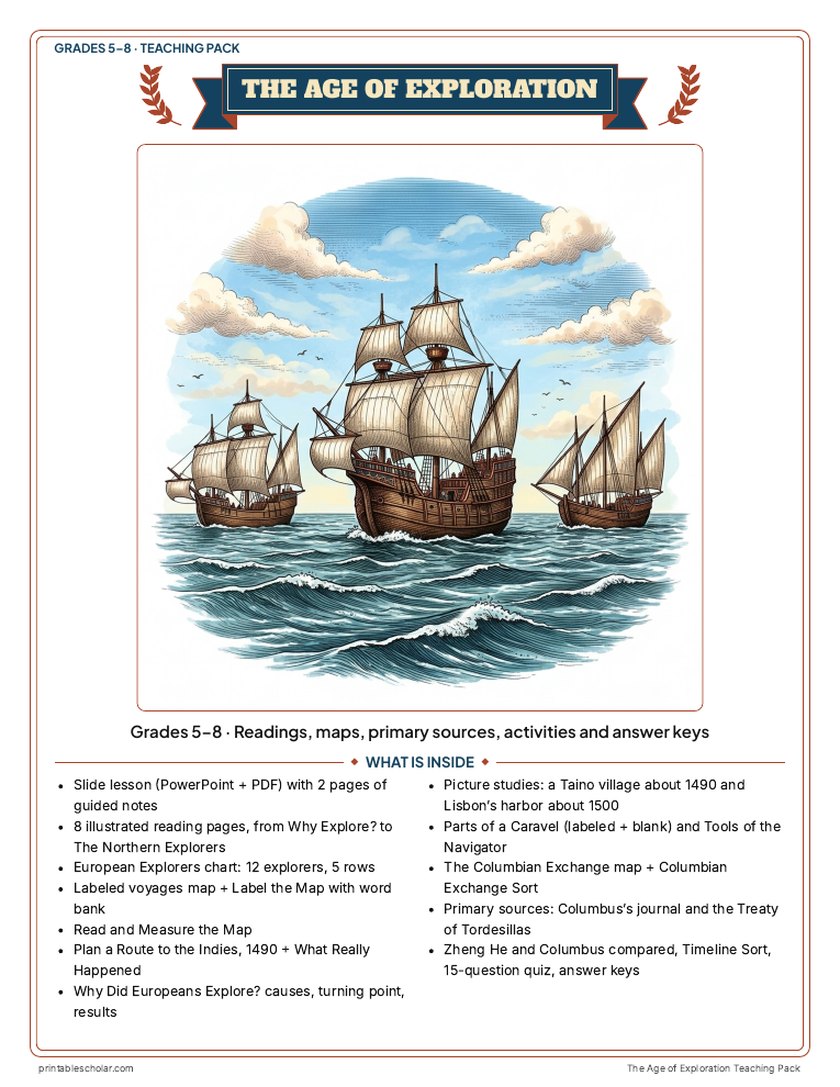
Teaching pack · Grades 5–8
Teaching the Age of Exploration? The whole unit, ready to teach.
Two weeks of lessons in one download: slides to present, notes for students to fill in, and printable pages that use these maps and pictures.
Every slide comes with teacher notes: what to say, what to ask, and sample answers.
- 50 lesson slides (PowerPoint you can edit) and 2 pages of guided notes
- 8 illustrated reading pages: why Europeans explored, ships and navigation, Portugal and Africa, Columbus and the Taino, around the world, Spain in the Americas, the Columbian Exchange and the northern explorers, plus a 12-explorer chart
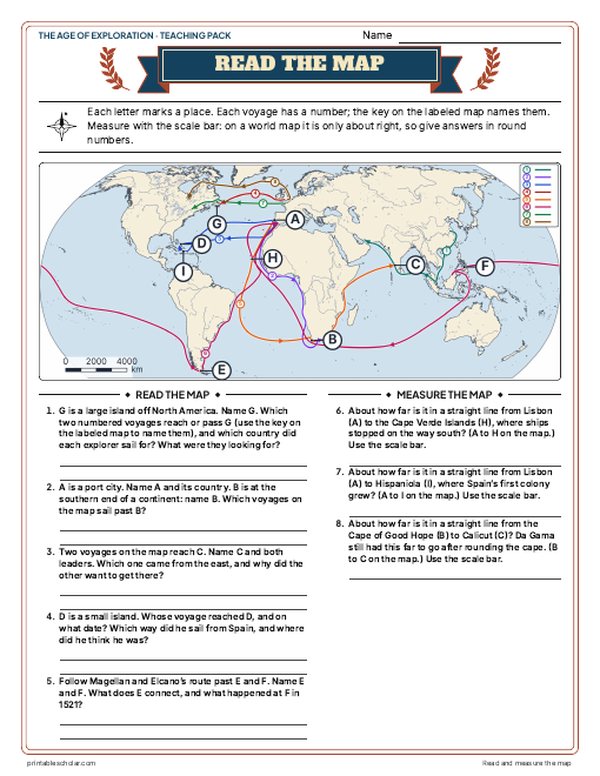
- Maps: a labeled voyages map, a blank map with word bank, Read and Measure the Map, Plan a Route to the Indies (1490) with What Really Happened, and the Columbian Exchange map
- Activities: picture studies of a Taino village and Lisbon's harbor, parts of a caravel, tools of the navigator, causes and results, Columbus's journal and the Treaty of Tordesillas as primary sources, Zheng He and Columbus compared, a timeline sort and a Columbian Exchange sort
- A 15-question quiz, a teacher guide with a two-week plan, and answer keys for everything
Every answer is in the pack. The readings, slides, maps and pictures teach everything the sheets and quiz ask, so no textbook is needed.
Get the Age of Exploration pack for $7Teaching more than one? Get all seven US history packs (Native American Regions, the Age of Exploration, the 13 Colonies, the American Revolution, the Constitution, Westward Expansion and the Civil War) for $34: about fourteen weeks of lessons.
Get all 7 packs for $34See all seven packsOr get every history pack (23) in one download:Get all 23 for $49
One-time purchase. Instant download. Color and ink-saving black-and-white editions. Secure checkout by Stripe.
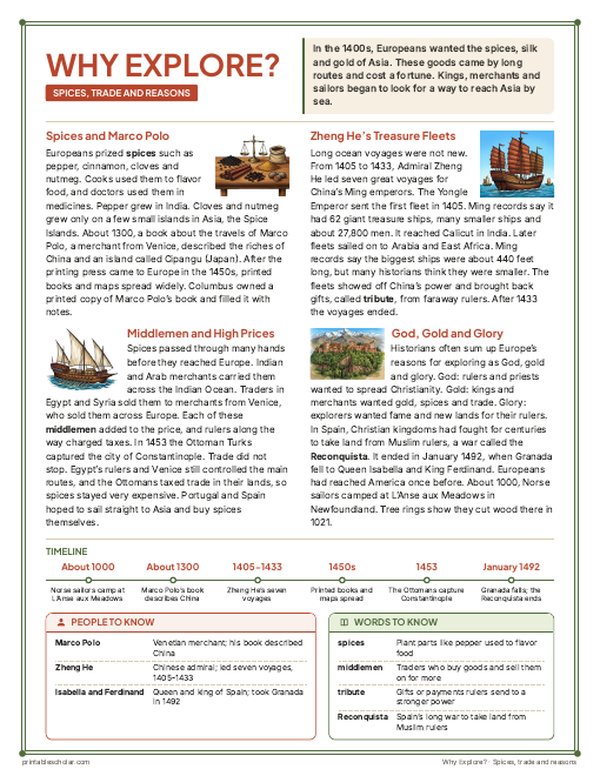
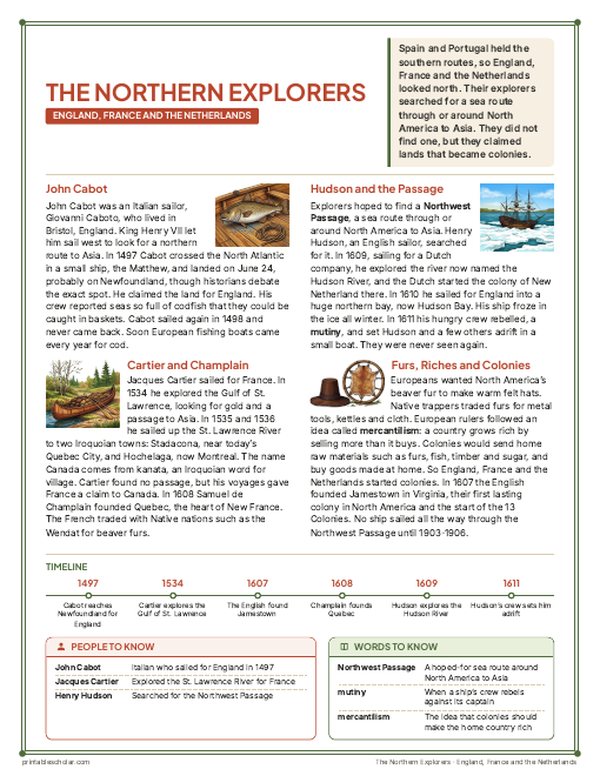
The twelve explorers
Sailing for Portugal
Bartolomeu Dias rounded the southern tip of Africa in 1488. Vasco da Gama sailed around Africa to Calicut, India, in 1498. Ferdinand Magellan was Portuguese, but sailed for Spain.
Sailing for Spain
Christopher Columbus reached the Caribbean in 1492. Magellan’s expedition left in 1519; he was killed at Mactan in the Philippines in 1521, and Juan Sebastián Elcano brought the Victoria home in 1522. Juan Ponce de León reached Florida in 1513.
Conquistadors
Hernán Cortés, with Tlaxcalan and other Indigenous allies, took Tenochtitlan in 1521. Francisco Pizarro captured the Inca ruler Atahualpa in 1532. Hernando de Soto (1539-1542) and Francisco Vázquez de Coronado (1540-1542) marched through the Southeast and the Southwest of today’s United States.
The northern explorers
John Cabot sailed for England to Newfoundland in 1497. Jacques Cartier sailed up the St. Lawrence River for France in 1535. Henry Hudson searched for a Northwest Passage, for the Dutch in 1609 and for England in 1610-1611.
Frequently asked questions
Did Columbus discover America?
No. Millions of people already lived in the Americas. Columbus reached islands in the Caribbean in 1492, the homelands of the Taino, and the Norse had reached Newfoundland about 1000. Columbus believed he had reached Asia.
Why did European explorers sail?
Teachers often sum it up as God, gold and glory: to spread Christianity, to get rich from spices, gold and trade, and to win fame and land for their rulers.
What grade is this chart for?
Grades 5 to 8. It fits the grade 5 exploration unit (California HSS 5.2) and the grade 7 study of the Age of Exploration.