Printable Scholar
Revolutionary War Map
Free printable Revolutionary War map on shaded relief, marking the major battles of the War of Independence — Lexington and Concord, Bunker Hill, Saratoga, Trenton, Yorktown and more — across the thirteen colonies, 1775–1781.

Choose your version
Black and white, color or blank.
All three are free PDFs sized for US Letter paper.

Black and white
Everything named on a plain outline map with no terrain. No color ink needed.
downloadBlack and white PDF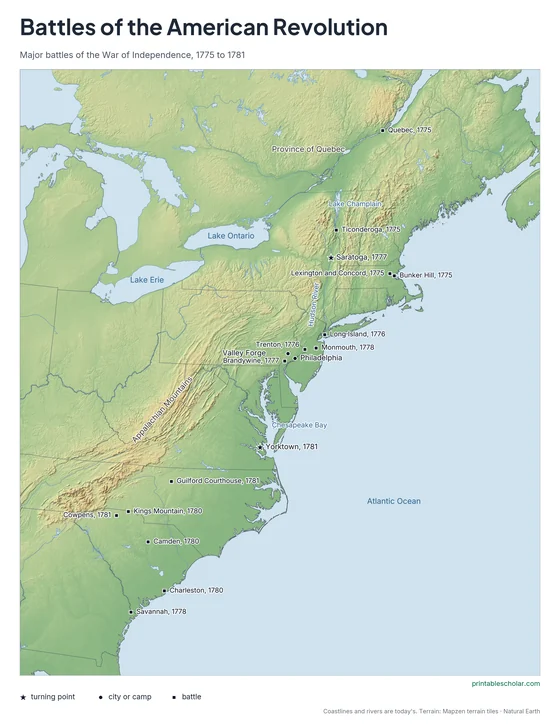
Color
Places, regions and rivers named, on shaded relief.
downloadColor PDF
Blank
The black-and-white map with its routes and markers but no names, for labeling practice.
downloadBlank PDF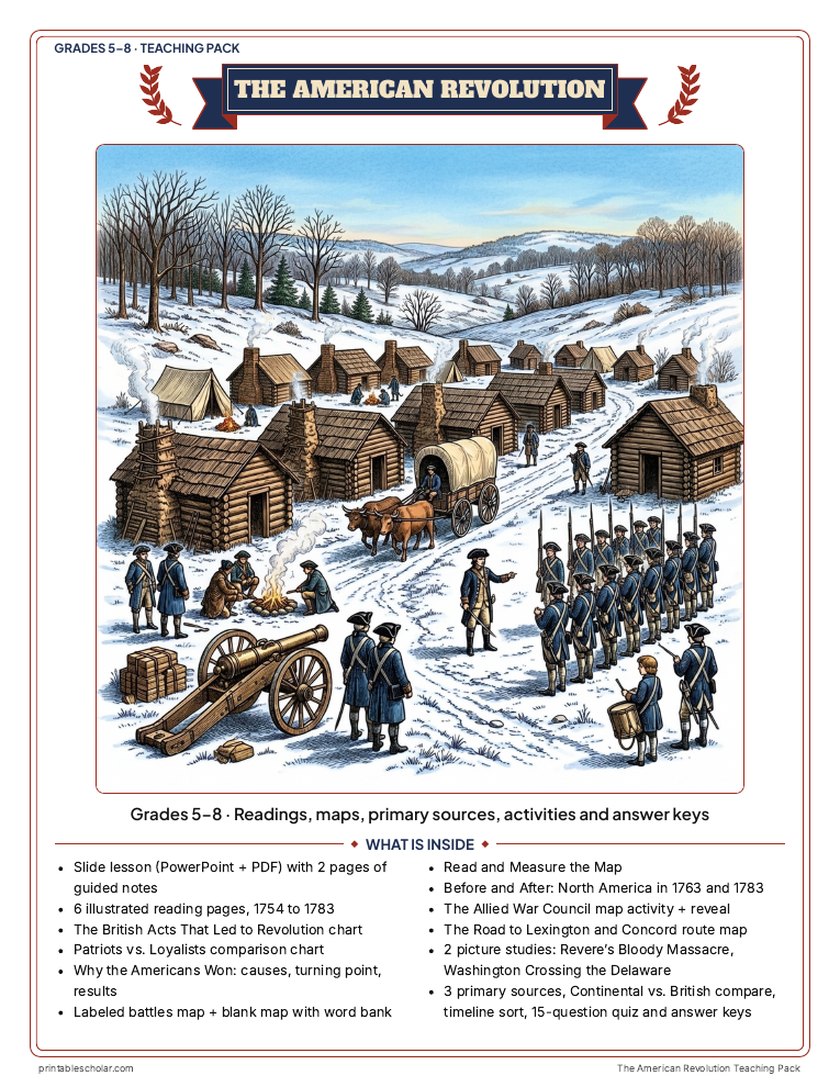
Teaching pack · Grades 5–8
Teaching the American Revolution? The whole unit, ready to teach.
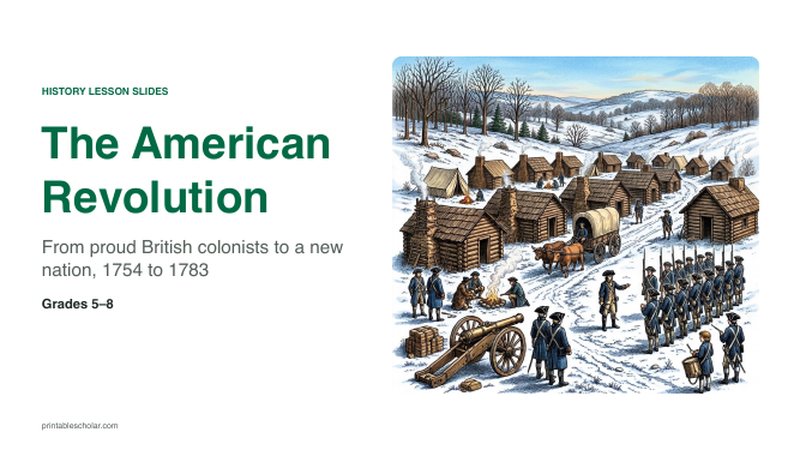
Two weeks of lessons in one download: slides to present, notes for students to fill in, and printable pages that use these maps and pictures.
Every slide comes with teacher notes: what to say, what to ask, and sample answers.
- 44 lesson slides (PowerPoint you can edit) and 2 pages of guided notes
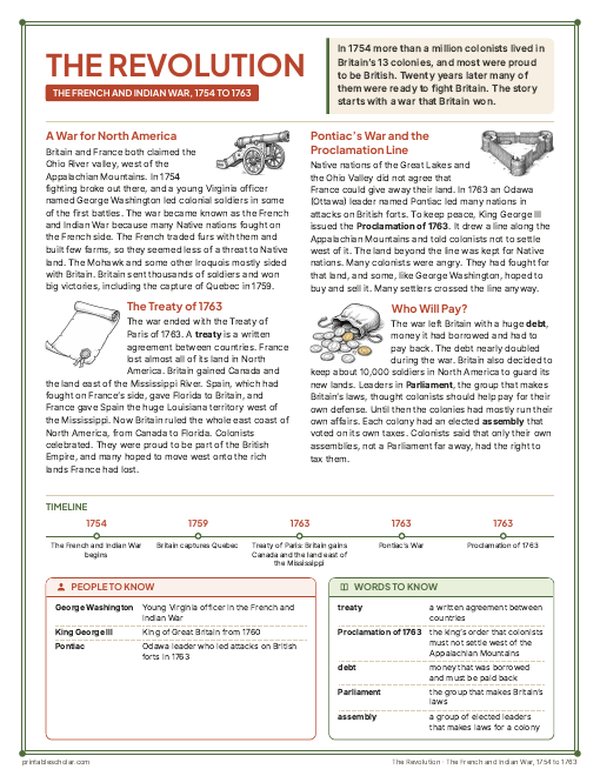
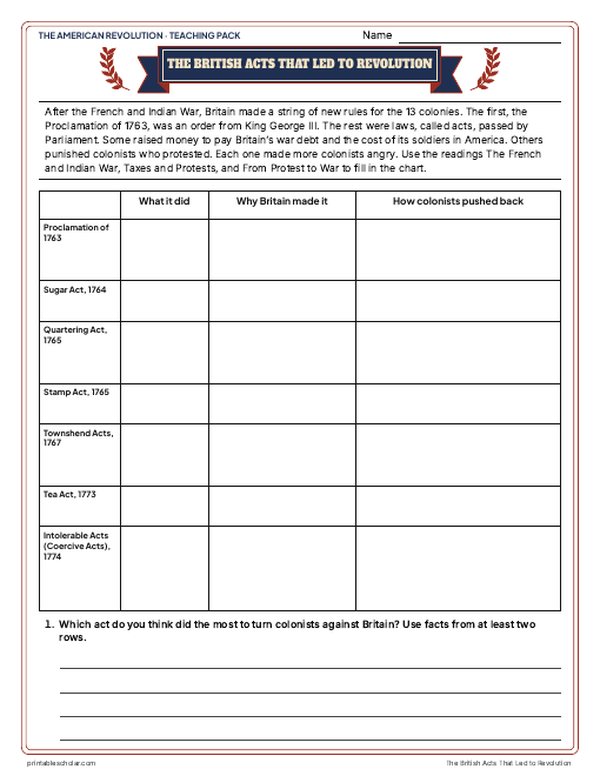
- 6 illustrated reading pages, 1754 to 1783, a British Acts chart, a Patriots vs. Loyalists chart and a Why the Americans Won sheet
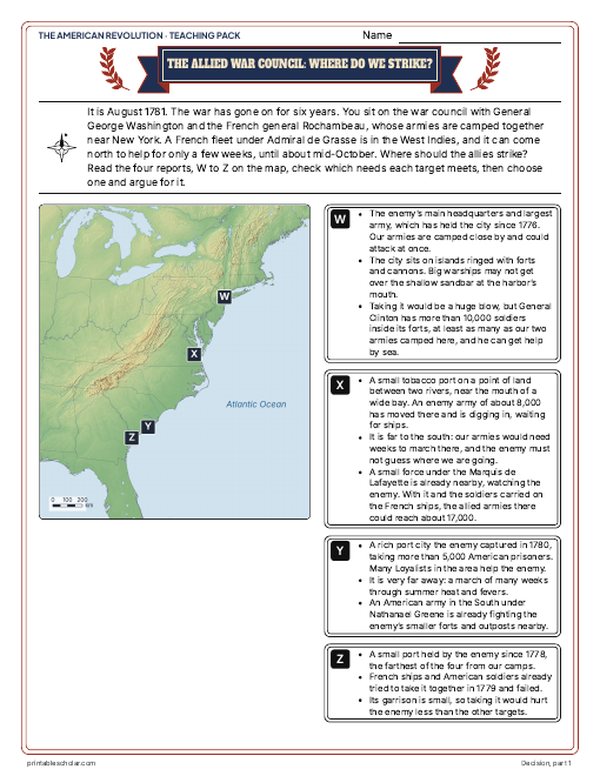
- Maps: labeled, blank, Read and Measure the Map, North America in 1763 and 1783, the Road to Lexington and Concord, and a 1781 war council decision with the reveal
- Primary sources: the Declaration of Independence, Common Sense beside a Loyalist reply, and Abigail Adams's "Remember the Ladies", each with plain English beside it; picture studies of Revere's 1770 engraving and Leutze's 1851 painting
- Continental Army vs. British Army, a timeline sort, a 15-question quiz, a teacher guide with a two-week plan, and answer keys for everything
Every answer is in the pack. The readings, slides, maps and pictures teach everything the sheets and quiz ask, so no textbook is needed.
Get the American Revolution pack for $7Teaching more than one? Get all seven US history packs (Native American Regions, the Age of Exploration, the 13 Colonies, the American Revolution, the Constitution, Westward Expansion and the Civil War) for $34: about fourteen weeks of lessons.
Get all 7 packs for $34See all seven packsOr get every history pack (24) in one download:Get all 24 for $49
One-time purchase. Instant download. Color and ink-saving black-and-white editions. Secure checkout by Stripe.
The 10-day plan
10 lessons, each planned for one class period of about 45 to 50 minutes, straight from the teacher guide. Some days are fuller than others; the note below shows how to even them out.
- Day 1Hook: The Allied War Council
- Day 2The French and Indian War and the 1763 map
- Day 3Taxes, protests and The Bloody Massacre
- Day 4From protest to war and the Lexington map
- Day 5Declaring independence, the Declaration and Common Sense
- Day 6The war for independence and the war maps
- Day 7Reveal, why the Americans won, Washington Crossing the Delaware
- Day 8People of the Revolution and "Remember the Ladies"
- Day 9Comparing the two armies and the timeline sort
- Day 10Review and the 15-question quiz
Fitting it to your schedule: Days 5 and 6 are the fullest and Day 9 the lightest. With 10 periods, move Read and Measure the Map from Day 6 to Day 9. With 8 periods, give Read and Measure the Map as homework and hold the Day 7 reveal at the end of Day 6, give Why the Americans Won and the Continental Army vs. British Army sheet as homework, and skip the Washington Crossing the Delaware picture study. Open the Day 10 review with the timeline sort.
See the full day-by-day plan
- Day 1
- Hook: The Allied War Council. Students read the reports, fill in the needs checklist and argue for a target. Save What Really Happened for Day 7.
- Day 2
- Slides 3 to 9 and reading: The French and Indian War, with guided notes page 1. North America Before and After: the 1763 map, questions 1 and 2.
- Day 3
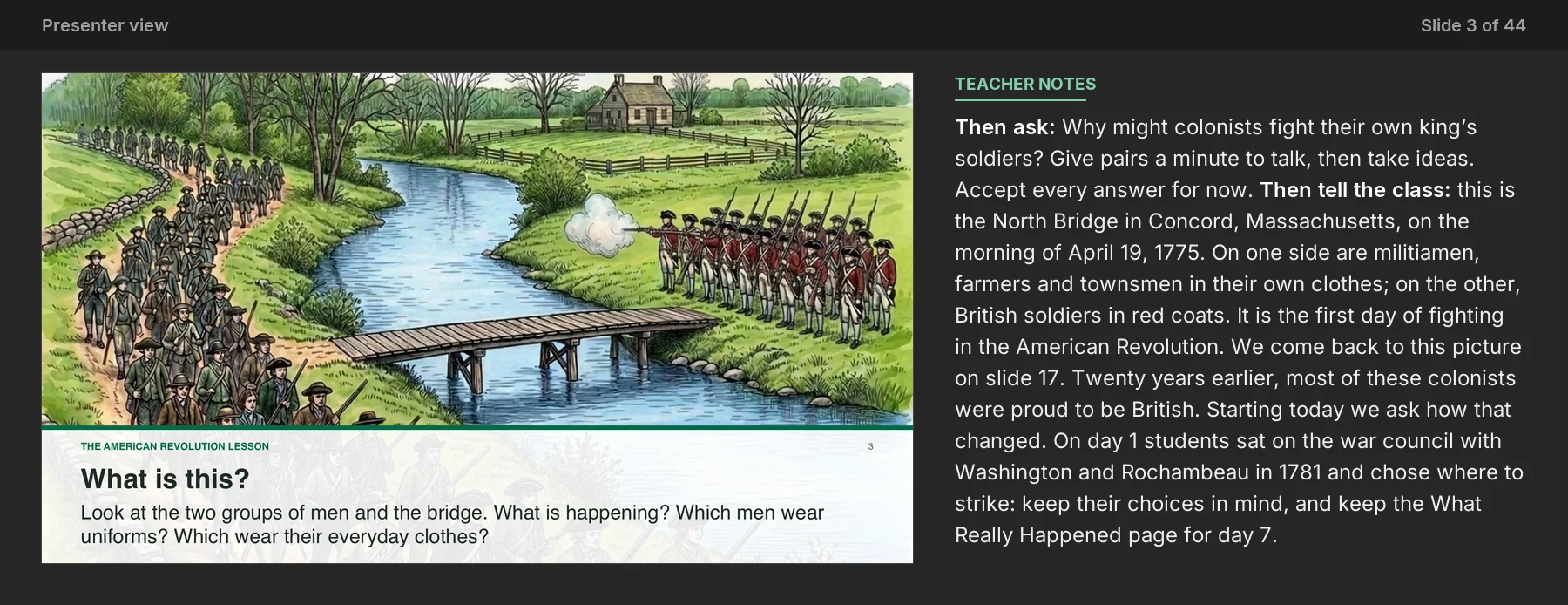
- Slides 10 to 14 (ends with a turn and talk) and reading: Taxes and Protests. Start The British Acts That Led to Revolution chart. Picture study: The Bloody Massacre.
- Day 4
- Slides 15 to 21 (the Revere myth on slide 18) and reading: From Protest to War. Finish the British Acts chart. The Road to Lexington and Concord map sheet.
- Day 5
- Slides 22 to 27 (the statue weird fact on slide 25; ends with a turn and talk) and reading: Declaring Independence. Primary sources: The Declaration of Independence; Common Sense and a Loyalist Reply. Start Patriots vs. Loyalists.
- Day 6
- Slides 28 to 35 and reading: The War for Independence, with guided notes page 2. Labeled map, blank map with word bank, Read and Measure the Map.
- Day 7
- Reveal: What Really Happened; compare with Day 1. Why the Americans Won (causes, turning point, results). Picture study: Washington Crossing the Delaware.
- Day 8
- Slides 36 to 41 and reading: People of the Revolution. Primary source: Remember the Ladies. Finish Patriots vs. Loyalists and the 1783 map questions.
- Day 9
- Continental Army vs. British Army compare sheet. Timeline sort.
- Day 10
- Slides 42 to 44: the Who am I? riddle and the exit question; finish guided notes page 2. 15-question quiz. Check every sheet with the keys.
About the Revolutionary War map
The Revolutionary War (1775–1781) was fought between Great Britain and its thirteen American colonies. It began in Massachusetts with the ’shot heard round the world’ at Lexington and Concord in April 1775, followed by the costly British victory at Bunker Hill.
The war’s turning point came in 1777 at Saratoga, New York, where the American victory persuaded France to join the fight as an ally. After hard winters — including the encampment at Valley Forge — and a grinding Southern campaign at Charleston, Camden, and Cowpens, the war moved toward its conclusion.
In 1781, combined American and French forces trapped the British army at Yorktown, Virginia. General Cornwallis’s surrender ended major fighting, and the 1783 Treaty of Paris recognized the United States as an independent nation.

Pair it with a timeline
Add the dates to the geography with the free printable American Revolution Timeline.
American Revolution TimelineFind it on the map
- Saratoga and Yorktown, the two turning points
- How the fighting moved south after 1778
- The cluster of battles between New York and Philadelphia
Battles are marked at their sites, with modern state lines for reference. Stars mark the two turning points: the American victory at Saratoga (1777) and the British surrender at Yorktown (1781). Coastlines and rivers are shown as they are today.
Frequently asked questions
What were the major battles of the Revolutionary War?
The war opened with Lexington & Concord and Bunker Hill in 1775. Key later battles included Trenton (1776), Brandywine and the pivotal American victory at Saratoga (1777), Charleston and Cowpens in the Southern campaign (1780–1781), and the decisive siege of Yorktown in 1781, which ended the fighting.
Why was the Battle of Saratoga so important?
Saratoga in 1777 was the turning point of the war. The American victory convinced France to enter the war as an ally, bringing the money, troops, and navy that helped secure independence.
Where did the Revolutionary War end?
The last major battle was the Siege of Yorktown, Virginia, in 1781. Surrounded by American and French forces, British General Cornwallis surrendered, effectively ending the war. The Treaty of Paris formally recognized American independence in 1783.